Alligator Lizard
Elgaria and Gerrhonotus (US alligator lizards: Elgaria coerulea, E. multicarinata, E. kingii, E. panamintina; Gerrhonotus infernalis) · also called Northern Alligator Lizard, Southern Alligator Lizard, Madrean Alligator Lizard and Arizona Alligator Lizard · Last checked November 3, 2026.
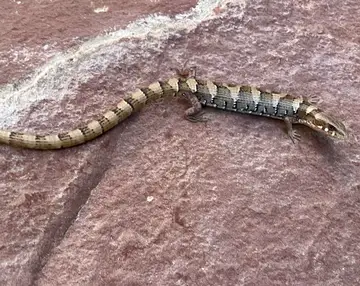
Alligator lizards are long-bodied, short-legged lizards with stiff, rectangular, armor-like scales and a fold of skin along each side. In the US they live in the West (California, Oregon, Washington, Arizona, New Mexico) and in Texas. Official sources say they often bite when captured; no official source checked states whether they are venomous, so that is shown as not stated. Washington Department of Fish and Wildlife
This page covers a genus (Elgaria and Gerrhonotus (US alligator lizards: Elgaria coerulea, E. multicarinata, E. kingii, E. panamintina; Gerrhonotus infernalis)), not a single species.
On this page
Is the alligator lizard dangerous?
Bites and stings: Bites when captured: Washington calls the southern alligator lizard aggressive and says it will bite when captured; Arizona says the Madrean alligator lizard often bites when captured.
No official source we use states whether this animal is venomous. That does not mean it is harmless: do not handle it.
How to identify an alligator lizard
A photo or description can narrow it down, but cannot confirm what an animal is or that it is safe. Look from a distance and do not handle wild animals.
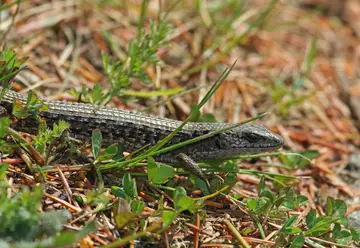

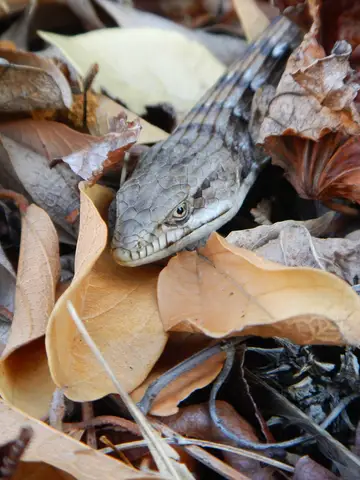

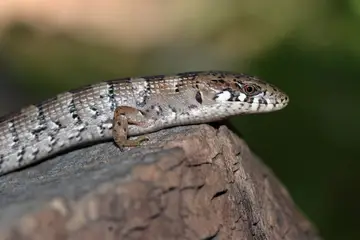

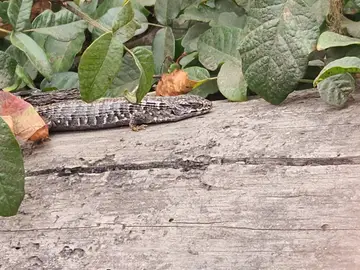
Size: Snout-to-vent length up to about 3.9 inches (northern) and 5.6 inches (southern), with a tail about twice the body length in the southern species; Madrean alligator lizard up to 5.5 inches snout to vent. Washington Department of Fish and Wildlife
Colors: Gray-brown to brown (northern and southern); tan or gray base color (Madrean). Pattern: Banded: black spots forming crossbands on the back; madrean: dark brown to red-brown crossbars, black and white lip markings.
Key features
- Rectangular (square) scales on back and belly and a fold of small scales along each side; Washington says no other lizards there have these Washington Department of Fish and Wildlife
- Scales reinforced with bony plates; side folds let the body expand Arizona Game and Fish Department
- Tail easily shed and regrown Washington Department of Fish and Wildlife
Young
Northern: like adults but back plain brown or with a single line of dark spots. Southern: back plain brownish to reddish.
Animals mistaken for the alligator lizard
Alligator Lizard or Northern vs Southern Alligator Lizard?
Alligator Lizard
Northern vs Southern Alligator Lizard Elgaria coerulea / Elgaria multicarinata
Southern is larger (up to 5.5 inches snout to vent, tail twice body length), lacks dark marks on the edges of belly scales and has yellow or gold eyes; northern has brown eyes. Washington Department of Fish and Wildlife
WDFW says the southern alligator lizard is aggressive and will bite when captured (it says nothing about bites for the northern); venom status not stated by official sources.
Where the alligator lizard lives
- Native or listed
- Nonnative or not established
- No official record in our data
- 1–9
- 10–99
- 100–999
- 1,000+
State boundaries: U.S. Census Bureau, cartographic boundary file cb_2024_us_state_20m.
When it is active
Daytime. In Washington, active from late March or early April, probably into October or early November. Madrean (Arizona): mainly active by day and at dawn and dusk, hibernating in late fall and winter. Washington Department of Fish and Wildlife
US open-licence records for all US alligator lizards (genera Elgaria and Gerrhonotus) peak in March to July.
Habitat and habits
Habitat: Varies by species: grassy, brushy or rocky openings in forests, rock piles, woody debris and building foundations (northern); grassland, chaparral, oak woodland, forest edges and creeks (southern); moist areas with leaf litter in riparian corridors, grassland, chaparral, woodlands and conifer forest from about 3,000 to over 8,500 feet (Madrean, Arizona). Washington Department of Fish and Wildlife
Behavior: Active by day; northern alligator lizards are secretive and rarely seen in the open, and in fall often enter houses, apparently looking for places to overwinter. Southern alligator lizards climb using a prehensile tail.
Diet: Small invertebrates such as beetles, spiders, slugs, snails, grasshoppers, crickets and scorpions; occasionally bird eggs, nestlings, small mammals and other lizards.
Young: Northern: females give birth to live young about three months after breeding. Southern: lays eggs (in Washington in talus in June). Madrean: up to 15 eggs in late spring or summer.
Legal status and reporting
Federal: Not listed under the ESA. No ECOS record for northern, southern, Madrean or Texas alligator lizards; Panamint alligator lizard appears only as a "Resolved Taxon". US Fish and Wildlife Service
Protection: Varies by state. In Washington, collecting is only allowed with a WDFW Scientific Collection Permit. New Mexico (BISON-M) gives the Madrean alligator lizard limited protection (commercial take; non-resident permit required).
Report: Washington asks people to share sightings through the WDFW wildlife reporting form. Washington Department of Fish and Wildlife
Questions about the alligator lizard
Are there alligator lizards in california?
Yes. California's official species list includes three native alligator lizards: the northern, southern and Panamint alligator lizards. In Yosemite, the National Park Service says the San Diego and Sierra alligator lizards are almost as common as the Sierra fence lizard but hide under rocks and logs during the day.
Sources
- Southern alligator lizard. Washington Department of Fish and Wildlife. undated page; checked November 3, 2026.
Quoted passages (1)
“An adult grows to 5.6 inches snout to vent length with a tail that is twice the body length.”
- Northern alligator lizard. Washington Department of Fish and Wildlife. undated page; checked November 3, 2026.
Quoted passages (9)
“The northern and southern alligator lizards are the only lizards in Washington with square scales and folds on the sides of the body.”
“The tail is easily shed.”
“Hatchlings and juveniles are similar to adults but the dorsum is either plain brown or brown with only a single line of dark spots down the midline.”
“The northern alligator lizard inhabits grassy, brushy or rocky openings within forested landscapes.”
“In the fall, northern alligator lizards often enter houses presumably in search of overwintering sites.”
“Activity starts in late March to early April depending on location and weather conditions. Similar to our other lizard species, activity probably continues into October or early November.”
“Females give birth about three months after breeding.”
“If you see this species, please share your observation using the WDFW wildlife reporting form.”
“Southern alligator lizards differ in being larger (up to 5.5 inches snout to vent length with a tail that is double the length of the body), lacking dark pigmentation on the lateral edges of the ventral scales and in having yellow or gold eyes.”
- Online Field Guide species account: Madrean Alligator Lizard (Elgaria kingii). Arizona Game and Fish Department. 2023; checked November 3, 2026.
Quoted passages (1)
“The back and belly are armored with large, stiff, rectangular, scales that are reinforced with bony plates.”
- Complete List of Amphibian, Reptile, Bird and Mammal Species in California. California Department of Fish and Wildlife (CWHR Program). 2016-05 (document dated "May, 2016"; checked November 3, 2026.
- Herps of Texas: Lizards of Texas. Herps of Texas, Biodiversity Collections, Dept. of Integrative Biology, The University of Texas at Austin. 2020-04-28 (archive capture date; checked November 3, 2026.
- Southern alligator lizard in Oregon. Oregon Department of Fish and Wildlife. undated page; checked November 3, 2026.
Quoted passages (1)
“This carnivorous lizard feeds primarily on small invertebrates (slugs, spiders, centipedes, scorpions, beetles, grasshoppers, and crickets), but also is known to feed on bird eggs, nestlings, other lizards, and small mammals.”
- ECOS species report query (p32 taxa). U.S. Fish and Wildlife Service. live query 2026-11-03; checked November 3, 2026.
Quoted passages (1)
“Elgaria panamintina: Panamint alligator lizard”
- Reptiles - Yosemite National Park. National Park Service. undated page; checked November 3, 2026.
- GBIF.org occurrence records, human observations licensed CC0 1.0 or CC BY 4.0 only, accessed November 3, 2026. The datasets behind these counts are listed on our Sources page.
- State boundaries: U.S. Census Bureau, cartographic boundary file cb_2024_us_state_20m.