Bark Scorpion
Centruroides · also called Arizona bark scorpion, striped bark scorpion, common striped scorpion and striped scorpion · Last checked November 3, 2026.
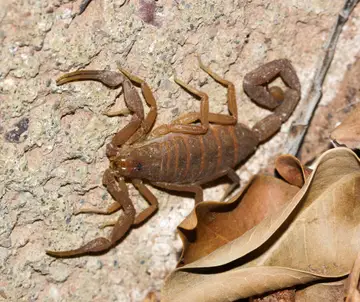
Bark scorpions are slender scorpions in the genus Centruroides, and one of them can be dangerous. The Arizona bark scorpion is venomous, and CDC says its sting can be life-threatening; young children and older people face the most risk. It lives mainly in Arizona, with official sources also placing it in small parts of California, Nevada, New Mexico and Utah. University of Arizona Extension also names Colorado and Texas, and the Arizona Department of Agriculture names Colorado; Colorado and Texas extension sources do not confirm it there. The striped bark scorpion, common from Texas to Missouri and nearby states, has a painful but comparatively mild sting. If stung, call 911 or Poison Help at 1-800-222-1222. CDC/NIOSH
This page covers a genus (Centruroides), not a single species.
On this page
Is the bark scorpion dangerous?
Arizona bark scorpion: stings can be life-threatening. University of Arizona Extension calls it the only scorpion species of medical significance in the US, says death is extremely rare, and says medical treatment is imperative for the young and elderly. Striped and other bark scorpions are described as far milder, but this applies to those species only. CDC/NIOSH
“These symptoms usually subside within 48 hours, although stings from a bark scorpion can be life-threatening.”
Bites and stings: Stings, not bites. All scorpions sting to defend themselves; most stings happen when a scorpion is accidentally grabbed, crushed against the body or stepped on.
If someone is bitten or stung, call 911 or Poison Help at 1-800-222-1222.
How to identify a bark scorpion
A photo or description can narrow it down, but cannot confirm what an animal is or that it is safe. Look from a distance and do not handle wild animals.
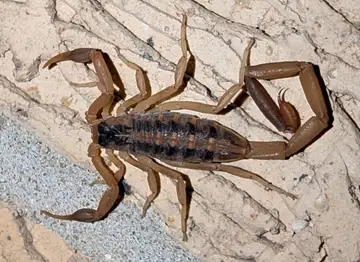
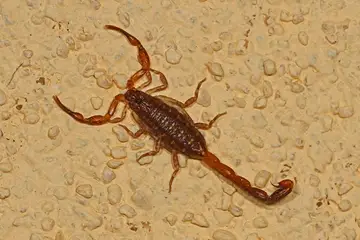

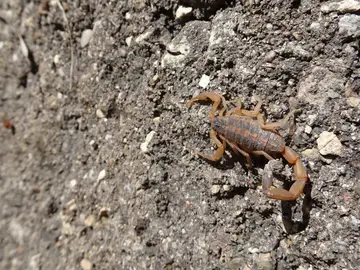
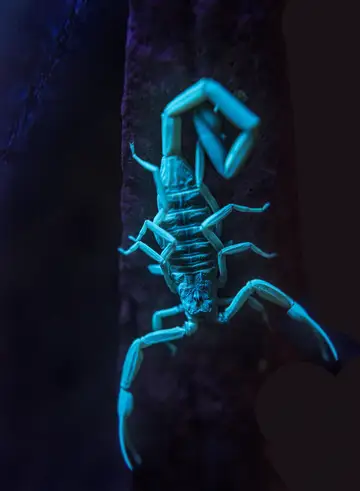

Size: Arizona bark scorpion: sources range from about 1 to 3 inches. Striped bark scorpion: about 2.5 inches is the usual figure. University of Arizona Cooperative Extension
Colors: Arizona bark scorpion: color varies. Some are pale, others darker. UC IPM says yellow without stripes, but University of Arizona says some have stripes, so lack of stripes is not a safe test; tan, yellowish or buff (AgriLife). Pattern: Striped bark scorpion: yellowish tan with two broad dark stripes and a dark triangle on the head.
Key features
- Slender pincers and tail (Arizona bark scorpion) University of Arizona Cooperative Extension
- Often holds the tail curled to the side at rest School IPM
- A proficient climber that can move up textured walls University of Arizona Cooperative Extension
- Glows under UV light National Park Service
Young
Females carry live-born young on the back. Texas says young scorpions can already sting, and immature striped bark scorpions may be lighter in color.
Animals mistaken for the bark scorpion
Bark Scorpion or Arizona stripe-tailed scorpion?
Bark Scorpion
Arizona stripe-tailed scorpion Paravaejovis spinigerus
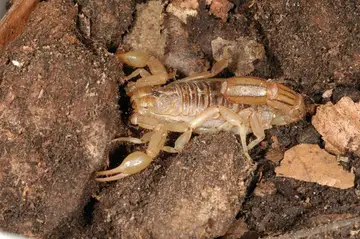

Often mistaken for bark scorpions, but heavily armored with bulkier pincers and tail. University of Arizona Cooperative Extension
University of Arizona says only Arizona bark scorpion stings are hazardous to human health.
Bark Scorpion or Yellow ground scorpion?
Bark Scorpion
Yellow ground scorpion Vaejovis confusus
Delicate pincers like a bark scorpion, but a much wider, bulkier tail. University of Arizona Cooperative Extension
As above.
Bark Scorpion or Giant hairy scorpion?
Bark Scorpion
Giant hairy scorpion Hadrurus arizonensis
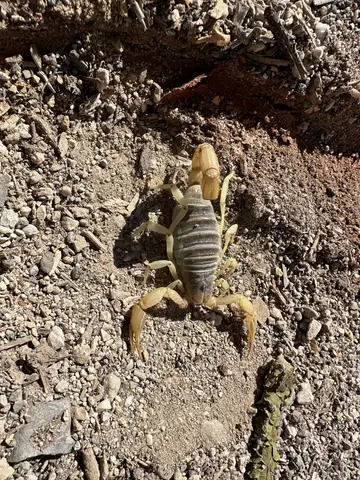
The largest US scorpion: heavy-bodied, adults often exceed 5 inches (University of Arizona gives 2-3 inches for adult Arizona bark scorpions). University of Arizona Cooperative Extension
As above.
Bark Scorpion or Vinegaroon?
Bark Scorpion
Vinegaroon
Whip scorpion, not a true scorpion. New Mexico says it is not venomous but its vinegar secretions can irritate. New Mexico Poison & Drug Information Center
Not venomous per New Mexico Poison Center.
Bark Scorpion or Pseudoscorpion?
Bark Scorpion
Pseudoscorpion
Tiny, with a rounded abdomen and no stinger. Missouri Department of Conservation
Utah State University Extension: pseudoscorpions pose absolutely no threat to humans.
Where the bark scorpion lives
- Native or listed
- Nonnative or not established
- No official record in our data
- 1–9
- 10–99
- 100–999
- 1,000+
State boundaries: U.S. Census Bureau, cartographic boundary file cb_2024_us_state_20m.
When it is active
Arizona bark scorpion: active most of the year in low desert, less active November to March. Most stings reported to the Arizona poison center happen on warm summer nights. Striped: Arkansas reports them roaming and entering houses April to early June. University of Arizona Cooperative Extension
US open-licence records for all bark scorpions (genus Centruroides) peak in April to August.
Habitat and habits
Habitat: Arizona bark scorpion: crevices, under rocks, logs and bark, in walls and around buildings in low desert. NPS says it prefers streamside habitat at Grand Canyon. Striped bark scorpion: glades and dry rocky places in Missouri, deserts, forests and grasslands more widely. University of Arizona Cooperative Extension
Behavior: Nocturnal and a good climber. In winter Arizona bark scorpions gather in groups in sheltered spaces; NPS says up to 40 together.
Diet: Insects, spiders, centipedes and other scorpions (UC IPM, general to scorpions); the striped bark scorpion prefers soft-bodied prey.
Young: Live birth; young ride on the mother until the first molt. NPS says up to 30 on her back for up to three weeks, for the Arizona bark scorpion.
Legal status and reporting
Protection: NM BISON-M: not protected by the State of New Mexico. New Mexico Department of Wildlife
Questions about the bark scorpion
What states have bark scorpions?
The Arizona bark scorpion, the dangerous one: Arizona, plus small parts of California, Nevada, New Mexico and Utah. University of Arizona also names Colorado and Texas, which Colorado and Texas extension sources do not confirm. Other bark scorpions: the striped bark scorpion in states including Texas, Oklahoma, Missouri, Arkansas and Colorado, and other species in Florida and Alabama.
Bark scorpion range
The Arizona bark scorpion is found in southeastern California, Arizona, Nevada, southern Utah and southwestern New Mexico, according to the Arizona Department of Agriculture. It also lives in western Sonora and Baja in Mexico. The striped bark scorpion ranges from Colorado and New Mexico east to Mississippi and Louisiana.
Are there bark scorpions in missouri?
Yes, the striped bark scorpion, the only scorpion in Missouri. It lives mainly in the Ozarks and southern half of the state. Missouri says its sting is quite painful but the venom is comparatively mild; some people may have a severe allergic reaction.
Are there bark scorpions in new mexico?
Yes. New Mexico's poison center says the Arizona bark scorpion is found in the southwestern corner of the state and is the only species there that causes serious illness.
Are there bark scorpions in oklahoma?
Yes, the striped bark scorpion. Oklahoma State says scorpions found in Oklahoma are not considered dangerously poisonous. No official source checked places the Arizona bark scorpion in Oklahoma. If stung, call 911 or Poison Help at 1-800-222-1222.
Bark scorpion oklahoma
Oklahoma State University Extension covers the striped bark scorpion and says Oklahoma may have 3 to 5 scorpion species, none considered dangerously poisonous.
Bark scorpion texas
The striped bark scorpion is the most common scorpion in Texas. Texas AgriLife says stings from Texas scorpions produce only moderate reactions in most people. University of Arizona Extension says the Arizona bark scorpion also colonizes small parts of Texas; Texas sources checked do not confirm that.
Bark scorpion florida
Florida has the Keys bark scorpion plus two other Centruroides species, the Hentz striped and slender brown scorpions. UF/IFAS says Florida scorpions are not known to cause significant medical issues. No official source checked places the Arizona bark scorpion in Florida.
Bark scorpion las vegas
Official sources place the Arizona bark scorpion in Nevada, and University of Arizona Extension reports a high sting rate in Las Vegas (170 per 100,000 people). It adds that scorpion stings outside Arizona and Nevada most likely involve species of little medical significance.
Bark scorpion size
Arizona bark scorpion figures range from about 1.5 inches (Arizona Poison Center) to 3 inches (UC IPM). The striped bark scorpion is usually given as about 2.5 inches.
Bark scorpion venom
All scorpions produce venom. NPS calls the Arizona bark scorpion the most venomous scorpion in North America. University of Arizona says its venom is of medical concern. Missouri calls the striped bark scorpion venom a comparatively mild neurotoxin.
Bark scorpion sting
A sting from an Arizona bark scorpion can be life-threatening, according to CDC, though University of Arizona says death is extremely rare. Children and older people are most at risk. Call 911 or Poison Help at 1-800-222-1222.
Bark scorpion sting symptoms
University of Arizona lists severe pain, often with little swelling, numbness, frothing at the mouth, difficulty breathing, muscle twitching, flailing limbs and convulsions. New Mexico adds that children may cry uncontrollably, drool heavily and have rapid eye movements. Call 911 or Poison Help at 1-800-222-1222.
Striped bark scorpion
Centruroides vittatus, a yellowish tan scorpion with two broad dark stripes and a dark triangle on the head, and the most common scorpion in Texas. Missouri says the sting is quite painful but the venom is comparatively mild.
Sources
- Insects and Scorpions at Work. CDC/NIOSH. archived copy, captured October 4, 2026; checked November 3, 2026.
Quoted passages (1)
“These symptoms usually subside within 48 hours, although stings from a bark scorpion can be life-threatening.”
- Scorpions of the Desert Southwest United States (az1768). University of Arizona Cooperative Extension. 2018-05; checked November 3, 2026.
Quoted passages (8)
“Adults are 2-3 inches in length”
“…have relatively slender appendages and a long, slender tail.”
“The Arizona bark scorpion is a proficient climber”
“…the Arizona bark scorpion is common around buildings of all kinds in low”
“During the coolest months (November-March) they are less”
“They are often mistaken for bark scorpions, but the”
“…have more delicate pedipalps (Fig. 4), their tails are wider and”
“Arizona giant hairy scorpion Hadrurus arizonensis (Fig. 2) is the largest scorpion in the U.S.; they are heavy bodied scorpions, and adults often exceed 5 inches in length.”
- Pest Notes: Scorpions. University of California Statewide IPM Program. Updated 12/2011; checked November 3, 2026.
Quoted passages (1)
“Scorpions are nocturnal, predatory animals that feed on a variety of insects, spiders, centipedes, and other scorpions.”
- Bites and Stings. New Mexico Poison & Drug Information Center. undated page; checked November 3, 2026.
Quoted passages (2)
“Like their relatives, all scorpions produce venom.”
“Unlike true scorpions, they are not venomous”
- Scorpions - School IPM. Utah State University Extension. undated page; checked November 3, 2026.
- Striped Bark Scorpion. Missouri Department of Conservation. undated page; checked November 3, 2026.
Quoted passages (1)
“Pseudoscorpions are tiny, scorpionlike animals that have rounded abdomens (completely lacking stingers).”
- Scorpions. Arizona Department of Agriculture. archived copy, captured May 21, 2025; checked November 3, 2026.
- IPM Action Plan for Bark Scorpions. Texas A&M AgriLife Extension Service (School IPM). undated page; checked November 3, 2026.
Quoted passages (1)
“They tend to hold their tails curled to the side, rather than upright over the body like most other scorpions.”
- Arizona Bark Scorpion. National Park Service (Grand Canyon National Park). Prepared November 2015; checked November 3, 2026.
Quoted passages (3)
“Under UV light, these scorpions will glow a bright bluish color making them easy to spot.”
“…in groups of up to 40 individuals”
“Females give birth to live young and carry up to 30 on their back for up to three weeks”
- Scorpions (ENTO-PU-032). Texas A&M AgriLife Extension Service. 05/22; checked November 3, 2026.
Quoted passages (1)
“Immature striped bark scorpions may be lighter in color.”
- BISON-M species export: Scorpiones. New Mexico Department of Wildlife. database queried November 3, 2026; checked November 3, 2026.
Quoted passages (1)
“State NM: Not protected by State of NM”
- Scorpions of Colorado. Colorado State University Extension (Western Colorado Insects). file path 2017/03; checked November 3, 2026.
- Scorpion (Arthropod Museum). University of Arkansas Arthropod Museum. undated page; checked November 3, 2026.
- The Spooky Bug Brigade: Scorpions. UF/IFAS Extension Sarasota County. updated October 21, 2024; checked November 3, 2026.
- Scorpion Management in Residential Homes. Alabama Cooperative Extension System. published 2021-06-09; checked November 3, 2026.
- Scorpions (Digital Diagnostics). Oklahoma State University Extension. archived copy, captured November 11, 2025; checked November 3, 2026.
- Scorpions. Arizona Poison and Drug Information Center. 2026 footer; checked November 3, 2026.
- GBIF.org occurrence records, human observations licensed CC0 1.0 or CC BY 4.0 only, accessed November 3, 2026. The datasets behind these counts are listed on our Sources page.
- State boundaries: U.S. Census Bureau, cartographic boundary file cb_2024_us_state_20m.