Camel spider
Solifugae · also called Windscorpion, Wind scorpion, Sun spider and Sunspider · Last checked November 3, 2026.
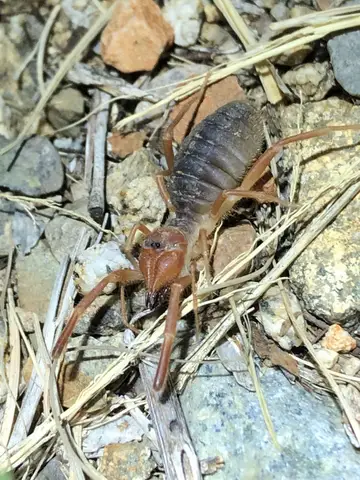
"Camel spider" is another name for windscorpions or sun spiders (order Solifugae). They are fast, night-hunting arachnids with big jaws, and they are neither true spiders nor scorpions. UC IPM (California) says they have no venom glands. The University of Arizona says none are known to have venom, Colorado State says they are not poisonous, and Texas A&M's extension guide says they are not venomous. They can bite if handled, but UC IPM says the bite is not serious. In the US they live in the West and Southwest: the University of Arizona says the southwestern US has more than 50 species. University of California Statewide IPM Program
This page covers an order (Solifugae), not a single species.
On this page
Is the camel spider dangerous?
UC IPM: although they look fierce, windscorpions cannot seriously harm people. They can bite in self-defense if handled, but because they have no poison glands the bite is not serious. University of California Statewide IPM Program
“Although they look fierce, windscorpions can’t seriously harm people and are considered beneficial since they feed on insects.”
Bites and stings: Can bite if handled or restrained (in self-defense). With no venom/poison glands, UC IPM says the bite is not serious.
How to identify a camel spider
A photo or description can narrow it down, but cannot confirm what an animal is or that it is safe. Look from a distance and do not handle wild animals.
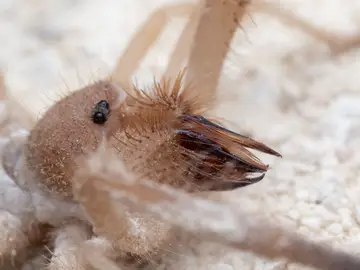
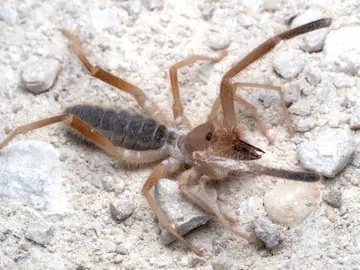
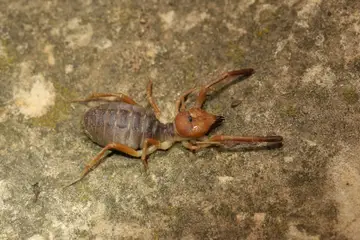
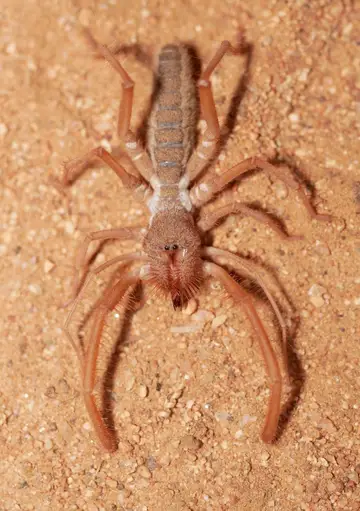
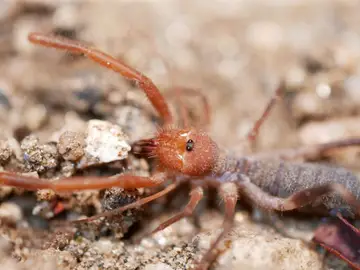
Size: About 3/4 to 1-1/2 inches long (UC IPM); 15 to 45 mm (5/8 to 1 3/4 inches) in the western US (University of Arizona). University of California Statewide IPM Program
Colors: tan, yellowish brown, reddish brown and brown. Pattern: plain, often darker abdomen and hairy.
Key features
- Large, pincer-like jaws pointing forward. No stinger, and no pincers like a scorpion. University of California Statewide IPM Program
- Seems to have 10 legs: the leg-like pedipalps at the front are held out as feelers. Colorado State University, Department of Bioagricultural Sciences and Pest Management
- Walks on the last three pairs of legs and uses the first pair as feelers. Runs very fast. University of California Statewide IPM Program
- Rounded abdomen with no stinger. It has no venom glands, no web-spinning organs and no pincers. University of California Statewide IPM Program
- Body is often covered with short hairs and has two distinct segments. Yavapai County
Animals mistaken for the camel spider
Camel spider or Spiders and scorpions?
Camel spider
Spiders and scorpions Araneae; Scorpiones
Unlike spiders, windscorpions have no venom glands or web-spinning organs. Unlike scorpions, they have no pincers and no stinger. University of California Statewide IPM Program
Scorpions sting. Texas A&M AgriLife's 'Venomous Terrestrial Animals of Texas' lists the striped bark scorpion and says its stings cause sharp, immediate pain. Colorado State lists "certain spiders and scorpions" as look-alikes.
Where the camel spider lives
- Native or listed
- Nonnative or not established
- No official record in our data
- 1–9
- 10–99
- 100–999
- 1,000+
State boundaries: U.S. Census Bureau, cartographic boundary file cb_2024_us_state_20m.
When it is active
Active mostly at night, but sometimes seen during the day. University of California Statewide IPM Program
US open-licence records for all camel spiders (order Solifugae) peak in May to June and September.
Habitat and habits
Habitat: Common in California's San Joaquin Valley and the arid Southwest. By day they hide under stones and other objects or in burrows. At night they appear on roads and paths and sometimes come into buildings. University of California Statewide IPM Program
Behavior: Fast runners that use their pedipalps to grab prey and pass it to the jaws, which crush it. They enter buildings at night while hunting.
Diet: Mainly live insects, spiders and other small creatures, including lizards.
Young: The female lays about 50 eggs in a burrow she digs and guards it until the young hatch. Colorado State says sunspiders usually live one or two years.
Questions about the camel spider
Camel spider bite
UC IPM says windscorpions (camel spiders) can bite if handled or restrained, in self-defense. Because they have no poison glands, the bite is not serious.
Are camel spiders venomous?
No. UC IPM says they do not have venom glands, the University of Arizona Extension says none are known to have venom, and Texas A&M's extension guide says they are not venomous.
Camel spider size
UC IPM gives 3/4 to 1-1/2 inches long. The University of Arizona Extension gives 15 to 45 mm (5/8 to 1 3/4 inches) for western US species.
Camel spider speed
Very fast.
Sun spider vs camel spider
Same animals. UC IPM says the windscorpion is also called a camel spider and a sun spider. It is neither a true spider nor a scorpion.
Camel spider california
Yes. UC IPM says windscorpions are common in California's San Joaquin Valley and arid parts of the Southwest.
Camel spider colorado
Yes. Colorado State University says sunspiders are found in many parts of Colorado and are most common in the southeast; it counts eleven species in the state.
Camel spider arizona
The University of Arizona Cooperative Extension describes solpugids (camel spiders) as beneficial predators and says the southwestern U.S. has more than 50 species.
Sources
- Windscorpion (Pest Notes, Home and Landscape). University of California Statewide IPM Program (UC Agriculture and Natural Resources). updated 05/2010; checked November 3, 2026.
Quoted passages (11)
“Although they look fierce, windscorpions can’t seriously harm people and are considered beneficial since they feed on insects.”
“The windscorpion is 3/4 to 1-1/2 inches long and yellowish brown.”
“Windscorpions have large, pincerlike jaws and a large pair of leglike organs called pedipalps that are located on the head or cephalothorax region.”
“The windscorpion has four pairs of legs, but it walks only on the last three pairs while using the first pair as feelers.”
“It has a rounded abdomen and no stinger.”
“Windscorpions are common in California’s San Joaquin Valley and arid sections of the Southwest.”
“Windscorpions feed primarily on living insects, spiders, and other small creatures such as lizards that they catch.”
“They use their pedipalps to seize and pass prey to their jaws, where they crush it.”
“They are active mostly at night, but you also might see them moving about during the day.”
“The female lays about 50 eggs in a burrow that she digs into the soil. She then guards the burrow until the young hatch.”
“It looks like a cross between a spider and a scorpion but it doesn’t have venom glands, web-spinning organs, or pincers.”
- Backyard Gardener #8: Sopulgids or Sun Spiders. University of Arizona Cooperative Extension (Yavapai County). June 2, 2022; checked November 3, 2026.
Quoted passages (1)
“Their bodies are often covered with short hairs and divided into two distinct body segments”
- Sunspiders (insect information sheet). Colorado State University, Department of Bioagricultural Sciences and Pest Management. Version: July 31, 2009; checked November 3, 2026.
Quoted passages (1)
“Sunspiders appear to have 10 legs, although the first pair of legs actually are actually part of the prominent jaws and used to detect their prey.”
- Venomous Terrestrial Animals of Texas (B-6118). Texas Cooperative Extension (now Texas A&M AgriLife Extension). 8-04 (publication code B-6118 8-04; checked November 3, 2026.
- GBIF.org occurrence records, human observations licensed CC0 1.0 or CC BY 4.0 only, accessed November 3, 2026. The datasets behind these counts are listed on our Sources page.
- State boundaries: U.S. Census Bureau, cartographic boundary file cb_2024_us_state_20m.