Giant African land snail
Lissachatina fulica · also called GALS, giant African snail, Achatina fulica and albino GALS (light-fleshed form) · Last checked November 3, 2026.
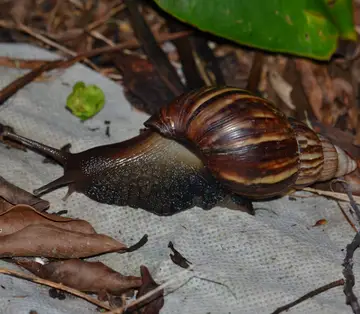
The giant African land snail is a huge invasive land snail, growing to over 7 inches long, with a cone-shaped, light-brown shell striped with dark brown. It eats at least 500 kinds of plants and is one of the most damaging snails in the world. It can carry rat lungworm, a parasite that can cause meningitis in people, so Florida officials say not to handle these snails without gloves. It is illegal to import or keep in the US without a permit. In the US it lives in Hawaii, and Florida has eradicated it three times; quarantines remain in Broward and Pasco counties. Florida Department of Agriculture and Consumer Services, Division of Plant Industry
On this page
Is the giant African land snail dangerous?
FDACS: a serious health risk to humans because it can carry rat lungworm, a parasite known to cause meningitis. Do not handle the snails without gloves. Florida Department of Agriculture and Consumer Services, Division of Plant Industry
“The snails also pose a serious health risk to humans by carrying the parasite rat lungworm, known to cause meningitis in humans.”
No official source we use states whether this animal is venomous. That does not mean it is harmless: do not handle it.
How to identify a giant African land snail
A photo or description can narrow it down, but cannot confirm what an animal is or that it is safe. Look from a distance and do not handle wild animals.
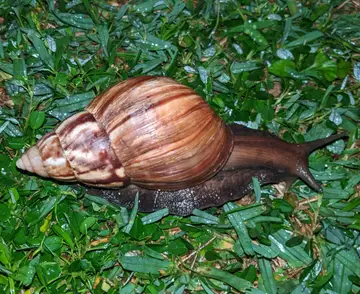
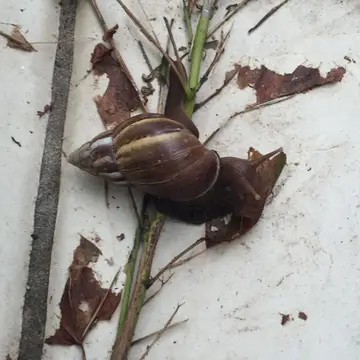
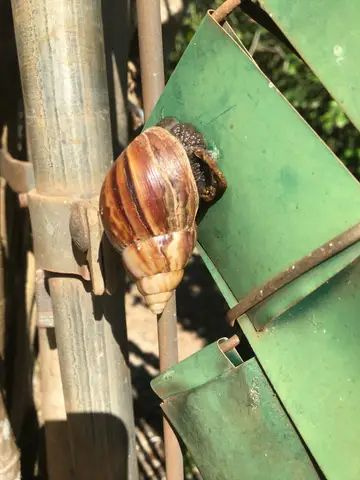
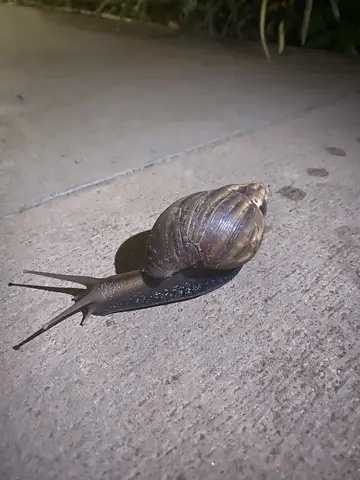
Size: Adults can grow to over 7 inches long (FDACS); UF/IFAS says nearly 8 inches (20 cm) long and 5 inches (13 cm) across. Florida Department of Agriculture and Consumer Services, Division of Plant Industry
Colors: Typically light brown with dark brown stripes; florida forms: dark brown shells with grayish-brown flesh (Miami-Dade, Lee); light to dark brown shells with milky white flesh (Pasco, sometimes called 'albino GALS'). Pattern: Only regular lengthwise bands, no cross banding.
Key features
- Thin, ceramic-like shell, elongate-oval with a conical tip Florida Department of Agriculture and Consumer Services, Division of Plant Industry
- Large size and a long columella with an inwardly curled free edge Florida Department of Agriculture and Consumer Services, Division of Plant Industry
- A land snail: it cannot survive long underwater Florida Department of Agriculture and Consumer Services, Division of Plant Industry
Young
Eggs are pea-sized, hard-shelled, about 1/6 to 1/5 inch, laid in soil; young stay in the soil 1 to 2 weeks after hatching.
Animals mistaken for the giant African land snail
Giant African land snail or Stock Island tree snail?
Giant African land snail
Stock Island tree snail Orthalicus reses
FDACS: in Florida the only large snail of similar shape and color; found in Miami-Dade and Monroe counties; lacks the inwardly curled columella. Florida Department of Agriculture and Consumer Services, Division of Plant Industry
Giant African land snail or Apple snails?
Giant African land snail
Apple snails Pomacea spp.
FDACS: large aquatic invasive snails nearly always found near water, with rounder, more spherical shells. Florida Department of Agriculture and Consumer Services, Division of Plant Industry
Where the giant African land snail lives
- Native or listed
- Nonnative or not established
- No official record in our data
- 1–9
- 10–99
- 100–999
- 1,000+
State boundaries: U.S. Census Bureau, cartographic boundary file cb_2024_us_state_20m.
When it is active
Mainly at night and in wet weather; inactive (aestivating) in dry weather, sometimes for months. Active at about 48 to 90 °F. Florida Department of Agriculture and Consumer Services, Division of Plant Industry
US open-licence records peak in January to March, May and October to December.
Habitat and habits
Habitat: Most abundant in disturbed areas such as gardens; rests in shaded, humid spots and can climb trees and walls. Can survive many environments and bury itself in soil for up to a year in bad conditions. UF/IFAS Extension
Behavior: Rests by day and feeds at night, travelling up to 50 feet in a night; active in wet weather. Spreads long distances by clinging to vehicles and machinery or in yard trash.
Diet: At least 500 kinds of plants, especially vegetables, flowers, ornamentals and seedlings; older snails also eat decaying plant matter. UF/IFAS says it seems particularly attracted to banana and papaya fruit.
Young: Hermaphrodites that usually mate with another snail. Can reproduce at about four months old and lay many thousands of eggs over a multiple-year life span; UF/IFAS says about 100 eggs in the first year and 200 to 1,000 in the second.
Legal status and reporting
Federal: Illegal to import or possess in the United States without a permit; a federally prohibited organism that cannot be legally sold or possessed in the USA. Florida Department of Agriculture and Consumer Services, Division of Plant Industry
Invasive status: Invasive in Florida (under quarantine and eradication) and Hawaii. Hawaii lists it as injurious wildlife, which may not be released or moved to islands where it is not established. Hawaii DLNR Division of Forestry and Wildlife
Report: Florida: take a picture and contact the FDACS Division of Plant Industry Helpline at 1-888-397-1517 (Mon to Fri, 8 a.m. to 5 p.m.) or [email protected]; email a photo if unsure. Do not handle snails without gloves. Florida Department of Agriculture and Consumer Services, Division of Plant Industry
Questions about the giant African land snail
Giant african land snail florida
FDACS says Florida has eradicated it three times: in 1975, 2021 (Miami-Dade) and 2026 (Lee County). Two quarantine areas remain, in Broward and Pasco counties. Report suspected snails to the FDACS helpline at 1-888-397-1517.
Giant african land snail legal in us
No. FDACS says they are illegal to import or possess in the United States without a permit and are a federally prohibited organism that cannot be legally sold or possessed in the USA.
Giant african land snail pet
Keeping one is illegal in the US without a permit. FDACS says the light-fleshed 'albino' form is sought in the illegal pet trade and points people interested in invertebrate pets to the USDA Invertebrate Pets website.
Giant african land snail size
Adults can grow over 7 inches long (FDACS); UF/IFAS says nearly 8 inches long and 5 inches across.
Giant african land snail lifespan
FDACS describes a multiple-year life span; snails can reproduce at about four months old. The sources checked give no exact number of years.
Giant african land snail eggs
Eggs are pea-sized (about 1/6 to 1/5 inch), hard-shelled and laid in soil. A mated snail can lay about 100 eggs in its first year and 200 to 1,000 in its second (UF/IFAS); FDACS says many thousands over its life.
Giant african land snail eating
It eats at least 500 kinds of plants, especially vegetables, flowers and seedlings. For people, the Hawaii Department of Health says to avoid eating raw or undercooked snails or slugs because of rat lungworm.
Sources
- Giant African Land Snail. Florida Department of Agriculture and Consumer Services, Division of Plant Industry. undated page; checked November 3, 2026.
Quoted passages (3)
“The snails also pose a serious health risk to humans by carrying the parasite rat lungworm, known to cause meningitis in humans.”
“The giant African land snail (GALS) is one of the most damaging snails in the world and consumes at least 500 different types of plants.”
“Giant African land snails are illegal to import or possess in the United States without a permit.”
- Pest Alert: Lissachatina fulica, Giant African Land Snail (FDACS-P-01717). Florida Department of Agriculture and Consumer Services, Division of Plant Industry. Pest Alert revised June 2023; checked November 3, 2026.
Quoted passages (9)
“Giant African land snail (Figs. 1–2) eggs are pea-sized and adults can grow to be over 7 inches in length.”
“The shell is thin and ceramic-like, and the shape is elongate-oval with a conical apex.”
“…the columella is long, with an inwardly curled free edge and truncate apex”
“Although they may be found near water, they cannot survive prolonged submersion in water.”
“They are primarily active at night, hiding in cool, damp places during the day.”
“They can reproduce as young as four months old, laying many thousands of eggs in its multiple-year life span”
“If you see a suspect GALS, take a picture, and contact the DPI Helpline at 1-888-397-1517 or [email protected] for instructions how to submit pictures and needed information.”
“These tree snails are easily distinguished by their lack of the inward curled columella.”
“The large, aquatic invasive apple snails are often confused with GALS, but they are nearly always found near a body of water and the shells are round and more spherical, like an apple.”
- ENY-512 Giant African Land Snail in Florida (Capinera). UF/IFAS Extension (EDIS). Original October 2011; checked November 3, 2026.
Quoted passages (3)
“Eggs have a hard shell, measure 1/6–1/5 inch (4.5–5.5 mm) in diameter, and are deposited in the soil.”
“Giant African snail is most abundant in unnatural (disturbed) areas such as gardens.”
“They may travel up to 50 feet (1500 cm) in a single night to feed.”
- Injurious Wildlife. Hawaii DLNR Division of Forestry and Wildlife. undated page; checked November 3, 2026.
Quoted passages (1)
“Release injurious wildlife into the wild; Transport them to islands or locations within the State where they are not already established and living in a wild state”
- Neuroangiostrongyliasis (Rat Lungworm). Hawaii State Department of Health, Disease Outbreak Control Division. case table 'as of November 2, 2026'; checked November 3, 2026.
- GBIF.org occurrence records, human observations licensed CC0 1.0 or CC BY 4.0 only, accessed November 3, 2026. The datasets behind these counts are listed on our Sources page.
- State boundaries: U.S. Census Bureau, cartographic boundary file cb_2024_us_state_20m.