Great blue heron
Ardea herodias · also called Great white heron (all-white form in Florida) · Last checked November 3, 2026.


The great blue heron is a very large wading bird, about 46 inches long with a wingspan of about 6 feet. It has a slate-blue (Missouri) or slate-gray (Alabama) body, a white head with a black stripe above the eye, long legs and a long, dagger-like bill. It hunts fish, frogs and other small animals in shallow water and nests in colonies, usually high in trees near water. It breeds from coastal Alaska and southern Canada south through Mexico, near shallow fresh or salt water, and winters mainly in the southern third of the continental US. It is a protected migratory bird. None of the official sources we checked describe it as a danger to people. Missouri Department of Conservation
On this page
Is the great blue heron dangerous?
How to identify a great blue heron
A photo or description can narrow it down, but cannot confirm what an animal is or that it is safe. Look from a distance and do not handle wild animals.
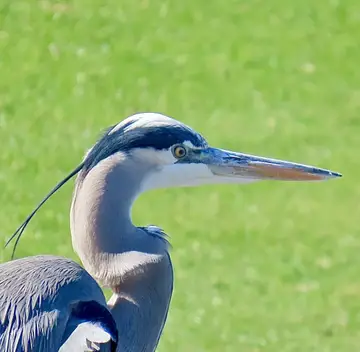




Size: About 46 inches long with a 72-inch wingspan (Alabama); Pennsylvania gives 38 to 53 inches long and a 70-inch wingspread.
Colors: Very large slate-blue body; white head with a black plumed eye line; reddish thighs; yellowish bill; an all-white form, the "great white heron," occurs in Florida. Pattern: White foreneck streaked with black; breeding adults have ornate plumes on head, neck and back.
Key features
- Flies with its neck folded, unlike cranes, geese, ibises, storks and cormorants, which fly with necks extended. Outdoor Alabama
- Voice a low, harsh "gwock," often heard in flight. Missouri Department of Conservation
Young
Juveniles have a black crown and no plumes.
Animals mistaken for the great blue heron
Great blue heron or Cranes?
Great blue heron
Cranes
Cranes are in a different family and fly with their necks extended; herons fly with necks tucked in. Pennsylvania Game Commission
Great blue heron or Egrets?
Great blue heron
Egrets
Missouri Department of Conservation: great blue herons have a very large slate-blue body, long legs, a long pointed bill and a long slender neck; the head is white with a black plumed eye line. Missouri Department of Conservation
Where the great blue heron lives
- Native or listed
- Nonnative or not established
- No official record in our data
- 1–9
- 10–99
- 100–999
- 1,000+
On our state guides
- Alabama birds
- Alaska birds
- Arizona birds
- California birds
- Delaware birds
- Georgia birds
- Hawaii birds
- Idaho birds
- Illinois birds
- Indiana birds
- Iowa birds
- Kentucky birds
- Maine birds
- Maryland birds
- Massachusetts birds
- Michigan birds
- Minnesota birds
- Missouri birds
- Montana birds
- Nevada birds
- New Jersey birds
- New Mexico birds
- New York birds
- North Carolina birds
- Ohio birds
- Pennsylvania birds
- Rhode Island birds
- South Carolina birds
- South Dakota birds
- Tennessee birds
- Texas birds
- Vermont birds
- Virginia birds
- Washington birds
- West Virginia birds
- Wisconsin birds
- Wyoming birds
State boundaries: U.S. Census Bureau, cartographic boundary file cb_2024_us_state_20m.
When it is active
Year-round in Alabama and Tennessee. In Missouri an uncommon summer resident in nesting colonies, common in migration, and an uncommon winter resident where water stays open. In Pennsylvania a spring migrant mid-March to late May and summer breeder; some stay the winter until water freezes.
US open-licence records peak in January, March to May and August to October.
Habitat and habits
Habitat: Shallow water of lakes, rivers, streams, ponds, marshes, swamps and tidal flats, salt or fresh, near trees suitable for nesting.
Behavior: Usually hunts alone in shallow water and flushes easily; may travel more than 10 miles to forage, sometimes close to people.
Diet: Fish, crayfish, frogs, salamanders, snakes and other small aquatic animals.
Young: Usually nests in colonies (rookeries) of a few to several hundred nests, sometimes singly; nests are platforms of sticks, usually high in trees near water. Lays 3 to 6 eggs, incubated nearly a month.
Legal status and reporting
Federal: Listed as a migratory bird under 50 CFR 10.13 (Migratory Bird Treaty Act list). US Fish and Wildlife Service regulation
Protection: Protected nongame bird; no hunting allowed (Alabama). Also a federally listed migratory bird. Outdoor Alabama
Report: Pennsylvania collects heron colony observations through its Heron Colony Observation Survey. Pennsylvania Game Commission
Sources
- Great Blue Heron (Field Guide). Missouri Department of Conservation. undated page; checked November 3, 2026.
Quoted passages (2)
“The voice is a low, harsh ‘gwock,’ often heard in flight.”
“Great blue herons have a very large, slate-blue body, long legs, long, pointy bill and a slender, long neck. The head is white with a black, plumed eye line.”
- Great Blue Heron. Alabama Department of Conservation and Natural Resources (Outdoor Alabama). undated page; checked November 3, 2026.
Quoted passages (3)
“All herons fly with their neck folded. This distinguishes them from cranes, geese, ibises, storks and cormorants, all of which fly with the neck extended.”
“Juvenile birds have a black crown and no plumes.”
“The Great Blue Heron is a protected nongame bird and no hunting of the species is allowed.”
- Great blue heron (Discover PA Wildlife). Pennsylvania Game Commission. undated page; checked November 3, 2026.
Quoted passages (2)
“The Pennsylvania Game Commission gathers heron colony observations to improve its ability to monitor heron populations and distribution throughout the state.”
“Many people mistakenly call this species a ‘crane’ or ‘blue crane’ but cranes are in a different family and fly with their necks extended rather than tucked in like herons.”
- 50 CFR 10.13 - List of Migratory Birds. U.S. Fish and Wildlife Service regulation (eCFR, Office of the Federal Register). Title 50 up to date as of 10/30/2026; checked November 3, 2026.
Quoted passages (1)
“Ardea herodias.”
- GBIF.org occurrence records, human observations licensed CC0 1.0 or CC BY 4.0 only, accessed November 3, 2026. The datasets behind these counts are listed on our Sources page.
- State boundaries: U.S. Census Bureau, cartographic boundary file cb_2024_us_state_20m.