Hellbender
Cryptobranchus alleganiensis · also called Eastern Hellbender, Ozark Hellbender, snot otter and water dog · Last checked November 3, 2026.
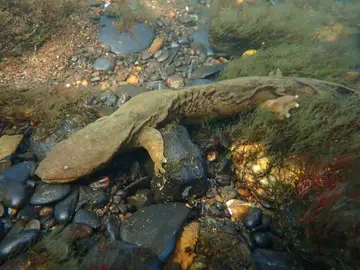
The hellbender is a giant, fully aquatic salamander, 16 to 17 inches long on average and sometimes more than 2 feet, with a flat head and wrinkled folds of skin along its sides. It lives under large flat rocks in clean, fast-flowing streams and rivers. North Carolina's wildlife agency says it is not poisonous or venomous and is quite harmless; Missouri calls it a large, harmless salamander. It lives in Appalachian and Ozark streams from southern New York to Alabama and west to Missouri and Arkansas. It is protected: the Ozark hellbender and Missouri's eastern hellbenders are federally endangered, and the eastern hellbender has been proposed for endangered listing range-wide. North Carolina Wildlife Resources Commission
On this page
Is the hellbender dangerous?
Hellbenders are not poisonous or venomous and are quite harmless (North Carolina Wildlife Resources Commission). North Carolina Wildlife Resources Commission
“Although they are large and slimy, contrary to popular belief hellbenders are not poisonous or venomous. In fact, they are quite harmless.”
How to identify a hellbender
A photo or description can narrow it down, but cannot confirm what an animal is or that it is safe. Look from a distance and do not handle wild animals.
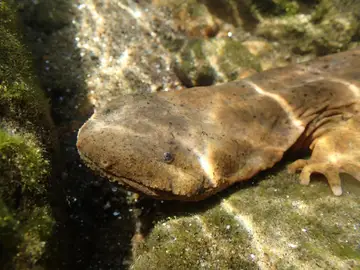
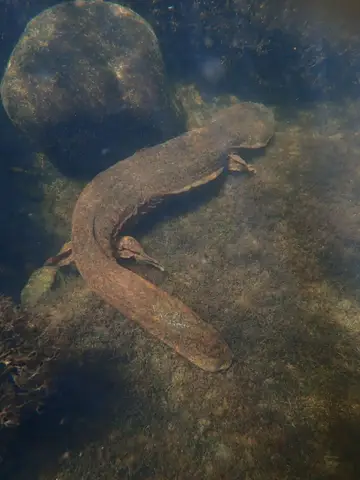
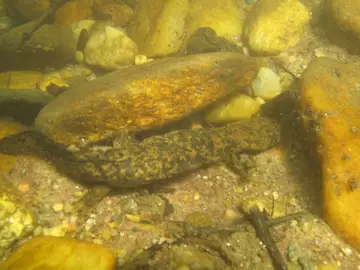

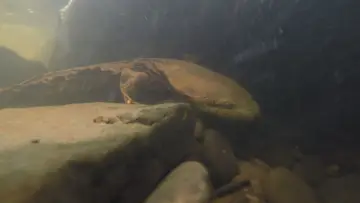
Size: Average 16 to 17 inches; can exceed 2 feet and 3 pounds. Missouri: eastern adults usually 13 to 23 inches, known to 29. North Carolina Wildlife Resources Commission
Colors: Back grayish brown to reddish brown, sometimes with darker spots or mottling; belly lighter. Pattern: Darker spots or mottled patches may be present.
Key features
- Flattened head and body, small eyes North Carolina Wildlife Resources Commission
- Loose fold of skin (frill) along each side North Carolina Wildlife Resources Commission
- Flattened, rudderlike tail Missouri Department of Conservation
- Adults have no external gills Missouri Department of Conservation
Young
Hatchlings and 1-to-2-year-olds have external gills. Missouri: brown to black irregular spots are often present on juveniles, while adults are typically uniform in color.
Animals mistaken for the hellbender
Hellbender or Mudpuppy?
Hellbender
Mudpuppy Necturus spp.
Missouri: mudpuppies keep red, plumelike external gills behind the head, have 4 toes on each foot and reach only 8 to 13 inches as adults. Hellbenders lose their external gills at 4 to 5 inches long and have 5 toes on the hind feet. (Very young hellbenders also have external gills, so check toes and size.) Missouri Department of Conservation
Not stated by the sources checked.
Where the hellbender lives
- Native or listed
- Nonnative or not established
- No official record in our data
- 1–9
- 10–99
- 100–999
- 1,000+
State boundaries: U.S. Census Bureau, cartographic boundary file cb_2024_us_state_20m.
When it is active
Mostly nocturnal (North Carolina); hunts at night (Missouri). North Carolina Wildlife Resources Commission
US open-licence records peak in August to September.
Habitat and habits
Habitat: Under flat rocks and in bedrock crevices in large, permanent, clean, cool streams and rivers. Missouri Department of Conservation
Behavior: Takes in oxygen through its skin; hides under rocks by day and walks the stream bottom hunting at night.
Diet: Mainly crayfish, also small fish, snails, worms and aquatic insects; scavenges.
Young: Missouri: breeds mainly in September; external fertilization, about 200 to 400 eggs per nest guarded by the male, hatching in about 45 days.
Legal status and reporting
Federal: Ozark hellbender: Endangered (2011). Eastern hellbender: Endangered in the Missouri DPS (2021), and Proposed Endangered wherever found (proposed December 13, 2024). No final range-wide rule was found in the Federal Register as of 2026-11-03. US Fish and Wildlife Service
Protection: Protected species. In North Carolina it is illegal to kill, harm, collect, harass or sell them; in Missouri none may be taken from the wild, and hellbenders caught on hook and line should be released unharmed. North Carolina Wildlife Resources Commission
Invasive status: Native; not invasive. US Fish and Wildlife Service
Report: North Carolina asks the public to report sightings to (919) 707-0050 or [email protected]. Elsewhere, Purdue Extension advises reporting sightings to your state natural resources agency. North Carolina Wildlife Resources Commission
Questions about the hellbender
Hellbender
A giant aquatic salamander, usually 16 to 17 inches and sometimes over 2 feet, that lives under big flat rocks in clean, fast streams of the eastern US and the Ozarks. North Carolina and Missouri wildlife agencies say it is harmless and is neither poisonous nor venomous. It is protected, and some populations are federally endangered.
Sources
- Eastern Hellbender. North Carolina Wildlife Resources Commission. undated page; checked November 3, 2026.
Quoted passages (8)
“Although they are large and slimy, contrary to popular belief hellbenders are not poisonous or venomous. In fact, they are quite harmless.”
“Hellbenders are 16 to 17 inches long on average, but they can grow to be more than 2 feet long and weigh more than 3 pounds.”
“The hellbender's head and body are flattened, with a rounded snout and a pair of small, poorly developed eyes.”
“A loose fold of skin called a "frill" runs from the base of the neck down to the tail on each side of its body.”
“Hatchling and 1-to-2 year hellbenders have external gills.”
“The hellbender is mostly nocturnal, and relies on touch and smell to catch food”
“Because hellbenders are a protected species, it is illegal to kill, harm, collect, harass or sell them.”
“If you have recently seen a hellbender, you can report it by phone to: (919) 707-0050 or email: [email protected].”
- Eastern Hellbender (Field Guide). Missouri Department of Conservation. undated page; checked November 3, 2026.
Quoted passages (7)
“The tail is flattened and rudderlike.”
“Hellbenders lose their external gills once they reach 4 or 5 inches long”
“This salamander lives under flat rocks and in bedrock crevices in large permanent streams and rivers.”
“The food of adult eastern hellbenders consists primarily of crayfish, small fish, and occasionally snails, worms, and aquatic insects.”
“These fully aquatic salamanders take in oxygen through their skin. By day, they hide under large flat rocks; by night, they walk slowly along the stream bottom, hunting.”
“Breeding in Missouri is mainly in September … Fertilization is external, about 200–400 eggs may be deposited into the nest, and the males guard the eggs. The eggs hatch in about 45 days.”
“…mudpuppies, however, have external gills, which are red and plumelike, behind the head on both sides. They have 4 toes on each foot. As adults, mudpuppies reach only 8–13 inches in length. Hellbenders lose their external gills once they reach 4 or 5 inches long, they have 4 toes on the forelimbs and 5 toes on the hind limbs”
- Species Status Assessment: Eastern hellbender (NY SWAP 2025). New York State Department of Environmental Conservation. Date Updated January 8, 2025; checked November 3, 2026.
- Endangered Species Status for Eastern Hellbender (proposed rule). U.S. Fish and Wildlife Service (Federal Register 89 FR 100934). published 2024-12-13; checked November 3, 2026.
Quoted passages (1)
“…a salamander subspecies from Alabama, Georgia, Illinois, Indiana, Kentucky, Maryland, Mississippi, Missouri, New York, North Carolina, Ohio, Pennsylvania, Tennessee, Virginia, and West Virginia”
- ECOS species report query (p16). U.S. Fish and Wildlife Service. live query 2026-11-03; checked November 3, 2026.
- GBIF.org occurrence records, human observations licensed CC0 1.0 or CC BY 4.0 only, accessed November 3, 2026. The datasets behind these counts are listed on our Sources page.
- State boundaries: U.S. Census Bureau, cartographic boundary file cb_2024_us_state_20m.