Horned Lizard
Phrynosoma (horned lizards; about eight US species, e.g. P. cornutum, P. platyrhinos, P. solare, P. hernandesi, P. blainvillii) · also called Horny Toad, Horned Toad, Texas Horned Lizard and Short-horned Lizard · Last checked November 3, 2026.
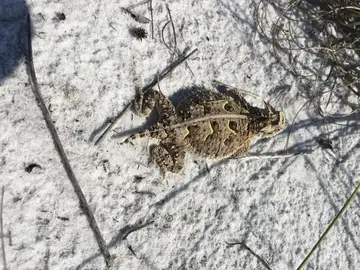
Horned lizards, often called "horny toads", are flat, wide, spiny lizards with horn-like scales on the back of the head. They eat mainly ants and rely on camouflage; some species can squirt blood from their eyes at predators. Missouri and Alabama say the Texas horned lizard is harmless to people. They live in open, dry, sandy or gravelly country in the West and southern Plains, including Texas, Oklahoma, Arizona, New Mexico, Colorado and California. Texas Parks and Wildlife Department
This page covers a genus (Phrynosoma (horned lizards; about eight US species, e.g. P. cornutum, P. platyrhinos, P. solare, P. hernandesi, P. blainvillii)), not a single species.
On this page
Is the horned lizard dangerous?
Missouri: Texas horned lizards are harmless to people; they defend themselves by puffing up or ejecting a little blood from the eyes. Missouri Department of Conservation
“These lizards are harmless to people. They defend themselves by puffing up their bodies with air to look larger, or they can eject a small amount of blood from the inner corners of each eye to confuse a predator.”
No official source we use states whether this animal is venomous. That does not mean it is harmless: do not handle it.
How to identify a horned lizard
A photo or description can narrow it down, but cannot confirm what an animal is or that it is safe. Look from a distance and do not handle wild animals.
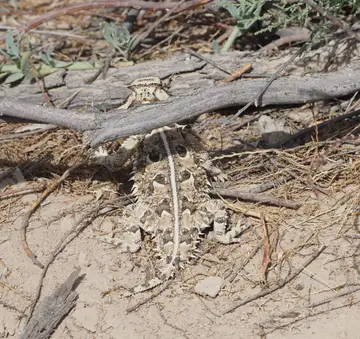
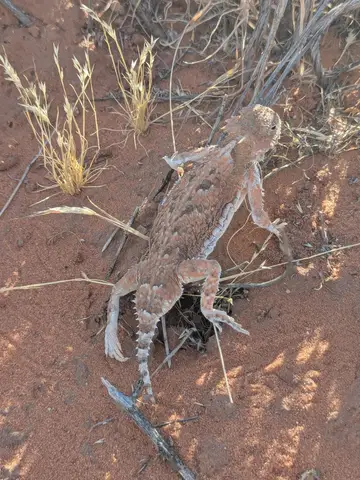
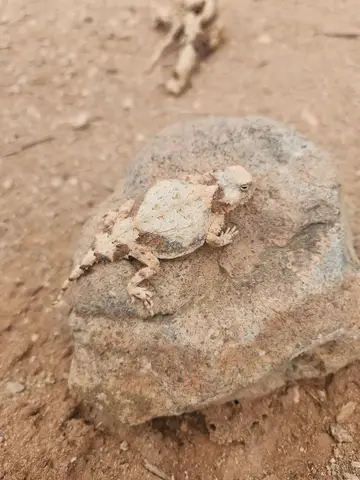
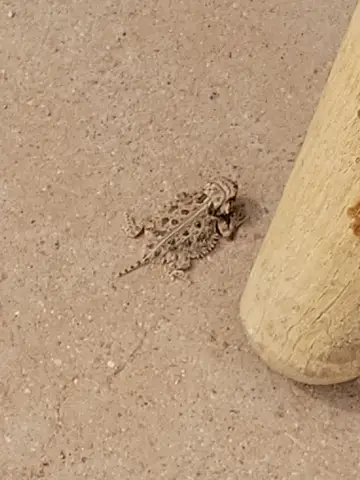
Size: Texas horned lizard: adult total length 2.5 to 4 inches, occasionally to 7 inches (Missouri). Missouri Department of Conservation
Colors: Red, brown or gray, often matching local soil. Pattern: Texas horned lizard: on most, a light line down the middle of the back; dark brown stripes radiate downward from the eyes; dark blotches on the back, two large dark spots behind the head.
Key features
- Horns on the back of the head are specialized scales, not bone Oklahoma Department of Wildlife Conservation
- Exceptionally flat, wide body; two rows of fringed scales along each side Texas Parks and Wildlife Department
- Short, pointed tail Oklahoma Department of Wildlife Conservation
Young
Hatchlings are about the size of a quarter; head spines are absent at first but grow quickly.
Animals mistaken for the horned lizard
Horned Lizard or Regal Horned Lizard?
Horned Lizard
Regal Horned Lizard Phrynosoma solare
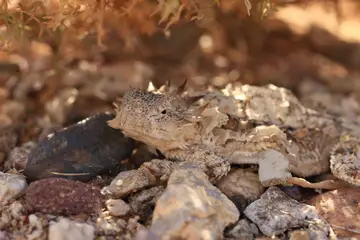
Arizona: the four central horns touch at their bases, unlike any other Arizona horned lizard. Arizona Game and Fish Department
Not stated by official sources checked.
Horned Lizard or Desert Horned Lizard?
Horned Lizard
Desert Horned Lizard Phrynosoma platyrhinos
Texas horned lizard is the only horned lizard with dark stripes radiating from the eyes (Arizona and Texas). Arizona Game and Fish Department
Not stated by official sources checked.
Where the horned lizard lives
- Native or listed
- Nonnative or not established
- No official record in our data
- 1–9
- 10–99
- 100–999
- 1,000+
State boundaries: U.S. Census Bureau, cartographic boundary file cb_2024_us_state_20m.
When it is active
Oklahoma: active early April through September; in October they burrow underground for winter hibernation. Missouri: active April to early October, by day while the sun is out and it is hot. Oklahoma Department of Wildlife Conservation
US open-licence records for all horned lizards (genus Phrynosoma) peak in April to July.
Habitat and habits
Habitat: Arid and semiarid open areas with sparse plant cover, commonly in loose sand or loamy soils (Texas); in Colorado, plains grassland with large patches of bare ground; in Arizona, Chihuahuan desertscrub and semidesert grassland. Texas Parks and Wildlife Department
Behavior: Usually stays still and relies on camouflage; if that fails it may sprint to shelter. When threatened or captured it may squirt blood from its eyes; it may also inflate itself by gulping air and poke with its horns.
Diet: Mostly ants, especially harvester ants; occasionally other insects such as beetles and grasshoppers, and spiders.
Young: Missouri: females lay an annual clutch of 13 to 49 eggs in a nest dug in loose soil or under large rocks; eggs hatch within 1 or 2 months.
Legal status and reporting
Federal: Not listed under the Endangered Species Act. ECOS lists the Texas horned lizard and some California and eastern short-horned subspecies as "Species of Concern" (an informal category, not ESA protection); flat-tailed horned lizard returns "Resolved Taxon". US Fish and Wildlife Service
Protection: Texas lists the Texas horned lizard as threatened. Colorado lists it as State Special Concern, Missouri as a Species of Conservation Concern and Oklahoma as a Species of Greatest Conservation Need. Check the state wildlife agency before handling or keeping one. Texas Parks and Wildlife Department
Questions about the horned lizard
Horned lizard shooting blood out of its eyes
When grasped, Texas horned lizards (and some other horned lizards) can squirt a stream of blood from sinuses around the eyes toward a predator. Oklahoma says the blood tastes bad and repels some predators, especially coyotes.
Horned lizard blood eyes
It is a defense: the lizard squirts blood from its eyes when threatened or captured. Arizona says the blood might have a foul taste to deter predators.
Horned lizard texas
The Texas horned lizard ("horny toad") is listed as a threatened species in Texas. It lives in arid, open areas with loose sand or loamy soil. Texas also has the greater short-horned and round-tailed horned lizards.
Horned lizard arizona
Arizona Game and Fish lists seven horned lizards in Arizona: Texas, Goode's, greater short-horned, flat-tailed, round-tailed, desert and regal.
Horned lizard california
California's official species list includes four horned lizards: pygmy short-horned, desert, Blainville's and flat-tailed.
Are there horned lizards in oklahoma?
Yes. Oklahoma says Texas horned lizards occur in all but the southeast corner of the state, typically in open areas.
Are there horned lizards in colorado?
Yes. Colorado Parks and Wildlife says the Texas horned lizard lives in southeastern Colorado, almost entirely south of the Arkansas River, and is fairly common there.
Are there horned lizards in arizona?
Yes. Arizona Game and Fish lists seven horned lizard species in the state.
Sources
- TPWD Wildlife Fact Sheet: Texas Horned Lizard (Phrynosoma cornutum). Texas Parks and Wildlife Department. undated page; checked November 3, 2026.
Quoted passages (3)
“This lizard is brownish with two rows of fringed scales along each side of the body.”
“They can be found in arid and semiarid habitats in open areas with sparse plant cover. Because horned lizards dig for hibernation, nesting and insulation purposes, they commonly are found in loose sand or loamy soils.”
“The Texas horned lizard currently is listed as a threatened species in Texas”
- Online Field Guide species account: Texas Horned Lizard (Phrynosoma cornutum). Arizona Game and Fish Department. 2023; checked November 3, 2026.
Quoted passages (2)
“When encountered it usually remains still and relying on its cryptic coloration to avoid detection. If crypsis fails it may sprint to the nearest shelter. It may squirt blood from its eyes when threatened or captured. … Other defensive behaviors include inflating itself by gulping air and poking with the horns.”
“Two or three wide, dark lines radiate from each eye distinguishing this lizard from all other horned lizards in Arizona.”
- Texas Horned Lizard (Field Guide). Missouri Department of Conservation. undated page; checked November 3, 2026.
Quoted passages (4)
“These lizards are harmless to people. They defend themselves by puffing up their bodies with air to look larger, or they can eject a small amount of blood from the inner corners of each eye to confuse a predator.”
“Adult total length: 2½–4 inches; occasionally to 7 inches.”
“Horned lizards eat primarily ants, especially harvester ants (Pogonomyrmex spp.), but occasionally they eat other insects (such as beetles and grasshoppers) and spiders.”
“Females produce an annual clutch of 13–49 eggs. The female digs a nest in loose soil or under large rocks and deposits her eggs in it. The eggs hatch within 1 or 2 months.”
- Texas Horned Lizard. Alabama Department of Conservation and Natural Resources (Outdoor Alabama). undated page; checked November 3, 2026.
- Texas Horned Lizard (Field Guide). Oklahoma Department of Wildlife Conservation. undated page; checked November 3, 2026.
Quoted passages (3)
“The ‘horns’ do not contain bone but are actually specialized body scales that serve to protect the lizards from predators.”
“…a short, pointed tail”
“Texas horned lizards are active in Oklahoma from early April through September. In October, they burrow underground to begin their winter hibernation.”
- Texas Horned Lizard (species profile). Colorado Parks and Wildlife. undated page; checked November 3, 2026.
Quoted passages (1)
“Head spines initially absent but grow quickly.”
- ECOS species report query (Crotalus horridus, Lampropeltis triangulum, Python bivittatus, Phrynosoma spp.). U.S. Fish and Wildlife Service. live query 2026-11-03; checked November 3, 2026.
- Online Field Guide species account: Regal Horned Lizard (Phrynosoma (Anota) solare). Arizona Game and Fish Department. 2023; checked November 3, 2026.
Quoted passages (1)
“The base of each of the four central horns is in contact with that of its neighbor distinguishing this lizard from all other horned lizards in Arizona.”
- Herps of Texas: Lizards of Texas. Herps of Texas, Biodiversity Collections, Dept. of Integrative Biology, The University of Texas at Austin. 2020-04-28 (archive capture date; checked November 3, 2026.
- Reptiles of Arizona field guide: Lizards (species list page). Arizona Game and Fish Department. undated page; checked November 3, 2026.
- Online Field Guide species account: Goode’S Horned Lizard (Phrynosoma (Doliosaurus) goodei). Arizona Game and Fish Department. 2023; checked November 3, 2026.
- Online Field Guide species account: Greater Short-Horned Lizard (Phrynosoma (Tapaja) hernandesi). Arizona Game and Fish Department. 2023; checked November 3, 2026.
- Online Field Guide species account: Flat-Tailed Horned Lizard (Phrynosoma (Anota) mcallii). Arizona Game and Fish Department. 2023; checked November 3, 2026.
- Online Field Guide species account: Round-Tailed Horned Lizard (Phrynosoma (Doliosaurus) modestum). Arizona Game and Fish Department. 2023; checked November 3, 2026.
- Online Field Guide species account: Desert Horned Lizard (Phrynosoma (Doliosaurus) platyrhinos). Arizona Game and Fish Department. 2023; checked November 3, 2026.
- Complete List of Amphibian, Reptile, Bird and Mammal Species in California. California Department of Fish and Wildlife (CWHR Program). 2016-05 (document dated "May, 2016"; checked November 3, 2026.
- GBIF.org occurrence records, human observations licensed CC0 1.0 or CC BY 4.0 only, accessed November 3, 2026. The datasets behind these counts are listed on our Sources page.
- State boundaries: U.S. Census Bureau, cartographic boundary file cb_2024_us_state_20m.