Leopard Frog
Lithobates (Rana) pipiens species group: leopard frogs. US species include Lithobates pipiens (northern), L. sphenocephalus (southern), L. blairi (plains), L. berlandieri (Rio Grande), L. chiricahuensis (Chiricahua), L. yavapaiensis (lowland), L. onca (relict) and L. kauffeldi (Atlantic Coast) · also called northern leopard frog, southern leopard frog, plains leopard frog and Rio Grande leopard frog · Last checked November 3, 2026.
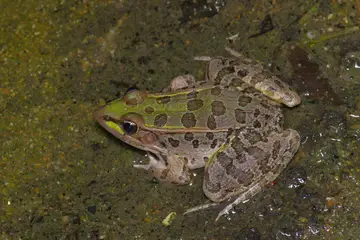
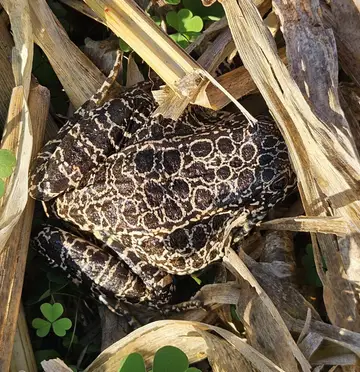
Leopard frogs are medium-sized green, tan or brown frogs with dark, rounded spots on the back and a pale ridge (dorsolateral fold) down each side of the back. The southern leopard frog is common across much of the East and South, the northern leopard frog lives across the North and West, and the plains, Rio Grande, Chiricahua, lowland and relict leopard frogs live in the Plains and Southwest. No official source collected calls them venomous. Missouri's conservation department calls Missouri's frogs harmless, says people are normally not affected by frog skin secretions, warns that the secretions burn if they get in the eyes, and says to wash hands after handling. Several western leopard frogs are declining; the Chiricahua leopard frog is federally threatened, and Arizona law protects its native leopard frogs. Illinois Natural History Survey (INHS), Prairie Research Institute, University of Illinois Urbana-Champaign
This page covers a group (Lithobates (Rana) pipiens species group: leopard frogs. US species include Lithobates pipiens (northern), L. sphenocephalus (southern), L. blairi (plains), L. berlandieri (Rio Grande), L. chiricahuensis (Chiricahua), L. yavapaiensis (lowland), L. onca (relict) and L. kauffeldi (Atlantic Coast)), not a single species.
On this page
Is the leopard frog dangerous?
Missouri Department of Conservation (about all Missouri toads and frogs, which include three leopard frogs): Missouri's frogs are harmless; people normally are not affected by frog and toad skin secretions, but human eyes are sensitive to them, and handwashing after handling a frog or toad is important. CDC: amphibians, including frogs, often carry Salmonella. MDC
“Missouri toads and frogs are colorful, harmless, vocal, and valuable.”
No official source we use states whether this animal is venomous. That does not mean it is harmless: do not handle it.
How to identify a leopard frog
A photo or description can narrow it down, but cannot confirm what an animal is or that it is safe. Look from a distance and do not handle wild animals.
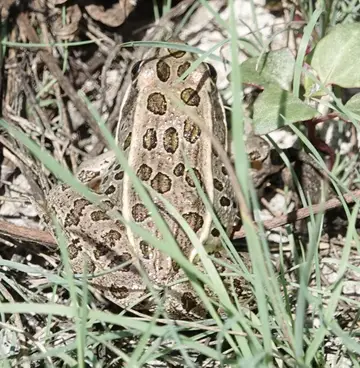
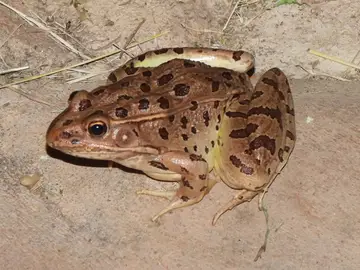

Size: Southern leopard frog about 2 to 3.5 inches (Texas, Missouri); Alabama says up to 5 inches. Northern leopard frog up to about 4.3 inches body length (Colorado); Arizona's largest leopard frogs reach about 4.4 to 4.5 inches. Texas Parks and Wildlife Department
Colors: green, tan or brown (sometimes mixed green and brown); belly white. Pattern: dark rounded spots on the back, sides and legs; in northern leopard frogs the spots are larger and ringed in white; southern leopard frog: back spots rounded, mostly smaller than the eye and rarely white-edged, few on the sides, most with a light spot on the eardrum; Missouri says its back spots are fewer and more elongated than the plains leopard frog's.
Key features
- pale ridge (dorsolateral fold) along each side of the back; complete in northern and southern leopard frogs, but broken and set inward toward the rear in several Arizona species N.C. Wildlife Resources Commission
- light line along the upper jaw Illinois Natural History Survey (INHS), Prairie Research Institute, University of Illinois Urbana-Champaign
- smooth skin; long, powerful hind legs; webbed hind feet N.C. Wildlife Resources Commission
Young
Tadpoles of the southern leopard frog hatch in about 7 to 10 days and grow to 65 to 70 mm before turning into frogs (Texas).
Animals mistaken for the leopard frog
Leopard Frog or Pickerel frog?
Leopard Frog
Pickerel frog Lithobates palustris
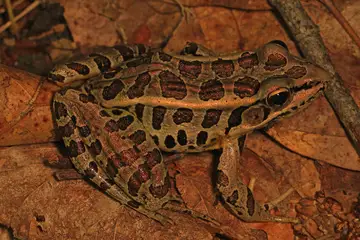

Pickerel frogs have squarish spots, bright orange or yellow on the hidden surfaces of the thighs, and no light spot on the eardrum. Southern leopard frogs have rounder spots, no bright orange thigh color and a light spot on the eardrum. The calls also differ. These comparisons are stated for the southern leopard frog. N.C. Wildlife Resources Commission
Pickerel frogs give off a skin secretion that is toxic to many predators; Missouri says some people get skin irritation after handling them.
Leopard Frog or Crawfish frog?
Leopard Frog
Crawfish frog Lithobates areolatus
Leopard frogs have a light line on the upper jaw; crawfish frogs do not (Illinois). Illinois Natural History Survey (INHS), Prairie Research Institute, University of Illinois Urbana-Champaign
Where the leopard frog lives
- Native or listed
- Nonnative or not established
- No official record in our data
- 1–9
- 10–99
- 100–999
- 1,000+
State boundaries: U.S. Census Bureau, cartographic boundary file cb_2024_us_state_20m.
When it is active
Southern leopard frogs are mainly nocturnal, hiding by day in vegetation at the water's edge. Northern leopard frogs in Arizona may be active day or night when water is above about 54°F. Northern leopard frogs spend winter under submerged logs or rocks. Texas Parks and Wildlife Department
US open-licence records for the eight US leopard frogs named on this page (Lithobates pipiens, L. sphenocephalus, L. blairi, L. berlandieri, L. chiricahuensis, L. yavapaiensis, L. onca and L. kauffeldi) peak in May to September.
Habitat and habits
Habitat: Almost any shallow fresh water: ponds, marshes, streams, lakes, ditches, wet meadows and swamps; southern leopard frogs also enter brackish coastal marshes. In summer they often move into grassy or weedy fields away from water. Illinois Natural History Survey (INHS), Prairie Research Institute, University of Illinois Urbana-Champaign
Behavior: Strong jumpers that escape into water and swim away underwater. Northern leopard frogs may give a startling scream when jumping and may release urine when grabbed. Eaten by fish, raccoons, skunks and aquatic snakes (Texas).
Diet: Insects and other invertebrates; large northern leopard frogs also eat small frogs, fish, snakes and other small vertebrates.
Young: Eggs in large masses in shallow water: southern leopard frog 1,000 to 4,000 eggs, late February to mid-April in Illinois (Missouri says 3,000 to 5,000 eggs), year-round in Texas and Alabama when conditions allow, sometimes in autumn too. Northern leopard frog eggs March to May in Illinois; tadpoles turn into frogs late June to August.
Legal status and reporting
Federal: Chiricahua leopard frog: Threatened under the Endangered Species Act. Arizona Game and Fish Department
Protection: Arizona protects its native leopard frogs under state law (see stateListings); the Chiricahua leopard frog is also federally protected. Arizona Game and Fish Department
Invasive status: The Rio Grande leopard frog is introduced in southwestern Arizona and is spreading; Arizona Game and Fish says it will likely prey on and compete with native leopard frogs. Arizona Game and Fish Department
Report: Ohio asks anyone who finds a southern leopard frog to take a photo and submit the data to the Division of Wildlife. No other official reporting request was found in the sources collected. Ohio Department of Natural Resources, Division of Wildlife
Questions about the leopard frog
Are southern leopard frogs poisonous?
No official source collected calls southern leopard frogs poisonous or venomous. Missouri's conservation department, which has southern leopard frogs statewide except the northwest, says its frogs are harmless and people are normally not affected by frog skin secretions. Missouri says even a slight amount in the eyes causes pain and burning, and that handwashing after handling a frog is important. The similar-looking pickerel frog has a skin secretion that is toxic to predators and can irritate people's skin.
Southern leopard frog poisonous to dogs
Not stated: no official source collected addresses southern leopard frogs and dogs. Missouri says frog skin secretions are generally weaker than those of toads.
Southern leopard frog size
About 2 to 3.5 inches (5 to 9 cm) according to Texas Parks and Wildlife and the Missouri Department of Conservation; Alabama gives two to five inches. Males are smaller than females.
Leopard frog
Leopard frogs are spotted green, tan or brown frogs with a pale ridge down each side of the back, found near ponds, marshes and streams across much of the US. Main species are the southern (East and South), northern (North and West) and plains leopard frogs, plus several southwestern species. The Chiricahua leopard frog is federally threatened, and Arizona protects its native leopard frogs by law.
Sources
- Northern Leopard Frog (Field Guide to Amphibians and Reptiles of Illinois). Illinois Natural History Survey (INHS), Prairie Research Institute, University of Illinois Urbana-Champaign. undated page; checked November 3, 2026.
- Southern Leopard Frog (Field Guide to Amphibians and Reptiles of Illinois). Illinois Natural History Survey (INHS), Prairie Research Institute, University of Illinois Urbana-Champaign. undated page; checked November 3, 2026.
Quoted passages (3)
“As in other leopard frogs and pickerel frogs, but not crawfish frogs, there is a light line on upper jaw.”
“This is a species of broad ecological tolerance and is found in all sorts of shallow water habitats. In summer, individuals venture away from shorelines and into nearby weed-and-grass-covered fields where they feed.”
“During the late February to mid-April breeding season, male produces breeding calls that sound like a mixed series of chuckles and groans. Female lays 1,000 to 4,000 eggs”
- TPWD Wildlife Fact Sheet: Southern Leopard Frog (Rana sphenocephala). Texas Parks and Wildlife Department. undated page; checked November 3, 2026.
Quoted passages (5)
“The southern leopard frog grows to a length of 2 to 3.5 inches (about 5 to 9 cm).”
“Tadpoles hatch in about seven to ten days.”
“They consume insects and small invertebrates.”
“Southern leopard frogs elude predators by jumping into nearby water and swimming underwater for some distance, while the predator continues looking near the point of entry into the water.”
“They are primarily nocturnal, hiding during the day in vegetation at the water's edge.”
- Species profile: Northern Leopard Frog. Colorado Parks and Wildlife. undated page; checked November 3, 2026.
- A Guide to Missouri's Toads and Frogs (MDC publication E00430). Missouri Department of Conservation (MDC). printed code "3/2022 E00430"; checked November 3, 2026.
Quoted passages (1)
“Missouri toads and frogs are colorful, harmless, vocal, and valuable.”
- Online Field Guide species account: Chiricahua Leopard Frog (Lithobates chiricahuensis). Arizona Game and Fish Department. 2023; checked November 3, 2026.
Quoted passages (2)
“Rana chiricahuensis is listed as THREATENED under the Endangered Species Act.”
“It is against Federal law to harass, harm, pursue, hunt, shoot, wound, kill, trap, capture, or collect this animal or to attempt to engage in any such conduct.”
- Online Field Guide species account: Northern Leopard Frog (Lithobates pipiens). Arizona Game and Fish Department. 2023; checked November 3, 2026.
- Southern Leopard Frog (NCWRC species page). N.C. Wildlife Resources Commission. undated page; checked November 3, 2026.
Quoted passages (3)
“Adult frogs also have two prominent yellow or gold dorsolateral folds extending the full length of the body.”
“Leopard frogs have long, powerful hind legs and webbed hind feet.”
“The southern leopard frog is sometimes confused with the closely related pickerel frog (Lithobates palustris), which is distinguished by its more squarish spots and bright orange or yellow coloration on the concealed surfaces of its thighs.”
- Online Field Guide species account: Rio Grande Leopard Frog (Lithobates berlandieri). Arizona Game and Fish Department. 2023; checked November 3, 2026.
Quoted passages (1)
“If it continues to spread upstream in the Salt and Agua Fria drainages, it will likely prey upon and compete with native leopard frogs.”
- Amphibians of Ohio Field Guide (Publication 5348). Ohio Department of Natural Resources, Division of Wildlife. PUBLICATION 5348; checked November 3, 2026.
Quoted passages (1)
“If you find one please take a photo and submit data to the Division of Wildlife.”
- MDC Field Guide: Reptiles and Amphibians > Frogs and toads (species accounts). Missouri Department of Conservation (MDC). undated page; checked November 3, 2026.
- Pickerel Frog (NCWRC species page). N.C. Wildlife Resources Commission. undated page; checked November 3, 2026.
- Southern Leopard Frog. Alabama Department of Conservation and Natural Resources (Outdoor Alabama). undated page; checked November 3, 2026.
- GBIF.org occurrence records, human observations licensed CC0 1.0 or CC BY 4.0 only, accessed November 3, 2026. The datasets behind these counts are listed on our Sources page.
- State boundaries: U.S. Census Bureau, cartographic boundary file cb_2024_us_state_20m.