Musk Turtle
Sternotherus (genus); the species most people meet is the Eastern Musk Turtle or stinkpot, Sternotherus odoratus · also called Stinkpot, Eastern Musk Turtle and Common Musk Turtle · Last checked November 3, 2026.
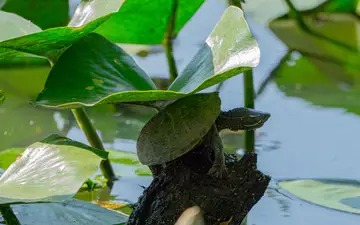
Musk turtles are small, dark freshwater turtles, named for the foul odor they give off when caught. The eastern musk turtle, or stinkpot, is usually 2 to 4 1/2 inches long, with two yellow stripes on each side of the head, and lives across much of the eastern US. Alabama says they are not aggressive but their jaws are very strong and bites can be extremely painful. No official source checked says whether they are venomous. The flattened musk turtle of Alabama is federally threatened. Missouri Department of Conservation
This page covers a genus (Sternotherus (genus); the species most people meet is the Eastern Musk Turtle or stinkpot, Sternotherus odoratus), not a single species.
On this page
Is the musk turtle dangerous?
Alabama: stinkpots are not aggressive and seldom do more than retract the head and open the mouth, but their jaws are very strong and bites can be extremely painful. Outdoor Alabama
“They do not lunge to bite like other snapping species, but their jaws are very strong and their bites can be extremely painful.”
Bites and stings: Yes, they can bite. Alabama: bites can be extremely painful. Missouri: the neck is long and the head can reach back as far as the hind legs.
How to identify a musk turtle
A photo or description can narrow it down, but cannot confirm what an animal is or that it is safe. Look from a distance and do not handle wild animals.
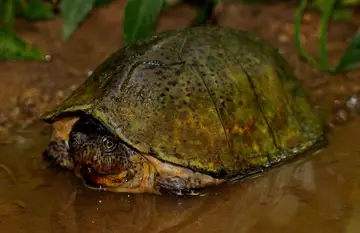

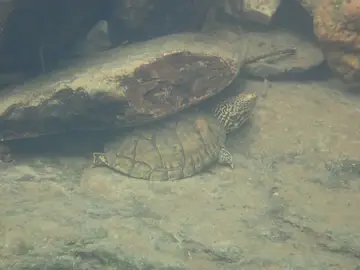

Size: Eastern musk turtle: upper shell 2 to 4 1/2 inches, occasionally to 6. Missouri's smallest turtle and one of the world's smallest. Missouri Department of Conservation
Colors: Upper shell dark gray-brown to black; lower shell yellow, brown or grayish yellow; dark gray or black body; shell may carry green algae. Pattern: Two distinct yellow stripes along each side of the head and neck; old animals' stripes fade.
Key features
- Small lower shell with exposed skin, and one weak hinge University of Georgia Savannah River Ecology Laboratory
- Fleshy barbels on chin and throat Missouri Department of Conservation
- Musky odor from glands along the shell Missouri Department of Conservation
Young
Young are black with light markings on the shell edge, and a marbled lower shell; hatchlings are under an inch.
Animals mistaken for the musk turtle
Musk Turtle or Mud turtles?
Musk Turtle
Mud turtles Kinosternon spp.
Mud turtles have larger lower shells with both front and hind parts movable. Tennessee: the eastern mud turtle has 2 hinges, one in front and one in the rear.
Musk Turtle or Loggerhead Musk Turtle?
Musk Turtle
Loggerhead Musk Turtle Sternotherus minor
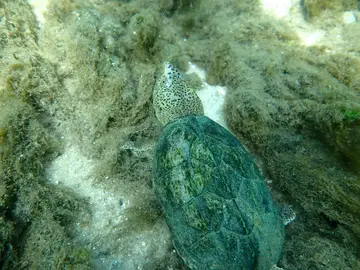
Much larger heads. SREL says loggerheads have "no slight stripes" (as printed) and light brown heads with dark spots; the common musk turtle has two light stripes on each side of the head.
Musk Turtle or Stripe-necked Musk Turtle?
Musk Turtle
Stripe-necked Musk Turtle Sternotherus peltifer
Tennessee: barbels on the chin only, while the eastern musk turtle has barbels on the chin and neck. Stripe colour is not a reliable test: Tennessee describes the stripe-necked musk turtle's head stripes as dark and prominent, but UGA SREL describes them as yellowish and broken.
Where the musk turtle lives
- Native or listed
- Nonnative or not established
- No official record in our data
- 1–9
- 10–99
- 100–999
- 1,000+
State boundaries: U.S. Census Bureau, cartographic boundary file cb_2024_us_state_20m.
When it is active
Missouri: active March to November, overwintering in mud. SREL: primarily nocturnal, often foraging in shallow water in the evening.
US open-licence records for all musk turtles (genus Sternotherus) peak in April to August.
Habitat and habits
Habitat: Mostly aquatic, in slow water with soft bottoms: rivers, streams, ponds, lakes, swamps and ditches. Virginia: not in brackish water.
Behavior: Rarely basks and crawls along the bottom; gives off a musky odor when captured. SREL says they can climb surprisingly well and may rest fairly high in trees.
Diet: Bottom foragers eating aquatic insects, earthworms, crayfish, mollusks, small fish, tadpoles, algae, plants and seeds, and dead animals.
Young: Missouri: mating peaks April to the end of June, egg-laying mostly May through July, 2 to 5 eggs that hatch in 65 to 86 days. Alabama: up to nine eggs per clutch.
Legal status and reporting
Federal: Flattened musk turtle (S. depressus): Threatened since June 11, 1987, in the Black Warrior River system upstream from Bankhead Dam. Eastern musk turtle: the ECOS query returned no entry, so no listing was found. Other Sternotherus species were not separately queried.
Protection: Alabama protects the flattened and razor-backed musk turtles under its nongame reptile regulation (Reg. 220-2-.92). Florida's checklist marks the loggerhead musk turtle as regulated. Eastern musk turtle: SREL says it has no state, federal or heritage ranking; Alabama lists it as low conservation concern.
Sources
- Eastern Musk Turtle. Missouri Department of Conservation. undated page; checked November 3, 2026.
Quoted passages (4)
“Adult upper shell length: 2 to 4½ inches; occasionally to 6 inches.”
“Barbels (small projections of the skin) are present on the chin and throat.”
“The odor is produced by musk glands in the skin just below the upper shell along the sides.”
“Eastern musk turtles are active bottom foragers searching for a wide variety of food”
- Stinkpot. Alabama Department of Conservation and Natural Resources (Outdoor Alabama). undated page; checked November 3, 2026.
Quoted passages (1)
“They do not lunge to bite like other snapping species, but their jaws are very strong and their bites can be extremely painful.”
- ECOS species report: Sternotherus depressus (ESA listing status). U.S. Fish and Wildlife Service, ECOS. live ECOS database query, retrieved 2026-11-03; checked November 3, 2026.
- Common Musk Turtle (Sternotherus odoratus). University of Georgia Savannah River Ecology Laboratory (linked by SCDNR as its species information). undated page; checked November 3, 2026.
Quoted passages (1)
“…their relatively small plastron (bottom of shell), which has one weak hinge and exposed areas of skin between plastron scutes”
- GBIF.org occurrence records, human observations licensed CC0 1.0 or CC BY 4.0 only, accessed November 3, 2026. The datasets behind these counts are listed on our Sources page.
- State boundaries: U.S. Census Bureau, cartographic boundary file cb_2024_us_state_20m.