Red-eared Slider
Trachemys scripta elegans · also called slider, pond slider (species) and RES · Last checked November 3, 2026.

The red-eared slider is a medium-sized freshwater turtle with a wide red or orange stripe behind each eye. The official sources checked do not address venom; the health concern they name is Salmonella bacteria, which turtles can carry and spread to people. CDC says children under 5 should not handle reptiles. It is native to the central US, including Texas and Missouri, and pet releases have spread it to many other states, where agencies such as California and Pennsylvania treat it as invasive. US Geological Survey, Nonindigenous Aquatic Species Database
This page covers a subspecies (Trachemys scripta elegans), not a single species.
On this page
Is the red-eared slider dangerous?
Red-eared sliders can transmit Salmonella to humans. Small turtles were a major source of human Salmonella infections, which led to the 1975 ban on selling turtles under 4 inches. California Department of Fish and Wildlife
“Red-eared sliders are also vectors of disease and can transmit parasites to native animal species, as well as the bacteria Salmonella to humans. The sale and distribution of viable eggs and all small turtles (shell length less than 4 inches) was banned, excepting educational and research purposes, in the United States in 1975 after public health investigations showed that small turtles were a major source of human Salmonella infections.”
Bites and stings: CDC says turtles have no teeth but can still bite painfully, and reptile bites can become infected.
How to identify a red-eared slider
A photo or description can narrow it down, but cannot confirm what an animal is or that it is safe. Look from a distance and do not handle wild animals.
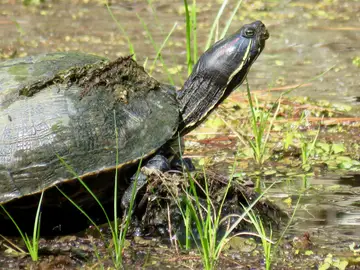
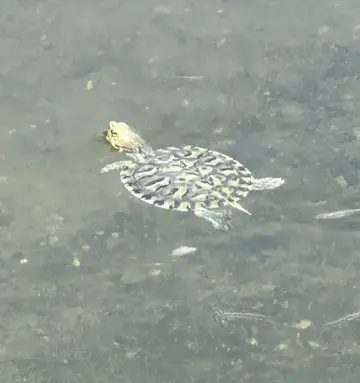
Size: Adult upper shell 5 to 8 inches, occasionally to 12; females larger than males. Missouri Department of Conservation
Colors: Upper shell olive brown with black and yellow lines; skin dark green with narrow yellow and black lines; lower shell yellow, usually with a large dark blotch on each scute. Pattern: Broad red or orange (rarely yellow) stripe behind each eye.
Key features
- Red 'ear' stripe on each side of the head Missouri Department of Conservation
- Old individuals can turn dark (melanism, associated with old males), hiding the yellow stripes and the red stripe Missouri Department of Conservation
- Slides off logs and rocks into the water when startled Texas Parks and Wildlife Department
Young
Younger individuals have numerous dark, eyelike spots on the yellow lower shell (USGS).
Animals mistaken for the red-eared slider
Red-eared Slider or Yellow-bellied Slider?
Red-eared Slider
Yellow-bellied Slider Trachemys scripta scripta
No red 'ear' stripe; mostly yellow lower shell with black spots along the edges. Missouri Department of Conservation
Not stated by the sources checked.
Red-eared Slider or Eastern River Cooter?
Red-eared Slider
Eastern River Cooter Pseudemys concinna
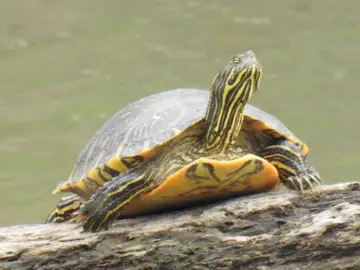
Missouri: yellow, usually Y-shaped mark behind each eye instead of a red stripe; lower shell normally yellow, either unmarked or with gray-brown markings along the scute seams (the slider has a large dark blotch on each scute). Missouri Department of Conservation
Not stated by the sources checked.
Red-eared Slider or Western Pond Turtle (California)?
Red-eared Slider
Western Pond Turtle (California) Actinemys marmorata
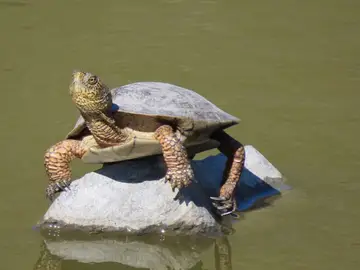
The native western pond turtle has a smooth-edged shell; the slider's outer shell scutes are serrated or slightly forked. California Department of Fish and Wildlife
Not stated by the sources checked.
Where the red-eared slider lives
- Native or listed
- Nonnative or not established
- No official record in our data
- 1–9
- 10–99
- 100–999
- 1,000+
State boundaries: U.S. Census Bureau, cartographic boundary file cb_2024_us_state_20m.
When it is active
Missouri: active from March (when air reaches 50°F) until mid-October; basks from midmorning to midafternoon on sunny days; overwinters underwater in mud. Missouri Department of Conservation
US open-licence records for the red-eared slider subspecies only (Trachemys scripta elegans) peak in March to July.
Habitat and habits
Habitat: Many aquatic habitats, preferring mud bottoms, plenty of aquatic plants and basking sites; rivers, sloughs, oxbow lakes, ditches, ponds and reservoirs. Missouri Department of Conservation
Behavior: Basks for hours on logs and rocks, sometimes stacked on each other; buries in mud for the winter.
Diet: Aquatic plants and animals; young eat more animal food, adults more plants.
Young: Missouri: eggs laid April to mid-July, mostly May and June; hatching in late summer or early autumn, young often stay in the nest until spring.
Legal status and reporting
Federal: Not listed under the Endangered Species Act (USFWS ECOS). US Fish and Wildlife Service
Invasive status: Native to the central US; invasive or introduced where released. California says it is listed among the world's 100 worst invasive species. California Department of Fish and Wildlife
Report: In California, report sightings to the CDFW Invasive Species Program online, by email to [email protected] or at (866) 440-9530. Elsewhere, USGS NAS has a 'Report a Sighting' link on its species profile for nonindigenous occurrences. California Department of Fish and Wildlife
Questions about the red-eared slider
Red eared slider
A medium-sized freshwater turtle with a wide red or orange stripe behind each eye, olive shell with yellow lines, and a yellow lower shell with dark blotches. Adults have a 5 to 8 inch shell. It is native to the central US and introduced in many other states.
Texas turtles red eared slider
Texas Parks and Wildlife calls red-eared sliders Texas's most common aquatic turtles. They are found in permanent, slow-moving water with mud bottoms in the eastern three quarters of the state, and are widely distributed except the far west.
Sources
- Trachemys scripta elegans (Red-eared Slider) Species Profile. U.S. Geological Survey, Nonindigenous Aquatic Species Database. Revision Date 7/17/2026; checked November 3, 2026.
Quoted passages (1)
“Younger individuals have numerous dark, eyelike spots on the yellow plastron”
- Reptiles and Amphibians (Healthy Pets, Healthy People). Centers for Disease Control and Prevention. archived copy, captured October 10, 2026; checked November 3, 2026.
- Red-eared Slider (Wildlife Fact Sheet). Texas Parks and Wildlife Department. undated page; checked November 3, 2026.
Quoted passages (2)
“These turtles get their name from a broad red stripe behind their eye and their habit of sliding off rocks and logs when startled.”
“Sliders are cold-blooded and spend hours sunning themselves on rocks and logs. If there are not enough rocks or logs for all of them they will often stack themselves one on top of the other! They bury themselves in loose soil or mud during the winter to escape the cold.”
- Red-Eared Slider (Field Guide). Missouri Department of Conservation. undated page; checked November 3, 2026.
Quoted passages (9)
“Adult upper shell length: 5–8 inches; occasionally to 12 inches. Adult females have larger shells than adult males.”
“A wide red or orange stripe is present on each side of the head behind the eye.”
“Old individuals sometimes have an excess of black pigment that obscures most of the yellow stripes on the shell and skin and the red stripe behind the eye. This condition is known as melanism and is associated with old males.”
“The red-eared slider occurs in a wide variety of aquatic habitats, but it prefers a mud bottom, plenty of aquatic plants, and abundant basking sites.”
“Young individuals often consume more animal foods, but as they age, their diet shifts to more plant foods.”
“Through most of Missouri, this turtle becomes active in March, when the air temperature reaches 50°F or higher, and it remains active until mid-October. … On sunny days, basking in the sun on logs or other objects projecting from the water begins in midmorning and generally lasts until midafternoon. … Individuals overwinter underwater buried in the mud or under a cut bank.”
“Egg-laying occurs between April and mid-July, with most eggs laid in May and June in Missouri. … Hatching usually takes place in late summer or early autumn, with incubation probably lasting some 68–70 days. Young turtles usually remain in the nest and emerge the following spring.”
“It lacks the red "ear" marking and somewhat resembles the eastern river cooter. The plastron is mostly yellow with black spots along the edges.”
“It is distinguished by a yellow, typically Y-shaped mark behind each eye, and by the lower shell, which is normally yellow; it may either lack dark markings completely or have gray-brown markings along the scute seams, especially toward the front.”
- California's Invaders: Red-Eared Slider. California Department of Fish and Wildlife (Invasive Species Program). undated page; checked November 3, 2026.
Quoted passages (4)
“Red-eared sliders are also vectors of disease and can transmit parasites to native animal species, as well as the bacteria Salmonella to humans. The sale and distribution of viable eggs and all small turtles (shell length less than 4 inches) was banned, excepting educational and research purposes, in the United States in 1975 after public health investigations showed that small turtles were a major source of human Salmonella infections.”
“Red-eared sliders have been introduced to many areas of the United States outside of their native range, as well as to other countries and are listed as one of the world's worst 100 invasive species.”
“…you may report your sighting to the CDFW Invasive Species Program online, by email to [email protected], or by calling (866) 440-9530.”
“Unlike the smooth-edged shell of California’s native western pond turtle (Actinemys marmorata), the marginal (outer carapace) scutes of red-eared sliders are serrated or slightly forked in appearance.”
- Aquatic Invasive Species Control Plan: Pond Slider. Pennsylvania Fish and Boat Commission. Updated July 2022; checked November 3, 2026.
- ECOS species report query (p16). U.S. Fish and Wildlife Service. live query 2026-11-03; checked November 3, 2026.
Quoted passages (1)
“Trachemys scripta elegans”
- GBIF.org occurrence records, human observations licensed CC0 1.0 or CC BY 4.0 only, accessed November 3, 2026. The datasets behind these counts are listed on our Sources page.
- State boundaries: U.S. Census Bureau, cartographic boundary file cb_2024_us_state_20m.