Greater roadrunner
Geococcyx californianus · also called Chaparral Bird, el corre caminos and el paisano · Last checked November 3, 2026.
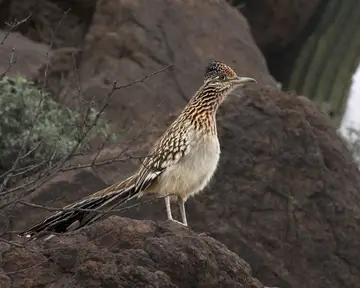
The greater roadrunner is a large, ground-running member of the cuckoo family, found across the southwestern United States into central Mexico, and it is the state bird of New Mexico. It is a predator of lizards, snakes, including occasional rattlesnakes, and other small animals. No official source checked makes a statement about danger to people. National Park Service
On this page
Is the greater roadrunner dangerous?
How to identify a greater roadrunner
A photo or description can narrow it down, but cannot confirm what an animal is or that it is safe. Look from a distance and do not handle wild animals.
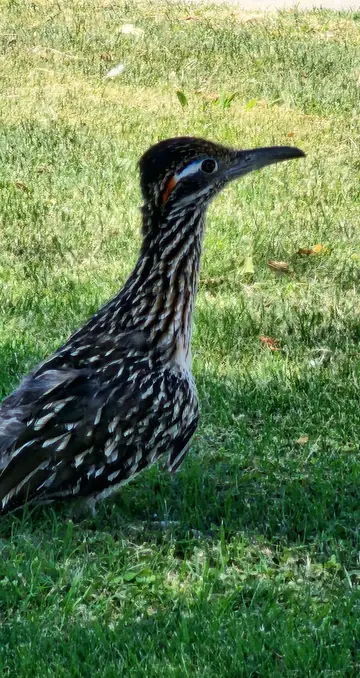
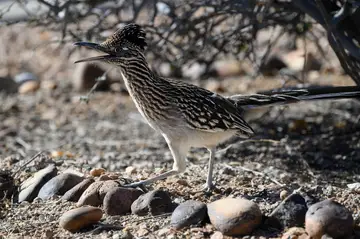

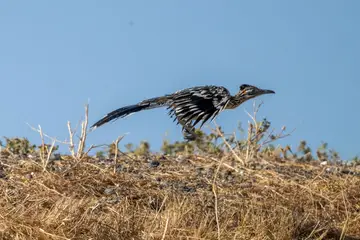
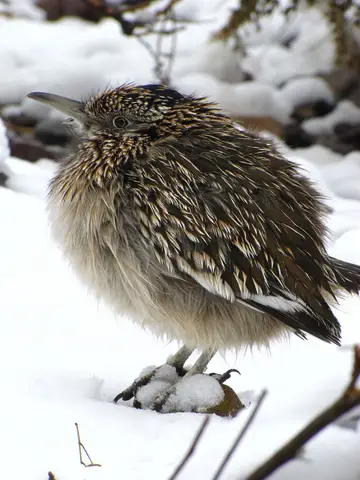
Size: Up to 23 inches long; a large one weighs about 1 1/2 pounds. Oklahoma gives 52 to 62 cm. National Park Service
Colors: Brown feathers with white streaks, white tail edging, red and blue skin patch around the eyes. Pattern: Streaked brown and pale, darker above than below.
Key features
- Shaggy crest that can be raised or lowered National Park Service
- Long tail; long, heavy, downcurved bill; X-shaped toes Missouri Department of Conservation
- Runs up to about 20 mph National Park Service
- Can fly short distances, but prefers to stay on the ground National Park Service
- Call is a descending series of coos Missouri Department of Conservation
Where the greater roadrunner lives
- Native or listed
- Nonnative or not established
- No official record in our data
- 1–9
- 10–99
- 100–999
- 1,000+
On our state guides
State boundaries: U.S. Census Bureau, cartographic boundary file cb_2024_us_state_20m.
When it is active
Rare permanent resident in southwestern Missouri (MDC). Oklahoma: on cool nights it lowers its body temperature and becomes lethargic, then warms itself in the morning sun. Missouri Department of Conservation
US open-licence records peak in January to May and August to September.
Habitat and habits
Habitat: Open country with little brush, often along roadsides; desert scrub, brushy areas and woodlands. Oklahoma Department of Wildlife Conservation
Behavior: Mostly on the ground; solitary for most of the year. Warms up on cool mornings using dark skin on its back.
Diet: About 90 percent animal matter (Oklahoma): lizards, snakes, rodents, insects, scorpions, spiders, small birds; the rest fruit and seeds.
Young: Clutches of two to six white eggs in low trees, shrubs or cacti; both parents incubate for about 18 to 20 days.
Legal status and reporting
Federal: Protected by the Migratory Bird Treaty Act: listed in 50 CFR 10.13 (List of Birds Protected by the Migratory Bird Treaty Act). US Fish and Wildlife Service regulation
Protection: Federally protected under the Migratory Bird Treaty Act (listed in 50 CFR 10.13). In Missouri a nongame species and a state species of conservation concern. Other state protections not established here. Missouri Department of Conservation
Sources
- Greater Roadrunner - White Sands National Park. National Park Service. updated August 21, 2020; checked November 3, 2026.
Quoted passages (6)
“Both grow up to 23 inches in length”
“The characteristic shaggy crest on their heads can be raised or lowered at will.”
“…roadrunners love to run and can reach speeds of up to 20 miles per hour.”
“They can fly for short distances but prefer to remain on the ground where they hunt for prey.”
“Throughout most of the year, roadrunners are solitary birds, only seeking out others during mating season.”
“Females lay one to two clutches per year, each clutch consisting of two to six white eggs.”
- Greater roadrunner (New Mexico Wildlife magazine). New Mexico Department of Game and Fish. Vol 59 #2, Summer 2016 edition listed on page; checked November 3, 2026.
- State Bird. New Mexico Secretary of State. undated page; checked November 3, 2026.
- Greater Roadrunner (Field Guide). Missouri Department of Conservation. undated page; checked November 3, 2026.
Quoted passages (4)
“…its long tail; long, heavy, downcurved bill; and four toes positioned like an X reflect this relationship.”
“The call is a descending series of ‘coos.’”
“Rare permanent resident in southwestern Missouri.”
“Nongame. Rare permanent resident in southwestern Missouri. The greater roadrunner is listed by the state as a species of conservation concern.”
- Greater Roadrunner (Field Guide). Oklahoma Department of Wildlife Conservation. undated page; checked November 3, 2026.
Quoted passages (2)
“Greater roadrunners prefer open country with little brush to slow them down.”
“A roadrunner's diet consists of about 90 percent animal matter; the remainder is fruit and seeds.”
- 50 CFR 10.13 - List of Migratory Birds. U.S. Fish and Wildlife Service regulation (eCFR, Office of the Federal Register). Title 50 up to date as of 10/30/2026; checked November 3, 2026.
Quoted passages (1)
“§ 10.13 List of Birds Protected by the Migratory Bird Treaty Act. … Greater Roadrunner Geococcyx californianus.”
- GBIF.org occurrence records, human observations licensed CC0 1.0 or CC BY 4.0 only, accessed November 3, 2026. The datasets behind these counts are listed on our Sources page.
- State boundaries: U.S. Census Bureau, cartographic boundary file cb_2024_us_state_20m.