Sea Nettle Jellyfish
Chrysaora (sea nettles): C. chesapeakei, C. quinquecirrha, C. fuscescens · also called sea nettle, bay nettle, Atlantic bay nettle and Atlantic sea nettle · Last checked November 3, 2026.
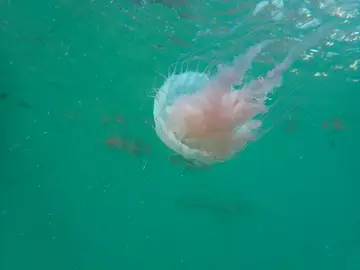
Sea nettles are stinging jellyfish with a white, pink or rust-colored bell and long tentacles, common in summer along US coasts. They are venomous and their sting is painful: South Carolina DNR rates it moderate to severe, and allergic reactions, though uncommon, can be serious. They live in the Chesapeake and other Atlantic estuaries, along the open Atlantic and Gulf coasts, and from central California to Washington. Chesapeake Bay Program
This page covers a genus (Chrysaora (sea nettles): C. chesapeakei, C. quinquecirrha, C. fuscescens), not a single species.
On this page
Is the sea nettle jellyfish dangerous?
South Carolina DNR: stings are moderate to severe. Exercise caution if sea nettles are seen, and do not swim if large numbers are present. South Carolina Department of Natural Resources
“Considered moderate to severe, sea nettle stings are similar to those of the lion’s mane.”
Bites and stings: It stings with its tentacles rather than biting. Detached tentacles can stick to skin and clothing and keep stinging.
If someone is bitten or stung, call 911 or Poison Help at 1-800-222-1222.
How to identify a sea nettle jellyfish
A photo or description can narrow it down, but cannot confirm what an animal is or that it is safe. Look from a distance and do not handle wild animals.
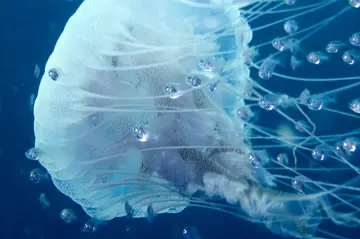

Size: Bell about 4 inches (Chesapeake); 4 to 6 inches (Alabama). Tentacles and arms can extend several feet. Chesapeake Bay Program
Colors: Milky white (Chesapeake); reddish-maroon markings in the southern Bay; sometimes pink, may be white (Alabama); triangles and tentacles clear to pink or rust (Texas coast). Pattern: Triangles radiate from the center of the bell.
Key features
- Twenty-four tentacles and four ribbon-like oral arms (Alabama); up to 24 tentacles (Chesapeake) Alabama Cooperative Extension System
- Bay nettles mature with 24 tentacles; open-coast nettles typically have 40 University of Maryland Center for Environmental Science
Young
Young develop from anemone-like polyps attached to hard surfaces, which release tiny floating medusae.
Animals mistaken for the sea nettle jellyfish
Sea Nettle Jellyfish or Lion's mane jellyfish?
Sea Nettle Jellyfish
Lion's mane jellyfish Cyanea capillata
Broad, flattened, usually orange-brown bell with eight clusters of short tentacles; common in the Bay in late November to March. Chesapeake Bay Program
It stings. South Carolina DNR describes sea nettle stings as similar to its stings.
Sea Nettle Jellyfish or Moon jellyfish?
Sea Nettle Jellyfish
Moon jellyfish Aurelia aurita (Chesapeake Bay Program); Aurelia marginalis (South Carolina DNR)
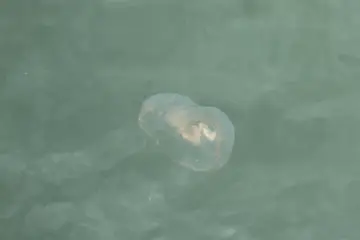
Hundreds of short tentacles like fringe on the bell's edge; South Carolina DNR says four pink 'horseshoes' show through a transparent bell. Chesapeake Bay Program
South Carolina DNR: only slightly venomous, with prickly sensations to mild burning.
Sea Nettle Jellyfish or Cannonball jellyfish?
Sea Nettle Jellyfish
Cannonball jellyfish Stomolophus meleagris
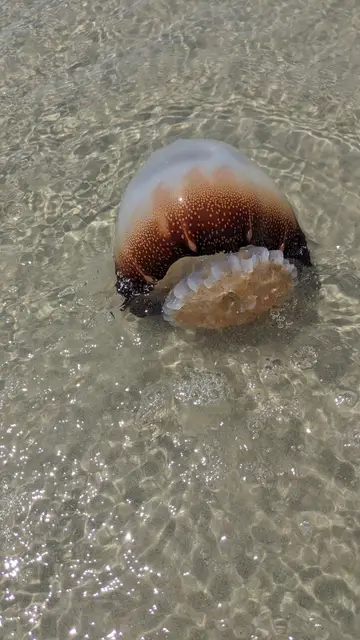
Very firm bell bordered with brown pigment, usually 8 to 10 inches across. Alabama Cooperative Extension System
Alabama Extension: reputed to be one of the least venomous.
Where the sea nettle jellyfish lives
- Native or listed
- Nonnative or not established
- No official record in our data
- 1–9
- 10–99
- 100–999
- 1,000+
State boundaries: U.S. Census Bureau, cartographic boundary file cb_2024_us_state_20m.
When it is active
Chesapeake: May to October (Chesapeake Bay Program) or about May to September (VIMS). Texas coast: common in summer. Delaware: toward the end of summer. Pacific: summer and fall. Chesapeake Bay Program
US open-licence records for the three US sea nettles named on this page (Chrysaora chesapeakei, C. quinquecirrha and C. fuscescens) peak in May and July to August.
Habitat and habits
Habitat: Brackish and salty waters, including shallows, open water and tidal rivers. Bay nettles keep to low salinity, with figures from 7 to 25 ppt by source. Chesapeake Bay Program
Behavior: Weak swimmers carried by wind and currents; they gather along windward shores or where a flood tide meets an obstacle.
Diet: Fish, shrimp, comb jellies and other small creatures.
Young: Spawn in mid-summer and then die. Larvae settle on firm surfaces and become polyps that overwinter and release new medusae by spring. New Jersey says bulkheads and floating docks give polyps habitat.
Questions about the sea nettle jellyfish
Sea nettle jellyfish
A stinging jellyfish with a white, pink or rust-colored bell, common in summer in US bays and coastal water. NOAA recognizes the bay nettle and the open-ocean sea nettle as separate species; the Pacific sea nettle is a third. South Carolina DNR rates stings as moderate to severe.
Jellyfish sting
For sea nettles, VIMS says stinging cells on the tentacles discharge venom, and detached tentacles can keep stinging. While uncommon, a sting can cause an allergic reaction with swelling and a restricted airway. Call 911 or Poison Help at 1-800-222-1222.
Jellyfish sting treatment
Call 911 or Poison Help at 1-800-222-1222. VIMS warns that jellyfish venoms differ by species, age, location and body part, so advice for one species may not fit another.
Sources
- Jellyfish (Chesapeake Bay Field Guide). Chesapeake Bay Program (EPA-led federal-state partnership). undated page; checked November 3, 2026.
Quoted passages (8)
“Sea nettles have a smooth, milky white bell that grows to about 4 inches in diameter.”
“The larvae blossom into anemone-like polyps that bud and grow over the winter.”
“Found throughout brackish and salty waters, including shallow waters, open waters and tidal rivers”
“Sea nettles and lion’s mane jellyfish prey upon fish, shrimp, comb jellies and other small creatures.”
“Sea nettles are abundant in May-October as far north as the Chesapeake Bay Bridge.”
“Sea nettles spawn in mid-summer. They die after spawning.”
“The lion’s mane jellyfish has a broad, flattened bell and eight clusters of short tentacles.”
“Hundreds of short tentacles hang like fringe from the bell’s edge.”
- Sea Science: Jellyfish. South Carolina Department of Natural Resources. undated page; checked November 3, 2026.
Quoted passages (1)
“Considered moderate to severe, sea nettle stings are similar to those of the lion’s mane.”
- Jellyfish Stings. Virginia Institute of Marine Science, William & Mary. undated page; checked November 3, 2026.
Quoted passages (1)
“…they often aggregate along windward shorelines or where a flood tide encounters an obstacle”
- New Jellyfish Species Discovered Hiding in Plain Sight. NOAA Fisheries. October 13, 2017; checked November 3, 2026.
- June 2026 Critter of the Month: Atlantic Bay Nettle. University of Maryland Center for Environmental Science. June 2026; checked November 3, 2026.
Quoted passages (1)
“…the Bay nettles seemed to mature with only 24 tentacles, compared to the 40 typical of their coastal counterparts”
- Final Biological Report: Final Rule to Revise the Critical Habitat Designation for Leatherback Sea Turtles. NOAA National Marine Fisheries Service. January 2012; checked November 3, 2026.
- Jellyfish in Alabama. Alabama Cooperative Extension System. published 2018-12-06; checked November 3, 2026.
Quoted passages (2)
“…has twenty-four tentacles and four ribbon-like oral arms”
“The bell is very firm, bordered with brown pigment, and usually 8 to 10 inches in diameter.”
- GBIF.org occurrence records, human observations licensed CC0 1.0 or CC BY 4.0 only, accessed November 3, 2026. The datasets behind these counts are listed on our Sources page.
- State boundaries: U.S. Census Bureau, cartographic boundary file cb_2024_us_state_20m.