Softshell Turtle
Apalone (US softshell turtles: A. spinifera, A. mutica, A. ferox) · also called Spiny Softshell, Eastern Spiny Softshell, Smooth Softshell and Midland Smooth Softshell · Last checked November 3, 2026.
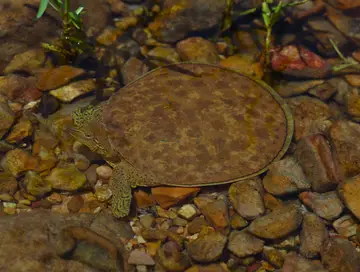

Softshell turtles are flat, pancake-like freshwater turtles with a leathery, flexible shell and a snorkel-like nose. US softshells include the widespread spiny softshell, the smooth softshell of larger rivers and the Florida softshell of the Southeast; some are introduced outside their native range. USGS says spiny and Florida softshells are difficult and dangerous to handle because of sharp claws and powerful jaws. Illinois Natural History Survey says spiny softshells readily bite and can deliver a painful wound, while smooth softshells are relatively nonaggressive. No official source checked states anything about venom. University of Georgia Savannah River Ecology Laboratory (SREL) Herpetology
This page covers a genus (Apalone (US softshell turtles: A. spinifera, A. mutica, A. ferox)), not a single species.
On this page
Is the softshell turtle dangerous?
USGS: spiny and Florida softshells are difficult and dangerous to handle because of sharp claws, sharp powerful jaws and a long neck, and are quick to defend themselves. Spiny softshell: readily bites and can deliver a painful wound (INHS). Smooth softshell: relatively nonaggressive (INHS). US Geological Survey, Nonindigenous Aquatic Species Database
“Apalone spinifera is difficult and dangerous to handle because of its sharp claws, sharp, powerful jaws and long protrusive neck; they are quick to defend themselves”
Bites and stings: Spiny softshells readily bite and can deliver a painful wound with sharp jaws hidden under fleshy lips (INHS); Illinois DNR says spiny softshells often bite when handled, smooth softshells do not.
How to identify a softshell turtle
A photo or description can narrow it down, but cannot confirm what an animal is or that it is safe. Look from a distance and do not handle wild animals.
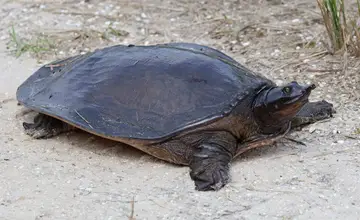

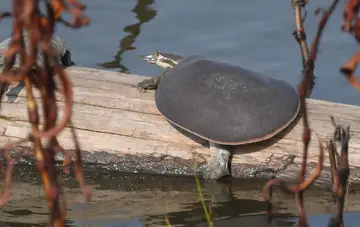
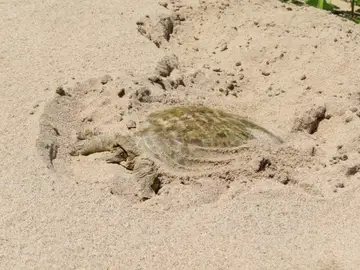
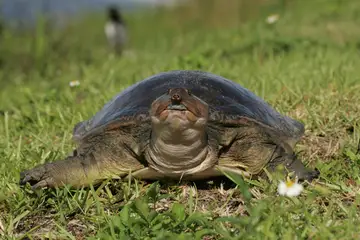

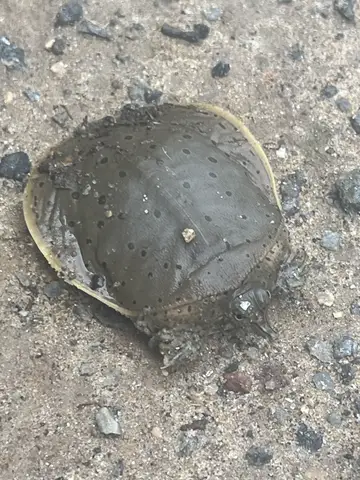
Size: Females are much larger than males. Spiny: shell up to 18 inches in females, 9 in males (SREL) or up to 38 cm (about 15 in) (INHS). Smooth: up to 28 cm (about 11 in) (INHS). Florida softshell: females 11 to 24 inches, males 6 to 12 (SREL). University of Georgia Savannah River Ecology Laboratory (SREL) Herpetology
Colors: Olive, brown or grayish shell, with dark spots in males and young (spiny); tan, brown or olive shell with small dark spots or dashes (smooth); dark brown to brownish-gray with dark spots (Florida). Pattern: Spotted (dark circles and spots in males and juveniles; larger blotches in females); light stripes on the head.
Key features
- Flat, leathery shell with flexible edges, "resembling a pancake" University of Georgia Savannah River Ecology Laboratory (SREL) Herpetology
- Snorkel-like nose University of Georgia Savannah River Ecology Laboratory (SREL) Herpetology
- Shell covered by skin instead of hard scutes Outdoor Alabama
Young
Florida softshell young show the dark bumps on the shell more clearly, as they are lighter in color than adults; spiny young have dark spots like males.
Animals mistaken for the softshell turtle
Softshell Turtle or Spiny vs Smooth Softshell?
Softshell Turtle
Spiny vs Smooth Softshell Apalone spinifera / Apalone mutica
Spiny softshells have small spines or bumps on the front edge of the shell and a ridge inside each nostril; smooth softshells have a smooth front edge and no nostril ridges (USGS: round nostrils, where other softshells have C-shaped ones). Illinois Natural History Survey, Prairie Research Institute, University of Illinois
USGS: spiny softshell is difficult and dangerous to handle. INHS: spiny readily bites; smooth relatively nonaggressive.
Softshell Turtle or Florida Softshell?
Softshell Turtle
Florida Softshell Apalone ferox
USGS: Florida softshells lack the spine-like projections on the front edge of the shell that spiny softshells have, and lack strongly patterned feet. In Georgia and South Carolina, SREL says they are best told apart by range (Florida softshells only in the Coastal Plain) and habitat (spiny in rivers and streams, Florida in ponds and wetlands). University of Georgia Savannah River Ecology Laboratory (SREL) Herpetology
USGS: difficult and dangerous to handle.
Where the softshell turtle lives
- Native or listed
- Nonnative or not established
- No official record in our data
- 1–9
- 10–99
- 100–999
- 1,000+
State boundaries: U.S. Census Bureau, cartographic boundary file cb_2024_us_state_20m.
When it is active
Spiny softshells are most active April through October (SREL, Georgia/South Carolina). Smooth softshells hibernate buried underwater in winter (Alabama). University of Georgia Savannah River Ecology Laboratory (SREL) Herpetology
US open-licence records for all US softshell turtles (genus Apalone) peak in March to July.
Habitat and habits
Habitat: Spiny: rivers and streams with muddy or sandy bottoms, also large lakes, reservoirs and ponds. Smooth: rivers and large streams with sand bars, unusual in lakes. Florida: lakes, streams, canals and roadside ditches. University of Georgia Savannah River Ecology Laboratory (SREL) Herpetology
Behavior: Often bury in mud or sand with only the head out and grab passing prey; bask on sandbars or logs.
Diet: Mainly carnivorous: fish, insects, crayfish and other aquatic animals; Florida softshells eat snails and fish and have been known to take ducks and small herons.
Young: Spiny: usually breed in May and lay 4 to 30 eggs on sunny sandbars or loose soil (SREL); Illinois females nest mid-May into July, averaging 18 round eggs, up to four clutches a year (INHS). Nests may be in people's yards (NCWRC).
Legal status and reporting
Federal: Not listed: ECOS shows spiny and smooth softshell as "Not Listed"; no ECOS record for Florida softshell. US Fish and Wildlife Service
Protection: Varies by state and species: Illinois Natural History Survey gives the smooth softshell's status as Endangered; New York and North Carolina list the eastern spiny softshell as Special Concern; Florida lists all three as Regulated Species (restrictions on collection or possession). Check the state agency.
Invasive status: Native over much of the US; introduced or invasive in some states: Louisiana lists the Florida softshell on its Invasive Species List (Tier 3); Arizona and California list the spiny softshell as introduced; USGS says it is also established outside its native range in Massachusetts, New Jersey, Nevada, Utah and Hawaii. Louisiana Department of Wildlife and Fisheries
Questions about the softshell turtle
Illinois softshell turtles
Illinois has two softshell turtles: the eastern spiny softshell, which remains common in most river systems, and the midland smooth softshell, which the Illinois Natural History Survey lists as Endangered and declining. Spiny softshells have small spines on the front edge of the shell and readily bite; smooth softshells lack the spines and are relatively nonaggressive.
Sources
- Spiny Softshell (Apalone spinifera). University of Georgia Savannah River Ecology Laboratory (SREL) Herpetology. undated page; checked November 3, 2026.
Quoted passages (9)
“This carapace can get up to 18″ long in females and only 9″ long in males”
“…the spiny softshell turtle has a flat, leathery shell with very flexible edges, ‘resembling a pancake’.”
“Apalone spinifera has a snorkel-like nose with 2 yellowish lines on the sides of its head.”
“Apalone spinifera are most common in rivers and streams with muddy or sandy bottoms, but are also found in large lakes and reservoirs.”
“These turtles are mainly carnivorous, eating almost anything living in the water that will fit into its mouth.”
“Softshells often bury themselves in the mud or sand where they sleep or wait for food to carelessly swim by.”
“Spiny softshell turtles are most active April through October.”
“They usually breed in May and lay 4 to 30 eggs on sunny sandbars or in loose soil.”
“Spiny Softshells resemble Florida Softshells and are best distinguished by range (Florida Softshells are only found in the Coastal Plain) and habitat (Spiny Softshells prefer rivers and streams while Florida Softshells are often found in ponds and wetlands).”
- Spiny Softshell Turtle (Field Guide to Amphibians and Reptiles of Illinois). Illinois Natural History Survey, Prairie Research Institute, University of Illinois. undated page; checked November 3, 2026.
- Smooth Softshell Turtle (Field Guide to Amphibians and Reptiles of Illinois). Illinois Natural History Survey, Prairie Research Institute, University of Illinois. undated page; checked November 3, 2026.
Quoted passages (1)
“Anterior edge of carapace lacking spines or tubercles; snout with rounded tip; nostrils lacking horizontal septal projections.”
- Florida Softshell (Apalone ferox). University of Georgia Savannah River Ecology Laboratory (SREL) Herpetology. undated page; checked November 3, 2026.
Quoted passages (1)
“In juveniles these dark bumps on the carapace are much more easily seen, as they are usually lighter in color than the adults.”
- Apalone ferox fact sheet. U.S. Geological Survey, Nonindigenous Aquatic Species Database. Revision Date 10/28/2009; checked November 3, 2026.
- Apalone spinifera fact sheet. U.S. Geological Survey, Nonindigenous Aquatic Species Database. Revision Date 6/12/2024; checked November 3, 2026.
Quoted passages (1)
“Apalone spinifera is difficult and dangerous to handle because of its sharp claws, sharp, powerful jaws and long protrusive neck; they are quick to defend themselves”
- Midland Smooth Softshell. Alabama Department of Conservation and Natural Resources (Outdoor Alabama). undated page; checked November 3, 2026.
Quoted passages (1)
“Carapaces are covered by skin instead of the hard scutes generally associated with many turtle species.”
- ECOS species report query (p32 taxa). U.S. Fish and Wildlife Service. live query 2026-11-03; checked November 3, 2026.
Quoted passages (1)
“{'value': 'Apalone spinifera', 'url': 'https://ecos.fws.gov/ecp/species/11261'}”
- 2025 Louisiana State Wildlife Action Plan. Louisiana Department of Wildlife and Fisheries. 2025 plan; checked November 3, 2026.
Quoted passages (1)
“Florida Softshell Apalone ferox”
- Know Your Illinois Turtles (OutdoorIllinois, May 2009). Illinois Department of Natural Resources. May 2009; checked November 3, 2026.
- GBIF.org occurrence records, human observations licensed CC0 1.0 or CC BY 4.0 only, accessed November 3, 2026. The datasets behind these counts are listed on our Sources page.
- State boundaries: U.S. Census Bureau, cartographic boundary file cb_2024_us_state_20m.