Spotted salamander
Ambystoma maculatum · also called Yellow-spotted salamander · Last checked November 3, 2026.
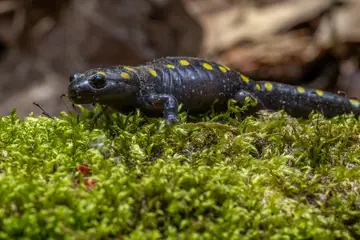

The spotted salamander is a large, stout salamander, usually 6 to 9 inches long, black or dark gray with two uneven rows of round yellow or orange spots. It lives in damp hardwood forests across the eastern United States, spending most of its life underground, and is seen mostly on rainy late-winter and spring nights when adults move to shallow woodland pools to breed. On danger, Virginia's wildlife agency says it can release a milky secretion from its neck and back that is toxic if eaten and mildly irritates skin; the official sources checked give no other danger statement. Virginia Department of Wildlife Resources
On this page
Is the spotted salamander dangerous?
Virginia DWR: to protect itself from predators it can secrete an off-white milky substance from its neck and back that is toxic when consumed and a mild skin irritant. Virginia Department of Wildlife Resources
“…it can also secrete an off-white milky substance from its neck and back that is toxic when consumed and a mild skin irritant.”
No official source we use states whether this animal is venomous. That does not mean it is harmless: do not handle it.
How to identify a spotted salamander
A photo or description can narrow it down, but cannot confirm what an animal is or that it is safe. Look from a distance and do not handle wild animals.
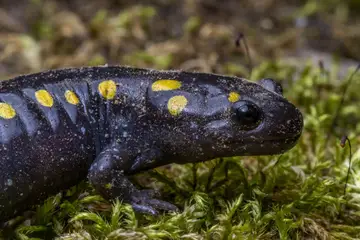

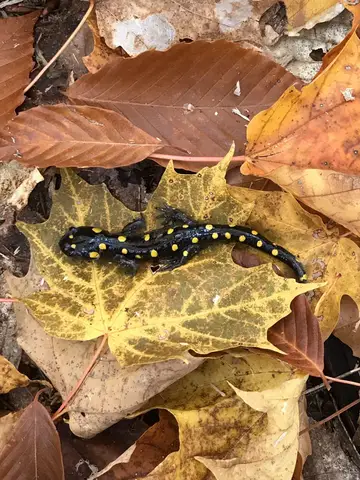
Size: Adults about 6 to 9 inches long (Ohio: 6 to 7¾ in.; Missouri: 4½ to 7¾ in., occasionally 10 in.; NCWRC: up to 9 in.).
Colors: Slate black body with a dark gray belly; small white flecks on the sides; back black, gray or brown; belly gray. Pattern: Two irregular rows of round yellow spots from head to tail; spots on the head may be orange. Some individuals have few or no spots.
Key features
- Large, chunky salamander with two irregular rows of yellow or greenish-yellow spots. Ohio Department of Natural Resources, Division of Wildlife
- 11 to 13 rib-like grooves along each side. Missouri Department of Conservation
Young
Larvae live in water; they are greenish-gray with fewer spots and a plain underside.
Animals mistaken for the spotted salamander
Spotted salamander or Tiger salamander?
Spotted salamander
Tiger salamander Ambystoma tigrinum
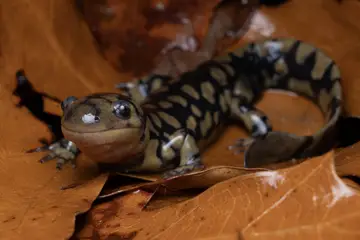
The larger tiger salamander has many irregular yellowish spots and blotches that extend onto the sides and belly. Michigan State University Cooperative Extension Service / MSU Museum
Spotted salamander or Blue-spotted salamander?
Spotted salamander
Blue-spotted salamander Ambystoma laterale
Newly transformed blue-spotted salamanders may have small yellow spots on the sides and belly, while very small spotted salamanders usually have plain grayish or brownish bellies. Michigan State University Cooperative Extension Service / MSU Museum
Where the spotted salamander lives
- Native or listed
- Nonnative or not established
- No official record in our data
- 1–9
- 10–99
- 100–999
- 1,000+
State boundaries: U.S. Census Bureau, cartographic boundary file cb_2024_us_state_20m.
When it is active
Active at night. Seen mostly in late winter and early spring, when warm rains bring adults out to breeding ponds (Missouri: late February to mid-March; Virginia: breeding March to May); people often see them crossing roads on warm, rainy nights.
US open-licence records peak in March to April.
Habitat and habits
Habitat: Damp hardwood forests near shallow ponds, usually hidden under logs, rocks or leaf piles or in small-mammal burrows. Breeds in shallow, often temporary, fishless woodland pools.
Behavior: Spends most of its life underground and is rarely seen except during breeding; can drop its tail and regrow it when attacked.
Diet: Adults eat worms, insects, spiders and land snails; larvae eat small invertebrates and may eat each other.
Young: Breeds in shallow, fishless woodland pools in late winter to spring; females attach jelly-covered egg masses to submerged sticks or plants, often with algae growing inside that supplies oxygen. Larvae hatch in about 4 to 6 weeks and most leave the pond by early September. Adults can live about two decades.
Legal status and reporting
Protection: Minnesota lists it as a species of special concern; Vermont lists it as a Species of Greatest Conservation Need; Mississippi lists it as nongame wildlife in need of management. SREL says it is common and not protected in South Carolina and Georgia.
Sources
- Spotted Salamander (VDWR Species Profile). Virginia Department of Wildlife Resources. updated June 25, 2024; checked November 3, 2026.
Quoted passages (1)
“…it can also secrete an off-white milky substance from its neck and back that is toxic when consumed and a mild skin irritant.”
- Spotted Salamander (MDC Field Guide). Missouri Department of Conservation. undated page; checked November 3, 2026.
Quoted passages (1)
“There are 11–13 riblike costal grooves along the side.”
- Amphibians of Ohio Field Guide (Publication 5348). Ohio Department of Natural Resources, Division of Wildlife. PUBLICATION 5348; checked November 3, 2026.
Quoted passages (1)
“This large, chunky salamander has two irregular rows of yellow or greenish-yellow spots.”
- Spotted Salamander (Ambystoma maculatum). University of Georgia Savannah River Ecology Laboratory (Herps of SC/GA). undated page; checked November 3, 2026.
- Spotted Salamander (NCWRC species page). N.C. Wildlife Resources Commission. undated page; checked November 3, 2026.
Quoted passages (1)
“…larvae are greenish-gray with fewer spots and a plain underside.”
- Michigan Frogs, Toads, and Salamanders: A Field Guide and Pocket Reference (MSU Extension Bulletin E-2350). Michigan State University Cooperative Extension Service / MSU Museum. FIRST EDITION 1992; checked November 3, 2026.
Quoted passages (2)
“The larger tiger s a l a m a n d e r (page 38) h a s numerous irregularly shaped yellowish spots and blotches which extend onto the sides and belly.”
“Newly transformed blue-spotted salamanders (page 22) may have small yellow spots on the sides and belly, while very small spotted salamanders usually have unspotted grayish or brownish bellies.”
- GBIF.org occurrence records, human observations licensed CC0 1.0 or CC BY 4.0 only, accessed November 3, 2026. The datasets behind these counts are listed on our Sources page.
- State boundaries: U.S. Census Bureau, cartographic boundary file cb_2024_us_state_20m.