Stingray
Dasyatidae (whiptail stingrays) and Urotrygonidae (round stingrays) · also called Atlantic stingray, southern stingray, yellow stingray and round stingray · Last checked November 3, 2026.
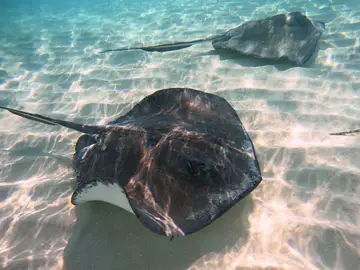

Stingrays are flat, bottom-dwelling rays with a venomous, serrated spine (barb) on the tail. They are not aggressive, but when stepped on they whip the tail and can cause a cut or puncture wound, and most stingray injuries need immediate medical attention. In the US they live in shallow coastal water off beaches and in bays and estuaries along the Atlantic, Gulf of America and Pacific coasts, including Florida, Texas, South Carolina, New York and California. FWC
This page covers a family (Dasyatidae (whiptail stingrays) and Urotrygonidae (round stingrays)), not a single species.
On this page
Is the stingray dangerous?
Non-aggressive and of little danger to people except for the defensive venomous barb near the base of the tail; most stingray injuries require immediate medical attention.
Bites and stings: Stingrays do not attack people; injuries come from the tail spine when a ray is stepped on or handled.
If someone is bitten or stung, call 911 or Poison Help at 1-800-222-1222.
How to identify a stingray
A photo or description can narrow it down, but cannot confirm what an animal is or that it is safe. Look from a distance and do not handle wild animals.
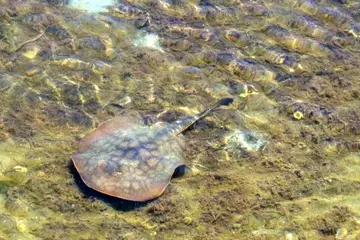
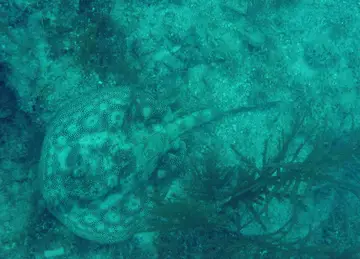
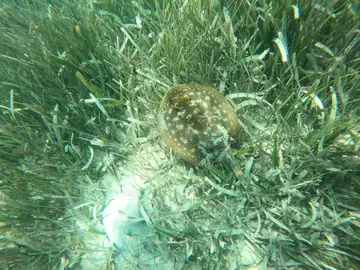
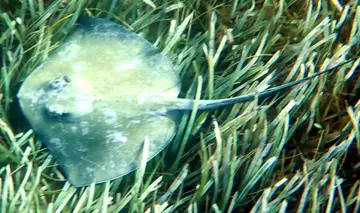
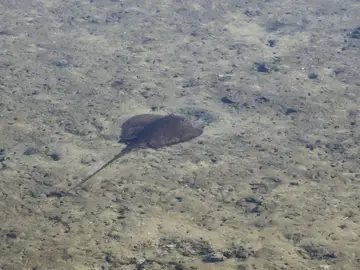
Size: Varies by species. Example: the round stingray (California) averages a 3 to 10 inch disc width and reaches about 22.8 inches total length. Florida Museum of Natural History
Colors: Atlantic stingray: brownish to yellowish brown on top, whitish below; southern stingray: brownish on top, whitish below; yellow stingray: yellowish with darker vermiculations or spots on top, whitish below; round stingray: grayish brown, plain, mottled or spotted on top; pale yellow, orange or white below. Pattern: Plain, mottled or spotted (varies by species).
Key features
- Flat, disc-shaped body with the pectoral fins joined to the head; tapered or whip-like tail, often with venomous spines SCDNR Marine Resources Division
- Atlantic and southern stingrays: spine near the base of a long whip-like tail FWC
- Round stingray: has a true rounded tail fin, and its spine sits about halfway down the tail. Yellow stingray: stout tail with a well-developed rounded tail fin, and the venomous spine sits just in front of the tail fin.
Young
Born live (1 to 4 pups per litter in the Atlantic stingray; up to 7 in the southern stingray); newborn round stingrays measure about 2.5 to 3.1 inches across.
Animals mistaken for the stingray
Stingray or Bat ray?
Stingray
Bat ray Myliobatis californica
Wide, angular disc with wing-like tips, dark brown to black on top, a whip-like tail twice the body length and a distinctly protruding head. Florida Museum of Natural History
Also has a venomous spine at the base of the tail (Florida Museum).
Stingray or Pacific electric ray?
Stingray
Pacific electric ray Torpedo californica
Two dorsal fins and no venomous spine on the tail. Florida Museum of Natural History
Can give an electric shock: Florida Museum says divers are warned to avoid contact with the ray, as the shock (45 volts or more) is powerful enough to knock down an adult human.
Stingray or Atlantic angel shark?
Stingray
Atlantic angel shark Squatina dumeril
A shark with a very flattened body; unlike rays, its pectoral fins are not joined to the head. SCDNR Marine Resources Division
SCDNR: only dangerous if accidentally stepped on. Protected in South Carolina and federal waters.
Where the stingray lives
- Native or listed
- Nonnative or not established
- No official record in our data
- 1–9
- 10–99
- 100–999
- 1,000+
State boundaries: U.S. Census Bureau, cartographic boundary file cb_2024_us_state_20m.
When it is active
Round stingray: feeds throughout daylight hours. Florida Museum of Natural History
US open-licence records for all whiptail and round stingrays (families Dasyatidae and Urotrygonidae) peak in May to October.
Habitat and habits
Habitat: Coastal waters including ocean beaches, bays, estuaries and lagoons, usually over sand or mud; the Atlantic stingray can enter Florida freshwater rivers.
Behavior: Often lies still on the bottom, partly buried; seen alone, in pairs or in groups.
Diet: Bottom-dwelling invertebrates such as marine worms, clams, shrimp and crabs, and sometimes small fishes.
Young: Live-bearing (aplacental viviparity); litters of 1 to 4 (Atlantic) or up to 7 (southern) pups.
Questions about the stingray
Stingray sting
Stingrays sting only in defense, usually when stepped on or handled; the venomous barb can cause a painful cut or puncture wound. FWC says most stingray injuries need immediate medical attention: call 911 or Poison Help 1-800-222-1222. Shuffling your feet in shallow water lowers the chance of stepping on one.
Stingray barb
The barb is a sharp, serrated, venomous spine on the tail, used for self-defense. It sits near the base of the tail in Atlantic and southern stingrays, about halfway down the tail in the round stingray, and just in front of the tail fin in the yellow stingray. Pieces of it can stay in a wound.
Sources
- Atlantic Stingray (FWRI ray species). Florida Fish and Wildlife Conservation Commission (FWC). archived copy, captured January 21, 2026; checked November 3, 2026. Archived copy.
Quoted passages (2)
“Spine near base of long whip like tail.”
“Feeds on benthic invertebrates, marine worms, small crustaceans, shrimp, crabs, mollusks, and sometimes small fishes.”
- Ray Species (FWRI). Florida Fish and Wildlife Conservation Commission (FWC). archived copy, captured May 12, 2026; checked November 3, 2026. Archived copy.
- Safety - Padre Island National Seashore. National Park Service. updated March 4, 2026; checked November 3, 2026.
- Round Stingray - Discover Fishes species profile. Florida Museum of Natural History (University of Florida). February 12, 2025; checked November 3, 2026.
Quoted passages (3)
“The average disc width of the round stingray is 3-10 inches (8-25 cm).”
“Feeding occurs continuously throughout daylight hours.”
“…the Pacific electric ray (Torpedo californica) can be distinguished by its two dorsal fins and lack of a venomous spine on the tail.”
- Sharks of South Carolina. SCDNR Marine Resources Division (C. H. Farmer III). 2004; checked November 3, 2026.
Quoted passages (2)
“The skates and rays have pectoral fins that are connected to the head (not separated) and a more tapered, or even whip-like tail, often with venomous spines.”
“A dramatically flattened body and eyes located on the top of the head immediately separate this species from all other sharks. The skates and rays have pectoral fins that are connected to the head (not separated) … head separated from pectoral fins”
- Species of Greatest Conservation Need status assessments: Sharks, Skates, and Rays. New York State Department of Environmental Conservation. file hpsgcnsharskat.pdf, 2015 SWAP cycle; checked November 3, 2026.
- Bat Ray - Discover Fishes species profile. Florida Museum of Natural History (University of Florida). February 6, 2025; checked November 3, 2026.
Quoted passages (1)
“The bat ray is named for the wide, angular shape of its pectoral disc, with trailing ‘wing’ tips and dark brown to black coloring on top. It has a whip-like tail twice the length of its body, with a venomous spine at the base, and distinctly protruding head and large eyes.”
- Southern Stingray (FWRI ray species). Florida Fish and Wildlife Conservation Commission (FWC). archived copy, captured March 12, 2026; checked November 3, 2026. Archived copy.
- Yellow Stingray (FWRI ray species). Florida Fish and Wildlife Conservation Commission (FWC). archived copy, captured March 9, 2026; checked November 3, 2026. Archived copy.
- GBIF.org occurrence records, human observations licensed CC0 1.0 or CC BY 4.0 only, accessed November 3, 2026. The datasets behind these counts are listed on our Sources page.
- State boundaries: U.S. Census Bureau, cartographic boundary file cb_2024_us_state_20m.