Whiptail Lizard
Aspidoscelis · also called whiptail, racerunner (some species), tiger whiptail and western whiptail · Last checked November 3, 2026.
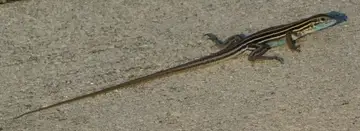
Whiptails are slim, fast, long-tailed lizards, mostly in the genus Aspidoscelis. They live mainly in the western and southwestern US, including Arizona, New Mexico, Texas, California, Colorado, Utah, Nevada, Oregon, Idaho and Oklahoma, and two introduced kinds live in Florida. No official source checked states directly whether whiptails are venomous or dangerous. The National Park Service says the Gila monster is perhaps the only venomous lizard in the US. Many whiptail species are all female. Arizona Game and Fish Department
This page covers a genus (Aspidoscelis), not a single species.
On this page
Is the whiptail lizard dangerous?
No official source we use states whether this animal is venomous. That does not mean it is harmless: do not handle it.
How to identify a whiptail lizard
A photo or description can narrow it down, but cannot confirm what an animal is or that it is safe. Look from a distance and do not handle wild animals.
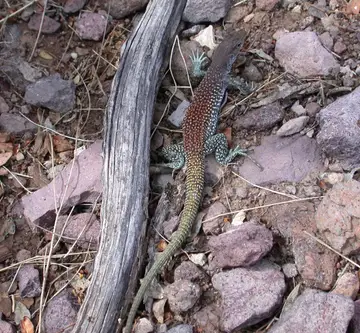
Size: Varies by species. Tiger whiptail: up to 4.3 inches from snout to vent in Arizona and 12.2 inches total length in Colorado. Plateau striped: up to 28 cm total. Florida's giant whiptail: males up to 33 cm. Arizona Game and Fish Department
Colors: Tiger whiptail: orange-brown to gray-brown. Red-backed whiptail: burgundy-brown with an orange tint on the lower back. Pattern: Depending on species: stripes, spots, checkers or dark marbling.
Key features
- Slim body, long thin tail and slim pointed snout. Arizona Game and Fish Department
- Tiny granular back scales, with large rectangular belly scales. Arizona Game and Fish Department
- Very long tail: at Organ Pipe, as long as the body. National Park Service
- Can drop the tail, which keeps twitching to distract predators. Colorado Parks and Wildlife
Young
Young tiger whiptails have distinct stripes, spots and a bright blue tail. Colorado also reports blue tails on hatchlings of the plateau striped whiptail.
Animals mistaken for the whiptail lizard
Whiptail Lizard or Red-backed whiptail vs tiger whiptail?
Whiptail Lizard
Red-backed whiptail vs tiger whiptail Aspidoscelis xanthonota
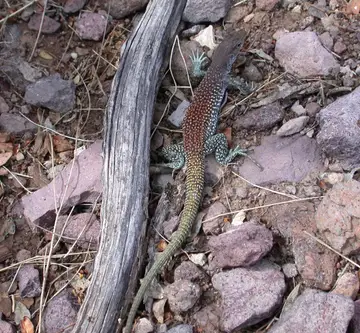
The red-backed is larger, with bright orange on the lower back and no dark marks on the sides and chest. Arizona Game and Fish Department
Whiptail Lizard or Six-lined racerunner?
Whiptail Lizard
Six-lined racerunner Aspidoscelis sexlineata
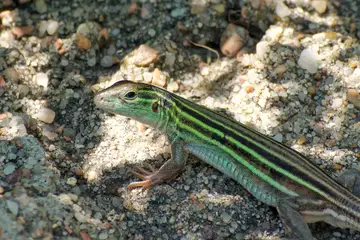
Colorado's key separates the striped forms by range: plateau striped whiptail on the western slope, six-lined racerunner on the eastern slope. Colorado Parks and Wildlife
Michigan and Wisconsin describe their lizards, including this one, as harmless.
Whiptail Lizard or Colorado checkered whiptail vs common checkered whiptail?
Whiptail Lizard
Colorado checkered whiptail vs common checkered whiptail Aspidoscelis neotesselatus / A. tesselata
Colorado says these two are difficult to tell apart. Colorado Parks and Wildlife
Where the whiptail lizard lives
- Native or listed
- Nonnative or not established
- No official record in our data
- 1–9
- 10–99
- 100–999
- 1,000+
State boundaries: U.S. Census Bureau, cartographic boundary file cb_2024_us_state_20m.
When it is active
Tiger whiptail in Arizona: active by day and hibernates in the cold months. Young emerge around March and stay active through October; adults are active about a month less at each end. Arizona Game and Fish Department
US open-licence records for all whiptails (genus Aspidoscelis) peak in April to July.
Habitat and habits
Habitat: Mostly warm, open and dry places. Tiger whiptail: desert scrub, grassland and chaparral in Arizona, and lowland river valleys in Colorado. Western whiptail in Oregon: flat, sandy areas and dry washes. Plateau striped whiptail: pinyon-juniper woodland, sagebrush and riparian areas. Arizona Game and Fish Department
Behavior: Alert, fast ground-dwellers that forage actively by day. Wary and difficult to approach.
Diet: Insects and other small invertebrates, including termites, beetles, grasshoppers and spiders. Oregon also reports scorpions and other lizards.
Young: Lays eggs. Many species are all female, and their unfertilized eggs hatch into clones of the mother. Others, such as the tiger whiptail, have both sexes.
Legal status and reporting
Federal: No ESA listing found for the US whiptails covered here. A live FWS ECOS query (Aspidoscelis and Cnemidophorus, 2026-11-03) lists the Arizona striped whiptail as "Not Listed", the checkered whiptail as "Resolved Taxon", and the orange-throated, Belding's orange-throated, canyon spotted, coastal western and gray-checkered whiptails as "Species of Concern" (an informal category; BISON-M calls it no longer maintained). The only Endangered entry is the Maria Island ground lizard (Cnemidophorus vanzoi); no official source checked places it in the US. ECOS
Protection: Rules vary by state. Colorado requires a license to collect or possess herps on its list, and Nevada sets take and possession limits for the Great Basin whiptail. Idaho lists the tiger whiptail as Protected Nongame. Check your state wildlife agency. Colorado Parks and Wildlife
Invasive status: Florida: the giant whiptail and rainbow whiptail are nonnative and established (FWC, 2019). Hawaii lists all whiptails and tegus as injurious wildlife. Florida Fish and Wildlife Conservation Commission
Report: No reporting program for native whiptails was found. In Florida, FWC prefers reports of lower-priority nonnative species, such as small nonnative lizards, through the free IveGot1 app or the web form at IveGot1.org; the FWC Invasive Species Hotline, 888-Ive-Got1 (483-4681), also takes reports of nonnative animals. FWC
Questions about the whiptail lizard
Whiptail lizard
A slim, fast, long-tailed lizard of the western and southwestern US, with introduced kinds in Florida. Most whiptail species are all female and reproduce without males, according to the National Park Service. No official source checked says directly whether whiptails are venomous; NPS says the Gila monster is perhaps the only venomous lizard in the US.
Sources
- Online Field Guide species account: Tiger Whiptail (Aspidoscelis tigris). Arizona Game and Fish Department. 2023; checked November 3, 2026.
Quoted passages (8)
“A medium-sized (up to 110 mm or 4.3″ from snout to vent)”
“…with a long, thin tail, and a slim, pointed snout”
“The scales on the body are small and granular.”
“Juveniles have a plain pale underside, distinct stripes, spots on the body and limbs, and a bright blue tail.”
“Primarily an inhabitant of Arizona's desertscrub communities”
“This is an alert, fast-moving, ground-dweller that actively forages during the day.”
“It hibernates during the cold months of fall and winter.”
“The similar looking Red-backed Whiptail is larger, has bright orange coloration on the lower back, and lacks dark markings on the sides and chest.”
- BISON-M (Biota Information System of New Mexico) species search export: taxonomic name "Squamata". New Mexico Department of Wildlife (BISON-M, with Natural Heritage New Mexico). database queried November 3, 2026; checked November 3, 2026.
- Herps of Texas: Lizards of Texas. Herps of Texas, Biodiversity Collections, Dept. of Integrative Biology, The University of Texas at Austin. 2020-04-28 (archive capture date; checked November 3, 2026.
- Complete List of Amphibian, Reptile, Bird and Mammal Species in California. California Department of Fish and Wildlife (CWHR Program). 2016-05 (document dated "May, 2016"; checked November 3, 2026.
- Species Profile List, filtered to Type = Reptile. Colorado Parks and Wildlife. species-profiles page modified 2026-04-09; checked November 3, 2026.
- Species tables for Utah's reptiles and amphibians. Utah Division of Wildlife Resources (DWR). page "Last updated: April 22, 2026"; checked November 3, 2026.
- Commission Regulation 24-15: 2025 & 2026 Seasons & Limits for Noncommercial Collection of Live, Unprotected Reptiles & Amphibians. Nevada Board of Wildlife Commissioners / Nevada Department of Wildlife. Commission Regulation 24-15, 2025 & 2026 seasons; checked November 3, 2026.
- Western whiptail (ODFW Wildlife Viewing). Oregon Department of Fish and Wildlife. undated page; checked November 3, 2026.
- Checklist of Oklahoma Amphibians and Reptiles. Sam Noble Oklahoma Museum of Natural History (SNOMNH) Herpetology, hosted by the Oklahoma Biological Survey, University of Oklahoma. PDF created 2014-09-09, modified 2016-06-06; checked November 3, 2026.
- Checklist of Florida's Amphibians and Reptiles (Revised 2023). Florida Fish and Wildlife Conservation Commission (FWC). Revised 2023; checked November 3, 2026.
- Lizards (Organ Pipe Cactus National Monument). National Park Service. updated September 2, 2023; checked November 3, 2026.
Quoted passages (2)
“…with tails as long as their bodies”
“Whiptails are insectivores”
- Lizards (Saguaro National Park). National Park Service. updated May 5, 2025; checked November 3, 2026.
Quoted passages (1)
“Most whiptails reproduce through parthenogenesis (asexual reproduction)”
- Aspidoscelis tigris (Tiger Whiptail) | Idaho Fish and Game Species Catalog. Idaho Department of Fish and Game. archived copy, captured June 20, 2025; checked November 3, 2026.
- Species profile: Tiger Whiptail. Colorado Parks and Wildlife. undated page; checked November 3, 2026.
Quoted passages (2)
“…they can drop their tail, which continues to twitch and wriggle, in order to distract predators”
“You need a license from CPW to collect or possess any of the animals on the W-7, Appendix C.”
- ECOS species report queries (genus-wide). U.S. Fish and Wildlife Service (ECOS). live query 2026-11-03; checked November 3, 2026.
- Whiptails and Wall Lizards. Florida Fish and Wildlife Conservation Commission. archived copy, captured July 15, 2019; checked November 3, 2026.
Quoted passages (1)
“Nonnative Whiptails and Wall Lizards”
- Report Nonnative Species. Florida Fish and Wildlife Conservation Commission (FWC). archived copy, captured October 25, 2026; checked November 3, 2026.
Quoted passages (1)
“Reporting nonnatives using the IveGot1 app or the IveGot1 website is preferred for lower priority species, such as small nonnative lizards and iguanas.”
- Quick Key to Amphibians and Reptiles of Colorado. Colorado Parks and Wildlife. archived copy, captured October 11, 2023; checked November 3, 2026.
Quoted passages (1)
“Found on western slope Plateau Striped Whiptail Found on eastern slope Six-lined Racerunner”
- Species profile: Common Checkered Whiptail. Colorado Parks and Wildlife. undated page; checked November 3, 2026.
Quoted passages (1)
“Difficult to distinguish from Colorado Checkered Whiptail”
- GBIF.org occurrence records, human observations licensed CC0 1.0 or CC BY 4.0 only, accessed November 3, 2026. The datasets behind these counts are listed on our Sources page.
- State boundaries: U.S. Census Bureau, cartographic boundary file cb_2024_us_state_20m.