Zebra mussel
Dreissena polymorpha · Last checked November 3, 2026.
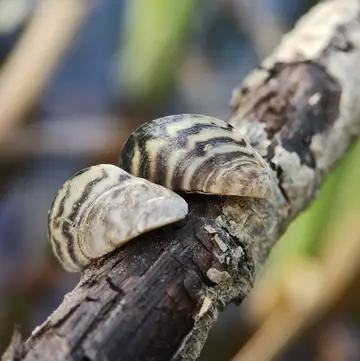
The zebra mussel is a small, fingernail-sized freshwater mussel with a striped, D-shaped shell, native to the Black and Caspian Sea region and invasive in the US since the late 1980s. It is not described by official sources as venomous or as a biting animal; the danger official sources name for people is that swimmers and pets can cut their feet on mussels attached to rocks, docks, swim rafts and ladders. USGS records it in more than 30 states, established in all the Great Lakes and the large navigable rivers of the eastern US, and spreading west and south (for example Texas lakes). It is federally listed as injurious wildlife. Missouri Department of Conservation
On this page
Is the zebra mussel dangerous?
Minnesota DNR: swimmers and pets can cut their feet on zebra mussels attached to rocks, docks, swim rafts and ladders. Minnesota Department of Natural Resources
“Swimmers and pets can cut their feet on zebra mussels attached to rocks, docks, swim rafts and ladders.”
Bites and stings: No bite. The official hazard to people is sharp shells: cut feet.
No official source we use states whether this animal is venomous. That does not mean it is harmless: do not handle it.
How to identify a zebra mussel
A photo or description can narrow it down, but cannot confirm what an animal is or that it is safe. Look from a distance and do not handle wild animals.
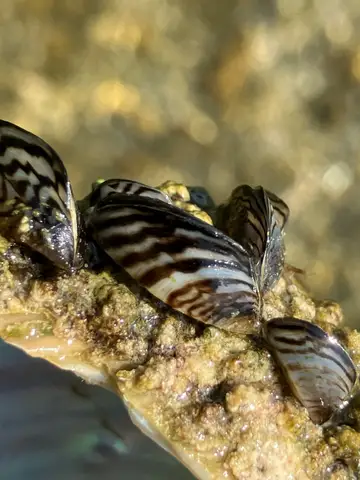
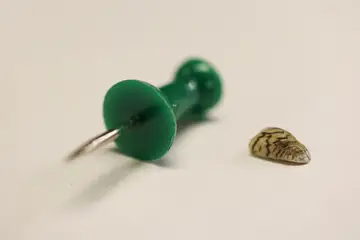

Size: Adults about 1/4 to 1 inch (Missouri) or 1/4 to 1 1/2 inches (Minnesota); USGS: adults under 5 cm, typically 3 cm. Larvae (veligers) are microscopic. Missouri Department of Conservation
Colors: alternating yellow and brownish stripes; some shells are all dark or all light with no stripes. Pattern: alternating light and dark bands (zebra stripes).
Key features
- thin, elongated triangular, inflated shell with a sharp angled ridge Missouri Department of Conservation
- attaches to hard surfaces with threads (byssal threads), often in dense clumps Missouri Department of Conservation
- sits stable on its flat underside; a quagga mussel tips over NAS
- D-shaped, fingernail-sized Minnesota Department of Natural Resources
Young
Larvae (veligers) are microscopic and free-swimming; after about three weeks they settle and attach.
Animals mistaken for the zebra mussel
Zebra mussel or Quagga mussel?
Zebra mussel
Quagga mussel Dreissena rostriformis bugensis
Quagga mussels are more rounded, less angular and usually paler near the hinge; placed on a flat surface a quagga tips over while a zebra mussel sits flat. Genetic testing is sometimes needed. Missouri Department of Conservation
Also invasive (Missouri: another nonnative invasive species); same genus Dreissena covered by the federal injurious listing.
Zebra mussel or Asian clam?
Zebra mussel
Asian clam Corbicula fluminea
Minnesota DNR lists Asian clam (invasive) as a zebra mussel look-alike; no official description of how to tell them apart was archived here. Minnesota Department of Natural Resources
Invasive (Minnesota DNR).
Zebra mussel or Native freshwater mussels?
Zebra mussel
Native freshwater mussels Unionidae
Minnesota DNR lists native mussels as look-alikes. Zebra mussels are often found attached on top of native mussels, which they can kill. Minnesota Department of Natural Resources
Native species; not described as dangerous.
Where the zebra mussel lives
- Native or listed
- Nonnative or not established
- No official record in our data
- 1–9
- 10–99
- 100–999
- 1,000+
State boundaries: U.S. Census Bureau, cartographic boundary file cb_2024_us_state_20m.
When it is active
Spawning usually happens in spring or summer depending on water temperature; it may start at about 12°C (54°F). NAS
US open-licence records peak in April to August and October.
Habitat and habits
Habitat: Underwater in lakes, reservoirs and rivers, attached to rocks, wood, plants, native mussels, pipes, docks, boat lifts, swim rafts and moored boats. Minnesota Department of Natural Resources
Behavior: Attaches with byssal threads and forms dense colonies; adults can survive several days out of water and hitchhike on boats, while larvae survive in bilge water, livewells and bait buckets.
Diet: Filter feeder on plankton, mainly algae; one mussel filters about a quart (about a liter) of water a day.
Young: A female can release up to about a million eggs a year (Missouri; Minnesota says 100,000 to 500,000). Larvae drift for two to three weeks, then settle and attach; colonies reach tens of thousands per square yard. USGS gives a life span of 3 to 9 years.
Legal status and reporting
Federal: Listed as injurious wildlife under 50 CFR 16.13: importing or transporting live zebra mussels (genus Dreissena), their larvae or eggs is prohibited without a permit. No ECOS endangered-species record (not a listed species). US Fish and Wildlife Service
Protection: No official source checked describes it as protected. Possession and transport are illegal in places: Minnesota makes it unlawful (a misdemeanor) to possess, import, purchase, transport or introduce without a permit; Pennsylvania prohibits its sale, barter, possession or transportation; New Mexico makes it unlawful to knowingly transport aquatic invasive species. Minnesota Department of Natural Resources
Invasive status: Invasive nonnative species. Missouri: huge negative impact on infested waters; Minnesota: prohibited invasive species. Missouri Department of Conservation
Report: Report new sightings to your state wildlife agency. Minnesota: contact a DNR Invasive Species Specialist or report through EDDMapS. Virginia DWR asks for sightings too. USGS NAS has a 'Report a Sighting' form for nonindigenous aquatic species. Minnesota Department of Natural Resources
Questions about the zebra mussel
Zebra mussel cuts
Yes, the shells can cut. Minnesota DNR warns that swimmers and pets can cut their feet on zebra mussels attached to rocks, docks, swim rafts and ladders.
Zebra mussels invasive species
Yes. Missouri calls it an invasive nonnative mollusk, Minnesota lists it as a prohibited invasive species, and the US Fish and Wildlife Service lists it as injurious wildlife. It came to the Great Lakes in ship ballast water and was first found there in 1988.
Zebra mussels great lakes
USGS says zebra mussels are established in all the Great Lakes. They were first discovered there in 1988, and USGS traces the introduction to ballast water from a cargo ship.
Zebra mussels lake erie
Yes. USGS NAS records zebra mussels in the Lake Erie watershed in Michigan, New York, Ohio and Pennsylvania, and says the species is established in all the Great Lakes.
Zebra mussels lake michigan
Yes. USGS NAS records zebra mussels in the Lake Michigan watershed in Illinois, Indiana, Michigan and Wisconsin, and says the species is established in all the Great Lakes.
Zebra mussels mn
Yes. Minnesota DNR says zebra mussels were first confirmed in the Duluth/Superior Harbor in 1989 and lists them as a prohibited invasive species. USGS NAS records them in 44 Minnesota watersheds (1989 to 2024). Report new finds to the DNR.
Zebra mussels texas
Yes. Texas Parks and Wildlife lists zebra mussels in many lakes, including Amistad, Austin, Belton, Lewisville, Ray Roberts, Texoma and Travis. Texas requires boaters to drain water from boats when leaving or approaching public fresh waters. USGS NAS has Texas records from 2009 to 2026.
Zebra mussel predators
USGS says many bird species known to eat zebra mussels live in the Great Lakes region, and fish such as blue catfish eat them too. Nothing has stopped their spread: Missouri says no one has found a way.
Sources
- Zebra Mussel (Field Guide). Missouri Department of Conservation. undated page; checked November 3, 2026.
Quoted passages (9)
“Adult length: ¼–1 inch.”
“The shells of zebra mussels are thin, elongated triangular, and inflated (not flat), with a prominent, angled ridge.”
“In areas infested with zebra mussels, they often clump together, covering rock, metal, rubber, wood, docks, boat hulls, native mussels, crayfish, and even aquatic plants.”
“These develop into microscopic free-swimming larvae (veligers) that quickly begin to form shells.”
“Zebra mussels filter plankton from water. Each mussel can filter about a quart of water per day.”
“Adult zebra mussels can live several days out of water.”
“Female zebra mussels can produce as many as 1 million eggs per year.”
“An invasive nonnative mollusk.”
“It is shaped and striped something like the zebra mussel, but it is more rounded and less angular and is usually paler near the hinge.”
- Zebra mussel (Dreissena polymorpha). Minnesota Department of Natural Resources. archived copy, captured September 8, 2026; checked November 3, 2026.
Quoted passages (7)
“Swimmers and pets can cut their feet on zebra mussels attached to rocks, docks, swim rafts and ladders.”
“Adults are typically fingernail-sized.”
“They live underwater, attached to natural and manmade substrates such as rocks, wood, plants, native mussels, pipes, docks, boat lifts, swim rafts, moored watercraft, and other debris.”
“…which means it is unlawful (a misdemeanor) to possess, import, purchase, transport, or introduce this species except under a permit for disposal, control, research, or education.”
“Report new occurrences of zebra mussels to the DNR immediately by contacting your DNR Invasive Species Specialist or log in and submit a report through EDDMapS.”
“Asian clam (invasive)”
“Attach to and kill native mussels.”
- Dreissena polymorpha (zebra mussel) - Species Profile, Nonindigenous Aquatic Species Database. U.S. Geological Survey (NAS). Revision Date: 10/11/2026; checked November 3, 2026.
Quoted passages (2)
“When placed on a surface, D. polymorpha is stable on their flattened underside while D. r. bugensis, lacking a flat underside, will fall over.”
“Eggs are expelled by the females and fertilized outside the body by the males; this process usually occurs in the spring or summer, depending on water temperature.”
- 50 CFR Part 16, Injurious Wildlife (eCFR). U.S. Fish and Wildlife Service (Code of Federal Regulations, via eCFR). current eCFR text as retrieved 2026-11-03; checked November 3, 2026.
Quoted passages (1)
“(iii) Live mollusks, veligers, or viable eggs of zebra mussels, genus Dreissena.”
- TPWD Wildlife Fact Sheet: Aquatic Invasive Species. Texas Parks and Wildlife Department. undated page; checked November 3, 2026.
- GBIF.org occurrence records, human observations licensed CC0 1.0 or CC BY 4.0 only, accessed November 3, 2026. The datasets behind these counts are listed on our Sources page.
- State boundaries: U.S. Census Bureau, cartographic boundary file cb_2024_us_state_20m.