American alligator
Alligator mississippiensis · also called alligator and gator · Last checked November 3, 2026.
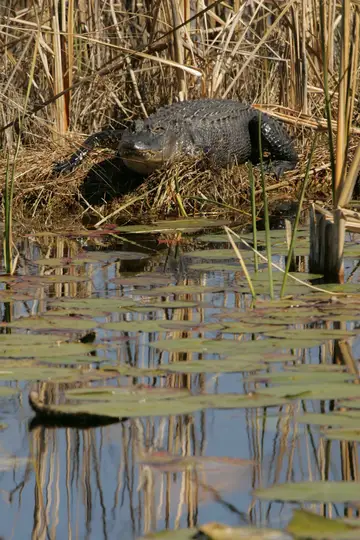

The American alligator is a large, armored, semi-aquatic reptile. It lives in freshwater swamps, marshes, rivers and lakes and can also turn up in brackish water. FWC says its range runs from southeast Oklahoma and east Texas to North Carolina and Florida, and it is found in all 67 Florida counties. Alligators normally avoid people, and FWC says serious injuries are rare in Florida, but they can attack, they have been known to prey on pets, and state agencies say never to feed them. It is federally listed as threatened due to similarity of appearance to the American crocodile; Alabama, North Carolina and Tennessee say killing or harming one outside permitted hunts is illegal. US Fish and Wildlife Service
On this page
Is the American alligator dangerous?
FWC: serious injuries caused by alligators are rare in Florida, but the potential for conflict always exists; never feed an alligator, keep your distance, swim only in designated areas during daylight, and keep pets on a leash and away from the water. TPWD: alligators normally avoid humans, have been known to prey on pets, must be treated with caution, and can run quickly over short distances. FWC
“Serious injuries caused by alligators are rare in Florida, but if you are concerned about an alligator, call FWC’s toll-free Nuisance Alligator Hotline at 866-392-4286.”
Bites and stings: Large predator. NPS: human conflicts are rare and generally not serious, but incidents do occur, and most attacks are attributed to illegal feeding. Alabama: alligator bites can result in serious infections; if bitten, seek medical attention immediately. Georgia DNR recorded nine attacks on people from 1980 to May 2007, including one fatality.
If someone is bitten or stung, call 911 or Poison Help at 1-800-222-1222.
How to identify an American alligator
A photo or description can narrow it down, but cannot confirm what an animal is or that it is safe. Look from a distance and do not handle wild animals.
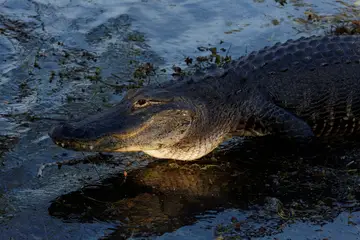

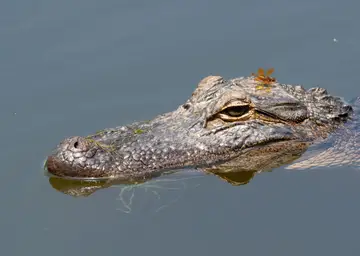
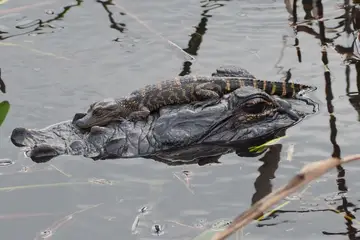
Size: USFWS and TPWD: body 6 to 14 feet long. NPS: adult males occasionally reach 13 to 15 feet; females up to about 10 feet. Florida records: 14 ft 3.5 in (length) and 1,043 lb (weight). Hatchlings are about 9 inches. US Fish and Wildlife Service
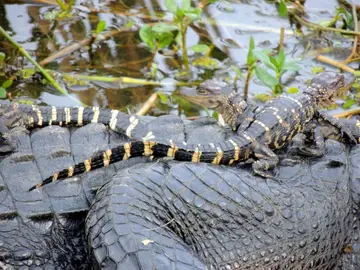
Colors: black, dark gray, olive, brown and cream. Pattern: plain dark back with armored scales (adults); yellow cross-bands (juveniles).
Key features
- Broad, rounded snout and darker skin than the American crocodile. US National Park Service
- With the mouth closed, the large fourth lower tooth is hidden (it shows in a crocodile). US Fish and Wildlife Service
- Almost black, with prominent eyes and nostrils on top of the head and coarse scales over the whole body. US Fish and Wildlife Service
- Eyes shine red at night in a light beam. FWC
Young
Black with bright yellow cross-bands that fade with age.
Animals mistaken for the American alligator
American alligator or American crocodile?
American alligator
American crocodile Crocodylus acutus
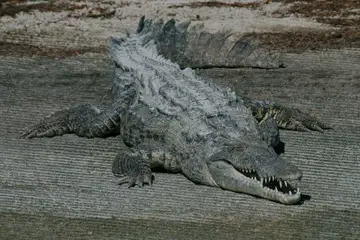
Crocodile: lighter grayish-green skin, narrow tapered triangular snout, fourth lower tooth visible with the mouth closed, and mostly coastal brackish or salt water in south Florida. Alligator: darker, broad rounded snout, mostly fresh water. US National Park Service
NPS: conflict with humans rarely occurs because American crocodiles are shy.
American alligator or Spectacled caiman?
American alligator
Spectacled caiman Caiman crocodilus
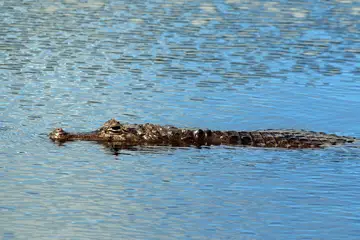

USGS: the common (spectacled) caiman's snout is not as broad and round as the American alligator's, and unlike the alligator it has a unique bony ridge in front of and between the eyes. US Geological Survey, Nonindigenous Aquatic Species database
Where the American alligator lives
- Native or listed
- Nonnative or not established
- No official record in our data
- 1–9
- 10–99
- 100–999
- 1,000+
State boundaries: U.S. Census Bureau, cartographic boundary file cb_2024_us_state_20m.
When it is active
Most active between dusk and dawn and when temperatures are 82 to 92 F. They stop feeding below about 70 F and are dormant below 55 F, through much of the winter. In Texas they are mostly inactive from mid-October until early March. SREL: active year-round in GA and SC, peaking in warm months. FWC
US open-licence records peak in January to April and December.
Habitat and habits
Habitat: Freshwater lakes, slow rivers and their wetlands, swamps and marshes. Also brackish water for short periods, and in neighborhoods, canals, golf-course ponds and storm drains. FWC
Behavior: Basks to regulate body temperature; often floats with only eyes and nostrils above water. Normally avoids people but can become aggressive if harassed, provoked or fed. Males bellow in breeding season.
Diet: Opportunistic. Juveniles eat insects, amphibians, small fish and other invertebrates. Adults eat fish, snakes, turtles, small mammals and birds, and large ones can take deer, feral pigs and pets.
Young: In Florida, courtship starts in early April and mating is in May or June. Females lay an average of 32 to 46 eggs in a mound nest in late June or early July. Eggs hatch mid-August to early September after about 63 to 68 days. Nest temperature sets the sex, and females guard the nest and young.
Legal status and reporting
Federal: Federally threatened due to similarity of appearance (to the American crocodile). Removed from the endangered list in 1987. FWC
Protection: Protected. Alabama law prohibits killing, harassing or possessing alligators. In North Carolina, hunting is by permit only and otherwise harming or killing one is strictly prohibited. In Tennessee, any attempt to capture or kill one is a violation of the law. Feeding is illegal in Alabama, and NPS says feeding or provoking them is illegal. NC is state threatened; Texas lists it as a protected game animal. In Florida, alligators can be taken only with proper licenses and permits. Outdoor Alabama
Report: Florida: if you are concerned about an alligator, call FWC's Nuisance Alligator Hotline, 866-392-4286 (866-FWC-GATOR). North Carolina: if an alligator is in a home or business or blocking a public road, call Wildlife Enforcement at 800-662-7137. South Carolina: for alligator emergencies, call Operation Game Thief at 1-800-922-5431. Alabama: call your district office. In a life-threatening emergency, call 911. FWC
Questions about the American alligator
What states have alligators?
Official sources confirm wild American alligators in Florida, Georgia, Alabama, South Carolina, North Carolina, Texas, Louisiana, Oklahoma, Arkansas and Tennessee. FWC describes the range as southeast Oklahoma and east Texas to North Carolina and Florida. Mississippi is inside that range but was not confirmed by a state page in this check.
Are there alligators in north carolina?
Yes. NCWRC says alligators occur naturally in North Carolina in patches along the coast. NC is the northern end of their range, and they get less common from south to north along the coast.
Are there alligators in texas?
Yes. TPWD says the American alligator lives in the eastern third of Texas, in or near water: swamps, rivers, bayous and marshes.
Are there alligators in tennessee?
A few. TWRA has confirmed sightings in Shelby, Fayette and Hardin counties since 2018, and one was caught in Norris Lake in March 2024. TWRA says they are naturally expanding into Tennessee from states to the south. They are protected, and possessing or releasing alligators in Tennessee is illegal.
Are there alligators in south carolina?
Yes. SCDNR says the American alligator is the only crocodilian native to South Carolina. SREL says they are restricted to the Coastal Plain.
Are there alligators in alabama?
Yes. Alabama DCNR says the American alligator, the only alligator species in Alabama, is found statewide, with the most in coastal marshes, swamps, lakes, rivers and reservoirs.
Are there alligators in louisiana?
Yes. LDWF says Louisiana's wild alligator population has grown from under 100,000 to more than 3 million in 50 years.
Are there alligators in oklahoma?
Yes, but they are hard to find. ODWC says they live in remote, marshy areas of the southeastern corner of the state, including Red Slough WMA and Little River National Wildlife Refuge. Choctaw and McCurtain counties have the most.
Does arkansas have alligators?
Yes. University of Arkansas Extension says the state is at the northern edge of the natural range and alligators were successfully reintroduced. They are found mainly in the southern counties, and most of northern Arkansas is too cool for them.
Are there alligators in virginia?
No established population was found in official sources. USGS records eight released or escaped alligators in Virginia (1969 to 2008), all marked "failed" (not established).
Are there alligators in michigan?
No established population. USGS lists 5 released or escaped alligators in Michigan (2005 to 2019), all marked "failed".
Are there alligators in ohio?
No established population was found. USGS has 7 Ohio records of released or escaped alligators (2007 to 2023): six marked "failed" and one 2023 St. Marys River record marked "unknown".
Alligator vs crocodile
Alligators are darker, with a broad rounded snout, and their fourth lower tooth is hidden when the mouth is closed. American crocodiles are lighter grayish-green, with a narrow tapered snout, and that tooth shows. In the US, crocodiles live only in coastal south Florida; south Florida is the only place both species live.
Are alligators dangerous?
They can be. NPS says conflicts are rare and generally not serious, but incidents do occur, mostly involving alligators that have been illegally fed. TPWD says they have been known to prey on pets. Do not feed them, keep your distance, and keep pets away from the water. If someone is bitten, call 911.
Sources
- American Alligator (Alligator mississippiensis). U.S. Fish and Wildlife Service. archived copy, captured October 21, 2026; checked November 3, 2026. Archived copy.
Quoted passages (2)
“Their body alone ranges from 6 - 14 feet long.”
“Almost black in color, it has prominent eyes and nostrils with coarse scales over the entire body.”
- Alligator Facts. Florida Fish and Wildlife Conservation Commission (FWC). archived copy, captured September 1, 2026; checked November 3, 2026. Archived copy.
Quoted passages (6)
“In alligators this eye-shine is red, but it can be different colors in other species.”
“They prefer fresh water lakes and slow-moving rivers and their associated wetlands, but they also can be found in brackish water habitats.”
“Juvenile alligators eat primarily insects, amphibians, small fish, and other invertebrates. Adult alligators eat rough fish, snakes, turtles, small mammals, and birds.”
“Alligators are most active when temperatures are between 82° to 92° F (28° to 33° C). They stop feeding when the ambient temperature drops below approximately 70° F (21° C) and they become dormant below 55° F (13° C).”
“Courtship begins in early April, and mating occurs in May or June. Females build a mound nest of soil, vegetation, or debris and deposit an average of 32 to 46 eggs in late June or early July. Incubation requires approximately 63-68 days, and hatching occurs from mid-August through early September.”
“The American alligator is classified by the US Fish and Wildlife Service as similarity of appearance to a threatened taxon.”
- Living with Alligators. Florida Fish and Wildlife Conservation Commission (FWC). archived copy, captured October 25, 2026; checked November 3, 2026. Archived copy.
Quoted passages (2)
“Serious injuries caused by alligators are rare in Florida, but if you are concerned about an alligator, call FWC’s toll-free Nuisance Alligator Hotline at 866-392-4286.”
“…if you are concerned about an alligator, call FWC’s toll-free Nuisance Alligator Hotline at 866-392-4286.”
- TPWD Wildlife Fact Sheet: American Alligator (Alligator mississippiensis). Texas Parks and Wildlife Department. undated page; checked November 3, 2026.
Quoted passages (1)
“An agile swimmer, the American alligator often floats or swims with only its eyes and nostrils exposed.”
- American Alligator: Species Profile (Everglades National Park). U.S. National Park Service. updated 2025-03-07; checked November 3, 2026.
Quoted passages (1)
“The bright yellow cross-bands that juvenile alligators sport against a black background provide effective camouflage. The yellow banding fades away as the juveniles mature.”
- Alligator, American (NCWRC species page). N.C. Wildlife Resources Commission. undated page; checked November 3, 2026.
- Living with Alligators. Alabama Department of Conservation and Natural Resources (Outdoor Alabama). undated page; checked November 3, 2026.
Quoted passages (1)
“State law prohibits killing, harassing, or possessing alligators.”
- American Crocodile: Species Profile (Everglades National Park). U.S. National Park Service. updated 2023-09-07; checked November 3, 2026.
Quoted passages (2)
“The darker skin and broader snout of the American alligator distinguish it from the American crocodile, shown above.”
“Alligators are more numerous in Florida than crocodiles, are darker, have a broader snout, and are typically found in freshwater habitats.”
- American Crocodile (Crocodylus acutus). U.S. Fish and Wildlife Service. archived copy, captured July 21, 2026; checked November 3, 2026. Archived copy.
Quoted passages (1)
“When the mouth is closed, the fourth tooth in the lower jaw is exposed in the crocodile but concealed in the alligator.”
- Caiman crocodilus (Common Caiman) - Species Profile. U.S. Geological Survey, Nonindigenous Aquatic Species database. Revision Date 6/22/2012; checked November 3, 2026.
Quoted passages (1)
“The snout is not as broad and round as in Alligator mississippiensis, the American alligator (Conant and Collins, 1998). Unlike A. mississippiensis and Crocodylus acutus, the American crocodile, the common caiman has a unique bony ridge in front of and between the eyes”
- Alligator Fact Sheet. Georgia DNR Wildlife Resources Division. Revised 09/16; checked November 3, 2026.
- American Alligator. South Carolina Department of Natural Resources. undated page; checked November 3, 2026.
- Alligator. Louisiana Department of Wildlife and Fisheries. undated page; checked November 3, 2026.
- American Alligator (field guide). Oklahoma Department of Wildlife Conservation. undated page; checked November 3, 2026.
- Alligators a steady presence in Arkansas. University of Arkansas System Division of Agriculture, Cooperative Extension Service. May 17, 2024; checked November 3, 2026.
- Alligators in Tennessee. Tennessee Wildlife Resources Agency. archived copy, captured October 22, 2026; checked November 3, 2026.
- Alligators of South Carolina and Georgia. University of Georgia Savannah River Ecology Laboratory (linked by SCDNR as its species information). undated page; checked November 3, 2026.
- NAS collection info: Alligator mississippiensis, Virginia. U.S. Geological Survey. database queried November 3, 2026; checked November 3, 2026.
- USGS NAS collection info: American alligator in Michigan. U.S. Geological Survey. database queried November 3, 2026; checked November 3, 2026.
- NAS collection info: American alligator, Ohio. U.S. Geological Survey. database queried November 3, 2026; checked November 3, 2026.
- GBIF.org occurrence records, human observations licensed CC0 1.0 or CC BY 4.0 only, accessed November 3, 2026. The datasets behind these counts are listed on our Sources page.
- State boundaries: U.S. Census Bureau, cartographic boundary file cb_2024_us_state_20m.