American crocodile
Crocodylus acutus · also called crocodile · Last checked November 3, 2026.
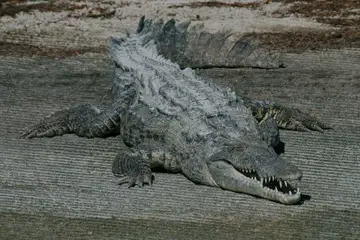
The American crocodile is a large, lizard-shaped reptile. It is lighter, grayish-green, with a narrower, more pointed snout than the alligator. In the US it lives only in coastal south Florida and the Keys, in brackish and salt water such as mangrove ponds, coves and creeks, and sometimes in canals inland. NPS says it is shy and conflicts with people are rare. The Florida population is federally threatened; FWC says numbers have recovered from a few hundred to as many as 2,000 adults since it was listed as endangered in 1975. US Fish and Wildlife Service
On this page
Is the American crocodile dangerous?
FWC calls American crocodiles shy and reclusive. FWC runs a crocodile response program; people concerned about a crocodile should call 866-392-4286 (866-FWC-GATOR). NPS reminds visitors to keep a safe distance. FWC
“American crocodiles are a shy and reclusive species.”
Bites and stings: NPS: conflict with humans rarely occurs because American crocodiles are shy. FWC: a crocodile splashing noisily into the water is frightened, and basking with the mouth open (gaping) regulates body temperature and does not mean the crocodile is acting aggressively.
If someone is bitten or stung, call 911 or Poison Help at 1-800-222-1222.
How to identify an American crocodile
A photo or description can narrow it down, but cannot confirm what an animal is or that it is safe. Look from a distance and do not handle wild animals.
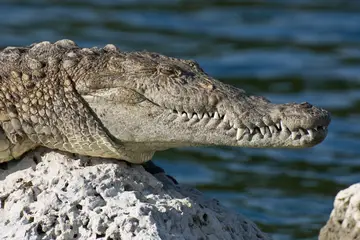

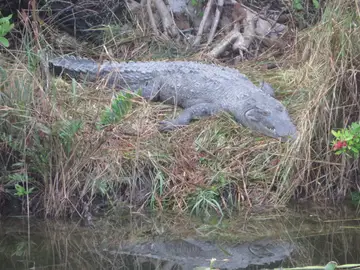
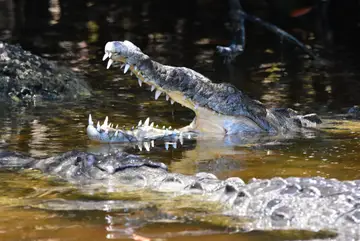
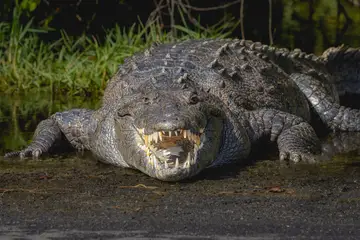

Size: USFWS: hatchlings are about 23 cm (9 in); adults may grow to 4.5 m (about 15 ft) or larger. NPS: males can reach about 20 feet but rarely exceed 14 feet in the wild; breeding females are about 8 to 12 feet. US Fish and Wildlife Service
Colors: grayish-green, white and yellowish. Pattern: plain; lighter than an alligator.
Key features
- Narrow, triangular snout; the fourth lower tooth on each side shows when the mouth is closed. US National Park Service
- Snout tapers forward from the eyes; an alligator snout is rounded. US Fish and Wildlife Service
- More slender build than an alligator. US Fish and Wildlife Service
Animals mistaken for the American crocodile
American crocodile or American alligator?
American crocodile
American alligator Alligator mississippiensis
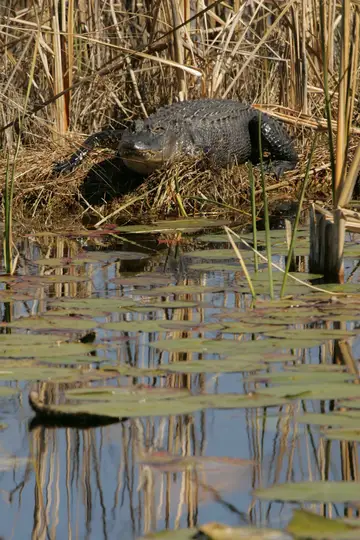

Alligator: darker skin, broad rounded snout, fourth lower tooth hidden with the mouth closed, usually in fresh water. Crocodile: lighter skin, narrow triangular snout, tooth visible, coastal brackish or salt water. US National Park Service
NPS: human conflicts with alligators are rare and generally not serious, but incidents do occur.
Where the American crocodile lives
- Native or listed
- Nonnative or not established
- No official record in our data
- 1–9
- 10–99
- 100–999
- 1,000+
State boundaries: U.S. Census Bureau, cartographic boundary file cb_2024_us_state_20m.
When it is active
Adults feed mostly at night (NPS). US National Park Service
US open-licence records peak in January to March and December.
Habitat and habits
Habitat: Coastal brackish and salt water: ponds, coves and creeks in mangrove swamps. Occasionally inland in fresh water along the southeast Florida coast via canals. FWC
Behavior: Shy and reclusive. Basks in the sun to warm up, sometimes with the mouth open (gaping) to regulate temperature. A startled basking crocodile may splash noisily into the water because it is frightened.
Diet: Hatchlings and young eat small fish, snails, crustaceans and insects. Adults feed mostly at night on fish, crabs, turtles, snakes and small mammals (USFWS adds birds).
Young: Nests are holes in or mounds of sand and other earthen material, built on elevated, well-drained sites. Females lay 20 to 60 eggs and incubate them about 85 days, hatching late July or early August. Incubation temperature sets the sex. When hatching begins, the mother digs open the nest and may help the hatchlings to water.
Legal status and reporting
Federal: Florida population: federally threatened (listed as endangered in 1975). NPS: the species worldwide is federally listed as endangered. FWC
Protection: Protected under the Endangered Species Act (FWC checklist marks it FT, federally threatened). FWC
Report: Florida: if you are concerned about a crocodile, call FWC at 866-392-4286 (866-FWC-GATOR); a crocodile response agent will respond. In an emergency, call 911. FWC
Questions about the American crocodile
Are there crocodiles in florida?
Yes. FWC says American crocodiles live in south Florida and the Keys in brackish and saltwater areas such as mangrove ponds, coves and creeks, and are occasionally found inland via canals on the southeast coast. Numbers have recovered to as many as 2,000 adults.
Does florida have alligators or crocodiles?
Both. NPS says south Florida is the only place where both US species live. Alligators are much more numerous, are found in all 67 counties and mostly in fresh water. Crocodiles are limited to coastal south Florida and the Keys.
Are there crocodiles in florida keys?
Yes. FWC says American crocodiles occur at the northern end of their range in south Florida and the Keys.
Are there crocodiles in the us?
Yes, but only in south Florida. NPS says two crocodilians are native to the US, the American alligator and the American crocodile, and the crocodile lives only in coastal south Florida.
Are there crocodiles in texas?
No wild crocodile population is recorded. The Herps of Texas list of Texas crocodilians (UT Austin) includes only the American alligator, and NPS and SREL say US crocodiles live only in south Florida.
Are there crocodiles in south carolina?
No native crocodiles. SCDNR says the American alligator is the only crocodilian native to South Carolina. USGS has one nonindigenous American crocodile record for the state (Isle of Palms pier, 2008, marked "failed"): a single occurrence, not a population.
Are there crocodiles in georgia?
No crocodile population is recorded. SREL (University of Georgia) says crocodiles in the US are limited to extreme south Florida; Georgia has alligators.
Crocodile vs alligator
American crocodiles are lighter grayish-green, with a narrow tapered snout, and their fourth lower tooth shows when the mouth is closed. They live in coastal salt or brackish water. Alligators are darker, with a broad rounded snout and the tooth hidden, and mostly live in fresh water.
Sources
- American Crocodile (Crocodylus acutus). U.S. Fish and Wildlife Service. archived copy, captured July 21, 2026; checked November 3, 2026. Archived copy.
Quoted passages (3)
“Hatchlings are about 23 centimeters in length; adults may grow to 4.5 meters or larger.”
“The crocodile's snout tapers forward from the eyes while the alligator's snout is untapered and rounded at the end.”
“Florida crocodiles may be distinguished from alligators by their more slender build and their difference in snout shape.”
- American Crocodile: Species Profile (Everglades National Park). U.S. National Park Service. updated 2023-09-07; checked November 3, 2026.
Quoted passages (5)
“Their narrow snout is triangular in shape, and the fourth tooth on both sides of the lower jaw is visible when the mouth is closed.”
“Hatchlings and young crocodiles eat small fish, snails, crustaceans, and insects. Adults feed mostly at night on fish, crabs, turtles, snakes, and small mammals.”
“Adults feed mostly at night on fish, crabs, turtles, snakes, and small mammals.”
“Females lay from 20 to 60 eggs per clutch and incubate the eggs for about 85 days until they hatch in late July or early August.”
“The lighter skin and narrower, triangular-shaped snout of the American crocodile distinguish it from the American alligator, shown below.”
- American Crocodile. Florida Fish and Wildlife Conservation Commission (FWC). archived copy, captured September 5, 2026; checked November 3, 2026. Archived copy.
Quoted passages (5)
“American crocodiles are a shy and reclusive species.”
“They occur in brackish or saltwater areas and can be found in ponds, coves, and creeks in mangrove swamps. They are occasionally encountered inland in freshwater areas of the southeast Florida coast as a result of the extensive canal system.”
“A basking crocodile may be surprised by an approaching person and quickly (and noisily) enter the water.”
“The Florida population of this native species is now classified as threatened by the U.S. Fish and Wildlife Service.”
“People who are concerned about a crocodile should call 866-392-4286 (866-FWC-GATOR), and one of our crocodile response agents will respond.”
- Living with Alligators. Florida Fish and Wildlife Conservation Commission (FWC). archived copy, captured October 25, 2026; checked November 3, 2026. Archived copy.
- Checklist of Florida's Amphibians and Reptiles (Revised 2023). Florida Fish and Wildlife Conservation Commission (FWC). Revised 2023; checked November 3, 2026.
Quoted passages (1)
“Protected under the Endangered Species Act.”
- Alligators of South Carolina and Georgia. University of Georgia Savannah River Ecology Laboratory (linked by SCDNR as its species information). undated page; checked November 3, 2026.
- Herps of Texas: Crocodilians of Texas. Herps of Texas, Biodiversity Collections, Dept. of Integrative Biology, The University of Texas at Austin. 2020-04-23 (archive capture date; checked November 3, 2026.
- American Alligator. South Carolina Department of Natural Resources. undated page; checked November 3, 2026.
- NAS species list: Reptiles, South Carolina. U.S. Geological Survey, Nonindigenous Aquatic Species Database. database queried November 3, 2026; checked November 3, 2026.
- Crocodylus acutus (American crocodile) - Collections Search, South Carolina. U.S. Geological Survey, Nonindigenous Aquatic Species Database. database queried November 3, 2026; checked November 3, 2026.
- Alligator Fact Sheet. Georgia DNR Wildlife Resources Division. Revised 09/16; checked November 3, 2026.
- GBIF.org occurrence records, human observations licensed CC0 1.0 or CC BY 4.0 only, accessed November 3, 2026. The datasets behind these counts are listed on our Sources page.
- State boundaries: U.S. Census Bureau, cartographic boundary file cb_2024_us_state_20m.