Blister Beetles
Meloidae · also called Meloids, Oil beetles (genus Meloe), Striped blister beetle (Epicauta vittata) and Ash-gray blister beetle (Epicauta fabricii) · Last checked November 3, 2026.
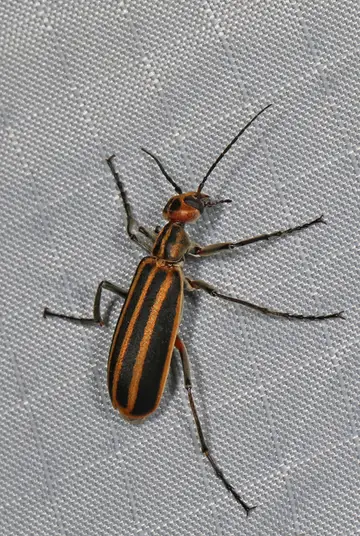
Blister beetles are long, narrow, soft-bodied beetles (most about 1/2 to 3/4 inch) with a 'neck' narrower than the head. Many are black, gray or brown; others are yellow, orange or red with spots or stripes. They do not bite or sting, but their body fluid contains cantharidin, which blisters human skin when a beetle is crushed or squeezed against it, and they are dangerous if eaten. Dead beetles in alfalfa hay can poison and kill horses and other livestock. NDSU Extension says they are common throughout the United States; adults become active in early to mid-summer and are drawn to flowering plants and crops. Missouri Department of Conservation
This page covers a family (Meloidae), not a single species.
On this page
Are blister beetles dangerous?
Texas A&M AgriLife Extension: blister beetles do not bite or sting, but produce cantharidin, which blisters the skin. They are dangerous if eaten and can cause a reaction in the urinary tract. Horses have died from eating dead blister beetles in hay. Texas Cooperative Extension
“Blister beetles do not bite or sting, but produce a fluid called cantharidin which blisters the skin. • They are dangerous if eaten, and can cause a reaction in the urinary tract. Horses have died from eating dead blister beetles in hay.”
Bites and stings: No. Texas AgriLife: blister beetles do not bite or sting.
If someone is bitten or stung, call 911 or Poison Help at 1-800-222-1222.
How to identify blister beetles
A photo or description can narrow it down, but cannot confirm what an animal is or that it is safe. Look from a distance and do not handle wild animals.
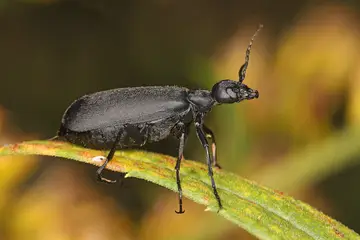

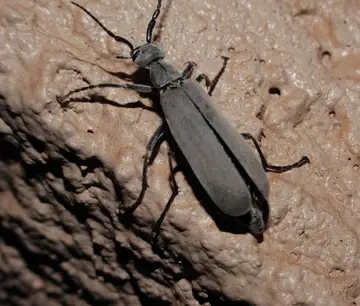
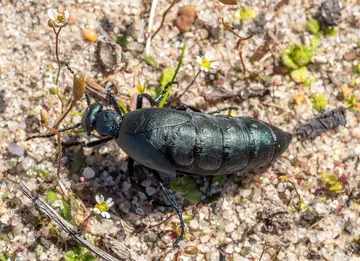

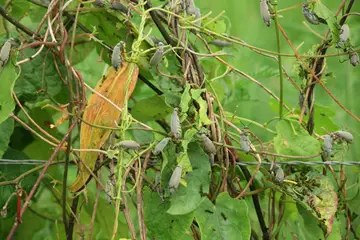
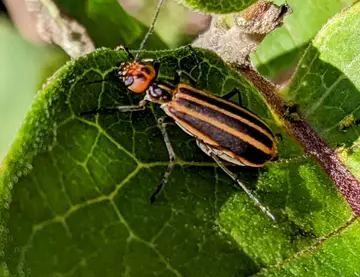
Size: Less than 1/4 inch to 2 1/2 inches; most are 1/2 to 3/4 inch. Missouri Department of Conservation
Colors: Many black, brown or other drab colors, sometimes iridescent blue or bronze or with yellow, orange or red markings; others mostly yellow, orange or red, sometimes with dark spots or stripes. Pattern: Striped blister beetle: dull yellow head and thorax with two black stripes on each wing cover; nuttall's blister beetle: purple-green iridescent sheen.
Key features
- Narrow, elongate, soft body with a 'neck' where the thorax narrows behind the head NDSU Extension
- Soft, flexible wing covers, unlike the hard wing covers of most beetles University of Kentucky Cooperative Extension, Entomology
- Thorax narrower than the head or wings UF/IFAS Extension
- Often in large groups, on flowers and crops NDSU Extension
Young
Larvae look very different from stage to stage. The earliest stage (triungulin) is tiny and active, with functioning legs; the grublike stages that parasitize underground bee nests are unlikely to be seen.
Where blister beetles live
- Native or listed
- Nonnative or not established
- No official record in our data
- 1–9
- 10–99
- 100–999
- 1,000+
State boundaries: U.S. Census Bureau, cartographic boundary file cb_2024_us_state_20m.
When it is active
Adults become active in early to mid-summer and are most active in the morning and late afternoon (North Dakota). In Kentucky they are checked for in hay fields July through early September.
US open-licence records for all blister beetles (family Meloidae) peak in March to May and July to August.
Habitat and habits
Habitat: Adults visit flowers, especially sunflower-family plants in prairies, old fields, pastures and roadsides; some spend more time on the ground. Missouri Department of Conservation
Behavior: Gregarious; easily disturbed, they drop off plants and hide or scamper away.
Diet: Adults eat nectar, pollen, flowers and sometimes leaves (sunflower, bean and potato families). Larvae eat grasshopper eggs or the food and young in ground-nesting bee nests.
Young: Most species have one generation a year; females lay clusters of about 100 to 200 eggs in soil; larvae (triungulins) prey on grasshopper egg pods or bee nests and overwinter in the soil.
Sources
- Blister Beetles (Meloids) (Field Guide). Missouri Department of Conservation. undated page; checked November 3, 2026.
Quoted passages (4)
“Length: less than ¼ to 2½ inches; most are ½ to ¾ inch (varies with species).”
“The larvae go through several stages that look very different from each other. The grublike stages that parasitize underground bee nests are unlikely to be seen. The earliest stage, though tiny, is active; at this point, they have large heads and slender bodies, with functioning legs. … hatches into an active larva called a triungulin”
“Several blister beetles prefer flowers in the sunflower family, which abound in prairies, old fields, pastures, along roadsides and other sunny places. … Others spend more time on the ground, laying eggs in the soil.”
“Adults visit flowers to eat nectar, pollen, and sometimes entire flowers. Some species eat leaves. Different types of blister beetles prefer different plant families; most prevalent are plants in the sunflower, bean, and potato families. The larvae of most blister beetles are parasitic on ground-nesting, solitary bees … The larvae of some groups eat the egg clusters of grasshoppers.”
- Venomous Terrestrial Animals of Texas (B-6118). Texas Cooperative Extension (now Texas A&M AgriLife Extension). 8-04 (publication code B-6118 8-04; checked November 3, 2026.
Quoted passages (1)
“Blister beetles do not bite or sting, but produce a fluid called cantharidin which blisters the skin. • They are dangerous if eaten, and can cause a reaction in the urinary tract. Horses have died from eating dead blister beetles in hay.”
- Blister Beetle Management in Forages and Field Crops (E1002). NDSU Extension (North Dakota State University). E1002, revised December 2021; checked November 3, 2026.
Quoted passages (4)
“…have a characteristic narrow, elongate, soft body with a ‘neck’ formed by the tapering of the pronotum between the head and abdomen.”
“Blister beetles are gregarious and are often found in high numbers in localized areas of the field. … Adults are attracted to blooming forage or field crop fields”
“Blister beetles are easily disturbed and will drop off plants and hide or scamper away.”
“Most blister beetle species have one generation per year. … Females will deposit eggs in the soil in clusters of about 100-200 eggs. Eggs hatch in about two weeks into larvae called triungulins, which actively prey on grasshopper egg pods (Epicauta spp.) or bee nests (Lytta spp.). … it transforms into the pseudo-pupae for overwintering in the soil.”
- Blister Beetles in Alfalfa (ENTFACT-102). University of Kentucky Cooperative Extension, Entomology. ENTFACT-102; checked November 3, 2026.
Quoted passages (1)
“The front wings are soft and flexible in contrast to the hard front wings of most beetles.”
- ENY-215 Stinging or Venomous Insects and Related Pests (Koehler & Diclaro). UF/IFAS Extension (EDIS). Original publication date January 1996; checked November 3, 2026.
Quoted passages (1)
“Blister beetles (Figure 14) are narrow beetles with a neck that is more slender than the head and wings.”
- GBIF.org occurrence records, human observations licensed CC0 1.0 or CC BY 4.0 only, accessed November 3, 2026. The datasets behind these counts are listed on our Sources page.
- State boundaries: U.S. Census Bureau, cartographic boundary file cb_2024_us_state_20m.