Boxelder bug
Boisea trivittata · also called box elder bug · Last checked November 3, 2026.
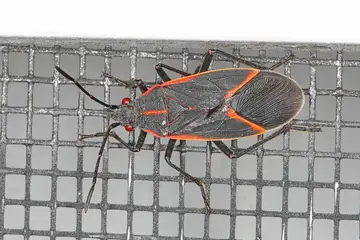

The boxelder bug is a native black and red true bug about 1/2 inch long. It feeds mainly on seeds of boxelder trees and gathers on sunny walls in fall, looking for somewhere to spend the winter. Extension services treat it as a household nuisance. Maryland, Vermont and Wisconsin say it does not bite and NC State says usually not, though Colorado State and Cornell note rare reports of bites. It can stain fabrics and smells unpleasant when crushed. Penn State gives its range as the eastern US west to Nevada. University of Vermont Extension
On this page
Is the boxelder bug dangerous?
Cornell Cooperative Extension: does not sting or transmit disease and is generally not known to bite, with rare reports of defensive biting. Treated as a nuisance pest. Cornell Cooperative Extension, Chautauqua County
“They do not sting or transmit disease, and are generally not known to bite, though there are rare reports of defensive biting.”
Bites and stings: Sources differ. Maryland, Vermont and Wisconsin say it does not bite; NC State says usually not; Colorado State and Cornell report rare bites.
No official source we use states whether this animal is venomous. That does not mean it is harmless: do not handle it.
How to identify a boxelder bug
A photo or description can narrow it down, but cannot confirm what an animal is or that it is safe. Look from a distance and do not handle wild animals.
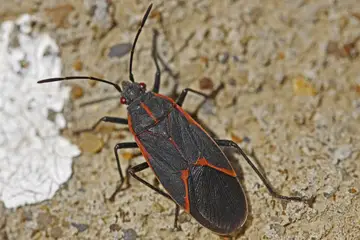

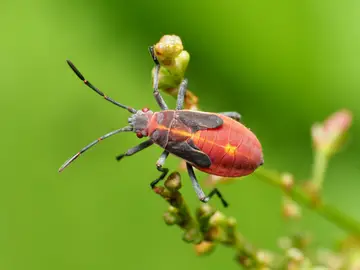
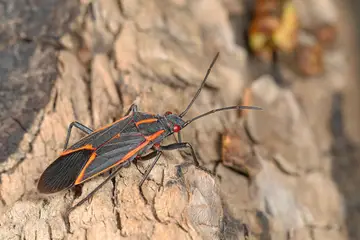

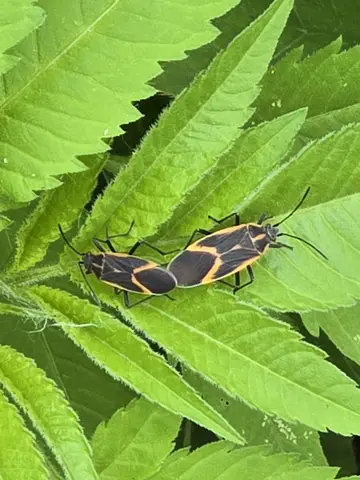
Size: About 1/2 inch long (one Wisconsin page says about 3/4 inch). Colorado State University Extension
Colors: black, red, orange and gray. Pattern: striped.
Key features
- Three red stripes behind the head. NC State Extension
- Red eyes. University of Vermont Extension
- Gathers in large groups on sunny walls in fall. University of Wisconsin-Madison Extension
Young
Nymphs are bright red, smaller and wingless, with darker heads.
Animals mistaken for the boxelder bug
Boxelder bug or Small milkweed bug?
Boxelder bug
Small milkweed bug Lygaeus kalmii
Missouri Department of Conservation: the small milkweed bug is only about 1/2 inch long and has an orange-and-black pattern with a reddish-orange X on the back and a reddish-orange band across the pronotum (the shield behind the head). MDC
Boxelder bug or Large milkweed bug?
Boxelder bug
Large milkweed bug Oncopeltus fasciatus
Missouri Department of Conservation: the large milkweed bug has a bold black-and-orange pattern; each forewing has an orange forward-pointing triangle, a wide black band and an orange backward-pointing triangle, with the outer membranous part black. MDC
Boxelder bug or False milkweed bug?
Boxelder bug
False milkweed bug Lygaeus turcicus
Missouri Department of Conservation: the false milkweed bug's roughly triangular black mark on the back is notched at the sides with orange, looking like two overlapping black triangles or hearts, and it has a T- or Y-shaped orange mark on its head. MDC
Where the boxelder bug lives
- Native or listed
- Nonnative or not established
- No official record in our data
- 1–9
- 10–99
- 100–999
- 1,000+
State boundaries: U.S. Census Bureau, cartographic boundary file cb_2024_us_state_20m.
When it is active
A nuisance around homes from fall through early spring. Colorado State says infestations should end by late May. Colorado State University Extension
US open-licence records peak in March to May and September to October.
Habitat and habits
Habitat: Boxelder trees, especially female trees, and to a lesser extent maple and ash. Overwinters in buildings and other sheltered places. NC State Extension
Behavior: Enters buildings through small gaps in fall. Active indoors when warmed; does not feed or reproduce inside.
Diet: Feeds on foliage and seeds with piercing-sucking mouthparts; favorite food is seed pods on female boxelder trees.
Young: Females lay eggs on host trees in spring. Colorado State calls them small and red; Penn State and NC State say they are yellowish at first and turn red. Eggs hatch in about 10 to 14 days. One or two generations a year in Pennsylvania; two in North Carolina.
Questions about the boxelder bug
Boxelder bug
A black and red true bug about 1/2 inch long that feeds on boxelder seeds and comes into homes in fall. Several extension services say it does not bite, though rare bites are reported. It can stain fabric and smells when crushed.
Sources
- Boxelder Bugs, Boisea trivittata (Say). University of Vermont Extension. Updated October 2022; checked November 3, 2026.
Quoted passages (1)
“Adult boxelder bugs are black and reddish orange with red eyes and are about ½ inch long.”
- Boxelder Bugs. Colorado State University Extension. undated page; checked November 3, 2026.
Quoted passages (3)
“This bug is about 1/2 inch long as an adult, black with three red lines on the thorax”
“…their favorite food is boxelder seed pods, which are found only on the female boxelder tree”
“Boxelder bugs become a nuisance in and around homes from fall through early spring.”
- Boxelder Bugs. Cornell Cooperative Extension, Chautauqua County. undated page; checked November 3, 2026.
Quoted passages (1)
“They do not sting or transmit disease, and are generally not known to bite, though there are rare reports of defensive biting.”
- Boxelder Bug. Penn State Extension. Revised December 2011; checked November 3, 2026.
Quoted passages (1)
“Depending on weather conditions, one to two generations may be produced each year in Pennsylvania.”
- Boxelder Bugs. University of Maryland Extension. undated page; checked November 3, 2026.
- Boxelder Bugs in the Landscape. NC State Extension. Reviewed/Revised Sept. 11, 2019; checked November 3, 2026.
Quoted passages (2)
“…are dark gray to black with three red stripes on the thorax.”
“Boxelder bugs feed on the seeds of boxelder trees and to a lesser extent on the seeds of maples and ash trees.”
- Boxelder Bug, Boisea trivittatus. University of Wisconsin-Madison Extension. undated page; checked November 3, 2026.
Quoted passages (3)
“They often gather in large congregations on walls or foundations when seeking entry.”
“Nymphs (immatures) are bright red with darker heads and look like the adults, but without developed wings.”
“Although they do not feed or reproduce inside the home, boxelder bugs may stain curtains and walls.”
- MDC Field Guide: Land Invertebrates and Butterflies and Moths (selected species accounts). Missouri Department of Conservation (MDC). undated page; checked November 3, 2026.
Quoted passages (3)
“Identify it from other, similar-looking true bugs by its smallish size (only to about ½ inch long) and its special orange-and-black pattern: note the reddish-orange X on the back and a reddish-orange band running across the pronotum”
“In this species, each forewing has, from front to back, an orange, front-pointing triangle, a wide black band, and an orange backward-pointing triangle; then, the outer, membranous portion of the forewing is black.”
“To identify it, note that instead of a big black, rather conventional heart-shape on the back, its roughly triangular black mark is notched at the sides with orange, making it look like two overlapping black triangles or hearts. Also, it has a T- or Y-shaped orange mark on its head instead of a red dot on the head between the eyes.”
- GBIF.org occurrence records, human observations licensed CC0 1.0 or CC BY 4.0 only, accessed November 3, 2026. The datasets behind these counts are listed on our Sources page.
- State boundaries: U.S. Census Bureau, cartographic boundary file cb_2024_us_state_20m.