Burmese Python
Python bivittatus · also called Python molurus bivittatus (former name) and Burmese/Indian Python · Last checked November 3, 2026.
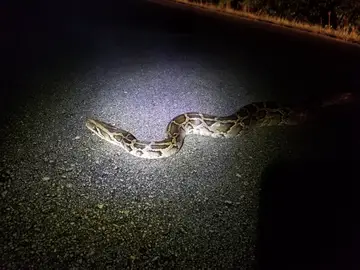
The Burmese python is a very large, nonvenomous constricting snake from Southeast Asia that is invasive in Florida, where it is established in the southern peninsula and the Everglades. It is not venomous, but large pythons have big, sharp teeth and their bites can cause severe lacerations; large ones can eat dogs and cats. USGS also has single records from Georgia, Louisiana and Ohio. FWC
On this page
Is the Burmese python dangerous?
Non-venomous. Small ones are not generally dangerous, but larger pythons have large, sharp teeth and bites can cause severe lacerations; large pythons can eat dogs and cats. Florida Museum of Natural History
“Non-venomous. Burmese Pythons may bite to defend themselves. Small individuals are not generally dangerous to people or pets. However, larger Burmese Pythons have large, sharp teeth, and their bites can cause severe lacerations. Large animals are also fully capable of eating dogs and cats.”
Bites and stings: May bite in defense and hold on while constricting if grabbed or pinned; virtually all bites occur when the snake is intentionally bothered (Florida Museum).
How to identify a Burmese python
A photo or description can narrow it down, but cannot confirm what an animal is or that it is safe. Look from a distance and do not handle wild animals.
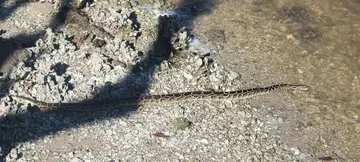
Size: Most adults in Florida 10 to 16 feet; Florida record 16.8 feet. Florida Museum of Natural History
Colors: Tan, tannish yellow or cream background with dark brown blotches. Pattern: Large dark brown black-bordered blotches down back and sides.
Key features
- Dark spearhead (arrow) shape on top of the head Florida Museum of Natural History
- Very large and heavy bodied; every life stage larger than native snakes in its invasive range US Geological Survey, Nonindigenous Aquatic Species (NAS) database
- Smooth scales; vertical (cat-like) pupil; deep facial pits along the front of the upper lip Florida Museum of Natural History
Young
Hatchlings average 26 inches; color pattern like adults but more vivid.
Animals mistaken for the Burmese python
Burmese Python or Northern African Python?
Burmese Python
Northern African Python Python sebae
USGS: the Northern African python's back pattern is less vivid/defined and its belly scales are patterned black and white, while the Burmese python's belly scales are white. Florida Museum: Northern African rock pythons have two mostly continuous, irregular dark blotches down the back bordered by black and white. Caution: Florida Museum also says the Burmese belly has dark spots along the sides, so belly colour alone is not a clean test.
Non-venomous (Florida Museum); also invasive and listed as injurious wildlife.
Where the Burmese python lives
- Native or listed
- Nonnative or not established
- No official record in our data
- 1–9
- 10–99
- 100–999
- 1,000+
On our state guides
State boundaries: U.S. Census Bureau, cartographic boundary file cb_2024_us_state_20m.
When it is active
Heat-sensing lip pits make them effective nighttime predators. In Everglades National Park, mating December to April, eggs May to June, hatching July to August. Florida Museum of Natural History
US open-licence records peak in January, July, September to October and December.
Habitat and habits
Habitat: In Florida: seasonally flooded wetlands (Everglades), tree islands, hardwood hammocks, prairies, mangrove salt marshes, farmland, canals and housing developments. Florida Museum of Natural History
Behavior: Stays hidden in dense vegetation; if cornered may strike quickly, and if grabbed may bite and hold while constricting. Not aggressive.
Diet: Mammals (including deer) and birds, occasionally alligators; powerful constrictors.
Young: In Florida, females lay 11 to 87 eggs and coil around them until they hatch, June to August.
Legal status and reporting
Federal: Listed as injurious wildlife by USFWS under 50 CFR 16 (as Python molurus, including P. molurus bivittatus); importation restricted. ECOS returns no ESA record for Python bivittatus (the separate Indian python, P. m. molurus, is listed Endangered). US Fish and Wildlife Service
Protection: FWC does not treat Burmese pythons as protected wildlife: it says nonnative reptiles like Burmese pythons can be humanely killed on private lands at any time with landowner permission (no permit required), and on 32 FWC-managed lands under Executive Order 23-16. Pythons must be humanely killed onsite at capture; live transport is not allowed. Follow FWC rules. FWC
Invasive status: Invasive and established in Florida; NPS says pythons are probably the main reason mammals have declined very sharply in Everglades National Park. National Park Service
Report: Florida: FWC asks the public to call its Invasive (Exotic) Species Hotline, 888-IveGot1 (888-483-4681), for high-priority species, which include all nonnative snakes. The IveGot1 app and IveGot1.org are preferred for lower-priority species. A good report has a clear photo, the location and the date. FWC
Questions about the Burmese python
Burmese python florida
Burmese pythons are invasive in Florida and established in the southern peninsula from Lake Okeechobee south to Key Largo and Florida Bay, with Everglades National Park a stronghold. Report sightings to FWC at 888-IveGot1 (888-483-4681).
Are there pythons in florida?
Yes. Burmese pythons are established in south Florida (Florida Museum: from Lake Okeechobee south to Key Largo and Florida Bay) and are found primarily in and around the Everglades (FWC). USGS NAS records them in Florida since 1979.
Burmese python everglades
NPS says pythons are established in Everglades National Park from released or escaped pets, are hard to find, and are probably the main reason mammals have declined sharply in the park. Visitors are unlikely to see one.
Burmese python size
Most adults in Florida are 10 to 16 feet; the Florida record is 16.8 feet (Florida Museum). USGS says they can grow to 20 feet and over 250 pounds.
Burmese python poisonous
No. FWC and the Florida Museum class the Burmese python as nonvenomous. Larger pythons can still cause severe lacerations with their teeth.
Burmese python teeth
Florida Museum says larger Burmese pythons have large, sharp teeth and their bites can cause severe lacerations.
Burmese python lifespan
USGS describes Burmese pythons as long lived, about 15 to 25 years.
Are there wild pythons in georgia?
For Burmese pythons: USGS NAS lists a single nonindigenous observation in Georgia (2012, Satilla drainage) and says populations may not be currently present. No established population is reported. Other python species were not checked.
Are there wild pythons in louisiana?
For Burmese pythons: USGS NAS lists a single observation in Louisiana (2019, Lake Maurepas) and says populations may not be currently present. Louisiana DWF lists the Burmese python on its invasive species list. Other python species were not checked.
Are there wild pythons in texas?
For Burmese pythons: the USGS NAS occurrence table (updated 11/3/2026) lists no Texas records; its only states are Florida, Georgia, Louisiana and Ohio, plus Puerto Rico. Other python species were not checked.
Sources
- Burmese Pythons in Florida. Florida Fish and Wildlife Conservation Commission (FWC). archived copy, captured October 11, 2026; checked November 3, 2026.
- Florida Snake ID Guide species account: Burmese Python. Florida Museum of Natural History (University of Florida). updated September 23, 2022; checked November 3, 2026.
Quoted passages (10)
“Non-venomous. Burmese Pythons may bite to defend themselves. Small individuals are not generally dangerous to people or pets. However, larger Burmese Pythons have large, sharp teeth, and their bites can cause severe lacerations. Large animals are also fully capable of eating dogs and cats.”
“Most adult Burmese Pythons are about 10-16 feet (3-5 m) in total length, with a record length in Florida recorded of 16.8 feet (5.12 m).”
“The top of the head is dark with a light stripe on both sides of the head that extends through the eye to converge on the nose, forming a dark spearhead pattern.”
“The scales on the body are smooth. The pupil is vertically elliptical. There are deep facial pits between the scales along front of the upper lip.”
“Hatchlings average 26 inches (65 cm) in total length. … Juvenile color pattern is similar to that of adults, except the coloration is more vivid.”
“In Florida, Burmese Pythons have been found in and around undeveloped seasonally flooded wetlands (e.g., the Florida Everglades), tree islands, hardwood hammocks, prairies, mangrove salt marshes, melaleuca and Brazilian pepper stands, agricultural areas, man-made canals and lakes, and housing developments.”
“Burmese Pythons primarily feed on a wide range of mammals (including deer) and birds, but they will occasionally eat alligators.”
“Burmese Pythons typically remain well hidden in dense vegetation to avoid detection. However, if they are cornered, both juveniles and adults may quickly strike at the attacker. If grabbed or pinned, they may bite the attacker and hold on while writhing and constricting. Nonetheless, these snakes are not aggressive, and striking is only used in defense as a last resort.”
“The deep facial pits between the scales on the upper lips of Burmese Pythons are sophisticated heat-sensitive organs … This extra sense helps these snakes to be highly effective nighttime predators.”
“In Florida, females lay 11-87 white eggs, which hatch between June and August. Females remain coiled around the eggs without eating until they hatch about two months later.”
- Burmese Python (Python bivittatus) - Species Profile. U.S. Geological Survey, Nonindigenous Aquatic Species (NAS) database. updated November 3, 2026; checked November 3, 2026.
Quoted passages (1)
“They are among one of the largest snake species in the world, with every life stage larger than any native snakes found in its invasive range”
- 50 CFR Part 16, Injurious Wildlife (eCFR). U.S. Fish and Wildlife Service (Code of Federal Regulations, via eCFR). current eCFR text as retrieved 2026-11-03; checked November 3, 2026.
Quoted passages (1)
“Python molurus (including P. molurus molurus (Indian python) and P. molurus bivittatus (Burmese python)).”
- Burmese Python - Everglades National Park. National Park Service. updated May 14, 2026; checked November 3, 2026.
Quoted passages (1)
“…studies show that pythons are probably the main reason that mammals have declined very sharply in number in Everglades National Park”
- Removing Pythons in Florida. Florida Fish and Wildlife Conservation Commission (FWC). archived copy, captured July 10, 2026; checked November 3, 2026.
Quoted passages (2)
“Pythons must be humanely killed onsite at the time of capture. Live transport of pythons is not allowed. Hunting on Private Land: Nonnative reptiles like Burmese pythons can be humanely killed on private lands at any time with landowner permission - no permit required- … Per Executive Order 23-16, nonnative reptiles including pythons may also be humanely killed at any time throughout the year on 32 Commission-managed lands”
“Burmese python observations can be reported to FWC’s Exotic Species Hotline at 888-Ive-Got1 (483-4681).”
- 2025 Louisiana State Wildlife Action Plan. Louisiana Department of Wildlife and Fisheries. 2025 plan; checked November 3, 2026.
- GBIF.org occurrence records, human observations licensed CC0 1.0 or CC BY 4.0 only, accessed November 3, 2026. The datasets behind these counts are listed on our Sources page.
- State boundaries: U.S. Census Bureau, cartographic boundary file cb_2024_us_state_20m.