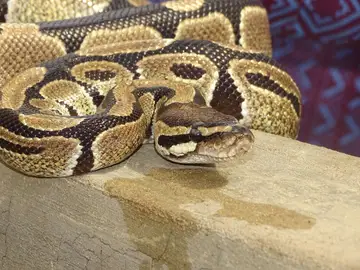
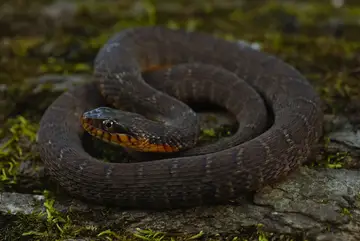
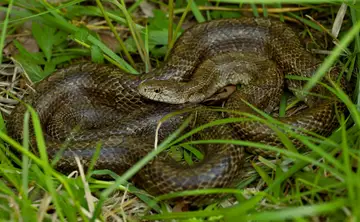
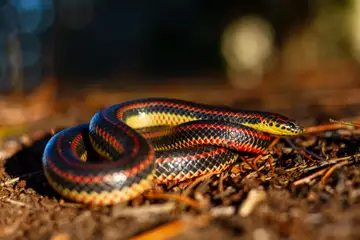
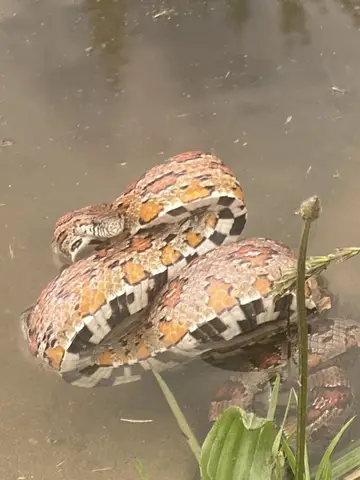
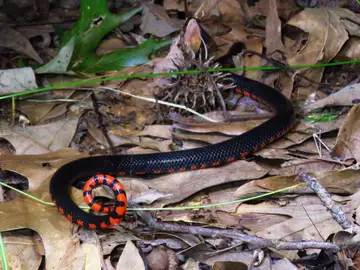
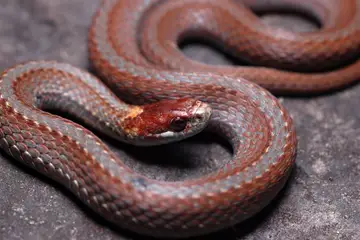
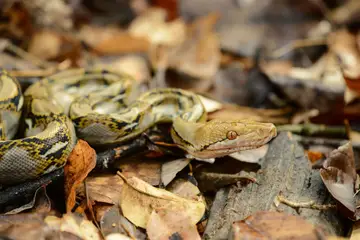
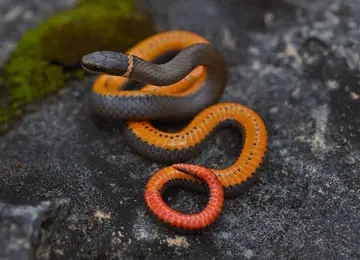
This page lists 50 snakes.
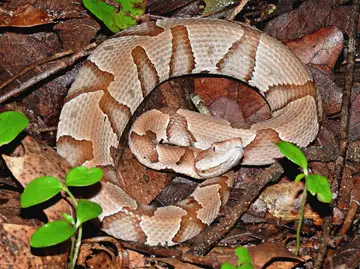
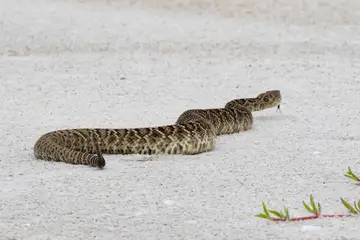
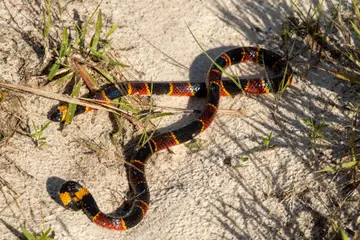
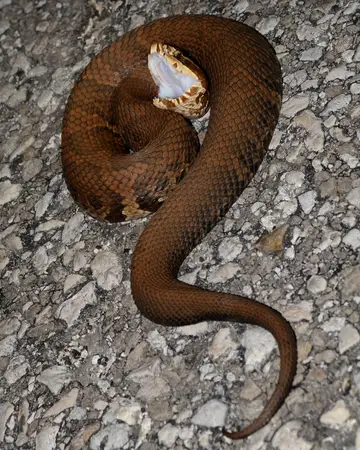
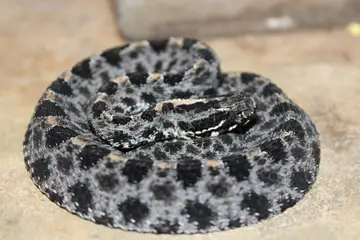
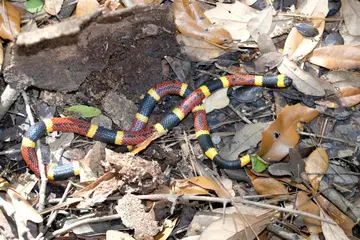
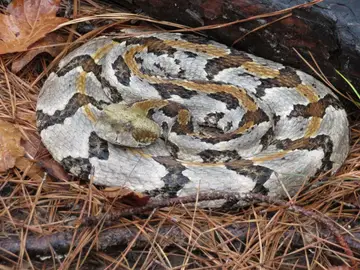
7 are venomous by official accounts: Eastern Copperhead, Eastern Diamond-backed Rattlesnake, Harlequin Coralsnake, Northern Cottonmouth, Pygmy Rattlesnake, Timber Rattlesnake and Texas Coralsnake. 5 are nonnative.
Found in the Florida Parishes east of the upper Amite River and lower Tangipahoa River. There have been no confirmed records from Louisiana since the 1980s … Louisiana Department of Wildlife and Fisheries
What the sources say
Range: Found in the Florida Parishes east of the upper Amite River and lower Tangipahoa River. There have been no confirmed records from Louisiana since the 1980s. Inhabit dry, wooded areas, especially pinelands and mixed forests, but some may be found in open pastures.
Relatively common in many places. Populations are considered stable within the state.
JFMAMJJASOND
218 records by month.What the sources say
Range: Found throughout Louisiana. They frequent swamplands and pond, lake, and stream borders, especially those with dense canopies. They often remain coiled near water, or on log jams in water, rarely ascending shrubs or palmettos. They frequently travel between streams, even over low ridges, and can be found in almost any habitat.
Rarely encountered and ranked as S2 (imperiled) in Louisiana.
What the sources say
Range: Found in upland areas and pine flatwoods in the Florida Parishes and northern and central Louisiana, southwest to Calcasieu Parish. There are isolated populations in the west edge of the Atchafalaya Basin-Vermilion River area, the salt dome islands around Cote Blanch Bay, and live oak ridges from the New Orleans area southward and eastward. Found in wooded areas but tend to avoid swamps. Favor areas with a grass understory such as pinelands and dry coastlands but are also found in palmetto flatwoods.
Populations appear stable in some places but have vanished from other known areas. Ranked as S3/S4 (rare/apparently secure) in Louisiana.
What the sources say
Range: Inhabit wooded and forested areas, preferring hardwoods. Found in most of Louisiana except coastal marshes. They occur on the salt dome islands around Cote Blanche Bay and adjacent high ground from Morgan City to Patterson, but there are no records west of the Atchafalaya Basin, in Acadiana, or in the pinelands of southwestern Louisiana.
From A to Z. "Not stated" means no official source we use gives a venom status, not that the snake is harmless. Some harmless snakes mimic venomous ones: leave every snake alone.
Most adults about 42 to 60 inches (3.5 to 5 ft); record 102 inches (8.5 ft). Ranges given by agencies: 41 to 84 in (Louisiana), 36 to 82 in (Oklahoma), adults average 50 to 72 in (Alabama), up to 94 in (NC State Extension), up to 80 in in Colorado and up to 68 in in Arizona.
How to recognize it
Long, slowly tapering tail whose scales look like a braided whip
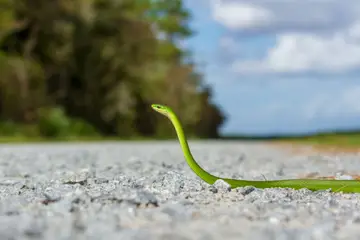
Very long and slender, with smooth scales
Large eyes with round pupils
Where in Louisiana
Inhabit upland portions of the Florida Parishes, upland parts of central and northern Louisiana, and the pine flatwoods west of Lake Charles; prefer dry, open pinelands … Louisiana Department of Wildlife and Fisheries
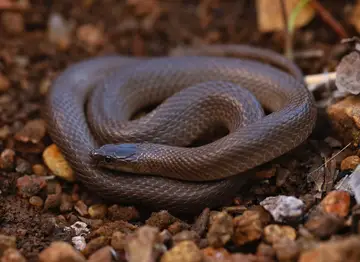
Most adults 9 to 13 inches; occasionally up to about 20 inches.
How to recognize it
Dark top of head; a dark spot under each eye and on each side of the neck
Keeled (ridged) scales in 17 rows; round pupil
Tennessee: a small dark downward streak on the side of the head
Where in Louisiana
The most frequently observed snake in suburban and urban portions of Louisiana. Tend to remain concealed beneath leaf litter, under objects, or in dense ground cover. Louisiana Department of Wildlife and Fisheries
Conservation
Populations are considered stable and can be observed routinely in almost every parish of Louisiana.
No official source we use states whether this animal is venomous. That does not mean it is harmless: do not handle it.
Size
Most adults are 48 to 66 inches long. The Florida Museum gives a record of 90 inches; Alabama gives a maximum of 83 inches for the northern and 74 inches for the black subspecies. New Jersey gives 48 to 100 inches.
How to recognize it
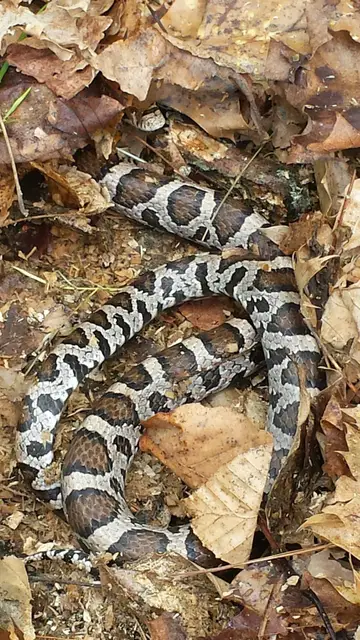
Pointed snout covered by a large, triangular, cone-shaped scale, used for pushing into soft earth.
Strongly keeled (ridged) body scales and round pupils.
Four prefrontal scales between and just in front of the eyes, where most similar snakes have two.
Conservation
Louisiana SGCN, state rank SH (possibly extirpated); federally threatened (2025 SWAP Table)
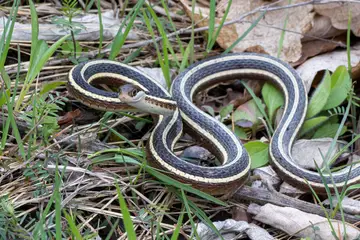
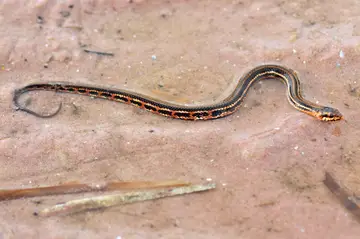
Eastern: most adults 18 to 26 inches (record 41 inches). Western: 16 to 42 inches in Louisiana; Oklahoma's orange-striped ribbonsnakes average 20 to 30 inches and can reach nearly 40.
How to recognize it
Very slender body; long tail, about one-third of total length.
Side stripes sit on the 3rd and 4th scale rows above the belly.
Upper lip scales white and unmarked; a distinct white spot in front of each eye; keeled (ridged) scales.
Found in and around marshes, swamps, and bayous in low, open areas of the state in the Mississippi - Atchafalaya basins, Acadiana, and the Red and Ouachita river bottoms. Louisiana Department of Wildlife and Fisheries
Conservation
Populations are considered stable within the state.
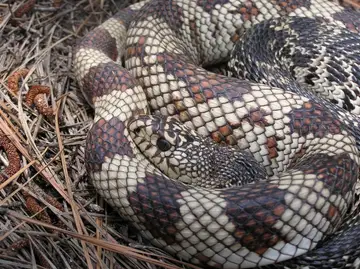
Range: Only occurs in eastern Texas and Louisiana west of the Mississippi River. Prefers areas with loose, sandy, well-drained soils. Found in open pine forests, xeric (dry) sandhill woodlands, especially longleaf pine savannahs with well-developed herbaceous understory dominated by grasses. Spend majority of time underground in burrows made by pocket gophers. The Louisiana pinesnake is presumed to be extirpated from much of its former range and is presently known from areas around Bienville Parish, the Peason Ridge area, and Fort Polk.
Ranked as S1/S2 (critically imperiled/imperiled) in Louisiana. Threats include death from vehicles and reduced habitat from agricultural and urban development
Ranked as S1 (critically imperiled) in Louisiana. Threats to population include land use conversion, habitat destruction, and fire suppression.
What the sources say
Range: Ranges along the Atlantic and Gulf coast from North Carolina to Louisiana. Found in and under rotting logs, leaves, soils, and other surface objects in coastal pine flatwoods and bottomland hardwood forests in the lower Florida Parishes from Livingston Parish eastward.
Found in northern, central, and southwestern Louisiana in upland longleaf pine woods and pine flatwoods, and mixed pine-hardwood forest, and the former prairie country … Louisiana Department of Wildlife and Fisheries
Conservation
Populations are considered stable within the state.
Range: Found in the Florida Parishes as far west as the Comite River. Rarely seen, apparently spends most of the time in the water or concealed within stream banks and root systems overhanging streams and rivers with relatively clear water, especially those with sand or gravel bottoms.
Populations are considered stable within the state.
What the sources say
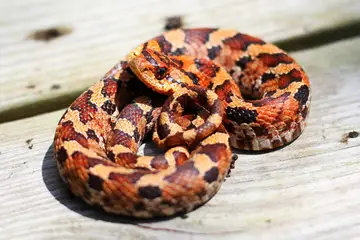
Range: Found in the Florida Parishes. A few corn snakes have been found in low country between the Mississippi River and Atchafalaya Basin; they are also present on the salt dome islands around Cote Blanch Bay. Frequent pine woods, mixed woodlands, and hardwood forests, and commonly occur in and around barns and other outbuildings where rodents are numerous.
Found in well-drained wooded and forested areas throughout the state but absent from coastal marshes and the Mississippi River floodplain … Louisiana Department of Wildlife and Fisheries
Conservation
Populations are considered stable within the state.
What the sources say
Range: Found in well-drained wooded and forested areas throughout the state but absent from coastal marshes and the Mississippi River floodplain. Thrive in yards in urban and suburban settings where they conceal themselves in leaf litter, mulch, and groundcover plants.
Most adults are 14 to 33 inches long (Florida Museum), with a record of 46 inches. Maryland, Missouri, Tennessee and Arkansas give 22 to 32 inches. The tail is long and thin, about a third or more of the total length.
How to recognize it
Keeled (ridged) scales in 17 rows, which feel rough; the smooth green snake has smooth scales.
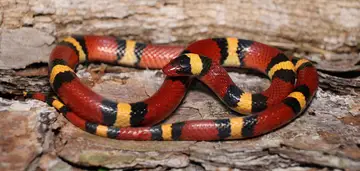
Most adults about 14-20 inches (36-51 cm); record 29.1 inches (Florida Museum). Louisiana gives 12 to 24 inches; NC State Extension says up to 27 inches.
How to recognize it
Red and yellow rings are separated by black rings, so red and yellow do not touch.
Found in wooded or forested areas, especially where there are pines, in the Florida Parishes and upland areas in northern and central Louisiana. Louisiana Department of Wildlife and Fisheries
Conservation
Populations are considered stable within the state.
Common in woodlands and semi-open habitats, including marshes and vacant lots, throughout Louisiana west of the Mississippi and Atchafalaya River floodplains. Louisiana Department of Wildlife and Fisheries
Conservation
Potential declining populations though still regularly observed.
Occur in bottomland hardwood and mixed pine-hardwood forests. Found along the Red River Valley and southeastward along the lower Mississippi River floodplain … Louisiana Department of Wildlife and Fisheries
Conservation
Populations are considered stable within the state.
Populations are considered stable within the state.
JFMAMJJASOND
72 records by month.What the sources say
Range: Found throughout Louisiana eastward to the Mississippi River floodplain but sparingly into the edge of the marsh country. Found in most habitats in Louisiana but most common in areas containing a mixture of pastures, farmland, and woodlands.
Active during the day and found in grassland and woodland habitats, often in the vicinity of water sources, around swamps and in marshes throughout Louisiana, except in … Louisiana Department of Wildlife and Fisheries
Conservation
Populations are considered stable within the state.
What the sources say
Range: Active during the day and found in grassland and woodland habitats, often in the vicinity of water sources, around swamps and in marshes throughout Louisiana, except in Washington and northern St. Tammany parishes. Prefer areas with ample sunlight.
TWRA: the racer lacks the coachwhip's reddish tint along the sides of the tail; an all-black coachwhip is distinctly lighter or reddish toward the rear. Oklahoma: the coachwhip is much larger.
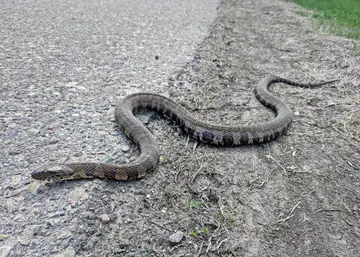
Northern watersnake or Cottonmouth (water moccasin)?
Photo: U.S. Fish and Wildlife Service - Midwest Region · Public domain · Wikimedia Commons
Cottonmouths are heavier-bodied with a larger, chunky head, a pit between nostril and eye, darker color, and a light line from the eye to the corner of the mouth (Missouri). Cottonmouths have cat-like pupils; watersnakes have round pupils and no facial pit, and seen from above a cottonmouth's eyes are hidden while a watersnake's are visible (Florida Museum). Georgia DNR: banded watersnakes have bands widest on top; banded cottonmouths have bands widest on the sides (hourglass-shaped from above). Cottonmouths float on the water; watersnakes swim with the body just below the surface (Virginia DWR). Cautions from the same agencies: Virginia DWR says some other nonvenomous snakes, such as the eastern hog-nosed snake, also float, and that watersnakes often flatten the head when threatened so it looks diamond-shaped; CDFW says older northern watersnakes can look almost entirely dark brown or black.
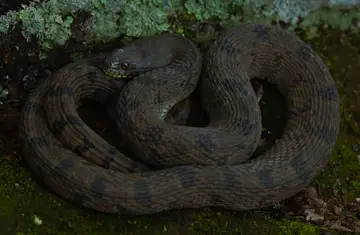
Northern watersnake or Copperhead?
Photo: U.S. Fish and Wildlife Service - Midwest Region · Public domain · Wikimedia Commons
Florida Museum (midland watersnake): the watersnake's crossbands are darker, narrower and much more numerous than a copperhead's and turn into blotches halfway down the body. Watersnakes have round pupils and dark vertical lines near the mouth; copperheads have no such lines.
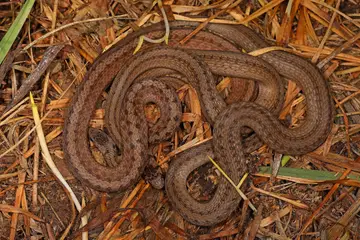
Copperheads have bold hourglass-shaped bands, and young copperheads under about 12 inches have bright yellow tail tips. Brown snakes have small spots, not hourglass bands.
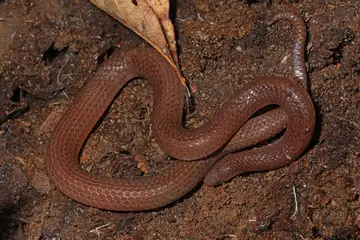
Brown Snake (Dekay's Brownsnake) or Red-bellied Snake?
Nuisance alligators: contact an LDWF field office, or Operation Game Thief 800-442-2511 after hours and weekends. Sick/injured/stranded sea turtles or marine mammals: 844-SEA-TRTL (844-732-8785). Rabies: Louisiana Department of Health, Office of Public Health, 1-800-256-2748. Louisiana Department of Wildlife and Fisheries
Yes. LDWF's field guide lists six venomous species (Eastern Copperhead, Harlequin Coralsnake, Eastern Diamond-backed Rattlesnake, Northern Cottonmouth, Pygmy Rattlesnake, Timber Rattlesnake); the LDWF 2022 poster also shows the Texas Coralsnake under "Venomous Snakes". Louisiana Department of Wildlife and Fisheries
“Venomous Snake Species”
Are there water moccasins (cottonmouths) in Louisiana?
Rarely. LDWF lists the Harlequin Coralsnake as venomous and says there have been no confirmed Louisiana records since the 1980s; the 2025 SWAP says it "may be extirpated from the state". The LDWF 2022 Snakes of Louisiana poster also shows the Texas Coralsnake under "Venomous Snakes" (no Louisiana range given). Louisiana Department of Wildlife and Fisheries
“There have been no confirmed records from Louisiana since the 1980s.”
Are there rattlesnakes in Louisiana?
Yes. LDWF lists Timber, Pygmy and Eastern Diamond-backed Rattlesnakes as venomous. LDWF says there are no more than eight verifiable Eastern Diamond-backed records in Louisiana (last in 1995) and ranks it S1; the 2025 SWAP says it "may be extirpated from the state". Louisiana Department of Wildlife and Fisheries
“There are no more than eight verifiable records of this snake in Louisiana”
“A Restricted Snake Permit is required for possession of any native and non-native venomous snake species in Louisiana.”
“Move from hibernation sites to summer foraging grounds in mid-spring and return to winter quarters in late summer and early fall; most often observed during these periods of travel.”