Scarlet kingsnake
Lampropeltis elapsoides · also called Scarlet king snake, Scarlet milksnake and Lampropeltis triangulum elapsoides (older name: formerly a milk snake subspecies; still used by Tennessee, Kentucky, Mississippi's 2012 checklist, Georgia DNR's coral snake fact sheet, Virginia's 2019 page and NPS Great Smoky Mountains) · Last checked November 3, 2026.
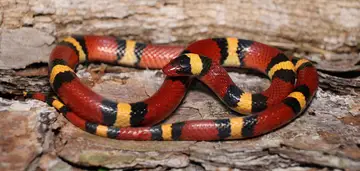

The scarlet kingsnake (Lampropeltis elapsoides) is a small, thin snake, usually 14-20 inches long, ringed in red, black and yellow (or white), with a red snout. The Florida Museum says it is non-venomous and not dangerous to people or pets. It looks like the venomous coral snake: on the scarlet kingsnake the red and yellow rings are separated by black and do not touch, but the Florida Museum warns that unusual color variations can break that rule, so if you are not 100% sure, leave the snake alone. It lives in the southeastern US, from Virginia and Kentucky south through Florida and west to Louisiana. Florida Museum of Natural History
On this page
Is the scarlet kingsnake dangerous?
Florida Museum of Natural History: non-venomous; scarlet kingsnakes are not dangerous to people or pets. But because it closely resembles the venomous coral snake, the Florida Museum advises: if you are not 100% positive of the identification of a snake, leave it alone. Florida Museum of Natural History
“Non-venomous. Scarlet Kingsnakes are not dangerous to people or pets.”
Bites and stings: Florida Museum: if grabbed or pinned it will readily bite and release a foul-smelling musk, though some do not bite; it is not aggressive and strikes only as a last resort in defense. NC State Extension: when handled it might bite and emit musk.
If someone is bitten or stung, call 911 or Poison Help at 1-800-222-1222.
How to identify a scarlet kingsnake
A photo or description can narrow it down, but cannot confirm what an animal is or that it is safe. Look from a distance and do not handle wild animals.
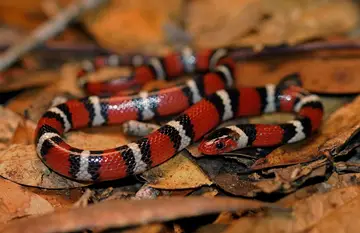

Size: Most adults about 14-20 inches (36-51 cm); record 29.1 inches (Florida Museum). Louisiana gives 12 to 24 inches; NC State Extension says up to 27 inches.
Colors: red, black, yellow and white. Pattern: rings of red, black and yellow that circle the whole body; red and yellow rings separated by black (do not touch); red snout.
Key features
- Red and yellow rings are separated by black rings, so red and yellow do not touch. Florida Museum of Natural History
- Small head with a red snout. Florida Museum of Natural History
- Rings continue across the belly (Louisiana). Louisiana Department of Wildlife and Fisheries
- Smooth, shiny scales; 19 scale rows at midbody. Florida Museum of Natural History
- Round pupil. Florida Museum of Natural History
Young
Colored like adults, but the yellow rings may be white.
Animals mistaken for the scarlet kingsnake
Scarlet kingsnake or Eastern coral snake (Harlequin coralsnake)?
Scarlet kingsnake
Eastern coral snake (Harlequin coralsnake) Micrurus fulvius
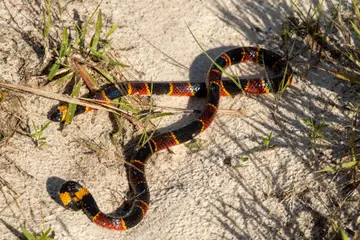
Coral snake: red and black rings separated by narrower yellow rings, so red touches yellow, and a black snout. Scarlet kingsnake: red touches only black, and the snout is red. UF/IFAS says the red-touches-yellow rule should only be applied to coral snakes in North America, and the NCWRC says it should never be used in tropical America. The Florida Museum says the rhymes hold true most of the time in Florida, but unusual color variations sometimes break the rules, so if you are not 100% sure, leave the snake alone.
Venomous. NC State Extension: highly venomous, with venom that can cause paralysis and respiratory failure. Leave it alone.
Scarlet kingsnake or Scarlet snake (Scarletsnake)?
Scarlet kingsnake
Scarlet snake (Scarletsnake) Cemophora coccinea
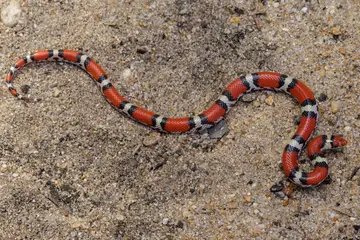

Scarlet snake: the rings do not go all the way around the body; the belly is plain creamy white; the red snout is more pointed. Scarlet kingsnake: rings encircle the body and continue across the belly.
Non-venomous (Florida Museum).
Scarlet kingsnake or Milk snakes (eastern and red milksnake)?
Scarlet kingsnake
Milk snakes (eastern and red milksnake) Lampropeltis triangulum
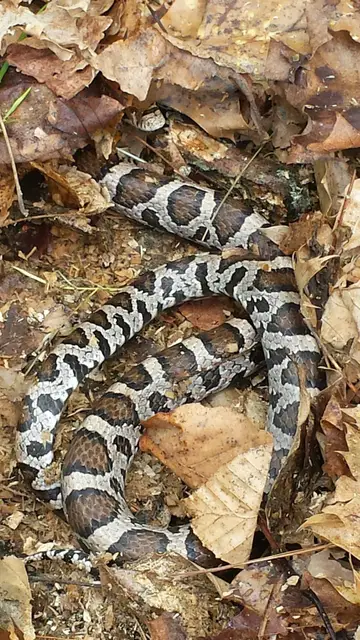
Tennessee: the eastern milksnake is gray or tan with brownish or reddish-brown, black-bordered blotches; the red milksnake has red blotches on a white or yellow body. Their bellies are a black-and-white checkerboard, while the scarlet kingsnake's ringed pattern continues onto the belly and red touches black but not yellow. Tennessee Wildlife Resources Agency
Non-venomous (see the milk-snake page). MSU Extension notes coral snakes can be confused with nonvenomous scarlet kingsnakes and milk snakes.
Where the scarlet kingsnake lives
- Native or listed
- Nonnative or not established
- No official record in our data
- 1–9
- 10–99
- 100–999
- 1,000+
On our state guides
- Alabama snakes
- Florida snakes
- Georgia snakes
- Kentucky snakes
- Louisiana snakes
- Mississippi snakes
- North Carolina snakes
- South Carolina snakes
- Virginia snakes
State boundaries: U.S. Census Bureau, cartographic boundary file cb_2024_us_state_20m.
When it is active
Mainly nocturnal (Florida Museum; NC State Extension). UGA SREL: often surfaces on warm, humid nights in spring and early summer, and may cross roads after rain. Alabama: hunts mostly at night, dawn or dusk but can be active by day; rarely seen except in spring.
US open-licence records peak in January, March, May and October.
Habitat and habits
Habitat: Typically wet pinelands and mesic hammocks, also drier habitats; usually under rocks, logs and debris, but an excellent climber found in trees and on buildings, and occasionally in suburban neighborhoods (Florida Museum). In North Carolina, rotting logs and bark in Coastal Plain pine forests.
Behavior: Secretive and rarely seen. When captured it may strike and vibrate its tail, which buzzes in leaf litter; it is not aggressive (Florida Museum). Often thought to mimic coral snakes, which UGA SREL calls a classic case of Batesian mimicry.
Diet: Mainly lizards (especially skinks) and small snakes, killed by constriction; larger ones may eat small mammals, and newborns eat small frogs and invertebrates (Florida Museum).
Young: Egg-layer. In Florida females lay about 2-8 eggs, underground, in rotten logs or debris; they hatch July to November (Florida Museum). Alabama: breeds March to June, lays eggs May through August, 2-9 eggs, young emerge about two months later.
Legal status and reporting
Protection: Alabama protects all native kingsnakes under nongame regulation 220-2-.92 (illegal to take, kill, possess or sell without a permit). UGA SREL says it is protected by law in Georgia and South Carolina.
Report: Not invasive, so no reporting program applies. The Florida Museum invites photos or videos of interesting observations by email to its herpetology staff, or posting on iNaturalist. Florida Museum of Natural History
Questions about the scarlet kingsnake
Scarlet kingsnake
A small (usually 14-20 inch), non-venomous snake of the southeastern US with red, black and yellow rings around the body and a red snout. The Florida Museum says it is not dangerous to people or pets. It looks like the venomous coral snake, so if you are not 100% sure what a snake is, leave it alone.
Coral snake vs scarlet kingsnake
On the coral snake the red rings touch the yellow rings and the snout is black. On the scarlet kingsnake the red rings touch only black and the snout is red (NC State Extension, UF/IFAS). These pattern rules apply to US snakes: UF/IFAS says use them only for North American coral snakes. The Florida Museum warns unusual color variations sometimes break the rules. If you are not 100% sure, leave the snake alone; coral snakes are highly venomous.
Coral snake vs king snake rhyme
Official versions vary, for example Florida Museum: "Red touches yellow, kill a fellow; red touches black, venom lack." It describes the US coral snake, whose red rings touch yellow. Use it with caution: the Florida Museum says unusual color variations sometimes break the rule, Georgia DNR says people often misremember it, UF/IFAS says to apply it only to coral snakes in North America, and NCWRC says it should never be used in tropical America. When in doubt, leave the snake alone.
King snake vs coral snake
The scarlet kingsnake is the kingsnake most often mistaken for a coral snake. Both have red, black and yellow rings around the body. The kingsnake has a red snout and its yellow rings are separated from the red by black; the coral snake has a black snout and red touches yellow (Georgia DNR, Florida Museum). The coral snake is venomous; the scarlet kingsnake is not. If unsure, do not touch.
Is a king snake a constrictor?
Yes. The Florida Museum says scarlet kingsnakes kill their prey (mostly lizards and small snakes) by constriction, and NCWRC calls them constrictors.
Are there king snakes in florida?
Yes. One of them, the scarlet kingsnake, is found throughout Florida and in every county, including two records from the Keys (Florida Museum). It is non-venomous but looks like the venomous harlequin coralsnake.
Are there king snakes in tennessee?
Yes. Among them, TWRA says the scarlet kingsnake (which it treats as a milksnake subspecies) ranges from southern Land Between the Lakes south along the Tennessee River to the Mississippi/Alabama border. NPS also lists it for Great Smoky Mountains National Park.
Are there king snakes in virginia?
Yes. Virginia DWR's native fauna list includes the scarlet kingsnake. DWR's older species page says it has been found mainly in southeastern Virginia, often near woodlands, especially pine.
Sources
- Florida Snake ID Guide species account: Scarlet Kingsnake. Florida Museum of Natural History (University of Florida). updated March 18, 2026; checked November 3, 2026.
Quoted passages (8)
“Non-venomous. Scarlet Kingsnakes are not dangerous to people or pets.”
“Both the red and yellow rings are separated by black rings. As a result, the red and yellow rings do not touch.”
“The small head is barely distinct from the neck and has a red snout.”
“The scales of the body are smooth and shiny, and there are 19 scale rows at midbody.”
“The pupil is round.”
“The coloration of juveniles is the same as described for adults, but the yellow rings may be white.”
“Scarlet Kingsnakes typically feed on lizards (especially skinks) and small snakes, which are killed by constriction. However, larger individuals may feed on small mammals, and newborns are known to eat small frogs and invertebrates.”
“Send photos or videos of interesting observations, along with associated information, by emailing the herpetology staff at the Florida Museum for documentation in the Museum’s Herpetology Master Database. You can also post your observations on iNaturalist.”
- Scarlet Kingsnake (Lampropeltis elapsoides). University of Georgia Savannah River Ecology Laboratory (linked by SCDNR as its species information). undated page; checked November 3, 2026.
- Kentucky Snakes (booklet, compiled by Bill Moore and Tim Slone). Kentucky Department of Fish and Wildlife Resources. archived copy, captured June 26, 2026; checked November 3, 2026.
- Snake Species Field Guide: Scarlet Kingsnake. Louisiana Department of Wildlife and Fisheries. undated page; checked November 3, 2026.
Quoted passages (1)
“Rings continue across belly. Snout is always red.”
- Reptiles » Snakes (Tennessee Watchable Wildlife species accounts). Tennessee Wildlife Resources Agency (Tennessee Watchable Wildlife website). undated page; checked November 3, 2026.
Quoted passages (1)
“Eastern Milksnake has a gray or tan body with irregular brownish or reddish-brown, black-bordered blotches down the back … Red Milksnake has a white or yellow body with red, reddish-brown, or orange-red, black-bordered blotches on the back. … Scarlet Kingsnake has a red snout and alternating bands of red, black, and yellow the length of the body in which red touches black but not yellow. Belly is marked with black and white checkerboard pattern, except dorsal pattern on Scarlet Kingsnake continues onto belly.”
- Snakes: Family Colubridae (AG-472-02). NC State Extension (N.C. Cooperative Extension, NC State University). Publication date: Aug. 21, 2019; checked November 3, 2026.
- Recognizing Florida's Venomous Snakes (UW229). UF/IFAS Extension (Ask IFAS). undated page; checked November 3, 2026.
- Snakes: Family Elapidae (AG-472-02). NC State Extension (N.C. Cooperative Extension, NC State University). Publication date: Aug. 21, 2019; checked November 3, 2026.
- Venomous Snakes Fact Sheet Series: Eastern Coral Snake. Georgia DNR Wildlife Resources Division. PDF Last-Modified Fri, 02 Feb 2024 14:12:53 GMT; checked November 3, 2026.
- Eastern Coral Snake (NCWRC species page). N.C. Wildlife Resources Commission. undated page; checked November 3, 2026.
- Eastern Coral Snake. Alabama Department of Conservation and Natural Resources (Outdoor Alabama). undated page; checked November 3, 2026.
- Scarlet Kingsnake. Alabama Department of Conservation and Natural Resources (Outdoor Alabama). undated page; checked November 3, 2026.
- Scarlet Kingsnake (NCWRC species page). N.C. Wildlife Resources Commission. undated page; checked November 3, 2026.
- Reptiles - Great Smoky Mountains National Park. U.S. National Park Service. updated October 29, 2025; checked November 3, 2026.
- List of Native and Naturalized Fauna of Virginia. Virginia Department of Wildlife Resources (DWR). May, 2026; checked November 3, 2026.
- Scarlet Kingsnake (Lampropeltis triangulum elapsoides) species information. Virginia Department of Game and Inland Fisheries (now Virginia Department of Wildlife Resources). archived copy, captured October 18, 2019; checked November 3, 2026.
- GBIF.org occurrence records, human observations licensed CC0 1.0 or CC BY 4.0 only, accessed November 3, 2026. The datasets behind these counts are listed on our Sources page.
- State boundaries: U.S. Census Bureau, cartographic boundary file cb_2024_us_state_20m.