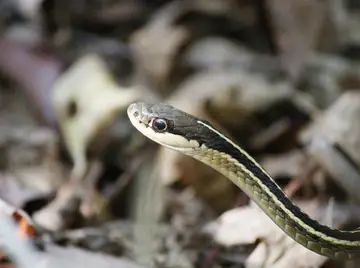
KDFWR: …of the 32 types of snakes found in Kentucky, only four are venomous
This page lists 33 snakes: all from KDFWR's Snakes of Kentucky with the KDFWR Reptiles of Kentucky species list.
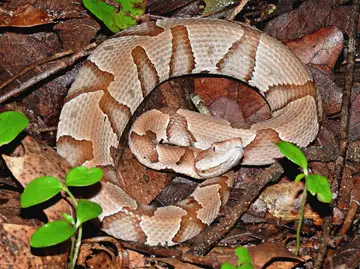
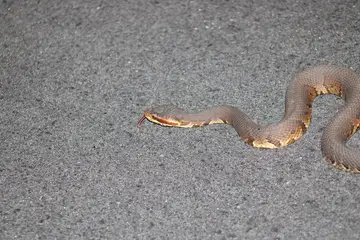
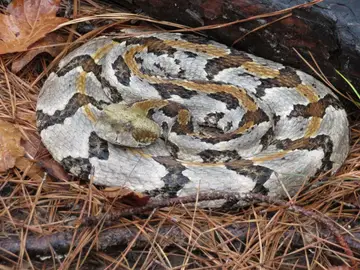
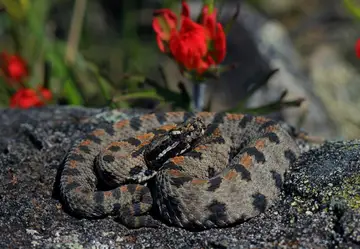
4 are venomous by official accounts: Eastern Copperhead, Timber Rattlesnake, Northern Cottonmouth and Western Pigmy Rattlesnake. KDFWR gives a total of 32; the 33 here are the snakes official sources name one by one.
“Kentucky’s venomous snakes are the copperhead, cottonmouth, timber rattlesnake, and pigmy rattlesnake. All four species belong to a group of snakes called pit vipers.” KDFWR
Size
Adults usually about 2 to 3 feet (24-36 in); record about 53 inches.
How to recognize it
Vertical (cat-like) pupils and a heat-sensing pit between eye and nostril
Heavy-bodied; keeled scales
Head shape alone is not a reliable way to identify copperheads
JFMAMJJASOND
83 records by month.What the sources say
Venom: “Venomous - Species with the "" icon indicate that this species is venomous; please use caution when encountering this species.) … of the 32 types of snakes found in Kentucky, only four are venomous. … [species card:] EASTERN COPPERHEAD (Agkistrodon contortrix)” (KDFWR)
“Kentucky’s venomous snakes are the copperhead, cottonmouth, timber rattlesnake, and pigmy rattlesnake. All four species belong to a group of snakes called pit vipers.” KDFWR
Size
Typically 30 to 48 inches (about 3 to 4 feet); recorded up to 75 inches.
How to recognize it
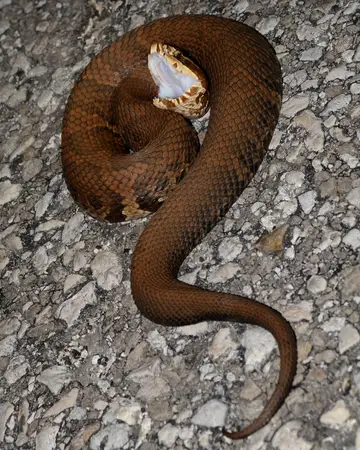
Heat-sensing pit between nostril and eye; no rattle
Head much wider than the neck, with a dark bar from the eye to the jaw; vertical (cat-eye) pupils
Gapes to show the white lining of its mouth when threatened
Where in Kentucky
Physiographic Regions: Interior Plateau, Interior River Valley And Hills, Mississippi Alluvial Plain, Mississippi Valley Loess Plain KDFWR
Conservation
KY SWAP 2023 Species of Greatest Conservation Need; priority group: High; state rank S3
What the sources say
Venom: “Venomous - Species with the "" icon indicate that this species is venomous; please use caution when encountering this species.) … of the 32 types of snakes found in Kentucky, only four are venomous. … [species card:] NORTHERN COTTONMOUTH (Agkistrodon piscivorus leucostoma)” (KDFWR)
Habitat: Generally requires high south or west facing wooded bluffs providing mammal burrows and/or other underground retreats for successful hibernation. (KDFWR)
“Kentucky’s venomous snakes are the copperhead, cottonmouth, timber rattlesnake, and pigmy rattlesnake. All four species belong to a group of snakes called pit vipers.” KDFWR
Size
Most adults 36 to 60 inches (3 to 5 feet); record 74.5 inches.
How to recognize it
Black tail ending in a rattle
Heat-sensing pit between nostril and eye
Large, thick head distinct from the neck; cat-like vertical pupil
Where in Kentucky
Physiographic Regions: Cumberland Mountains, Cumberland Plateau, Plateau Escarpment, Bluegrass, Knobs, Interior Plateau, Interior River Valley And Hills, Mississippi … KDFWR
Conservation
KY SWAP 2023 Species of Greatest Conservation Need; priority group: Moderate; state rank S5
What the sources say
Venom: “Venomous - Species with the "" icon indicate that this species is venomous; please use caution when encountering this species.) … of the 32 types of snakes found in Kentucky, only four are venomous. … [species card:] TIMBER RATTLESNAKE (Crotalus horridus)” (KDFWR)
Range: Physiographic Regions: Cumberland Mountains, Cumberland Plateau, Plateau Escarpment, Bluegrass, Knobs, Interior Plateau, Interior River Valley And Hills, Mississippi Alluvial Plain, Mississippi Valley Loess Plain
Habitat: Most common in mature upland forest; often associated with cliffs and boulder-strewn slopes. Also uses powerline cuts, old mine sites, and abandoned quarries for basking and/or birthing areas. (KDFWR)
“Kentucky’s venomous snakes are the copperhead, cottonmouth, timber rattlesnake, and pigmy rattlesnake. All four species belong to a group of snakes called pit vipers.” KDFWR
KY SWAP 2023 Species of Greatest Conservation Need (data deficient); priority group: Data Deficient; state rank S1
What the sources say
Venom: “Venomous - Species with the "" icon indicate that this species is venomous; please use caution when encountering this species.) … of the 32 types of snakes found in Kentucky, only four are venomous. … [species card:] WESTERN PIGMY RATTLESNAKE (Sistrurus miliarius steckeri)” (KDFWR)
Habitat: Uses a variety of habitat, including margins of ag fields and cemeteries, rocky upland woods, periphery of gravel pit/quarry and associated roadsides. (KDFWR)
The other 29 snakes
From A to Z. Some harmless snakes mimic venomous ones: leave every snake alone.
KY SWAP 2023 Species of Greatest Conservation Need; priority group: High; state rank S1
What the sources say
Venom: “Non-venomous (Harmless) - This gallery includes both egg-laying and live-bearing snakes that are harmless. … [species card:] Broad-banded Watersnake (Nerodia fasciata confluens)” (KDFWR)
Habitat: Occurs in and along various wetland habitats including cypress swamps and flooded bottomland hardwood forests; also in sloughs, bayous, sluggish stream channels, seasonal shallow wetlands, and roadside ditches in both forested and open habitats. (KDFWR)
Venom: “Non-venomous (Harmless) - This gallery includes both egg-laying and live-bearing snakes that are harmless. … [species card:] Central Ratsnake (Pantherophis alleghaniensis)” (KDFWR)
Photo: U.S. Fish and Wildlife Service - Midwest Region · Public domain · Wikimedia Commons
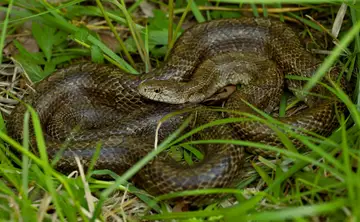
Adults 22 to 42 inches long, occasionally to 59 inches (Missouri). Pennsylvania gives 24 to over 50 inches; females are usually bigger than males.
How to recognize it
Dark crossbands on the front part of the body break up into rows of blotches from the middle of the body to the tail.
Belly white, yellow or orange, usually with dark half-moon-shaped spots.
Keeled (ridged) scales, so it feels rough; round pupils like other nonvenomous snakes in Missouri.
JFMAMJJASOND
76 records by month.What the sources say
Venom: “Non-venomous (Harmless) - This gallery includes both egg-laying and live-bearing snakes that are harmless. … [species card:] Common Watersnake (Nerodia sipedon)” (KDFWR)
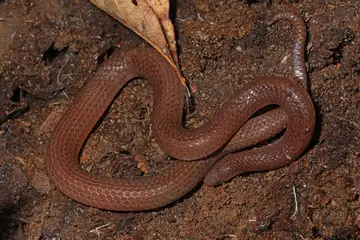
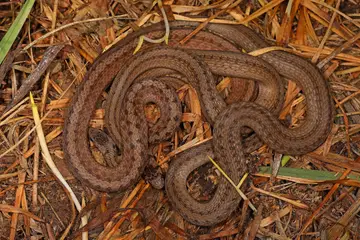
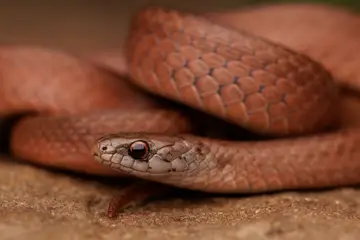
Venom: “Non-venomous (Harmless) - This gallery includes both egg-laying and live-bearing snakes that are harmless. … [species card:] Common Wormsnake (Carphonphis amoenus)” (KDFWR)
Physiographic Regions: Bluegrass, Interior Plateau, Interior River Valley And Hills KDFWR
Conservation
KY SWAP 2023 Species of Greatest Conservation Need; priority group: High; state rank S3; federal status: Threatened
What the sources say
Venom: “Non-venomous (Harmless) - This gallery includes both egg-laying and live-bearing snakes that are harmless. … [species card:] Copperbelly Watersnake (Nerodia erythrogaster neglecta)” (KDFWR)
Habitat: Found in and along wetlands, lakes, ponds, and sluggish streams. (KDFWR)
Most adults 9 to 13 inches; occasionally up to about 20 inches.
How to recognize it
Dark top of head; a dark spot under each eye and on each side of the neck
Keeled (ridged) scales in 17 rows; round pupil
Tennessee: a small dark downward streak on the side of the head
JFMAMJJASOND
40 records by month.What the sources say
Venom: “Non-venomous (Harmless) - This gallery includes both egg-laying and live-bearing snakes that are harmless. … [species card:] DeKay's Brownsnake (Storeria dekayi)” (KDFWR)
Venom: “Non-venomous (Harmless) - This gallery includes both egg-laying and live-bearing snakes that are harmless. … [species card:] Diamond-backed Watersnake (Nerodia rhombifer)” (KDFWR)
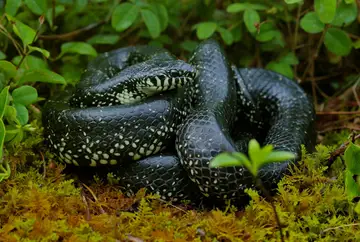
Venom: “Non-venomous (Harmless) - This gallery includes both egg-laying and live-bearing snakes that are harmless. … [species card:] Eastern Black Kingsnake (Lampropeltis nigra)” (KDFWR)
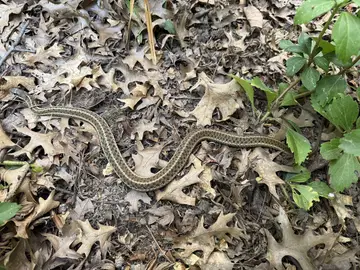
Venom: “Non-venomous (Harmless) - This gallery includes both egg-laying and live-bearing snakes that are harmless. … [species card:] Eastern Gartersnake (Thamnophis sirtalis sirtalis)” (KDFWR)
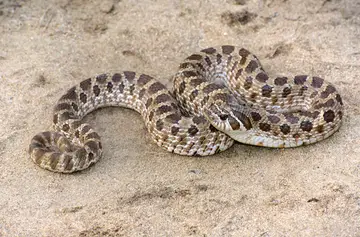
Venom: “Non-venomous (Harmless) - This gallery includes both egg-laying and live-bearing snakes that are harmless. … [species card:] Eastern Hog-nosed Snake (Heterodon platirhinos)” (KDFWR)
Eastern milksnake 24 to 52 inches (Alabama); TN gives 24 to 36 inches for eastern and 21 to 28 for red milksnake.
How to recognize it
Eastern milksnake: black-and-white checkerboard belly (Ohio). Western milksnake in Louisiana: underside dull white with scattered black marks.
Eastern milksnake: a light Y- or V-shaped mark is usually present on the nape
Smooth, shiny scales and round pupils
JFMAMJJASOND
46 records by month.What the sources say
Venom: “Non-venomous (Harmless) - This gallery includes both egg-laying and live-bearing snakes that are harmless. … [species card:] Eastern Milksnake (Lampropeltis triangulum)” (KDFWR)
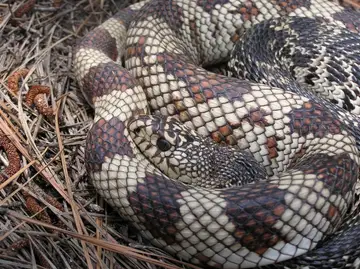
Most adults are 48 to 66 inches long. The Florida Museum gives a record of 90 inches; Alabama gives a maximum of 83 inches for the northern and 74 inches for the black subspecies. New Jersey gives 48 to 100 inches.
How to recognize it
Pointed snout covered by a large, triangular, cone-shaped scale, used for pushing into soft earth.
Strongly keeled (ridged) body scales and round pupils.
Four prefrontal scales between and just in front of the eyes, where most similar snakes have two.
Where in Kentucky
Physiographic Regions: Cumberland Mountains, Cumberland Plateau, Plateau Escarpment, Interior Plateau, Interior River Valley And Hills KDFWR
Conservation
KY SWAP 2023 Species of Greatest Conservation Need (data deficient); priority group: Data Deficient; state rank S1
What the sources say
Venom: “Non-venomous (Harmless) - This gallery includes both egg-laying and live-bearing snakes that are harmless. … [species card:] Eastern Pinesnake (Pituophis melanoleucus)” (KDFWR)
Habitat: Uses open understory woodlands, grasslands, old fields, savannahs - avoids wetlands and closed canopy forests. (KDFWR)
Physiographic Regions: Plateau Escarpment, Bluegrass, Knobs, Interior Plateau, Interior River Valley And Hills, Mississippi Alluvial Plain, Mississippi Valley Loess Plain KDFWR
Conservation
KY SWAP 2023 Species of Greatest Conservation Need (data deficient); priority group: Data Deficient; state rank S3
What the sources say
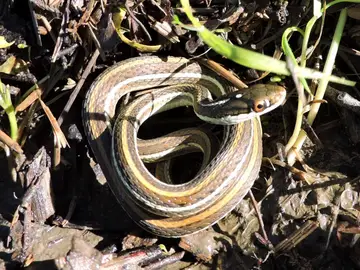
Venom: “Non-venomous (Harmless) - This gallery includes both egg-laying and live-bearing snakes that are harmless. … [species card:] Eastern Ribbonsnake (Thamnophis saurita saurita)” (KDFWR)
Habitat: In western Kentucky, found in and along various wetland habitats including cypress swamps, flooded bottomland hardwood stands, sloughs, bayous, sluggish stream channels, seasonal shallow wetlands, and roadside ditches. In the eastern and southern portion of the Interior Plateau, occurs in small isolated colonies associated with shallow swamps and sinkhole ponds and is quite rare. (KDFWR)
Physiographic Regions: Bluegrass, Knobs, Interior River Valley And Hills, Mississippi Valley Loess Plain KDFWR
Conservation
KY SWAP 2023 Species of Greatest Conservation Need (data deficient); priority group: Data Deficient; state rank S2
What the sources say
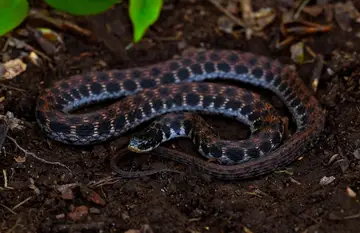
Venom: “Non-venomous (Harmless) - This gallery includes both egg-laying and live-bearing snakes that are harmless. … [species card:] Kirtland's Snake (Clonophis kirtlandii)” (KDFWR)
Habitat: In addition to natural wetland, also uses impacted areas including low-lying back yards, vacant lots, and waste areas. (KDFWR)
KY SWAP 2023 Species of Greatest Conservation Need (data deficient); priority group: Data Deficient; state rank S1
What the sources say
Venom: “Non-venomous (Harmless) - This gallery includes both egg-laying and live-bearing snakes that are harmless. … [species card:] Mississippi Green Watersnake (Nerodia cyclopion)” (KDFWR)
Habitat: Wetland habitat. (KDFWR)
Photo: Everglades NPS from Homestead, Florida, United States · Public domain · Wikimedia Commons
Most adults about 3 to 5 ft. Sources range from 20 to 56 inches (Florida Museum) to 34 to 77 inches (New Jersey); Alabama says some exceed 6 ft.
How to recognize it
Smooth scales
Long and slender with large eyes
White chin
JFMAMJJASOND
69 records by month.What the sources say
Venom: “Non-venomous (Harmless) - This gallery includes both egg-laying and live-bearing snakes that are harmless. … [species card:] North American Racer (Coluber consrictor)” (KDFWR)
Venom: “Non-venomous (Harmless) - This gallery includes both egg-laying and live-bearing snakes that are harmless. … [species card:] Plain-bellied Water Snake (Nerodia erythrogaster)” (KDFWR)
Venom: “Non-venomous (Harmless) - This gallery includes both egg-laying and live-bearing snakes that are harmless. … [species card:] Prairie Kingsnake (Lampropeltis calligaster)” (KDFWR)
Venom: “Non-venomous (Harmless) - This gallery includes both egg-laying and live-bearing snakes that are harmless. … [species card:] Queensnake (Regina septemvittata)” (KDFWR)
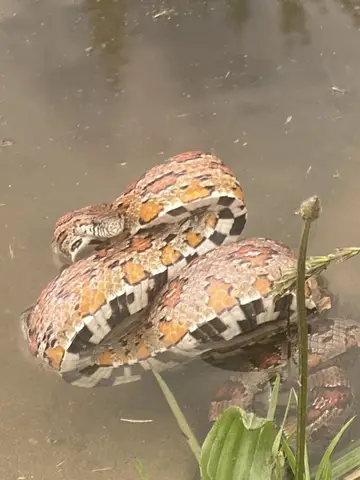
Most adults 30-48 inches (76-122 cm); record 74 inches (188 cm)
How to recognize it
Spear-shaped head marking from the neck to a point between the eyes is a reliable identification feature
Weakly keeled scales and round pupil
Where in Kentucky
Physiographic Regions: Cumberland Plateau, Plateau Escarpment, Interior Plateau, Interior River Valley And Hills KDFWR
Conservation
KY SWAP 2023 Species of Greatest Conservation Need (data deficient); priority group: Data Deficient; state rank S3
What the sources say
Venom: “Non-venomous (Harmless) - This gallery includes both egg-laying and live-bearing snakes that are harmless. … [species card:] Red Cornsnake (Pantherophis guttantus)” (KDFWR)
Habitat: Mostly found in and around openings, remnant grasslands, glades, and prairie patches situated within matrix consisting primarily of upland forest but sometimes encountered in intact forests. (KDFWR)
Physiographic Regions: Interior Plateau, Interior River Valley And Hills, Mississippi Alluvial Plain, Mississippi Valley Loess Plain KDFWR
Conservation
KY SWAP 2023 Species of Greatest Conservation Need; priority group: High; state rank S3
What the sources say
Venom: “Non-venomous (Harmless) - This gallery includes both egg-laying and live-bearing snakes that are harmless. … [species card:] Red-bellied Mudsnake (Farancia abacura)” (KDFWR)
Habitat: Occurs primarily in forested wetlands including cypress swamps, sloughs, bayous, and sluggish waterways meandering through bottomland forests; nearly always found in or immediately adjacent to water. (KDFWR)
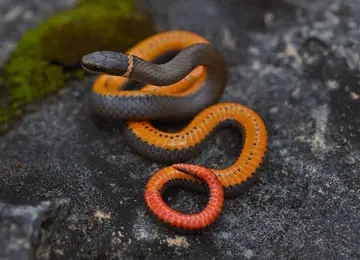
Usually 8 to 10 inches; state figures run from about 4 to 16 inches, with a Florida record of 16.6 inches.
How to recognize it
Plain, unmarked red or orange belly.
Three light spots just behind the head, which may fuse into a collar.
Keeled (ridged) scales in 15 rows at midbody and round pupils.
What the sources say
Venom: “Non-venomous (Harmless) - This gallery includes both egg-laying and live-bearing snakes that are harmless. … [species card:] Red-bellied Snake (Storeria occipitomaculata)” (KDFWR)
Usually 8 to 15 inches long; Alabama reports up to about 18 inches, rarely 24. AZGFD gives a maximum of 34 inches for Arizona animals.
How to recognize it
A yellow, cream or orange ring around the neck; it may be incomplete, and some Lower Florida Keys and western Arizona snakes lack it.
Bright yellow to orange or red belly, often with a row of black half-moon spots; the underside of the tail is often red.
Smooth, shiny scales and a small head only slightly wider than the neck.
JFMAMJJASOND
60 records by month.What the sources say
Venom: “Non-venomous (Harmless) - This gallery includes both egg-laying and live-bearing snakes that are harmless. … [species card:] Ring-necked Snake (Diadophis punctatus)” (KDFWR)
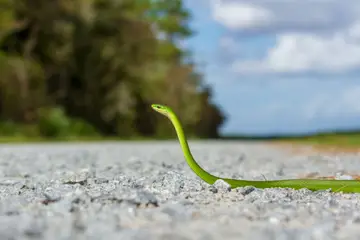
Most adults are 14 to 33 inches long (Florida Museum), with a record of 46 inches. Maryland, Missouri, Tennessee and Arkansas give 22 to 32 inches. The tail is long and thin, about a third or more of the total length.
How to recognize it
Keeled (ridged) scales in 17 rows, which feel rough; the smooth green snake has smooth scales.
Extremely long, thin tail and round pupils.
Large eyes.
JFMAMJJASOND
34 records by month.What the sources say
Venom: “Non-venomous (Harmless) - This gallery includes both egg-laying and live-bearing snakes that are harmless. … [species card:] Rough Greensnake (Opheodrys aestivus)” (KDFWR)
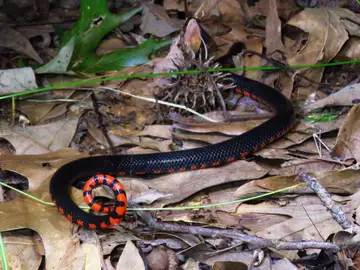
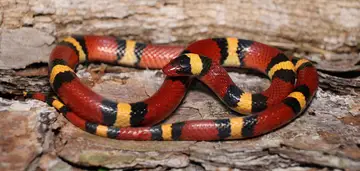
Most adults about 14-20 inches (36-51 cm); record 29.1 inches (Florida Museum). Louisiana gives 12 to 24 inches; NC State Extension says up to 27 inches.
How to recognize it
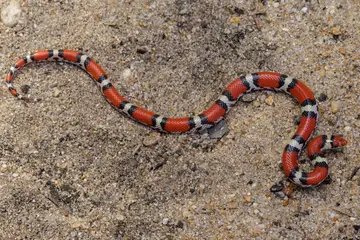
Red and yellow rings are separated by black rings, so red and yellow do not touch.
KY SWAP 2023 Species of Greatest Conservation Need (data deficient); priority group: Data Deficient; state rank S1
What the sources say
Venom: “Non-venomous (Harmless) - This gallery includes both egg-laying and live-bearing snakes that are harmless. … [species card:] Scarlet Kingsnake (Lampropeltis elaposoides)” (KDFWR)
Physiographic Regions: Cumberland Plateau, Plateau Escarpment, Bluegrass, Knobs, Interior Plateau, Interior River Valley And Hills KDFWR
Conservation
KY SWAP 2023 Species of Greatest Conservation Need (data deficient); priority group: Data Deficient; state rank S3
What the sources say
Venom: “Non-venomous (Harmless) - This gallery includes both egg-laying and live-bearing snakes that are harmless. … [species card:] Scarlet Snake (Cemophora coccinea)” (KDFWR)
Habitat: Uses dry open woods, rocky glades, and barrens; mostly a burrower. (KDFWR)
Venom: “Non-venomous (Harmless) - This gallery includes both egg-laying and live-bearing snakes that are harmless. … [species card:] Smooth Earthsnake (Virigina valeriae)” (KDFWR)
Physiographic Regions: Plateau Escarpment, Bluegrass, Knobs, Interior Plateau, Interior River Valley And Hills, Mississippi Valley Loess Plain KDFWR
Conservation
KY SWAP 2023 Species of Greatest Conservation Need (data deficient); priority group: Data Deficient; state rank S2
What the sources say
Venom: “Non-venomous (Harmless) - This gallery includes both egg-laying and live-bearing snakes that are harmless. … [species card:] Southeastern Crowned Snake (Tantilla coronata)” (KDFWR)
Habitat: Uses dry upland woods and adjacent open habitats including abandoned quarries and gravel pits, rocky and/or gravelly roadside slopes, powerline rights-of-way, small upland cemeteries in forested settings, abandoned farms and homesites, and rocky or gravelly woodlands. (KDFWR)
Physiographic Regions: Interior River Valley And Hills, Mississippi Alluvial Plain KDFWR
Conservation
KY SWAP 2023 Species of Greatest Conservation Need (data deficient); priority group: Data Deficient; state rank S1
What the sources say
Venom: “Non-venomous (Harmless) - This gallery includes both egg-laying and live-bearing snakes that are harmless. … [species card:] Western Ribbonsnake (Thamnophis proximus)” (KDFWR)
Habitat: Found in and along various wetland habitats including cypress swamps, flooded bottomland hardwood stands, sloughs, bayous, sluggish stream channels, seasonal shallow wetlands, and roadside ditches. (KDFWR)
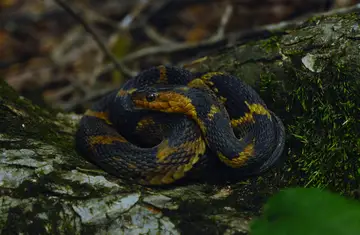
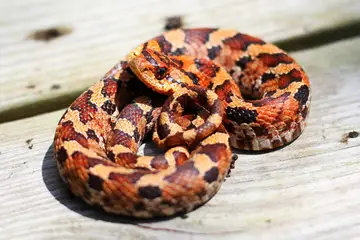
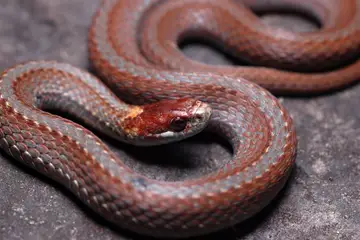
Also venomous. Juvenile cottonmouths have many dark spots and speckles inside their dark crossbands (copperhead bands have none or at most one). The Florida Museum says adult Florida cottonmouths are typically uniformly dark, but SCDNR says cottonmouth color ranges from dark brown and black to olive drab and yellow-tan, so a pale snake is not ruled out. The copperhead's eye is not obscured by the dark facial band typical of the cottonmouth. Cottonmouths are almost always associated with wetlands.
Photo: U.S. Fish and Wildlife Service - Midwest Region · Public domain · Wikimedia Commons
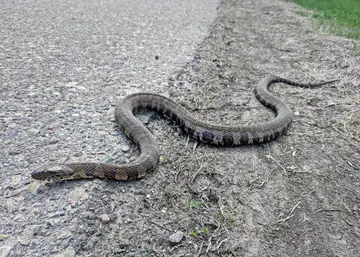
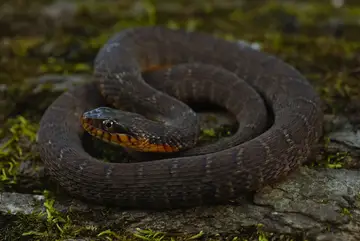
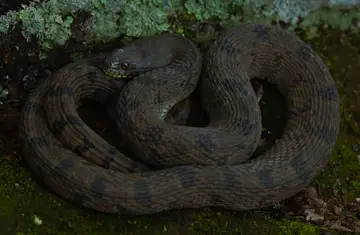
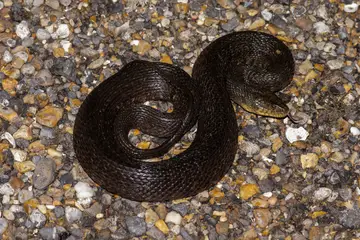
Northern water snake Non-venomous
Its dark bands form a 'reverse hourglass': wider across the back and narrower on the sides (the copperhead's are narrow on the back, wide on the sides). Older water snakes can look solid dark.
Milk snake blotches are outlined in black and widest across the middle of the back; belly is a black-and-white checkerboard (copperhead belly is mottled white to gray).
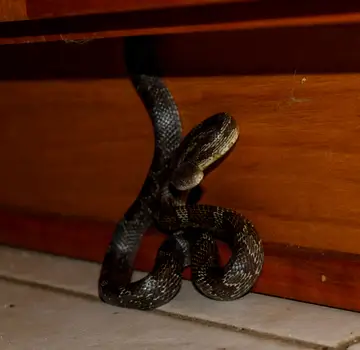
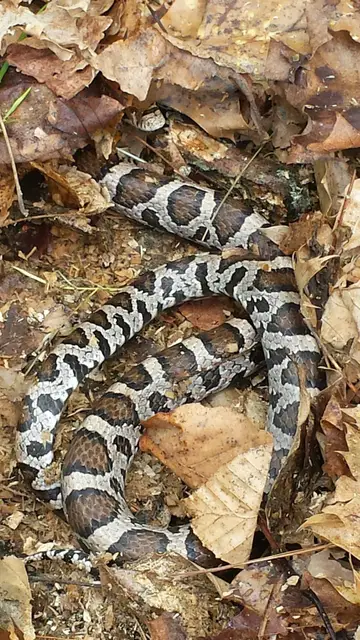
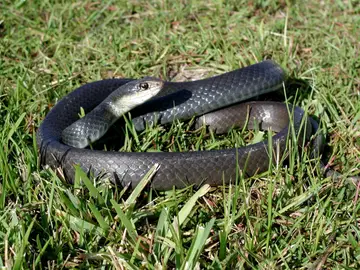
Young rat snakes (black rat snake / eastern ratsnake) Non-venomous
Hatchling and yearling rat snakes have irregular blotches, not hourglass bands, and turn virtually all black as adults (NJ Division of Fish and Wildlife). New Jersey says no other snake there has the copperhead's hourglass pattern; Delaware DNREC says the same for Delaware.
Named by Delaware DNREC and Rutgers as a frequent copperhead misidentification. Use the hourglass test: in Delaware only the copperhead has dark hourglass crossbands narrowest at the center of the back.
Photos show typical adults; individuals vary. Never get close to compare.
When snakes are active in Kentucky
Records of snakes in Kentucky peak in April to June. They show when people record snakes, not how many there are (about month bars).
JanFebMarAprMayJunJulAugSepOctNovDec
910 records of snakes in Kentucky by month (GBIF, CC0 and CC BY records).
Copperheads give birth to live young in late summer or early fall. KDFWR
If you are bitten or stung
Call 911 or Poison Help at 1-800-222-1222 right away. Poison Help connects you to your local poison center, any time of day.
Official advice from KDFWR:
If you find a snake and are unsure whether it is venomous, leave it alone; do not try to catch or kill it. KDFWR
Do not handle a freshly killed venomous snake; it can still bite by reflex. KDFWR
Snakebite: call 911 or Poison Help at 1-800-222-1222 and get to the nearest hospital right away. KDFWR
How to report
Report people feeding bears or aggressive bears to Kentucky Fish and Wildlife at 1-800-25ALERT (1-800-252-5378); report sick or injured bats via the KDFWR online Report a Bat form; report suspected fire ant mounds or stings to UK Entomology at [email protected]. KDFWR
Snakes (Snakes of Kentucky). Kentucky Department of Fish and Wildlife Resources (KDFWR). archived copy, captured August 27, 2025; checked November 3, 2026.Quoted passages (38)
“…of the 32 types of snakes found in Kentucky, only four are venomous”
“Venomous - Species with the "" icon indicate that this species is venomous; please use caution when encountering this species.) … of the 32 types of snakes found in Kentucky, only four are venomous. … [species card:] EASTERN COPPERHEAD (Agkistrodon contortrix)”
“Venomous - Species with the "" icon indicate that this species is venomous; please use caution when encountering this species.) … of the 32 types of snakes found in Kentucky, only four are venomous. … [species card:] TIMBER RATTLESNAKE (Crotalus horridus)”
“Venomous - Species with the "" icon indicate that this species is venomous; please use caution when encountering this species.) … of the 32 types of snakes found in Kentucky, only four are venomous. … [species card:] NORTHERN COTTONMOUTH (Agkistrodon piscivorus leucostoma)”
“Venomous - Species with the "" icon indicate that this species is venomous; please use caution when encountering this species.) … of the 32 types of snakes found in Kentucky, only four are venomous. … [species card:] WESTERN PIGMY RATTLESNAKE (Sistrurus miliarius steckeri)”
“Non-venomous (Harmless) - This gallery includes both egg-laying and live-bearing snakes that are harmless. … [species card:] Broad-banded Watersnake (Nerodia fasciata confluens)”
“Non-venomous (Harmless) - This gallery includes both egg-laying and live-bearing snakes that are harmless. … [species card:] Central Ratsnake (Pantherophis alleghaniensis)”
“Non-venomous (Harmless) - This gallery includes both egg-laying and live-bearing snakes that are harmless. … [species card:] Common Watersnake (Nerodia sipedon)”
“Non-venomous (Harmless) - This gallery includes both egg-laying and live-bearing snakes that are harmless. … [species card:] Common Wormsnake (Carphonphis amoenus)”
“Non-venomous (Harmless) - This gallery includes both egg-laying and live-bearing snakes that are harmless. … [species card:] Copperbelly Watersnake (Nerodia erythrogaster neglecta)”
“Non-venomous (Harmless) - This gallery includes both egg-laying and live-bearing snakes that are harmless. … [species card:] DeKay's Brownsnake (Storeria dekayi)”
“Non-venomous (Harmless) - This gallery includes both egg-laying and live-bearing snakes that are harmless. … [species card:] Diamond-backed Watersnake (Nerodia rhombifer)”
“Non-venomous (Harmless) - This gallery includes both egg-laying and live-bearing snakes that are harmless. … [species card:] Eastern Black Kingsnake (Lampropeltis nigra)”
“Non-venomous (Harmless) - This gallery includes both egg-laying and live-bearing snakes that are harmless. … [species card:] Eastern Gartersnake (Thamnophis sirtalis sirtalis)”
“Non-venomous (Harmless) - This gallery includes both egg-laying and live-bearing snakes that are harmless. … [species card:] Eastern Hog-nosed Snake (Heterodon platirhinos)”
“Non-venomous (Harmless) - This gallery includes both egg-laying and live-bearing snakes that are harmless. … [species card:] Eastern Milksnake (Lampropeltis triangulum)”
“Non-venomous (Harmless) - This gallery includes both egg-laying and live-bearing snakes that are harmless. … [species card:] Eastern Pinesnake (Pituophis melanoleucus)”
“Non-venomous (Harmless) - This gallery includes both egg-laying and live-bearing snakes that are harmless. … [species card:] Eastern Ribbonsnake (Thamnophis saurita saurita)”
“Non-venomous (Harmless) - This gallery includes both egg-laying and live-bearing snakes that are harmless. … [species card:] Kirtland's Snake (Clonophis kirtlandii)”
“Non-venomous (Harmless) - This gallery includes both egg-laying and live-bearing snakes that are harmless. … [species card:] Mississippi Green Watersnake (Nerodia cyclopion)”
“Non-venomous (Harmless) - This gallery includes both egg-laying and live-bearing snakes that are harmless. … [species card:] North American Racer (Coluber consrictor)”
“Non-venomous (Harmless) - This gallery includes both egg-laying and live-bearing snakes that are harmless. … [species card:] Plain-bellied Water Snake (Nerodia erythrogaster)”
“Non-venomous (Harmless) - This gallery includes both egg-laying and live-bearing snakes that are harmless. … [species card:] Prairie Kingsnake (Lampropeltis calligaster)”
“Non-venomous (Harmless) - This gallery includes both egg-laying and live-bearing snakes that are harmless. … [species card:] Queensnake (Regina septemvittata)”
“Non-venomous (Harmless) - This gallery includes both egg-laying and live-bearing snakes that are harmless. … [species card:] Red Cornsnake (Pantherophis guttantus)”
“Non-venomous (Harmless) - This gallery includes both egg-laying and live-bearing snakes that are harmless. … [species card:] Red-bellied Mudsnake (Farancia abacura)”
“Non-venomous (Harmless) - This gallery includes both egg-laying and live-bearing snakes that are harmless. … [species card:] Red-bellied Snake (Storeria occipitomaculata)”
“Non-venomous (Harmless) - This gallery includes both egg-laying and live-bearing snakes that are harmless. … [species card:] Ring-necked Snake (Diadophis punctatus)”
“Non-venomous (Harmless) - This gallery includes both egg-laying and live-bearing snakes that are harmless. … [species card:] Rough Greensnake (Opheodrys aestivus)”
“Non-venomous (Harmless) - This gallery includes both egg-laying and live-bearing snakes that are harmless. … [species card:] Scarlet Kingsnake (Lampropeltis elaposoides)”
“Non-venomous (Harmless) - This gallery includes both egg-laying and live-bearing snakes that are harmless. … [species card:] Scarlet Snake (Cemophora coccinea)”
“Non-venomous (Harmless) - This gallery includes both egg-laying and live-bearing snakes that are harmless. … [species card:] Smooth Earthsnake (Virigina valeriae)”
“Non-venomous (Harmless) - This gallery includes both egg-laying and live-bearing snakes that are harmless. … [species card:] Southeastern Crowned Snake (Tantilla coronata)”
“Non-venomous (Harmless) - This gallery includes both egg-laying and live-bearing snakes that are harmless. … [species card:] Western Ribbonsnake (Thamnophis proximus)”
“When in doubt, leave it alone. Most snake bites are accidental and often come from trying to handle or kill a snake. If you are uncertain about the snake's identity, leave it alone. Don't try to catch or kill it.”
“Do not poke or prod at a freshly killed snake. Snakes may still exhibit active reflexes, such as slowly writhing their bodies, and may potentially bite. Do not handle a freshly killed venomous snake.”
“Seek immediate attention from the nearest hospital or medical facility. [Poison Help,”
“However, the state has never stocked rattlesnakes in Kentucky.”
Kentucky Snakes (booklet). Kentucky Department of Fish and Wildlife Resources (KDFWR). archived copy, captured January 21, 2015; checked November 3, 2026.Quoted passages (2)
“Kentucky’s venomous snakes are the copperhead, cottonmouth, timber rattlesnake, and pigmy rattlesnake. All four species belong to a group of snakes called pit vipers.”
“Copperheads mate in the spring and the young are born alive in late summer or early fall.”
Black Bears. Kentucky Department of Fish and Wildlife Resources (KDFWR). archived copy, captured September 14, 2026; checked November 3, 2026.Quoted passages (1)
“Immediately report any instances of people feeding bears to Kentucky Fish and Wildlife by calling 1-800-25ALERT (1-800-252-5378). [UK Entfact 469: "You can report a suspicious ant mound or a stinging event to the University of Kentucky Entomology Department through email, [email protected]"]”