Rough green snake
Opheodrys aestivus · also called Rough greensnake, Northern rough greensnake, Florida rough greensnake and Green snake · Last checked November 3, 2026.
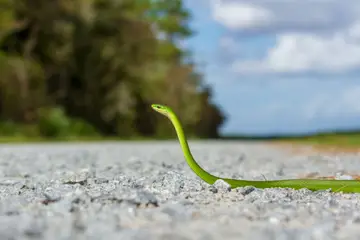
The rough green snake is a long, very slender, bright green snake with a white, cream or yellow belly and keeled (ridged) scales, usually about 14 to 33 inches long. Official sources say it is non-venomous: the Florida Museum says it is not dangerous to people or pets, and Missouri calls it a gentle and harmless species that rarely tries to bite. It lives in shrubs, vines and trees, often near water, across much of the East and Southeast, from southern New Jersey to Florida and west to Oklahoma and Texas. It is active by day and is easy to miss because it blends into leaves. Florida Museum of Natural History
On this page
Is the rough green snake dangerous?
Florida Museum: rough greensnakes are non-venomous and not dangerous to people or pets; they are not aggressive and avoid direct contact with people and pets. Florida Museum of Natural History
“Non-venomous. Rough Greensnakes are not dangerous to people or pets. The snakes are not aggressive and avoid direct contact with people and pets.”
Bites and stings: Rarely. Florida Museum: rarely if ever bites in defense. Illinois: may open its dark-lined mouth threateningly but rarely bites. Ohio: a rare bite would do virtually no harm, and it is much more likely to release musk.
How to identify a rough green snake
A photo or description can narrow it down, but cannot confirm what an animal is or that it is safe. Look from a distance and do not handle wild animals.
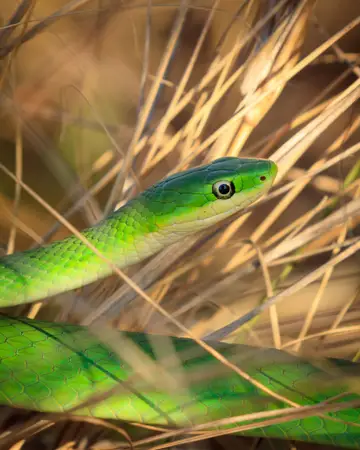
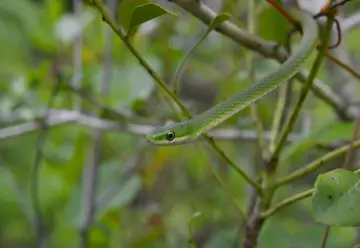
Size: Most adults are 14 to 33 inches long (Florida Museum), with a record of 46 inches. Maryland, Missouri, Tennessee and Arkansas give 22 to 32 inches. The tail is long and thin, about a third or more of the total length. Florida Museum of Natural History
Colors: bright green, light green, white, cream and yellow. Pattern: solid.
Key features
- Keeled (ridged) scales in 17 rows, which feel rough; the smooth green snake has smooth scales. Florida Museum of Natural History
- Extremely long, thin tail and round pupils. Florida Museum of Natural History
- Large eyes. University of Georgia Savannah River Ecology Laboratory
- The body turns blue after death, which explains reports of "blue" road-killed snakes. DNR
Young
Young look like adults but are duller; Tennessee describes them as grayish-green. North Carolina says hatchlings look like miniature adults, less vividly green.
Animals mistaken for the rough green snake
Rough green snake or Smooth green snake?
Rough green snake
Smooth green snake Opheodrys vernalis
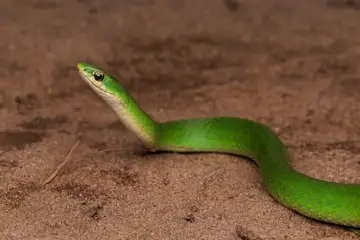

The smooth green snake has smooth scales, is generally smaller and rarely climbs. Missouri: the scales of a rough greensnake feel rough, and the smooth greensnake is a grassland species. SREL: the smooth green snake replaces this species in the Appalachian Mountains and the Northeast. Indiana Department of Natural Resources, Division of State Parks
Not stated as dangerous by these sources
Rough green snake or Eastern yellow-bellied racer (some populations)?
Rough green snake
Eastern yellow-bellied racer (some populations) Coluber constrictor

Oklahoma: some central and western Oklahoma populations of the eastern yellow-bellied racer can look green. Rough greensnakes have distinctly keeled scales; racers have smooth scales. Oklahoma Department of Wildlife Conservation
Non-venomous
Where the rough green snake lives
- Native or listed
- Nonnative or not established
- No official record in our data
- 1–9
- 10–99
- 100–999
- 1,000+
On our state guides
- Arkansas snakes
- Delaware snakes
- Florida snakes
- Georgia snakes
- Illinois snakes
- Indiana snakes
- Kansas snakes
- Kentucky snakes
- Louisiana snakes
- Maryland snakes
- Missouri snakes
- New Jersey snakes
- New Mexico snakes
- Oklahoma snakes
- Pennsylvania snakes
- South Carolina snakes
- Tennessee snakes
- Texas snakes
- Virginia snakes
State boundaries: U.S. Census Bureau, cartographic boundary file cb_2024_us_state_20m.
When it is active
Active by day. Season varies by state: late March through October in Missouri, March through late October in Oklahoma, April to early October in Arkansas. MDC
US open-licence records peak in April to May and September to October.
Habitat and habits
Habitat: Trees, shrubs and vines, especially dense vegetation along ponds, streams, rivers, wetlands and forest edges; also hardwood forest, old fields, coastal thickets and suburban neighborhoods. Florida Museum of Natural History
Behavior: Climbs well and relies on camouflage. When approached it freezes and may sway like a branch in the wind, then flees into foliage. If captured it often squirms and releases foul-smelling musk, and it may gape to show its dark mouth lining. It sometimes swims and at night coils among leaves.
Diet: Mostly insects and spiders, such as crickets, grasshoppers, caterpillars and dragonflies; occasionally small tree frogs and land snails. It does not constrict and swallows prey alive.
Young: Mates in spring and sometimes fall. Lays roughly 1 to 14 elongated eggs in early summer in rotting logs, under rocks or in tree holes; eggs hatch in late summer or early fall. Females may share nest sites.
Legal status and reporting
Protection: Pennsylvania: Endangered. Indiana: species of special concern. Ohio: species of concern. Georgia: may not be held as a pet; SREL says protected throughout Georgia. Mississippi: a nongame species in need of management under state rule. Tennessee: not protected. Alabama: lowest conservation concern. Check your state agency. Pennsylvania Fish and Boat Commission
Questions about the rough green snake
Rough green snake
A long, slender, bright green snake with a pale belly and keeled scales that lives in shrubs and trees, often near water. The Florida Museum says it is non-venomous and not dangerous to people or pets.
Green snake poisonous
Official sources say the rough green snake is non-venomous. The Florida Museum says it is not dangerous to people or pets and rarely if ever bites in defense; Missouri Department of Conservation calls it gentle and harmless to people.
Green snake nc
The rough green snake lives in North Carolina. The N.C. Wildlife Resources Commission says it feeds on insects and spiders, climbs well, is active mainly by day and is common where dense vegetation surrounds water.
Green snake texas
Herps of Texas (University of Texas at Austin) lists both the rough greensnake and the smooth greensnake for Texas, and Texas Parks and Wildlife says both eat insects, especially crickets, grasshoppers and caterpillars.
Green snake virginia
Virginia DWR lists both the northern rough greensnake and the smooth greensnake as native to Virginia.
Green snakes in florida
The rough green snake is found in every county of mainland Florida and throughout the Keys. The Florida Museum says there are no other native bright green snakes in Florida and that it is not dangerous to people or pets.
Sources
- Florida Snake ID Guide species account: Rough Greensnake. Florida Museum of Natural History (University of Florida). updated March 18, 2026; checked November 3, 2026.
Quoted passages (8)
“Non-venomous. Rough Greensnakes are not dangerous to people or pets. The snakes are not aggressive and avoid direct contact with people and pets.”
“Non-venomous. Rough Greensnakes are not dangerous to people or pets.”
“Most adult Rough Greensnakes are about 14-33 inches (35-82 cm) in total length, with a record length recorded of 46 inches (116 cm).”
“The body scales are strongly keeled (each scale has a prominent raised ridge), and they are arranged in 17 scale rows at midbody.”
“The tail is extremely long and thin. The pupils are round.”
“Juvenile coloration is similar to adults but not as vivid.”
“These snakes primarily live in trees and prefer densely leafed trees and shrubs, often at the edges of fields and around ponds.”
“When approached, Rough Greensnakes will typically freeze and sway as if perhaps mimicking a branch blowing in the wind.”
- MDC Field Guide: Reptiles and Amphibians > Snakes (species accounts). Missouri Department of Conservation (MDC). undated page; checked November 3, 2026.
Quoted passages (2)
“Rough greensnakes eat mostly insects and spiders.”
“The active season of this species is late March through October, with peak activity in spring (April and May) and autumn (September and October). The rough greensnake is active by day”
- Rough Green Snake. Alabama Department of Conservation and Natural Resources (Outdoor Alabama). undated page; checked November 3, 2026.
Quoted passages (1)
“Rough green snakes mate in both spring and fall. Females lay 3-12 cylindrical eggs, usually in rotting logs or under rocks, during June or July.”
- Rough Greensnake (ODWC Field Guide). Oklahoma Department of Wildlife Conservation. undated page; checked November 3, 2026.
Quoted passages (1)
“In addition, rough greensnakes have distinctly keeled scales, whereas racers have smooth scales.”
- Rough Greensnake (Field Guide to Amphibians and Reptiles of Illinois). Illinois Natural History Survey (INHS), Prairie Research Institute, University of Illinois Urbana-Champaign. undated page; checked November 3, 2026.
- Rough Green Snake (Opheodrys aestivus). University of Georgia Savannah River Ecology Laboratory (linked by SCDNR as its species information). undated page; checked November 3, 2026.
Quoted passages (1)
“Rough Green Snakes have keeled scales and large eyes.”
- Rough Greensnake (DNR field guide species page). Maryland Department of Natural Resources (DNR). archived copy, captured March 8, 2026; checked November 3, 2026.
Quoted passages (1)
“The body turns blue a short time after death, accounting for reports of road-killed ‘blue’ snakes.”
- Pennsylvania Native Reptile and Amphibian Species (PA Species and Endangered Species Act listing status). Pennsylvania Fish and Boat Commission. undated page; checked November 3, 2026.
Quoted passages (1)
“Northern Rough Greensnake Opheodrys aestivus E”
- Common Snakes of Indiana State Parks (brochure). Indiana Department of Natural Resources, Division of State Parks (Interpretive Services). brochure dated 9/2017; checked November 3, 2026.
Quoted passages (1)
“The smooth green snake has smooth scales. It rarely climbs and is generally smaller than the rough green snake.”
- Snake Species Field Guide: Rough Greensnake. Louisiana Department of Wildlife and Fisheries. undated page; checked November 3, 2026.
- Rough Green Snake (NCWRC species page). N.C. Wildlife Resources Commission. undated page; checked November 3, 2026.
- Herps of Texas: snakes. University of Texas at Austin, Biodiversity Collections (Herps of Texas). 2020-07-23 archive capture; checked November 3, 2026.
- Snakes Alive! FAQ (Texas Junior Naturalists). Texas Parks and Wildlife Department. undated page; checked November 3, 2026.
- List of Native and Naturalized Fauna of Virginia. Virginia Department of Wildlife Resources (DWR). May, 2026; checked November 3, 2026.
- GBIF.org occurrence records, human observations licensed CC0 1.0 or CC BY 4.0 only, accessed November 3, 2026. The datasets behind these counts are listed on our Sources page.
- State boundaries: U.S. Census Bureau, cartographic boundary file cb_2024_us_state_20m.