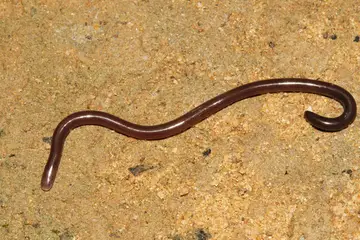
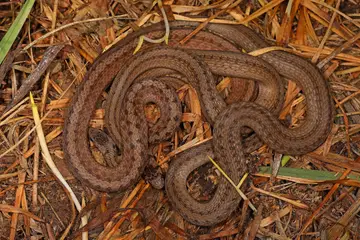
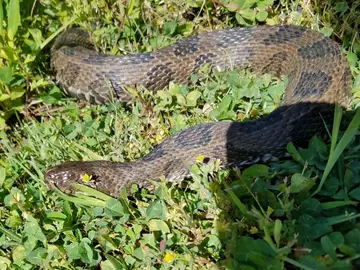
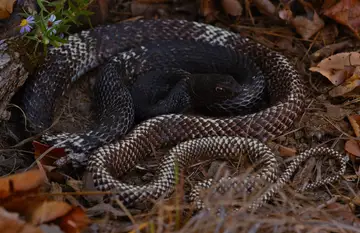
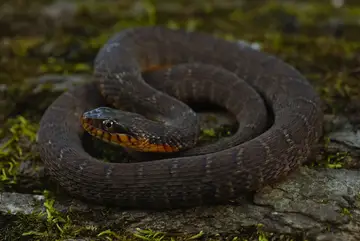
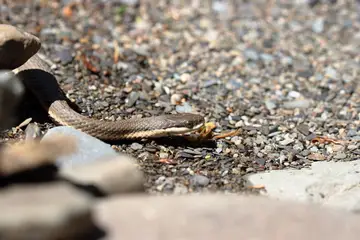
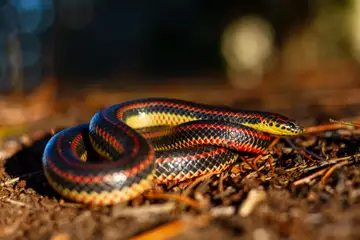
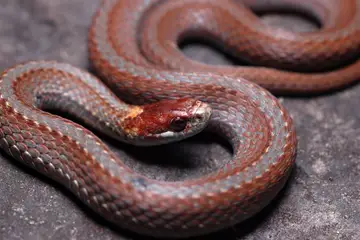
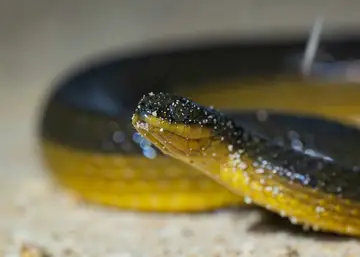
States Wildlife

Georgia Snakes: Identification Guide With Pictures

Last checked November 3, 2026 against official sources.

On this page
  1. Venomous snakes
  2. The other 40 snakes
  3. Lookalikes
  4. When they are active
  5. If you are bitten or stung
  6. How to report
  7. What official sources say
  8. About this list
  9. Sources

Georgia DNR Wildlife Resources Division: Georgia is fortunate to have among the highest biodiversity of snakes in the United States with 47 species.

This page lists 47 snakes: all from Georgia DNR Wildlife Resources Division's Snake Information & Resources: Non-Venomous Snakes in Georgia / Venomous Snakes In Georgia. 7 are venomous by official accounts: Copperhead, Northern Cottonmouth, Florida Cottonmouth, Eastern Diamond-backed Rattlesnake, Timber Rattlesnake, Pigmy Rattlesnake and Eastern Coral Snake. 1 is nonnative.

Venomous snakes in Georgia

Official sources label these snakes venomous in Georgia. Venomous snakes in Georgia has more on each one.

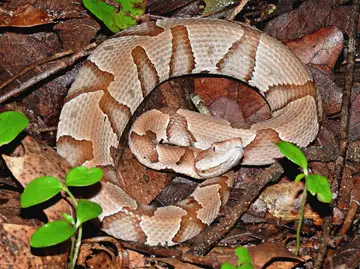
Copperhead
Photo: USFWSmidwest · Public domain · Wikimedia Commons

Copperhead

Agkistrodon contortrix

Venomous per Georgia DNR Wildlife Resources Division, Wildlife Conservation Section

Size
Adults usually about 2 to 3 feet (24-36 in); record about 53 inches.
How to recognize it
  • Vertical (cat-like) pupils and a heat-sensing pit between eye and nostril
  • Heavy-bodied; keeled scales
  • Head shape alone is not a reliable way to identify copperheads
Where in Georgia
Most of Georgia except the southeastern corner Georgia DNR Wildlife Resources Division
81 records by month.
What the sources say

Venom: “Of the 47 species of snakes known from Georgia, only seven species are venomous: Copperhead (Agkistrodon contortrix), Northern and Florida Cottonmouth (Agkistrodon piscivorus and Agkistrodon conanti), Eastern Diamond-backed Rattlesnake (Crotalus adamanteus), Timber/Canebrake Rattlesnake (Crotalus horridus), Pigmy Rattlesnake (Sistrurus miliarius) and Eastern Coral Snake (Micrurus fulvius).” (Georgia DNR Wildlife Resources Division, Wildlife Conservation Section)

Habitat: Occur in most forested habitats but are particularly common on rocky wooded hillsides in the mountains and swamp and river edges in the Piedmont and Coastal Plain. (Georgia DNR Wildlife Resources Division, Wildlife Conservation Section)

Full Copperhead guide

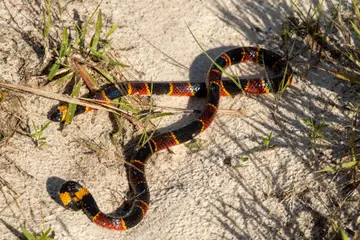
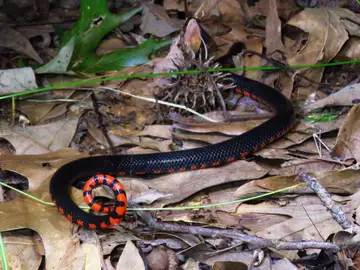
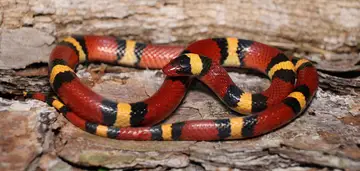
Eastern Coral Snake
Photo: Court Harding · CC BY 4.0 · iNaturalist

Eastern Coral Snake

Micrurus fulvius

Venomous per Georgia DNR Wildlife Resources Division, Wildlife Conservation Section

Where in Georgia
Mainly Coastal Plain; lower Piedmont population along the Flint River basin Georgia DNR Wildlife Resources Division
Conservation
Georgia Species of Concern (STATUS: Rare, Georgia Species of Concern.)
What the sources say

Venom: “Of the 47 species of snakes known from Georgia, only seven species are venomous: Copperhead (Agkistrodon contortrix), Northern and Florida Cottonmouth (Agkistrodon piscivorus and Agkistrodon conanti), Eastern Diamond-backed Rattlesnake (Crotalus adamanteus), Timber/Canebrake Rattlesnake (Crotalus horridus), Pigmy Rattlesnake (Sistrurus miliarius) and Eastern Coral Snake (Micrurus fulvius).” (Georgia DNR Wildlife Resources Division, Wildlife Conservation Section)

Habitat: Coastal Plain populations are typically associated with sandy upland habitats such as longleaf pine sandhills and pine-saw palmetto flatwoods. (Georgia DNR Wildlife Resources Division, Wildlife Conservation Section)

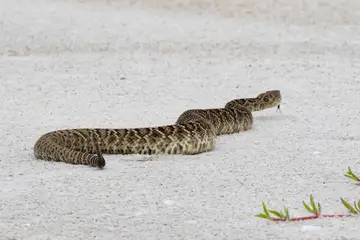
Eastern Diamond-backed Rattlesnake
Photo: Kent P. McFarland · CC0 1.0 · iNaturalist

Eastern Diamond-backed Rattlesnake

Crotalus adamanteus

Venomous per Georgia DNR Wildlife Resources Division, Wildlife Conservation Section

Danger to people
“Of the 47 species of snakes known from Georgia, only seven species are venomous: Copperhead (Agkistrodon contortrix), Northern and Florida Cottonmouth (Agkistrodon piscivorus and Agkistrodon …” Georgia DNR Wildlife Resources Division, Wildlife Conservation Section
Size
Most adults 33 to 72 inches (about 3 to 6 feet); record 99 inches.
How to recognize it
  • Light-bordered dark stripe running diagonally through each eye
  • Tail ends in a rattle, often held above the ground
  • Cat-like vertical pupil and a deep heat-sensing pit between nostril and eye
Where in Georgia
South of the Fall Line, Coastal Plain Georgia DNR Wildlife Resources Division
Conservation
Georgia Species of Concern (STATUS: Rare, Georgia Species of Concern.)
What the sources say

Venom: “Of the 47 species of snakes known from Georgia, only seven species are venomous: Copperhead (Agkistrodon contortrix), Northern and Florida Cottonmouth (Agkistrodon piscivorus and Agkistrodon conanti), Eastern Diamond-backed Rattlesnake (Crotalus adamanteus), Timber/Canebrake Rattlesnake (Crotalus horridus), Pigmy Rattlesnake (Sistrurus miliarius) and Eastern Coral Snake (Micrurus fulvius).” (Georgia DNR Wildlife Resources Division, Wildlife Conservation Section)

Habitat: Eastern Diamond-backed Rattlesnakes occupy upland habitats with an open canopy, especially native longleaf pine forests on sandhills, clay hills and flatwoods. (Georgia DNR Wildlife Resources Division, Wildlife Conservation Section)

Full Eastern Diamond-backed Rattlesnake guide

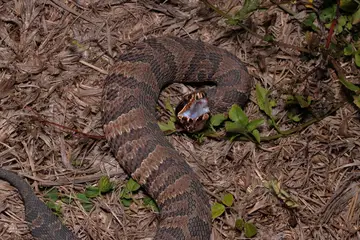
Florida Cottonmouth
Photo: Rstanton13 · CC BY-SA 4.0 · Wikimedia Commons · resized

Florida Cottonmouth

Agkistrodon conanti

Venomous per Georgia DNR Wildlife Resources Division, Wildlife Conservation Section

Danger to people
“Of the 47 species of snakes known from Georgia, only seven species are venomous: Copperhead (Agkistrodon contortrix), Northern and Florida Cottonmouth (Agkistrodon piscivorus and Agkistrodon …” Georgia DNR Wildlife Resources Division, Wildlife Conservation Section
Where in Georgia
Cottonmouths combined: mostly Coastal Plain; DNR brochure: 'differentiating the species and their geographic distributions is difficult' Georgia DNR Wildlife Resources Division
What the sources say

Venom: “Of the 47 species of snakes known from Georgia, only seven species are venomous: Copperhead (Agkistrodon contortrix), Northern and Florida Cottonmouth (Agkistrodon piscivorus and Agkistrodon conanti), Eastern Diamond-backed Rattlesnake (Crotalus adamanteus), Timber/Canebrake Rattlesnake (Crotalus horridus), Pigmy Rattlesnake (Sistrurus miliarius) and Eastern Coral Snake (Micrurus fulvius).” (Georgia DNR Wildlife Resources Division, Wildlife Conservation Section)

Habitat: Semi-aquatic. Cottonmouths prefer swamp-like habitats and can be very abundant in these areas. (Georgia DNR Wildlife Resources Division, Wildlife Conservation Section)

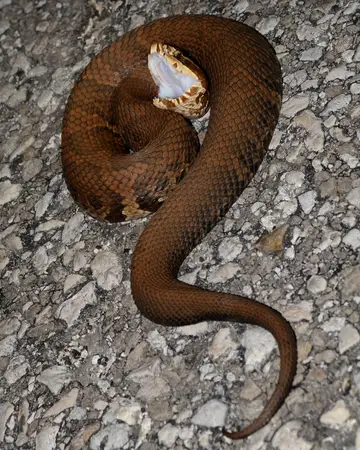
Northern Cottonmouth
Photo: Geoff Gallice from Gainesville · CC BY 2.0 · Wikimedia Commons

Northern Cottonmouth

Agkistrodon piscivorus

Venomous per Georgia DNR Wildlife Resources Division, Wildlife Conservation Section

Danger to people
“Of the 47 species of snakes known from Georgia, only seven species are venomous: Copperhead (Agkistrodon contortrix), Northern and Florida Cottonmouth (Agkistrodon piscivorus and Agkistrodon …” Georgia DNR Wildlife Resources Division, Wildlife Conservation Section
Size
Typically 30 to 48 inches (about 3 to 4 feet); recorded up to 75 inches.
How to recognize it
  • Heat-sensing pit between nostril and eye; no rattle
  • Head much wider than the neck, with a dark bar from the eye to the jaw; vertical (cat-eye) pupils
  • Gapes to show the white lining of its mouth when threatened
Where in Georgia
Mostly Coastal Plain, up the western side; absent from the northeastern quarter (cottonmouths combined) Georgia DNR Wildlife Resources Division
46 records by month.
What the sources say

Venom: “Of the 47 species of snakes known from Georgia, only seven species are venomous: Copperhead (Agkistrodon contortrix), Northern and Florida Cottonmouth (Agkistrodon piscivorus and Agkistrodon conanti), Eastern Diamond-backed Rattlesnake (Crotalus adamanteus), Timber/Canebrake Rattlesnake (Crotalus horridus), Pigmy Rattlesnake (Sistrurus miliarius) and Eastern Coral Snake (Micrurus fulvius).” (Georgia DNR Wildlife Resources Division, Wildlife Conservation Section)

Habitat: Semi-aquatic. Cottonmouths prefer swamp-like habitats and can be very abundant in these areas. (Georgia DNR Wildlife Resources Division, Wildlife Conservation Section)

Full Northern Cottonmouth guide

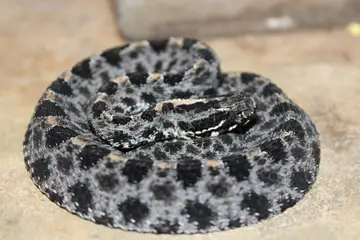
Pigmy Rattlesnake
Photo: Jolieokefenokee · CC BY 4.0 · Wikimedia Commons

Pigmy Rattlesnake

Sistrurus miliarius

Venomous per Georgia DNR Wildlife Resources Division, Wildlife Conservation Section

Size
Adults usually 12-24 inches (30-61 cm); record 31-33 inches. Newborns about 5-6 inches.
How to recognize it
  • Tiny rattle at the end of a slender tail; buzz sounds like an insect
  • Pit viper: heat-sensing pit between nostril and eye, vertical (cat-like) pupils, keeled scales; nine large plates on top of the head
  • Large head scales (other rattlesnakes have small scales on the head)
Where in Georgia
Piedmont and Mountains (mainly eastern side) and lower Coastal Plain; wide gaps Georgia DNR Wildlife Resources Division
What the sources say

Venom: “Of the 47 species of snakes known from Georgia, only seven species are venomous: Copperhead (Agkistrodon contortrix), Northern and Florida Cottonmouth (Agkistrodon piscivorus and Agkistrodon conanti), Eastern Diamond-backed Rattlesnake (Crotalus adamanteus), Timber/Canebrake Rattlesnake (Crotalus horridus), Pigmy Rattlesnake (Sistrurus miliarius) and Eastern Coral Snake (Micrurus fulvius).” (Georgia DNR Wildlife Resources Division, Wildlife Conservation Section)

Habitat: Found in a variety of habitats at elevations of 0-1,640 feet and ranging from dry sandhills and longleaf pine forests to wet hammocks and seasonally flooded pine flatwoods. (Georgia DNR Wildlife Resources Division, Wildlife Conservation Section)

Full Pigmy Rattlesnake guide

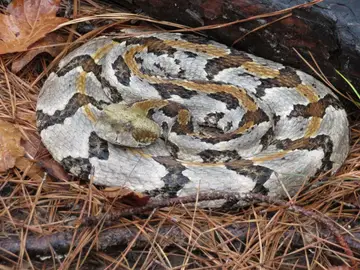
Timber Rattlesnake
Photo: NPS Photo · Public domain · Wikimedia Commons

Timber Rattlesnake

Crotalus horridus

Venomous per Georgia DNR Wildlife Resources Division, Wildlife Conservation Section

Danger to people
“Of the 47 species of snakes known from Georgia, only seven species are venomous: Copperhead (Agkistrodon contortrix), Northern and Florida Cottonmouth (Agkistrodon piscivorus and Agkistrodon …” Georgia DNR Wildlife Resources Division, Wildlife Conservation Section
Size
Most adults 36 to 60 inches (3 to 5 feet); record 74.5 inches.
How to recognize it
  • Black tail ending in a rattle
  • Heat-sensing pit between nostril and eye
  • Large, thick head distinct from the neck; cat-like vertical pupil
Where in Georgia
Statewide except a few locations in the extreme southwestern corner Georgia DNR Wildlife Resources Division
60 records by month.
What the sources say

Venom: “Of the 47 species of snakes known from Georgia, only seven species are venomous: Copperhead (Agkistrodon contortrix), Northern and Florida Cottonmouth (Agkistrodon piscivorus and Agkistrodon conanti), Eastern Diamond-backed Rattlesnake (Crotalus adamanteus), Timber/Canebrake Rattlesnake (Crotalus horridus), Pigmy Rattlesnake (Sistrurus miliarius) and Eastern Coral Snake (Micrurus fulvius).” (Georgia DNR Wildlife Resources Division, Wildlife Conservation Section)

Habitat: Common in much of the heavily wooded country of the Coastal Plain, but in more open areas these snakes are primarily limited to wooded stream corridors. (Georgia DNR Wildlife Resources Division, Wildlife Conservation Section)

Full Timber Rattlesnake guide

The other 40 snakes

From A to Z. Some harmless snakes mimic venomous ones: leave every snake alone.

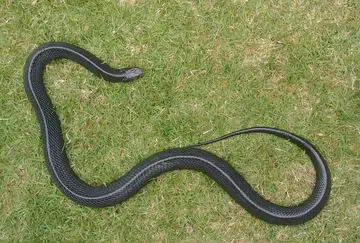
Black Racer
Photo: Everglades NPS from Homestead, Florida, United States · Public domain · Wikimedia Commons

Black Racer

Coluber constrictor

Non-venomous per Georgia DNR Wildlife Resources Division

Size
Most adults about 3 to 5 ft. Sources range from 20 to 56 inches (Florida Museum) to 34 to 77 inches (New Jersey); Alabama says some exceed 6 ft.
How to recognize it
  • Smooth scales
  • Long and slender with large eyes
  • White chin
93 records by month.

Full Black Racer guide

Coachwhip
Photo: Peter Paplanus from St. Louis, Missouri · CC BY 2.0 · Wikimedia Commons

Coachwhip

Coluber flagellum

Non-venomous per Georgia DNR Wildlife Resources Division

Size
Most adults about 42 to 60 inches (3.5 to 5 ft); record 102 inches (8.5 ft). Ranges given by agencies: 41 to 84 in (Louisiana), 36 to 82 in (Oklahoma), adults average 50 to 72 in (Alabama), up to 94 in (NC State Extension), up to 80 in in Colorado and up to 68 in in Arizona.
How to recognize it
  • Long, slowly tapering tail whose scales look like a braided whip
  • Very long and slender, with smooth scales
  • Large eyes with round pupils

Full Coachwhip guide

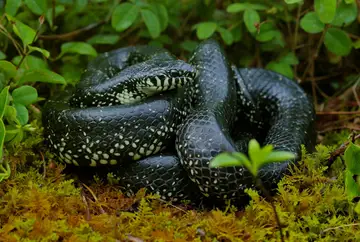
Eastern Indigo Snake
Photo: chloe ⋆˚꩜。 · CC BY-SA 4.0 · iNaturalist · resized

Eastern Indigo Snake

Drymarchon couperi

Non-venomous per Georgia DNR Wildlife Resources Division

Size
Most adults about 60 to 82 inches (5 to 7 feet) long; record 8.6 feet. The longest native snake in the US.
How to recognize it
  • Large, thick-bodied, glossy black snake with smooth scales and round pupils
  • Anal plate single (entire), unlike the black racer whose anal plate is divided
Conservation
state threatened; federally threatened (ESA)

Full Eastern Indigo Snake guide

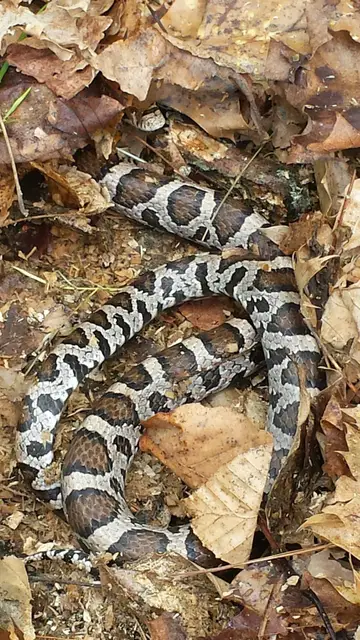
Eastern Milk Snake
Photo: Tom Norton · CC BY 4.0 · iNaturalist

Eastern Milk Snake

Lampropeltis triangulum

Non-venomous per Georgia DNR Wildlife Resources Division

Size
Eastern milksnake 24 to 52 inches (Alabama); TN gives 24 to 36 inches for eastern and 21 to 28 for red milksnake.
How to recognize it
  • Eastern milksnake: black-and-white checkerboard belly (Ohio). Western milksnake in Louisiana: underside dull white with scattered black marks.
  • Eastern milksnake: a light Y- or V-shaped mark is usually present on the nape
  • Smooth, shiny scales and round pupils

Full Eastern Milk Snake guide

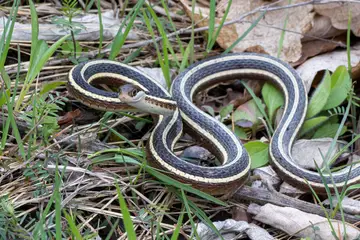
Eastern Ribbon Snake
Photo: Rstanton13 · CC BY-SA 4.0 · Wikimedia Commons · resized

Eastern Ribbon Snake

Thamnophis saurita

Non-venomous per Georgia DNR Wildlife Resources Division

Size
Eastern: most adults 18 to 26 inches (record 41 inches). Western: 16 to 42 inches in Louisiana; Oklahoma's orange-striped ribbonsnakes average 20 to 30 inches and can reach nearly 40.
How to recognize it
  • Very slender body; long tail, about one-third of total length.
  • Side stripes sit on the 3rd and 4th scale rows above the belly.
  • Upper lip scales white and unmarked; a distinct white spot in front of each eye; keeled (ridged) scales.

Full Eastern Ribbon Snake guide

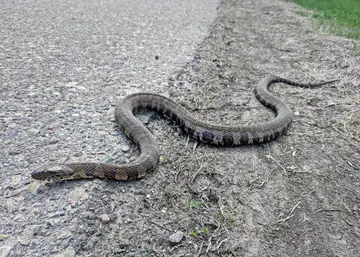
Northern Watersnake
Photo: U.S. Fish and Wildlife Service - Midwest Region · Public domain · Wikimedia Commons

Northern Watersnake

Nerodia sipedon

Non-venomous per Georgia DNR Wildlife Resources Division

Size
Adults 22 to 42 inches long, occasionally to 59 inches (Missouri). Pennsylvania gives 24 to over 50 inches; females are usually bigger than males.
How to recognize it
  • Dark crossbands on the front part of the body break up into rows of blotches from the middle of the body to the tail.
  • Belly white, yellow or orange, usually with dark half-moon-shaped spots.
  • Keeled (ridged) scales, so it feels rough; round pupils like other nonvenomous snakes in Missouri.
152 records by month.

Full Northern Watersnake guide

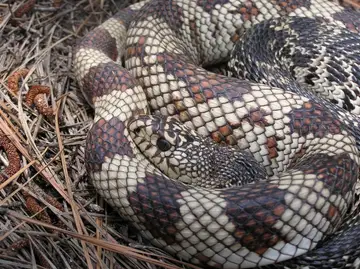
Pine Snake
Photo: Alpha Wolf · CC BY 4.0 · iNaturalist

Pine Snake

Pituophis melanoleucus

Non-venomous per Georgia DNR Wildlife Resources Division

Size
Most adults are 48 to 66 inches long. The Florida Museum gives a record of 90 inches; Alabama gives a maximum of 83 inches for the northern and 74 inches for the black subspecies. New Jersey gives 48 to 100 inches.
How to recognize it
  • Pointed snout covered by a large, triangular, cone-shaped scale, used for pushing into soft earth.
  • Strongly keeled (ridged) body scales and round pupils.
  • Four prefrontal scales between and just in front of the eyes, where most similar snakes have two.

Full Pine Snake guide

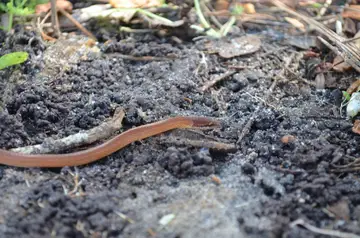
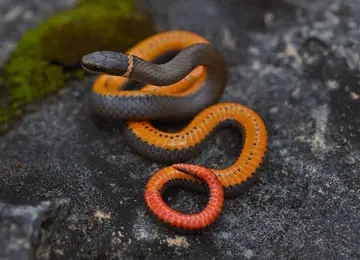
Red-bellied Snake
Photo: Rstanton13 · CC BY-SA 4.0 · Wikimedia Commons · resized

Red-bellied Snake

Storeria occipitomaculata

Non-venomous per Georgia DNR Wildlife Resources Division

Size
Usually 8 to 10 inches; state figures run from about 4 to 16 inches, with a Florida record of 16.6 inches.
How to recognize it
  • Plain, unmarked red or orange belly.
  • Three light spots just behind the head, which may fuse into a collar.
  • Keeled (ridged) scales in 15 rows at midbody and round pupils.
57 records by month.

Full Red-bellied Snake guide

Ringneck Snake
Photo: Peter Paplanus from St. Louis, Missouri · CC BY 2.0 · Wikimedia Commons

Ringneck Snake

Diadophis punctatus

Non-venomous per Georgia DNR Wildlife Resources Division

Size
Usually 8 to 15 inches long; Alabama reports up to about 18 inches, rarely 24. AZGFD gives a maximum of 34 inches for Arizona animals.
How to recognize it
  • A yellow, cream or orange ring around the neck; it may be incomplete, and some Lower Florida Keys and western Arizona snakes lack it.
  • Bright yellow to orange or red belly, often with a row of black half-moon spots; the underside of the tail is often red.
  • Smooth, shiny scales and a small head only slightly wider than the neck.
76 records by month.

Full Ringneck Snake guide

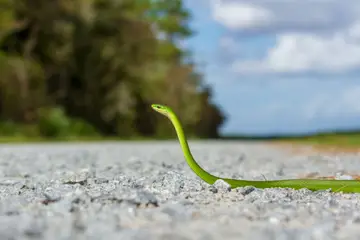
Rough Green Snake
Photo: Joshua Liverman · CC BY 4.0 · iNaturalist

Rough Green Snake

Opheodrys aestivus

Non-venomous per Georgia DNR Wildlife Resources Division

Size
Most adults are 14 to 33 inches long (Florida Museum), with a record of 46 inches. Maryland, Missouri, Tennessee and Arkansas give 22 to 32 inches. The tail is long and thin, about a third or more of the total length.
How to recognize it
  • Keeled (ridged) scales in 17 rows, which feel rough; the smooth green snake has smooth scales.
  • Extremely long, thin tail and round pupils.
  • Large eyes.
71 records by month.

Full Rough Green Snake guide

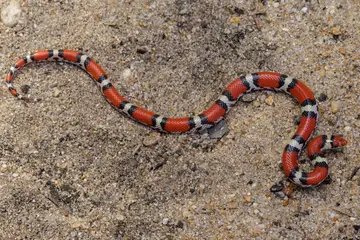
Scarlet Kingsnake
Photo: MH Herpetology · CC BY-SA 4.0 · Wikimedia Commons · resized

Scarlet Kingsnake

Lampropeltis elapsoides

Non-venomous per Georgia DNR Wildlife Resources Division

Size
Most adults about 14-20 inches (36-51 cm); record 29.1 inches (Florida Museum). Louisiana gives 12 to 24 inches; NC State Extension says up to 27 inches.
How to recognize it
  • Red and yellow rings are separated by black rings, so red and yellow do not touch.
  • Small head with a red snout.
  • Rings continue across the belly (Louisiana).

Full Scarlet Kingsnake guide

Snakes people confuse

Northern watersnake or Cottonmouth (water moccasin)?

Northern watersnake
Photo: U.S. Fish and Wildlife Service - Midwest Region · Public domain · Wikimedia Commons

Northern watersnake Non-venomous

Cottonmouth (water moccasin)
Photo: Geoff Gallice from Gainesville · CC BY 2.0 · Wikimedia Commons

Cottonmouth (water moccasin) Venomous

Cottonmouths are heavier-bodied with a larger, chunky head, a pit between nostril and eye, darker color, and a light line from the eye to the corner of the mouth (Missouri). Cottonmouths have cat-like pupils; watersnakes have round pupils and no facial pit, and seen from above a cottonmouth's eyes are hidden while a watersnake's are visible (Florida Museum). Georgia DNR: banded watersnakes have bands widest on top; banded cottonmouths have bands widest on the sides (hourglass-shaped from above). Cottonmouths float on the water; watersnakes swim with the body just below the surface (Virginia DWR). Cautions from the same agencies: Virginia DWR says some other nonvenomous snakes, such as the eastern hog-nosed snake, also float, and that watersnakes often flatten the head when threatened so it looks diamond-shaped; CDFW says older northern watersnakes can look almost entirely dark brown or black.

Northern watersnake or Copperhead?

Northern watersnake
Photo: U.S. Fish and Wildlife Service - Midwest Region · Public domain · Wikimedia Commons

Northern watersnake Non-venomous

Copperhead
Photo: USFWSmidwest · Public domain · Wikimedia Commons

Copperhead Venomous

Florida Museum (midland watersnake): the watersnake's crossbands are darker, narrower and much more numerous than a copperhead's and turn into blotches halfway down the body. Watersnakes have round pupils and dark vertical lines near the mouth; copperheads have no such lines.

Brown Snake (Dekay's Brownsnake) or Copperhead?

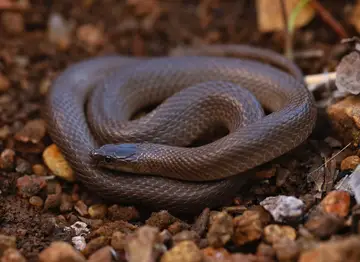
Brown Snake (Dekay's Brownsnake)
Photo: Judy Gallagher · CC BY 2.0 · Wikimedia Commons

Brown Snake (Dekay's Brownsnake) Non-venomous

Copperhead
Photo: USFWSmidwest · Public domain · Wikimedia Commons

Copperhead Venomous

Copperheads have bold hourglass-shaped bands, and young copperheads under about 12 inches have bright yellow tail tips. Brown snakes have small spots, not hourglass bands.

Brown Snake (Dekay's Brownsnake) or Red-bellied Snake?

Brown Snake (Dekay's Brownsnake)
Photo: Judy Gallagher · CC BY 2.0 · Wikimedia Commons

Brown Snake (Dekay's Brownsnake) Non-venomous

Red-bellied Snake
Photo: Rstanton13 · CC BY-SA 4.0 · Wikimedia Commons · resized

Red-bellied Snake Non-venomous

The red-bellied snake has a red underside; the brown snake's belly is cream, yellow or pink.

Brown Snake (Dekay's Brownsnake) or Florida Brownsnake?

Brown Snake (Dekay's Brownsnake)
Photo: Judy Gallagher · CC BY 2.0 · Wikimedia Commons

Brown Snake (Dekay's Brownsnake) Non-venomous

No confirmed photo of Florida Brownsnake

Florida Brownsnake Non-venomous

Told apart mainly by range: the Florida brownsnake replaces Dekay's brownsnake in peninsular Florida and extreme southern Georgia (Dekay's occurs in the Florida Panhandle west of the Aucilla River). Florida Museum also gives 17 scale rows at midbody for Dekay's brownsnake and 15 for the Florida brownsnake.

Brown Snake (Dekay's Brownsnake) or Ring-necked Snake?

Brown Snake (Dekay's Brownsnake)
Photo: Judy Gallagher · CC BY 2.0 · Wikimedia Commons

Brown Snake (Dekay's Brownsnake) Non-venomous

Ring-necked Snake
Photo: Peter Paplanus from St. Louis, Missouri · CC BY 2.0 · Wikimedia Commons

Ring-necked Snake Non-venomous

Ring-necked snakes have smooth scales and yellow bellies with paired dots down the center.

Photos show typical adults; individuals vary. Never get close to compare.

When snakes are active in Georgia

Records of snakes in Georgia peak in March to June and September. They show when people record snakes, not how many there are (about month bars).

1,533 records of snakes in Georgia by month (GBIF, CC0 and CC BY records).

If you are bitten or stung

Call 911 or Poison Help at 1-800-222-1222 right away. Poison Help connects you to your local poison center, any time of day.

Official advice from Georgia DNR Wildlife Resources Division, Wildlife Conservation Section:

How to report

Wildlife conflict advice: Georgia DNR 1-800-366-2661. Mountain lion sightings: regional WRD Game Management office (Region 1 706-295-6041; Region 2 770-535-5700; Region 3 706-595-4222; Region 4 229-426-5267; Region 5 229-430-4254; Region 6 912-262-3173), after hours 800-241-4113. Georgia DNR Wildlife Resources Division

What official sources say

Are there burmese pythons in Georgia?

USGS NAS lists a single Georgia record: Charlton County, 2012, with status 'unknown'. No established population is stated by the sources reviewed. USGS Nonindigenous Aquatic Species database

Are there snakeheads in Georgia?

Georgia DNR: the first confirmed northern snakehead in Georgia was caught by an angler in Gwinnett County in October 2019. Georgia DNR Wildlife Resources Division

“In October 2019, the first confirmed northern snakehead in GA was captured and reported by an angler in Gwinnett County.”

About this list

The species list comes from Snake Information & Resources (Snakes of Georgia): Non-Venomous Snakes in Georgia / Venomous Snakes In Georgia (Georgia DNR Wildlife Resources Division, undated web page; retrieved 2026-11-03; venomous brochure PDF Last-Modified 2024-02-02).

Venom labels come only from official sources and link to them; "Not stated" never means harmless. How labels work.

"Nonnative" and "Invasive" follow the wording of the source list. See invasive species in Georgia.

Want a paper copy? Print the Georgia snakes ID chart.

Sources

  1. Georgia DNR Wildlife Resources Division home page. Georgia DNR Wildlife Resources Division. undated page; checked November 3, 2026.
  2. Snake Information & Resources (Snakes of Georgia). Georgia DNR Wildlife Resources Division. undated page; checked November 3, 2026.
    Quoted passages (2)
    “Georgia is fortunate to have among the highest biodiversity of snakes in the United States with 47 species.”
    “Therefore, when it is cold or extremely hot outside, snakes are relatively inactive.”
  3. Venomous Snakes of Georgia (brochure). Georgia DNR Wildlife Resources Division, Wildlife Conservation Section. PDF Last-Modified 2024-02-02; checked November 3, 2026.
    Quoted passages (6)
    “Of the 47 species of snakes known from Georgia, only seven species are venomous: Copperhead (Agkistrodon contortrix), Northern and Florida Cottonmouth (Agkistrodon piscivorus and Agkistrodon conanti), Eastern Diamond-backed Rattlesnake (Crotalus adamanteus), Timber/Canebrake Rattlesnake (Crotalus horridus), Pigmy Rattlesnake (Sistrurus miliarius) and Eastern Coral Snake (Micrurus fulvius).”
    “Of the 47 species of snakes known from Georgia, only seven species are venomous: Copperhead (Agkistrodon contortrix), Northern and Florida Cottonmouth (Agkistrodon piscivorus and Agkistrodon conanti), Eastern Diamond-backed Rattlesnake (Crotalus adamanteus), Timber/Canebrake Rattlesnake (Crotalus horridus), Pigmy Rattlesnake (Sistrurus miliarius) and Eastern Coral Snake (Micrurus fulvius). … only the Timber Rattlesnake, Eastern Diamond-backed Rattlesnake and Cottonmouths realistically represent a serious threat to human life.”
    “Call 911 or the Georgia Poison Center (1-800-222-1222) immediately.”
    “DO NOT TRY TO KILL THE SNAKE; it could bite again.”
    “Caution should be used when approaching any snake, and snakes found in the wild should only be handled by experienced people after proper identification.”
    “In Georgia, it is illegal (a misdemeanor, punishable by up to a $1,000 fine and a year in jail) to possess or kill many of the state’s nongame wildlife species, including non-venomous snakes (O.C.G.A. §27-1-28).”
  4. Venomous Snakes Fact Sheet Series: Copperhead. Georgia DNR Wildlife Resources Division. PDF Last-Modified Fri, 02 Feb 2024 14:12:53 GMT; checked November 3, 2026.
    Quoted passages (2)
    “They are thick snakes with keeled scales.”
    “However, corn snakes are longer and slender and have smooth, shiny scales. Corn snakes also have an elongated head, and square blotches with black outlines going down the back. Corn snakes also tend to feature more red, orange and yellow colors against a grayish or brownish background.”
  5. Venomous Snakes Fact Sheet Series: Cottonmouth. Georgia DNR Wildlife Resources Division. PDF Last-Modified Fri, 02 Feb 2024 14:12:53 GMT; checked November 3, 2026.
    Quoted passages (1)
    “They are surprisingly tolerant of cool weather and are often seen basking on sunny days in the winter.”
  6. Venomous Snakes Fact Sheet Series: Eastern Diamondback Rattlesnake. Georgia DNR Wildlife Resources Division. PDF Last-Modified Fri, 02 Feb 2024 14:12:53 GMT; checked November 3, 2026.
  7. Venomous Snakes Fact Sheet Series: Timber Rattlesnake. Georgia DNR Wildlife Resources Division. PDF Last-Modified Fri, 02 Feb 2024 14:12:53 GMT; checked November 3, 2026.
  8. Venomous Snakes Fact Sheet Series: Pigmy Rattlesnake. Georgia DNR Wildlife Resources Division. PDF Last-Modified Fri, 02 Feb 2024 14:12:53 GMT; checked November 3, 2026.
    Quoted passages (1)
    “The head has 9 large scales on it, whereas the other two species of rattlesnakes have small scales covering the head.”
  9. Venomous Snakes Fact Sheet Series: Eastern Coral Snake. Georgia DNR Wildlife Resources Division. PDF Last-Modified Fri, 02 Feb 2024 14:12:53 GMT; checked November 3, 2026.
    Quoted passages (1)
    “Dawn and dusk seem to be high activity periods. Spring is often a time of high surface activity for male snakes, and in fall, females are often active.”
  10. Preventing Wildlife Conflicts. Georgia DNR Wildlife Resources Division. undated page; checked November 3, 2026.
    Quoted passages (1)
    “Need more advice? Call 1-800-366-2661.”
  11. Burmese Python - Collections (Georgia). USGS Nonindigenous Aquatic Species database. database queried November 3, 2026; checked November 3, 2026.
  12. Aquatic Nuisance Species (ANS) in Georgia. Georgia DNR Wildlife Resources Division. undated page; checked November 3, 2026.
    Quoted passages (1)
    “In October 2019, the first confirmed northern snakehead in GA was captured and reported by an angler in Gwinnett County.”
  13. GBIF.org occurrence records, human observations licensed CC0 1.0 or CC BY 4.0 only, accessed November 3, 2026. The datasets behind these counts are listed on our Sources page.