Timber Rattlesnake
Crotalus horridus · also called Canebrake Rattlesnake, Canebrake, Banded Rattlesnake and Velvet-tailed Rattler · Last checked November 3, 2026.
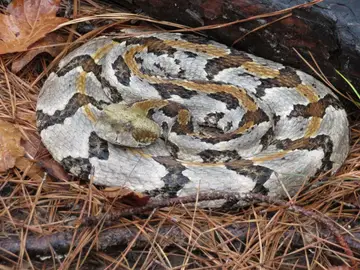

The timber rattlesnake (called the canebrake rattlesnake in much of the South) is a large, heavy-bodied pit viper with dark chevron crossbands and a black tail tipped with a rattle. It is venomous: official sources say its bite is dangerous to people and pets and can cause human death, though it is not aggressive and most bites happen when the snake is molested or stepped on. It lives across much of the eastern half of the US, from New England to northern Florida and west to Texas, Oklahoma and Wisconsin. Florida Museum of Natural History
On this page
Is the timber rattlesnake dangerous?
Venomous. Bites can be very dangerous to people and pets; the snake is not aggressive and avoids contact. Florida Museum of Natural History
“The Timber Rattlesnake is a large and impressive snake, and bites can be very dangerous to people and pets. … Timber rattlesnakes are not aggressive and avoid direct contact with people and pets.”
Bites and stings: Not aggressive; Florida Museum says most bites occur when the snake is intentionally molested or accidentally stepped on. It can strike without rattling first (Florida Museum, Georgia DNR, CDC/NIOSH).
If someone is bitten or stung, call 911 or Poison Help at 1-800-222-1222.
How to identify a timber rattlesnake
A photo or description can narrow it down, but cannot confirm what an animal is or that it is safe. Look from a distance and do not handle wild animals.
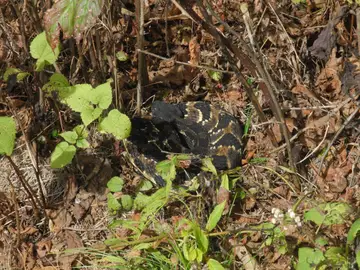
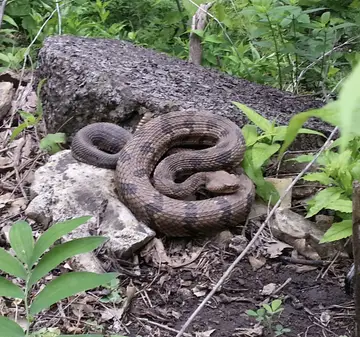
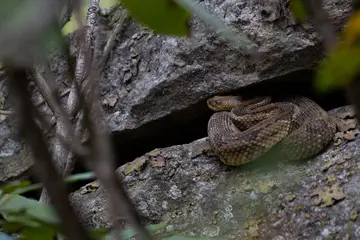

Size: Most adults 36 to 60 inches (3 to 5 feet); record 74.5 inches. Florida Museum of Natural History
Colors: Ground color yellow, tan, brown or gray; southern (canebrake) form: gray, brown, tan, yellow, orange or pink; dark phase: crossbands on a blackish-brown background. Pattern: Large black chevron-like (V-shaped) crossbands down the body; reddish-brown stripe down the center of the back.
Key features
- Black tail ending in a rattle Florida Museum of Natural History
- Heat-sensing pit between nostril and eye Missouri Department of Conservation
- Large, thick head distinct from the neck; cat-like vertical pupil Florida Museum of Natural History
- Keeled (ridged) scales Florida Museum of Natural History
- Do not rely on the rattle: tails can be injured and a surprised snake may not rattle Missouri Department of Conservation
Young
Newborns are miniature adults about 10 to 14 inches long, with hollow fangs and venom and a tiny rattle segment called a "pre-button"; after the first shed they drop it to reveal the button (New York).
Animals mistaken for the timber rattlesnake
Timber Rattlesnake or Eastern Diamondback Rattlesnake?
Timber Rattlesnake
Eastern Diamondback Rattlesnake Crotalus adamanteus
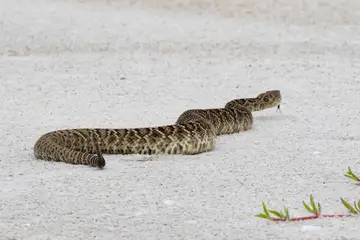
Diamondback has a row of large dark diamonds with brown centers and cream borders, and a light-bordered dark stripe through each eye. Florida Museum of Natural History
Venomous (Florida Museum).
Timber Rattlesnake or Pygmy Rattlesnake?
Timber Rattlesnake
Pygmy Rattlesnake Sistrurus miliarius
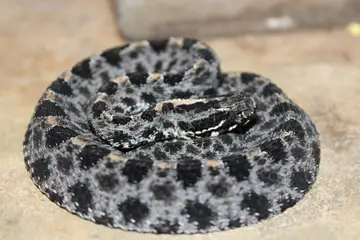

Oklahoma (western pygmy rattlesnake): much smaller (usually under 2 feet), spots rather than crossbands, and a very small rattle; it has tiny scales on top of the head where the timber has large scales. Pygmies also have an orange to red-orange midline, so a back stripe does not separate them. Oklahoma Department of Wildlife Conservation
Venomous (Louisiana LDWF).
Where the timber rattlesnake lives
- Native or listed
- Nonnative or not established
- No official record in our data
- 1–9
- 10–99
- 100–999
- 1,000+
On our state guides
- Alabama snakes
- Arkansas snakes
- Connecticut snakes
- Florida snakes
- Georgia snakes
- Illinois snakes
- Indiana snakes
- Iowa snakes
- Kansas snakes
- Kentucky snakes
- Louisiana snakes
- Maine snakes
- Maryland snakes
- Massachusetts snakes
- Minnesota snakes
- Mississippi snakes
- Missouri snakes
- Nebraska snakes
- New Hampshire snakes
- New Jersey snakes
- New York snakes
- North Carolina snakes
- Ohio snakes
- Oklahoma snakes
- Pennsylvania snakes
- Rhode Island snakes
- South Carolina snakes
- Tennessee snakes
- Texas snakes
- Vermont snakes
- Virginia snakes
- West Virginia snakes
- Wisconsin snakes
State boundaries: U.S. Census Bureau, cartographic boundary file cb_2024_us_state_20m.
When it is active
Missouri: mainly active April through mid-October; basks on sunny rocks in spring and autumn, mostly nocturnal in summer; overwinters in dens (often communal on rock ledges and bluffs in northern Missouri). Missouri Department of Conservation
US open-licence records peak in May to August.
Habitat and habits
Habitat: Hardwood forest with rocky outcrops, pine flatwoods, bottomland hardwood forest and cane thickets (Alabama); in New York, deciduous hardwood forests in rugged terrain, also lowlands, wetlands or residential areas near dens. Outdoor Alabama
Behavior: Usually mild tempered and tries to escape; may lie still and rely on camouflage, and strikes only in defense. Sometimes climbs trees.
Diet: Mainly mammals, occasionally birds; also lizards, snakes, amphibians, insects and carrion (Florida Museum). Texas: rabbits, squirrels, rats, mice; waits coiled beside a fallen tree or log for prey.
Young: Gives birth to live young: in New York 4 to 14 (average 9) young every three to five years, late August to mid-September.
Legal status and reporting
Federal: Not listed under the Endangered Species Act (ECOS returns "Resolved Taxon"; NYSDEC states Federal Status: Not Listed). US Fish and Wildlife Service
Protection: Protected in several states: threatened in New York (collecting prohibited), endangered in Ohio, legally protected in Pennsylvania (permit required to take or possess), special concern in North Carolina. Check the state wildlife agency. NYSDEC
Report: Some states ask for sightings: North Carolina Wildlife Resources Commission ("Rattlesnake Sightings Wanted"), NYSDEC regional wildlife offices, and Ohio Division of Wildlife (sighting form in Publication 115). For a snake that must be moved in Pennsylvania, PFBC says to call a local Waterways Conservation Officer. N.C. Wildlife Resources Commission
Questions about the timber rattlesnake
Timber rattlesnake bite
Timber rattlesnakes are venomous. Missouri says the bite is dangerous and can cause human death; New York says venom can be fatal if a bite is untreated. Most bites happen when the snake is molested or stepped on. If bitten, call 911 or Poison Help at 1-800-222-1222.
Timber rattlesnake venom
Official sources class the timber rattlesnake as venomous. New York says the venom is used mainly to immobilize prey and can be fatal to humans if a bite is untreated; Texas calls it highly venomous. Newborns already have fangs and venom.
What states have timber rattlesnakes?
The range runs from southern New Hampshire through the Appalachians to northern Florida and west to southeastern Texas, southeastern Nebraska and Wisconsin, with isolated populations in the Northeast (NYSDEC). State agencies confirm it in Alabama, Florida, Georgia, Louisiana, Missouri, New York, North Carolina, Ohio, Oklahoma, Pennsylvania, South Carolina, Tennessee, Texas, Virginia and West Virginia, among others.
Timber rattlesnake range
From New England to northern Florida, west to central Texas and north to southwest Wisconsin (Alabama), and from central Oklahoma nearly to Maine (Oklahoma).
Timber rattlesnake size
Most adults are 36 to 60 inches long; the record is 74.5 inches (Florida Museum). Missouri says they can reach up to 75 inches. Northern snakes tend to be smaller than southern canebrakes.
Timber rattlesnake baby
Young are born live, about 10 to 14 inches long, look like small adults and already have hollow fangs and venom. They stay in the area with their mother for 1 to 2 weeks until they shed and disperse (New York).
Canebrake rattlesnake
Canebrake rattlesnake is a regional name for the timber rattlesnake. Georgia says the southern form is larger, with bold chevrons and a reddish-orange stripe down the back. It is the same venomous species.
Eastern diamondback rattlesnake vs timber rattlesnake
Both are venomous. The diamondback has a row of large dark diamonds with brown centers and cream borders; the timber has black chevron crossbands, a reddish-brown back stripe and a black tail.
Timber rattlesnake pa
The timber rattlesnake is legally protected in Pennsylvania and a permit is required to take or possess one. PFBC says not to kill, move or capture any snake, and to call a local Waterways Conservation Officer if one must be moved.
Timber rattlesnake nc
North Carolina lists the timber rattlesnake as a state Special Concern species. It is venomous and most common in the mountains and Coastal Plain.
Timber rattlesnake tennessee
Tennessee calls the timber rattlesnake the largest and most dangerous of its four venomous snakes, and says it occurs across the state.
Sources
- Florida Snake ID Guide species account: Timber Rattlesnake. Florida Museum of Natural History (University of Florida). updated September 23, 2022; checked November 3, 2026.
Quoted passages (7)
“The Timber Rattlesnake is a large and impressive snake, and bites can be very dangerous to people and pets. … Timber rattlesnakes are not aggressive and avoid direct contact with people and pets.”
“Most adult Timber Rattlesnakes are about 36-60 inches (76-152 cm) in total length, with a record length recorded of 74.5 inches (189 cm).”
“The tail is usually uniformly black. The tail ends in a rattle, which is often held above the ground.”
“The large and thick head is distinct from the neck … The pupil is vertically elliptical”
“The dorsal scales of the body are keeled”
“This is generally a mild tempered rattlesnake that will usually attempt to escape if disturbed. Some Timber Rattlesnakes lie quietly coiled when first discovered. … Nonetheless, these snakes are not aggressive, and striking is only used in defense as a last resort.”
“The Eastern Diamond-backed Rattlesnake has a row of large dark diamonds with brown centers and cream borders down its back. The large and thick head is distinct from the neck and has a light bordered dark stripe running diagonally through each eye.”
- Timber Rattlesnake (Field Guide). Missouri Department of Conservation. undated page; checked November 3, 2026.
Quoted passages (3)
“There is a large sensory pit (heat-sensing pit) located between the nostril and eye on either side of the head.”
“Do not rely on a rattle sound for identification, though; remember that snakes’ tails are occasionally injured or cut off, and that a surprised snake may not have time to sound its rattle.”
“Mainly active from April through mid-October. They bask on sunny rocks in spring and autumn. In summer they are mostly nocturnal.”
- Timber Rattlesnake. Alabama Department of Conservation and Natural Resources (Outdoor Alabama). undated page; checked November 3, 2026.
Quoted passages (1)
“Timber rattlesnakes inhabit upland and lowland habitats such as hardwood forest with rocky outcrops, pine flatwoods, bottomland hardwood forests, and cane thickets.”
- Venomous Snakes Fact Sheet Series: Timber Rattlesnake. Georgia DNR Wildlife Resources Division. PDF Last-Modified Fri, 02 Feb 2024 14:12:53 GMT; checked November 3, 2026.
- Timber Rattlesnake. NYSDEC. archived copy, captured October 15, 2026; checked November 3, 2026.
Quoted passages (3)
“Neonates (newborn) timber rattlesnakes are about 10-14 inches long at birth. … The young are miniature versions of adults, complete with hollow fangs, venom and a tiny rattle segment called a "pre-button". Shortly after birth, they shed their skin and drop their pre-button to reveal the button”
“Following a gestation period of 4-5 months, females give birth to 4-14 (average 9) young every three to five years between late August to mid-September.”
“Collecting timber rattlesnakes from the wild is now prohibited by law under Environmental Conservation Law 11-0535 and 11-0103(2)(c).”
- ECOS species report query (Crotalus horridus, Lampropeltis triangulum, Python bivittatus, Phrynosoma spp.). U.S. Fish and Wildlife Service. live query 2026-11-03; checked November 3, 2026.
- Timber Rattlesnake (NCWRC species page). N.C. Wildlife Resources Commission. undated page; checked November 3, 2026.
Quoted passages (1)
“See a rattlesnake in the wild? We want to know!”
- Timber Rattlesnake (Field Guide). Oklahoma Department of Wildlife Conservation. undated page; checked November 3, 2026.
Quoted passages (1)
“The only remotely similar snake is the western pygmy rattlesnake, which is much smaller in size (usually less than two feet in total length), has spots rather than cross bands, and has a very small rattle. Western pygmy rattlesnakes do have an orange to red-orange midline. Close examination on the top of the head will reveal tiny scales on the western pygmy rattlesnake and large scales on timber rattlesnakes.”
- TPWD Wildlife Fact Sheet: Timber Rattlesnake (Crotalus horridus). Texas Parks and Wildlife Department. undated page; checked November 3, 2026.
- DNR, Marshall students study how relocation affects rattlesnakes. West Virginia Division of Natural Resources. published 2020-06-16; checked November 3, 2026.
- Snake Species Field Guide: Timber Rattlesnake. Louisiana Department of Wildlife and Fisheries. undated page; checked November 3, 2026.
- Timber Rattlesnake Conservation. Pennsylvania Fish and Boat Commission. undated page; checked November 3, 2026.
- Reptiles » Snakes (Tennessee Watchable Wildlife species accounts). Tennessee Wildlife Resources Agency (Tennessee Watchable Wildlife website). undated page; checked November 3, 2026.
- GBIF.org occurrence records, human observations licensed CC0 1.0 or CC BY 4.0 only, accessed November 3, 2026. The datasets behind these counts are listed on our Sources page.
- State boundaries: U.S. Census Bureau, cartographic boundary file cb_2024_us_state_20m.