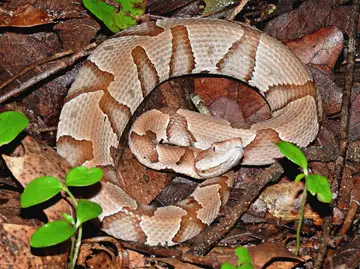
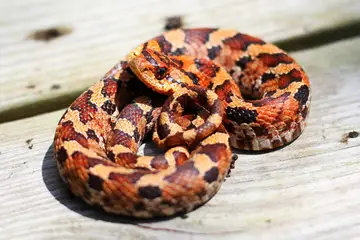
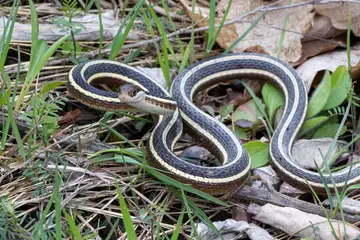
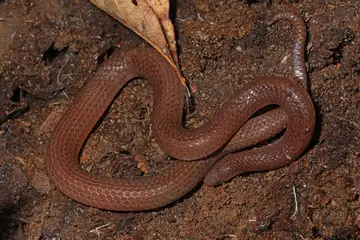
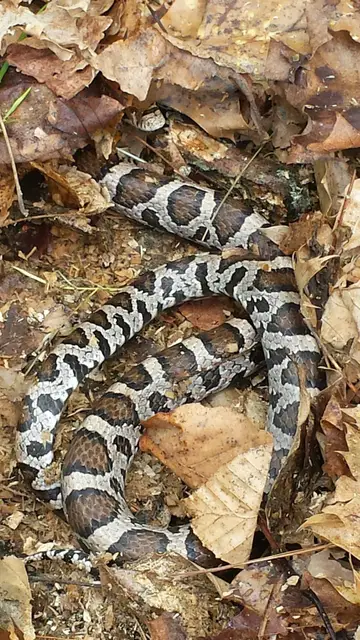
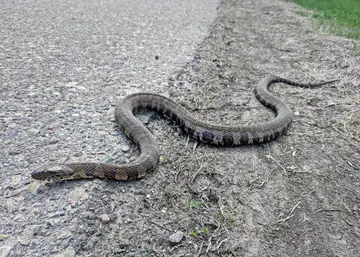
“Most copperhead bites occur when people step on or touch one accidentally. Bites require immediate medical attention. They are painful and can cause tissue damage, but they are not fatal.” MassWildlife Natural Heritage & Endangered Species Program
Size
Adults usually about 2 to 3 feet (24-36 in); record about 53 inches.
How to recognize it
Vertical (cat-like) pupils and a heat-sensing pit between eye and nostril
Heavy-bodied; keeled scales
Head shape alone is not a reliable way to identify copperheads
Where in Massachusetts
Hampden, Hampshire, and Norfolk counties. Listed as Endangered. MassWildlife
Conservation
state endangered (MESA list, Aug 16 2024)
What the sources say
Venom: “Only 2 of the 14 types of snakes in Massachusetts are venomous: the timber rattlesnake and the copperhead.” (MassWildlife)
Habitat: In and around deciduous forests; moist, damp habitats and traprock (basalt) ledges with extensive rock slides below (MassWildlife Natural Heritage & Endangered Species Program)
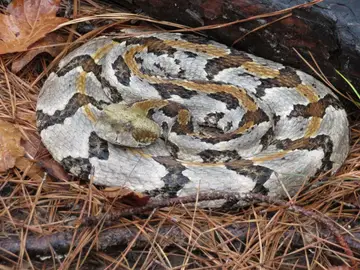
Most adults 36 to 60 inches (3 to 5 feet); record 74.5 inches.
How to recognize it
Black tail ending in a rattle
Heat-sensing pit between nostril and eye
Large, thick head distinct from the neck; cat-like vertical pupil
Where in Massachusetts
Berkshire, Hampden, Hampshire, and Norfolk counties. Listed as Endangered. MassWildlife
Conservation
state endangered (MESA list, Aug 16 2024)
What the sources say
Venom: “Only 2 of the 14 types of snakes in Massachusetts are venomous: the timber rattlesnake and the copperhead.” (MassWildlife)
Habitat: Mountainous terrains with steep ledges or rockslides close to forested areas and large populations of rodents (MassWildlife Natural Heritage & Endangered Species Program)
Florida Museum (midland watersnake): the watersnake's crossbands are darker, narrower and much more numerous than a copperhead's and turn into blotches halfway down the body. Watersnakes have round pupils and dark vertical lines near the mouth; copperheads have no such lines.
The copperhead's head is coppery with no marks; the milksnake's head is light with brownish marks (Pennsylvania). Tennessee: copperhead has a copper-colored, unmarked head and triangular shapes on the side of the body. Pennsylvania says the eastern milksnake is the snake most often killed by mistake for a copperhead. Belly colour is not used here: Pennsylvania's own pages describe the copperhead belly two different ways (uniform cream in one account, mottled white to gray in another).
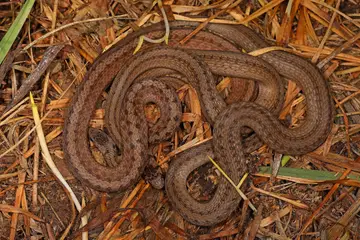
Copperheads have bold hourglass-shaped bands, and young copperheads under about 12 inches have bright yellow tail tips. Brown snakes have small spots, not hourglass bands.
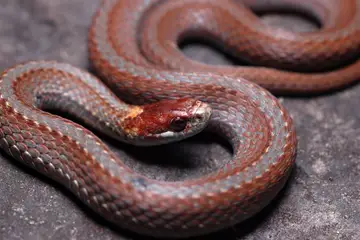
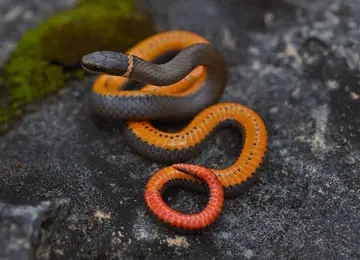
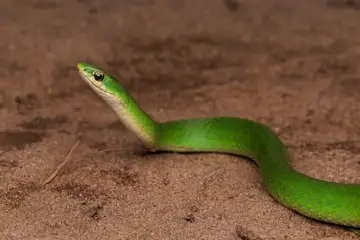
Brown Snake (Dekay's Brownsnake) or Red-bellied Snake?
Wildlife problems: contact MassWildlife, (508) 389-6300 or [email protected] (M–F 8–4). Rattlesnake sightings: [email protected] (photos from a distance); suspected illegal activity: Massachusetts Environmental Police 1-800-632-8075. Rare species sightings: MassWildlife Heritage Hub or Rare Animal Observation Form. Spotted lanternfly in a new town: photo + reporting form at mass.gov/slf. Non-emergency shark sightings on the Outer Cape: Sharktivity app or ranger stations (508) 255-2112 / (508) 487-2100. MassWildlife
What official sources say
Are there venomous snakes in Massachusetts?
Yes. MassWildlife: only 2 of the 14 snake species are venomous, the timber rattlesnake and the copperhead; both live in only a few areas and are state endangered. MassWildlife
“Only 2 of the 14 types of snakes in Massachusetts are venomous: the timber rattlesnake and the copperhead.”
Are there rattlesnakes in Massachusetts?
Yes, but rare. Timber rattlesnakes are native but the statewide population is only in the hundreds, scattered over a few areas; most people never see one. MassWildlife
“Today, their statewide population is only in the hundreds and scattered over a small handful of areas, making the chance of seeing one very low.”
“Range in MA: Limited to small, localized populations in Norfolk and Hampden counties”
Are there cottonmouths (water moccasins) in Massachusetts?
No. Not on the MassWildlife list. USGS NAS has 2 Massachusetts records, both from Milton in 1986, and says the species was never established in Massachusetts (the specimen may have been a released pet). US Geological Survey, Nonindigenous Aquatic Species database
“A. piscivorus was never established in Massachusetts.”
About this list
The species list comes from Snakes of Massachusetts; Amphibians and Reptiles in Massachusetts (Massachusetts Division of Fisheries and Wildlife (MassWildlife), undated web pages (herp list Update September 2020); Internet Archive captures 2026-01-17 and 2026-10-24). 14 more entries come from other official sources named on each card.
Venom labels come only from official sources and link to them; "Not stated" never means harmless. How labels work.
“If you aren’t sure what species of snake you are looking at, treat it as though it is venomous and give it plenty of space. To avoid an encounter, make sure to stay on trails, and keep pets leashed.”
“…they hibernate for six months of the year.”
“You can report sightings of rattlesnakes to MassWildlife at [email protected], or report any suspected illegal activity directly to the Massachusetts Environmental Police at 1-800-632-8075.”
“Today, their statewide population is only in the hundreds and scattered over a small handful of areas, making the chance of seeing one very low.”
Snakes of Massachusetts. Massachusetts Division of Fisheries and Wildlife (MassWildlife). archived copy, captured October 24, 2026; checked November 3, 2026.Quoted passages (2)
“Massachusetts is home to an impressive diversity of wildlife, including 14 species of snakes.”
“Only 2 of the 14 types of snakes in Massachusetts are venomous: the timber rattlesnake and the copperhead.”
Amphibians and Reptiles in Massachusetts. Massachusetts Division of Fisheries and Wildlife (MassWildlife). archived copy, captured January 17, 2026; checked November 3, 2026.
Learn about timber rattlesnakes. MassWildlife Natural Heritage & Endangered Species Program. archived copy, captured March 13, 2026; checked November 3, 2026.Quoted passages (3)
“Bites require immediate medical attention, but they are very rare, and they are even more rarely fatal. Most snake bites from timber rattlers are due to illegal or otherwise ill-advised handling or harassment.”
“Because they are venomous AND endangered in Massachusetts, please maintain a safe, respectful distance. Do not handle or otherwise disturb them.”
“Massachusetts timber rattlesnakes are active from mid-April to mid-October.”
Learn about copperheads. MassWildlife Natural Heritage & Endangered Species Program. archived copy, captured May 20, 2026; checked November 3, 2026.Quoted passages (4)
“Most copperhead bites occur when people step on or touch one accidentally. Bites require immediate medical attention. They are painful and can cause tissue damage, but they are not fatal.”
“Bites require immediate medical attention.”
“Massachusetts copperheads are active from April to October.”
“Range in MA: Limited to small, localized populations in Norfolk and Hampden counties”