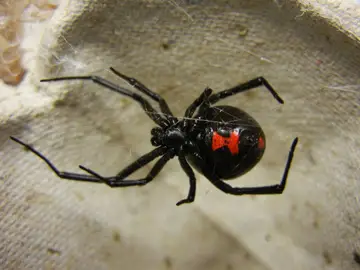
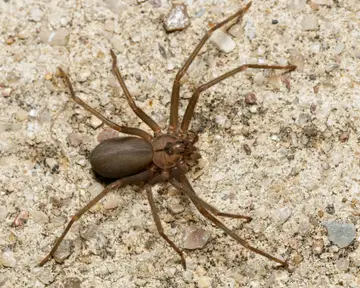
This page lists 3 spiders: all from Cape Cod Cooperative Extension, Barnstable County's It's Spider Season on Cape Cod.
2 are venomous by official accounts.
Not every species: no complete official list of Massachusetts spiders exists, so this page covers the ones state and Extension sources name. How lists are built.
Which spiders can hurt you
Official sources single out these spiders in Massachusetts, in their own words:
Venomous. “We do have one venomous spider in Massachusetts … the black widow. Occasionally found in houses but more often in garden sheds and wood piles.” Cape Cod Cooperative Extension, Barnstable County
Ticks (arachnids, not spiders)
Official sources single out these ticks in Massachusetts, in their own words:
Black-legged (deer) tick and dog tick (arachnids, not spiders)
May spread disease-causing germs when they bite. “Black-legged (deer) ticks and dog ticks are found throughout Massachusetts and may spread different disease-causing germs when they bite you. The most common tick-borne diseases in Massachusetts are Lyme Disease, Babesiosis, and Anaplasmosis.” Massachusetts Department of Public Health, Bureau of Infectious Disease and Laboratory Sciences
All 3 spiders
Venomous species first, then A to Z. Do not handle them.
Venom: “We do have one venomous spider in Massachusetts … the black widow. Occasionally found in houses but more often in garden sheds and wood piles.” (Cape Cod Cooperative Extension, Barnstable County)
Habitat: Occasionally in houses, more often in garden sheds and wood piles (Cape Cod Cooperative Extension, Barnstable County)
Venom: “I do get frequent calls about spiders … brown recluse in particular. Yes, they are one of three venomous spiders found in North America. Their distribution is confined to Nebraska, Kansas, Missouri and the south. In every case these sightings turn out to be wolf spiders.” (Cape Cod Cooperative Extension, Barnstable County)
No confirmed photo of Wolf spiders
Wolf spiders
Not stated
Venom
No official source we use states whether this animal is venomous. That does not mean it is harmless: do not handle it.
When spiders are active in Massachusetts
Records of spiders in Massachusetts peak in June to September. They show when people record spiders, not how many there are (about month bars).
JanFebMarAprMayJunJulAugSepOctNovDec
4,190 records of spiders in Massachusetts by month (GBIF, CC0 and CC BY records).
Call 911 or Poison Help at 1-800-222-1222 right away. Poison Help connects you to your local poison center, any time of day.
What official sources say
Are there black widow spiders in Massachusetts?
Yes. Cape Cod Cooperative Extension: the black widow is the one venomous spider in Massachusetts, occasionally in houses but more often in garden sheds and wood piles. Cape Cod Cooperative Extension, Barnstable County
“We do have one venomous spider in Massachusetts … the black widow. Occasionally found in houses but more often in garden sheds and wood piles.”
Are there brown recluse spiders in Massachusetts?
No. Cape Cod Cooperative Extension: brown recluse distribution is confined to Nebraska, Kansas, Missouri and the south; reported sightings turn out to be wolf spiders. Cape Cod Cooperative Extension, Barnstable County
“Their distribution is confined to Nebraska, Kansas, Missouri and the south. In every case these sightings turn out to be wolf spiders.”
“We do have one venomous spider in Massachusetts … the black widow. Occasionally found in houses but more often in garden sheds and wood piles.”
“I do get frequent calls about spiders … brown recluse in particular. Yes, they are one of three venomous spiders found in North America. Their distribution is confined to Nebraska, Kansas, Missouri and the south. In every case these sightings turn out to be wolf spiders.”
“Now that it’s getting colder, you’re going to see an influx of spiders in your home.”
“Their distribution is confined to Nebraska, Kansas, Missouri and the south. In every case these sightings turn out to be wolf spiders.”
Tick-borne Diseases. Massachusetts Department of Public Health, Bureau of Infectious Disease and Laboratory Sciences. archived copy, captured September 30, 2026; checked November 3, 2026.Quoted passages (1)
“Black-legged (deer) ticks and dog ticks are found throughout Massachusetts and may spread different disease-causing germs when they bite you. The most common tick-borne diseases in Massachusetts are Lyme Disease, Babesiosis, and Anaplasmosis.”