Milk Snake
Lampropeltis triangulum (eastern milksnake); some agencies now also list Lampropeltis gentilis (western milksnake), formerly part of L. triangulum · also called Milksnake, Eastern Milksnake, Western Milksnake and Red Milk Snake · Last checked November 3, 2026.
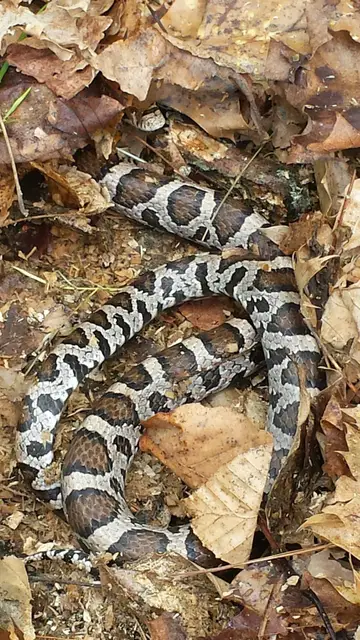
Milk snakes are medium-sized, smooth, shiny snakes in the kingsnake family. Eastern milksnakes are gray or tan with black-bordered reddish-brown blotches; western forms are banded red, black and white or yellow, and look like venomous coral snakes. State agencies class milk snakes as nonvenomous. They are secretive, often hide under logs and rocks, and live across much of the eastern and central US, with western forms reaching Arizona and New Mexico. Tennessee Wildlife Resources Agency
On this page
Is the milk snake dangerous?
Nonvenomous (Arizona Game and Fish). Arizona Game and Fish Department
“MILKSNAKE Lampropeltis triangulum Non-Venomous”
Bites and stings: May vibrate its tail and strike repeatedly if thoroughly pestered, but Ohio says the teeth can barely puncture the skin; Texas says they seldom bite, though they may nip.
How to identify a milk snake
A photo or description can narrow it down, but cannot confirm what an animal is or that it is safe. Look from a distance and do not handle wild animals.
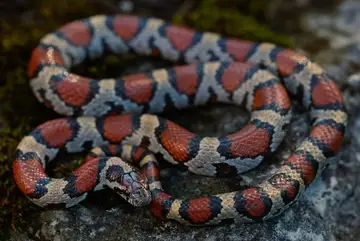

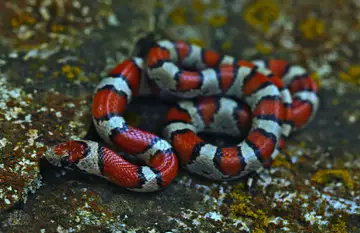

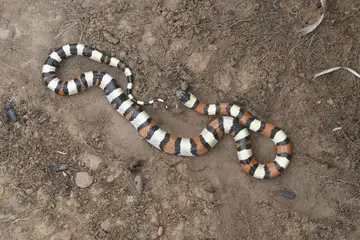
Size: Eastern milksnake 24 to 52 inches (Alabama); TN gives 24 to 36 inches for eastern and 21 to 28 for red milksnake. Outdoor Alabama
Colors: Eastern: gray or tan body with brownish or reddish-brown, black-bordered blotches; red milksnake: white or yellow body with red or orange-red, black-bordered blotches; western forms: Arizona describes red, black and white bands; Texas (Louisiana milk snake) black-red-black-yellow-black bands; Louisiana (western milksnake) red with white crossbands bordered by black. Pattern: Blotched (eastern) or banded (western); texas: red bands bordered by black (black-red-black-yellow-black).
Key features
- Eastern milksnake: black-and-white checkerboard belly (Ohio). Western milksnake in Louisiana: underside dull white with scattered black marks. Ohio Department of Natural Resources, Division of Wildlife
- Eastern milksnake: a light Y- or V-shaped mark is usually present on the nape Ohio Department of Natural Resources, Division of Wildlife
- Smooth, shiny scales and round pupils Arizona Game and Fish Department
- Arizona: black snout separates it from the Sonoran mountain kingsnake Arizona Game and Fish Department
Young
Eastern milksnake blotches are red in juveniles; hatchlings about 5 to 11 inches.
Animals mistaken for the milk snake
Milk Snake or Coral Snake?
Milk Snake
Coral Snake Micrurus spp.
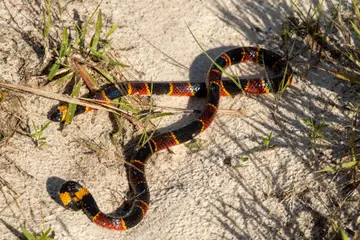
Texas Parks and Wildlife (Louisiana milk snake account): coral snakes have red bands bordered by yellow; milk snakes have red bands bordered by black. TPWD also says never to disturb snakes in the wild, especially if you are unsure whether it is a coral snake or a milk snake. CDC: coral snakes are sometimes confused with nonvenomous king snakes, which have similar colored bands.
Highly venomous (TPWD).
Milk Snake or Copperhead?
Milk Snake
Copperhead Agkistrodon contortrix
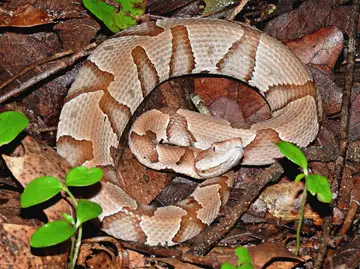

The copperhead's head is coppery with no marks; the milksnake's head is light with brownish marks (Pennsylvania). Tennessee: copperhead has a copper-colored, unmarked head and triangular shapes on the side of the body. Pennsylvania says the eastern milksnake is the snake most often killed by mistake for a copperhead. Belly colour is not used here: Pennsylvania's own pages describe the copperhead belly two different ways (uniform cream in one account, mottled white to gray in another).
Venomous (CDC/NIOSH lists copperheads among US venomous snakes).
Milk Snake or Corn Snake?
Milk Snake
Corn Snake Pantherophis guttatus
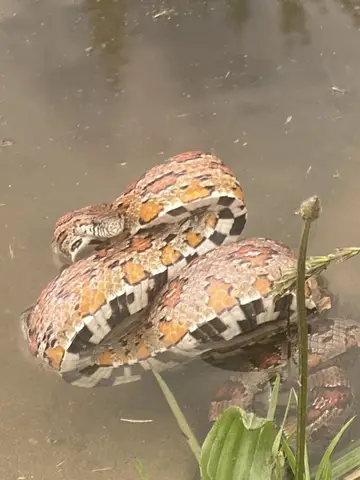
Tennessee: the corn snake has a spear-point pattern between the eyes and a striped underside of the tail; milksnakes lack striping under the tail. Both have checkerboard bellies, so the belly alone does not separate them. Tennessee Wildlife Resources Agency
Milk Snake or Scarlet Kingsnake?
Milk Snake
Scarlet Kingsnake Lampropeltis elapsoides
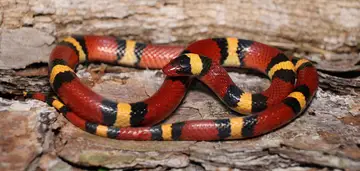

Scarlet kingsnake has a red snout and red, black and yellow bands in which red touches black but not yellow; its pattern continues onto the belly (Tennessee). Louisiana: the snout is always red and the rings continue across the belly. Tennessee still lists it as a milksnake subspecies (L. t. elapsoides); Louisiana lists it as Lampropeltis elapsoides.
Nonvenomous (Louisiana LDWF).
Where the milk snake lives
- Native or listed
- Nonnative or not established
- No official record in our data
- 1–9
- 10–99
- 100–999
- 1,000+
On our state guides
- Alabama snakes
- Arizona snakes
- Arkansas snakes
- Colorado snakes
- Connecticut snakes
- Delaware snakes
- Georgia snakes
- Illinois snakes
- Indiana snakes
- Iowa snakes
- Kansas snakes
- Kentucky snakes
- Louisiana snakes
- Maine snakes
- Maryland snakes
- Massachusetts snakes
- Michigan snakes
- Minnesota snakes
- Mississippi snakes
- Missouri snakes
- Nebraska snakes
- New Hampshire snakes
- New Jersey snakes
- New Mexico snakes
- New York snakes
- North Carolina snakes
- Ohio snakes
- Oklahoma snakes
- Pennsylvania snakes
- Rhode Island snakes
- South Carolina snakes
- South Dakota snakes
- Tennessee snakes
- Texas snakes
- Vermont snakes
- Virginia snakes
- Wisconsin snakes
State boundaries: U.S. Census Bureau, cartographic boundary file cb_2024_us_state_20m.
When it is active
Secretive and mostly nocturnal; hides by day under objects, bark or in soil. Texas Parks and Wildlife Department
US open-licence records peak in May to June and September.
Habitat and habits
Habitat: Varied: generally pine or hardwood forest with rock outcrops, but also under rocks or logs in fields, savannahs, farmland, suburbs, wetlands and forest edges (Tennessee). Arizona: open plains, low valleys and rolling hills in grassland. Tennessee Wildlife Resources Agency
Behavior: Usually stays still or crawls away; if thoroughly pestered may vibrate its tail and strike. A true constrictor.
Diet: Mice, shrews and voles, plus lizards, snakes, birds and eggs.
Young: Lays eggs: spring breeding, clutch of 2 to 17 eggs under rocks, logs or rotten stumps, hatching in late summer (Tennessee).
Legal status and reporting
Federal: No ECOS (USFWS) record returned for Lampropeltis triangulum: not federally listed as far as ECOS shows. US Fish and Wildlife Service
Protection: Varies by state. Arizona: protected in Cochise County. Alabama: Moderate Conservation Concern, and Alabama Regulation 220-2-.92 protects all native kingsnakes (Lampropeltis spp.). Tennessee says populations are not protected. Arizona Game and Fish Department
Questions about the milk snake
Is a milk snake poisonous?
No. State agencies in Arizona, Louisiana, North Carolina and Texas class milk snakes as nonvenomous. Note that red, black and yellow banded milk snakes look like venomous coral snakes.
Is a milk snake dangerous?
Milk snakes are classed as nonvenomous. Ohio says that if pestered they may strike, but their teeth can barely puncture the skin; Texas says they seldom bite, although they may nip.
Is a milk snake harmless?
NC State Extension labels the eastern milk snake "Harmless" and state agencies class it as nonvenomous. Make sure it is not a coral snake or copperhead, which are venomous lookalikes.
Coral snake vs milk snake
Texas Parks and Wildlife: coral snakes have red bands bordered by yellow; milk snakes have red bands bordered by black. Coral snakes are highly venomous; milk snakes are not.
Coral snake vs milk snake rhyme
Texas Parks and Wildlife gives the rhyme "Red to yellow, kill a fellow; Red to black, friend of Jack" in its Louisiana milk snake account, and also says never to disturb snakes in the wild, especially if you are unsure whether it is a coral snake or a milk snake.
Copperhead vs milk snake
Pennsylvania: the copperhead's head is coppery with no marks; the milksnake's head is light with brownish marks. Tennessee adds that the copperhead has triangular shapes on the side of the body. Pennsylvania says the eastern milksnake is the snake most often killed by mistake for a copperhead. Copperheads are venomous (CDC).
Milk snake vs corn snake
Tennessee: the corn snake has a spear-point pattern between the eyes and striping under the tail; milksnakes lack striping under the tail. Both have black-and-white checkerboard bellies.
Is a milk snake a king snake?
Texas Parks and Wildlife says milk snakes are members of the king snake family. Both are in the genus Lampropeltis.
Is a milk snake a constrictor?
Yes. Ohio says the milksnake is a true constrictor that wraps loops of its body around prey.
Milk snake size
Eastern milk snakes range from 24 to 52 inches (Alabama); western forms are smaller, such as 18 to 23 inches in Louisiana and up to about 35 inches in Arizona.
Milk snake ohio
Ohio lists the eastern milksnake as common and says it is encountered throughout Ohio in woods, meadows and river bottoms, even within cities, where it occasionally enters buildings in search of mice.
Milk snake pa
Pennsylvania says the eastern milksnake is seen quite often, is among the state's most beneficial snakes, and is the snake most often killed by mistake for a copperhead.
Sources
- Reptiles » Snakes (Tennessee Watchable Wildlife species accounts). Tennessee Wildlife Resources Agency (Tennessee Watchable Wildlife website). undated page; checked November 3, 2026.
Quoted passages (4)
“Milksnakes are found in a variety of habitats, but generally prefer pine or hardwood forests with rock outcroppings. They also live under rocks or logs in other habitats including fields, savannahs, agricultural, suburban, wetlands, and forest edges.”
“Prefers mice, shrews, and voles; but also eats lizards, snakes, birds, and eggs.”
“Adults breed in the spring. Females choose nest sites under rocks, logs, or rotten stumps that are warm and humid. Females lay a clutch of 2-17 elliptical eggs about 30-40 days after breeding. Eggs typically hatch in late summer.”
“Red Cornsnake has a spearpoint pattern between the eyes and underside of tail is striped.”
- Online Field Guide species account: Milksnake (Lampropeltis triangulum). Arizona Game and Fish Department. 2023; checked November 3, 2026.
Quoted passages (4)
“MILKSNAKE Lampropeltis triangulum Non-Venomous”
“The pupils are round and the scales are smooth and shiny.”
“The Milksnake’s black snout distinguishes it from the similar looking Sonoran Mountain Kingsnake which has a light snout.”
“Protected in Cochise County.”
- Snake Species Field Guide: Western Milksnake. Louisiana Department of Wildlife and Fisheries. undated page; checked November 3, 2026.
- TPWD Wildlife Fact Sheet: Louisiana Milk Snake (Lampropeltis triangulum amaura). Texas Parks and Wildlife Department. undated page; checked November 3, 2026.
Quoted passages (1)
“Milk snakes are secretive burrowers, hiding by day in loose, sandy soil, beneath objects on the ground or under the bark of tree trunks or logs. They are nocturnal, or move above ground at night.”
- Eastern Milksnake (NCWRC species page). N.C. Wildlife Resources Commission. undated page; checked November 3, 2026.
- Eastern Milk Snake. Alabama Department of Conservation and Natural Resources (Outdoor Alabama). undated page; checked November 3, 2026.
Quoted passages (2)
“Eastern milk snakes (Lampropeltis triangulum triangulum) are medium sized snakes that range in total length from 24-52 inches.”
“…black bordered dark gray or brownish blotches (red in juveniles) … Young range from approximately 5-11 inches in length.”
- Reptiles of Ohio Field Guide (Publication 5354). Ohio Department of Natural Resources, Division of Wildlife. PUBLICATION 5354; checked November 3, 2026.
Quoted passages (3)
“The belly has a black and white checkerboard pattern.”
“A Y-shaped or V-shaped light-colored blotch is usually present on the nape of the neck.”
“When first encountered, the milksnake either remains motionless or attempts to crawl away. If thoroughly pestered, it may vibrate the tip of its tail rapidly and strike repeatedly. … The milksnake is a true constrictor.”
- ECOS species report query (Crotalus horridus, Lampropeltis triangulum, Python bivittatus, Phrynosoma spp.). U.S. Fish and Wildlife Service. live query 2026-11-03; checked November 3, 2026.
Quoted passages (1)
“Lampropeltis triangulum: no record returned”
- Snakes: Family Colubridae (AG-472-02). NC State Extension (N.C. Cooperative Extension, NC State University). Publication date: Aug. 21, 2019; checked November 3, 2026.
- Snakes (species accounts). Pennsylvania Fish and Boat Commission. undated page; checked November 3, 2026.
- Venomous Snakes (NIOSH Outdoor Workers). CDC / NIOSH. archived copy, captured October 6, 2026; checked November 3, 2026.
- GBIF.org occurrence records, human observations licensed CC0 1.0 or CC BY 4.0 only, accessed November 3, 2026. The datasets behind these counts are listed on our Sources page.
- State boundaries: U.S. Census Bureau, cartographic boundary file cb_2024_us_state_20m.