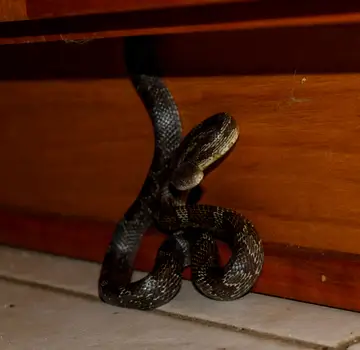
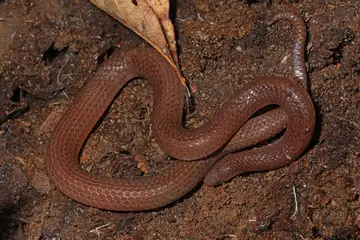
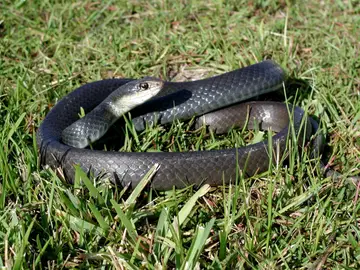
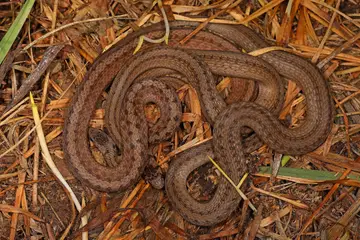
NYSDEC: There are 2600 species worldwide and 17 species in New York, but only 3 of these are venomous (with limited distribution).
This page lists 17 snakes: all from NYSDEC Division of Fish and Wildlife's Checklist of Amphibians, Reptiles, Birds and Mammals of New York State, Including Their Legal Status.
3 are venomous by official accounts: Northern Copperhead, Eastern Massasauga and Timber Rattlesnake.
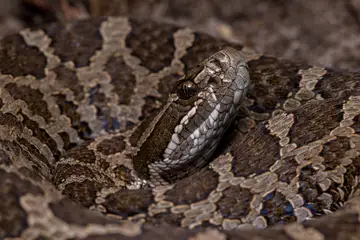
Usually 18 to 30 inches long (New York DEC: 18 to 40 inches, average 27.5). The western massasauga in Arizona reaches only about 22 inches.
How to recognize it
A segmented rattle (a single button in newborns) and vertical, catlike pupils. In Michigan it is the only snake with both.
Nine large plates on top of the head (the timber rattlesnake has many small scales there)
A heat-sensing pit on each side of the head between the eye and nostril; the head is flat and much wider than the neck
Where in New York
There are only two known populations remaining in New York, both of which occur in boggy, forested wetlands NYSDEC
Conservation
New York Endangered; Federal Threatened
What the sources say
Venom: “The massasauga rattlesnake is the smallest of the three venomous snakes found in New York State, the other two being the timber rattlesnake (Crotalus horridus) and the copperhead (Agkistrodon contortrix).” (NYSDEC)
“The venom, which is used primarily to immobilize prey, can be fatal to humans if the bite is untreated …” NYSDEC
Size
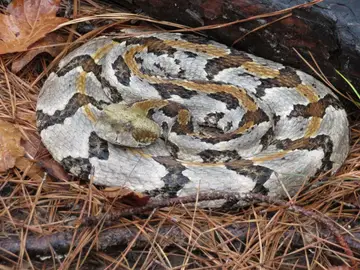
Most adults 36 to 60 inches (3 to 5 feet); record 74.5 inches.
How to recognize it
Black tail ending in a rattle
Heat-sensing pit between nostril and eye
Large, thick head distinct from the neck; cat-like vertical pupil
Where in New York
They are now found in smaller numbers throughout the state with isolated populations in southeastern New York, the Southern Tier, and in the edges of the eastern … NYSDEC
Conservation
New York Threatened
JFMAMJJASOND
155 records by month.What the sources say
Venom: “…the timber rattlesnake is the largest venomous snake in New York.” (NYSDEC)
Range: They are now found in smaller numbers throughout the state with isolated populations in southeastern New York, the Southern Tier, and in the edges of the eastern Catskills and Adirond
Habitat: Timber rattlesnakes are generally found in deciduous hardwood forests in rugged terrain. (NYSDEC Division of Fish and Wildlife)
From A to Z. "Not stated" means no official source we use gives a venom status, not that the snake is harmless. Some harmless snakes mimic venomous ones: leave every snake alone.
No official source we use states whether this animal is venomous. That does not mean it is harmless: do not handle it.
Size
Most adults about 3 to 5 ft. Sources range from 20 to 56 inches (Florida Museum) to 34 to 77 inches (New Jersey); Alabama says some exceed 6 ft.
How to recognize it
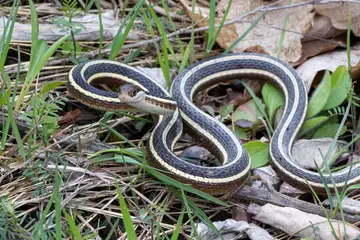
Smooth scales
Long and slender with large eyes
White chin
JFMAMJJASOND
121 records by month.What the sources say
Habitat: Racers are typically found in open woodlands, shrubby grasslands, old fields and along the edges of wetlands (NYSDEC, reprinted from New York State Conservationist)
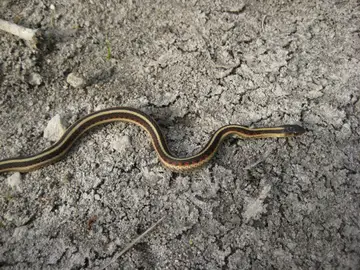
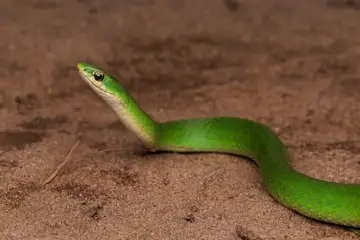
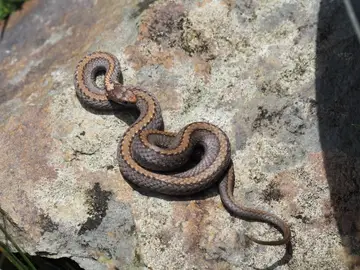
Venom: “Other kinds that occur all across New York in appropriate habitat are the green, redbelly, brown, and ringneck snakes; all four of these are small, slender, and completely benign species” (SUNY College of Environmental Science and Forestry)
Venom: “Other kinds that occur all across New York in appropriate habitat are the green, redbelly, brown, and ringneck snakes; all four of these are small, slender, and completely benign species” (SUNY College of Environmental Science and Forestry)
Venom: “Other kinds that occur all across New York in appropriate habitat are the green, redbelly, brown, and ringneck snakes; all four of these are small, slender, and completely benign species” (SUNY College of Environmental Science and Forestry)
Venom: “Other kinds that occur all across New York in appropriate habitat are the green, redbelly, brown, and ringneck snakes; all four of these are small, slender, and completely benign species” (SUNY College of Environmental Science and Forestry)
Snakes people confuse
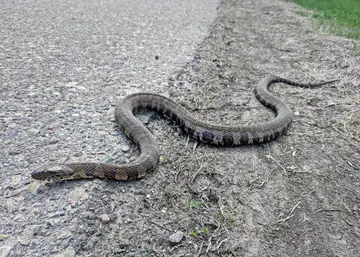
Northern watersnake or Copperhead?
Photo: U.S. Fish and Wildlife Service - Midwest Region · Public domain · Wikimedia Commons
Florida Museum (midland watersnake): the watersnake's crossbands are darker, narrower and much more numerous than a copperhead's and turn into blotches halfway down the body. Watersnakes have round pupils and dark vertical lines near the mouth; copperheads have no such lines.
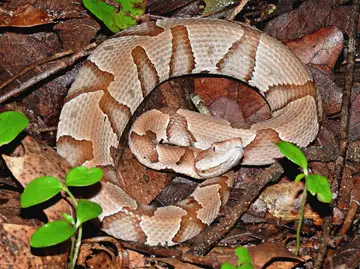
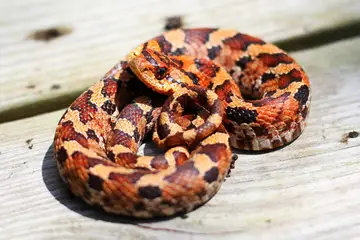
Copperheads have bold hourglass-shaped bands, and young copperheads under about 12 inches have bright yellow tail tips. Brown snakes have small spots, not hourglass bands.
Brown Snake (Dekay's Brownsnake) or Red-bellied Snake?
Missouri: red-bellied snakes are sometimes mistaken for young copperheads. Copperheads are stout-bodied with hourglass-shaped markings on the back, vertical pupils, a sensory pit between each nostril and eye and, sometimes, especially in young copperheads, a yellow tail tip.
Yes. DEC lists the copperhead as one of three venomous snakes. ESF says it is mainly along the lower Hudson Valley south of Kingston and scattered through the Catskills. SUNY College of Environmental Science and Forestry
“The copperhead is mainly found along the lower Hudson Valley south of Kingston and scattered through the Catskills.”
Are there cottonmouths or water moccasins in New York?
No. ESF says the cottonmouth does not occur within state borders. DEC's guide gives its northern limit as southern Virginia. Northern water snakes are often mistaken for it. SUNY College of Environmental Science and Forestry
“…this latter species is a large venomous snake that does not occur within our state borders.”
Are there coral snakes in New York?
Not on the official list. DEC's checklist has no coral snake and DEC names only three venomous species. NYSDEC
“The massasauga rattlesnake is the smallest of the three venomous snakes found in New York State, the other two being the timber rattlesnake (Crotalus horridus) and the copperhead (Agkistrodon contortrix).”
“Other kinds that occur all across New York in appropriate habitat are the green, redbelly, brown, and ringneck snakes; all four of these are small, slender, and completely benign species”
“They are completely harmless to people.”
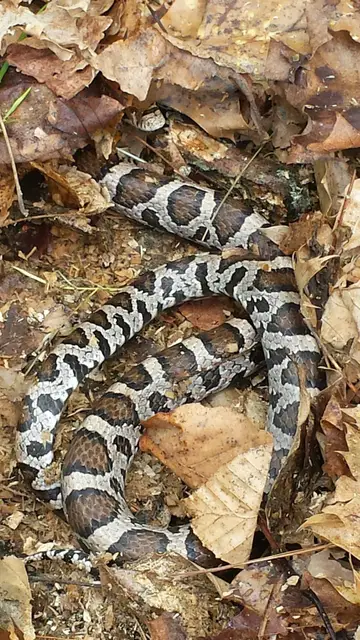
“The milk snake is harmless.”
“The copperhead is mainly found along the lower Hudson Valley south of Kingston and scattered through the Catskills.”
“…this latter species is a large venomous snake that does not occur within our state borders.”
Eastern Massasauga. NYSDEC. archived copy, captured July 15, 2026; checked November 3, 2026.Quoted passages (1)
“The massasauga rattlesnake is the smallest of the three venomous snakes found in New York State, the other two being the timber rattlesnake (Crotalus horridus) and the copperhead (Agkistrodon contortrix).”
Timber Rattlesnake. NYSDEC. archived copy, captured October 15, 2026; checked November 3, 2026.Quoted passages (5)
“…the timber rattlesnake is the largest venomous snake in New York.”
“The venom, which is used primarily to immobilize prey, can be fatal to humans if the bite is untreated. However, in New York there have been no records of human deaths attributed to rattlesnakes in the wild during the last several decades.”
“Do not panic! Keep a safe distance of 6ft or more away. Let them move along on their own. Do not kill or collect the individual.”
“Timber rattlesnake have an active season that runs from late April until mid-October. In Northern New York, emergence is often delayed until mid-May.”
“To report sighting, or ask questions, contact your Regional Wildlife Office”