Massasauga rattlesnake
Sistrurus catenatus (eastern massasauga) and Sistrurus tergeminus (western massasauga, including the prairie and desert massasaugas) · also called Eastern massasauga, Western massasauga, Prairie massasauga and Desert massasauga · Last checked November 3, 2026.
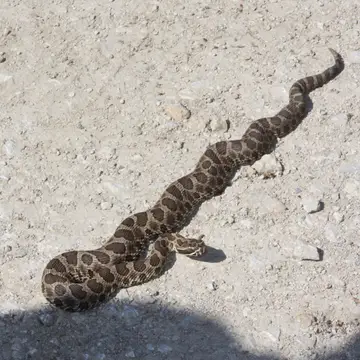

The massasauga is a small, thick-bodied rattlesnake, usually 18 to 30 inches long, gray or light brown with dark brown blotches (some are almost black), a small rattle and catlike vertical pupils. It is venomous. Bites are rare because the snake is shy and usually avoids people, but its venom is potent, and Michigan DNR says any bite should get prompt professional medical attention. The eastern massasauga lives in scattered wetland sites from New York and Pennsylvania west to Iowa and Missouri, and is federally threatened. The western massasauga lives in grasslands and marshes of the Great Plains and Southwest, from Iowa and Missouri to Colorado, Arizona and Texas. US Fish and Wildlife Service
On this page
Is the massasauga rattlesnake dangerous?
Michigan DNR: massasaugas avoid people and are not prone to strike, but their short fangs easily puncture skin and they have potent venom. Leave them alone. Any bite should get prompt professional medical attention. Michigan Department of Natural Resources
“Their short fangs can easily puncture skin, and they do possess a potent venom. It is best to treat them with respect and leave them alone. The few bites that occur to humans often result from attempts to handle or kill the snakes. Any bite from a massasauga should receive prompt professional medical attention.”
Bites and stings: Rare. USFWS: people are rarely bitten because the snake is elusive and shy. Michigan DNR: the few bites that happen to people often come from trying to handle or kill the snake.
If someone is bitten or stung, call 911 or Poison Help at 1-800-222-1222.
How to identify a massasauga rattlesnake
A photo or description can narrow it down, but cannot confirm what an animal is or that it is safe. Look from a distance and do not handle wild animals.
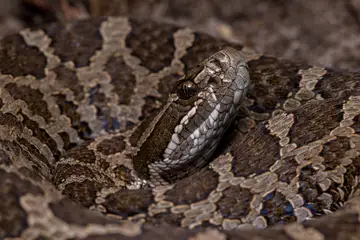

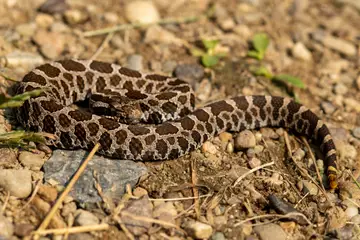
Size: Usually 18 to 30 inches long (New York DEC: 18 to 40 inches, average 27.5). The western massasauga in Arizona reaches only about 22 inches. IDNR
Colors: Gray or light brown, with large light-edged chocolate-brown to black blotches; some are black; eastern massasauga belly mostly black; prairie (western) massasauga belly generally light. Pattern: A row of large dark blotches down the back and three rows of smaller dark spots on each side; a dark bar with a light border from the eye to the back of the jaw.
Key features
- A segmented rattle (a single button in newborns) and vertical, catlike pupils. In Michigan it is the only snake with both. Michigan Department of Natural Resources
- Nine large plates on top of the head (the timber rattlesnake has many small scales there) Pennsylvania Fish and Boat Commission
- A heat-sensing pit on each side of the head between the eye and nostril; the head is flat and much wider than the neck IDNR
- The tail has 4 to 7 black rings Illinois Natural History Survey (INHS), Prairie Research Institute, University of Illinois Urbana-Champaign
- Rattle segments can break off and young snakes have only a small button, so a missing rattle does not rule it out Illinois Natural History Survey (INHS), Prairie Research Institute, University of Illinois Urbana-Champaign
Young
Newborns are about 7 to 10 inches long, have a single button instead of a rattle, and are patterned like adults. Young western massasaugas in Arizona have a yellow tail used to lure lizards. Kansas notes the young are venomous at birth.
Animals mistaken for the massasauga rattlesnake
Massasauga rattlesnake or Timber rattlesnake?
Massasauga rattlesnake
Timber rattlesnake Crotalus horridus
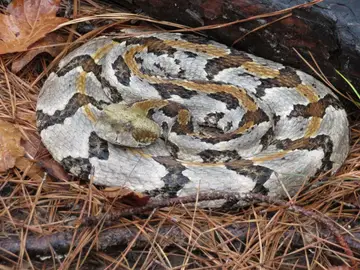

The timber rattlesnake has many small scales on top of the head (the massasauga has nine large plates), a uniformly black tail (the massasauga's tail has 4 to 7 black rings) and narrow, often chevron-shaped back bands rather than bow-tie-shaped blotches. INHS warns that head plates are hard to see on a live snake and says not to get close enough to check, because this is a venomous species. Illinois Natural History Survey (INHS), Prairie Research Institute, University of Illinois Urbana-Champaign
Also venomous.
Massasauga rattlesnake or Fox snake (eastern and western foxsnakes)?
Massasauga rattlesnake
Fox snake (eastern and western foxsnakes) Pantherophis vulpinus / Pantherophis gloydi
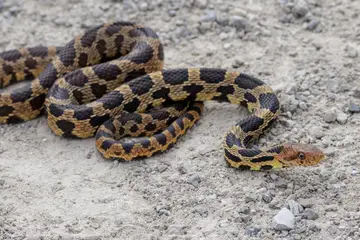

The fox snake has rounder back blotches (not bow-tie shaped) and only one row of smaller blotches on each side. INHS warns it is not always feasible to rely on the rattle, because segments can break and very young snakes have an inconspicuous rattle. Illinois Natural History Survey (INHS), Prairie Research Institute, University of Illinois Urbana-Champaign
Massasauga rattlesnake or Common (northern) watersnake?
Massasauga rattlesnake
Common (northern) watersnake Nerodia sipedon
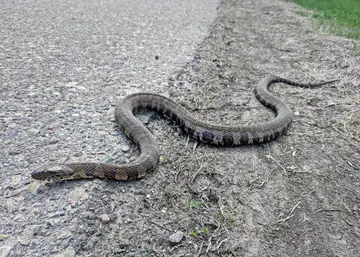

Minnesota DNR says many people who see a common watersnake mistake it for a massasauga. Minnesota Department of Natural Resources, Nongame Wildlife Program
Massasauga rattlesnake or Rattlesnake mimics (snakes that vibrate their tails)?
Massasauga rattlesnake
Rattlesnake mimics (snakes that vibrate their tails)
Several Michigan snakes that Michigan DNR calls harmless buzz their tails when approached or handled, which can sound like a rattle, but they have no segmented rattle. Wisconsin DNR says the same about its rattlesnake mimics. INHS warns the rattle is not always reliable: segments can break and very young snakes have an inconspicuous rattle. Michigan Department of Natural Resources
Michigan DNR calls these other species harmless (Michigan).
Massasauga rattlesnake or Eastern vs. western (prairie) massasauga?
Massasauga rattlesnake
Eastern vs. western (prairie) massasauga Sistrurus catenatus / Sistrurus tergeminus
The two massasaugas look almost the same; Missouri identifies them mainly by where they are found. MDC
Both are venomous.
Where the massasauga rattlesnake lives
- Native or listed
- Nonnative or not established
- No official record in our data
- 1–9
- 10–99
- 100–999
- 1,000+
On our state guides
- Arizona snakes
- Colorado snakes
- Illinois snakes
- Indiana snakes
- Iowa snakes
- Michigan snakes
- Minnesota snakes
- Missouri snakes
- New York snakes
- Ohio snakes
- Oklahoma snakes
- Pennsylvania snakes
- Texas snakes
- Wisconsin snakes
State boundaries: U.S. Census Bureau, cartographic boundary file cb_2024_us_state_20m.
When it is active
Active roughly April to October (Illinois: March through October; Indiana: as early as April and as late as November). Mostly active by day in spring and fall, and at night in hot summer weather. It hibernates in crayfish burrows, mammal burrows, stumps or rock crevices; in New York from late October to late April. The Arizona population is mainly nocturnal. Illinois Natural History Survey (INHS), Prairie Research Institute, University of Illinois Urbana-Champaign
Too few open-licence records to chart by month: GBIF has only 29 records CC0 or CC BY human observations of this species in the US.
Habitat and habits
Habitat: Eastern massasauga: shallow wetlands such as wet prairies, marshes, bogs, fens and swamps, plus nearby uplands. Western massasauga: grasslands and prairies (dry or wet) and open marshes; in Arizona, semidesert grassland. US Fish and Wildlife Service
Behavior: Shy and sluggish. It relies on camouflage, avoids people when it can and usually leaves rather than strikes. It may rattle if disturbed.
Diet: Mainly small rodents such as mice and voles; also shrews, frogs, lizards, birds and other snakes.
Young: Gives birth to live young (no eggs) in late summer, usually August or September; litters of about 2 to 20.
Legal status and reporting
Federal: Eastern massasauga (Sistrurus catenatus): Threatened under the Endangered Species Act, wherever found, listed 2016-09-30. The desert massasauga (S. c. edwardsii in ECOS) is Not Listed. The western massasauga (S. tergeminus) did not appear as a separate entity in the ECOS query. US Fish and Wildlife Service
Protection: Protected species. It is state-listed in most of its range (endangered in PA, OH, IN, IL, WI, NY, MN, IA and MO; threatened in MI; special concern in CO). Pennsylvania: illegal to possess, kill, sell or offer for sale. Michigan DNR: illegal to own as a pet. Arizona: illegal to harass, harm, pursue, hunt, kill, capture or collect it. Pennsylvania Fish and Boat Commission
Questions about the massasauga rattlesnake
Massasauga rattlesnakes in michigan
Yes. The eastern massasauga is Michigan's only venomous snake. It lives in wetlands across the Lower Peninsula and on Bois Blanc and Mackinac islands, but not on the Upper Peninsula mainland. It is rare and is listed as threatened by the state and federally.
Are there rattlesnakes in illinois?
Yes, two: the timber rattlesnake and the eastern massasauga. The massasauga is state endangered and federally threatened. IDNR says it is known from fewer than 10 Illinois populations; the Illinois Natural History Survey says it is very rare, perhaps only one location, in Clinton County.
Are there rattlesnakes in indiana?
Yes, two rare ones. The eastern massasauga lives in northern Indiana and the timber rattlesnake in south-central Indiana.
Are there rattlesnakes in pennsylvania?
Yes, two: the timber rattlesnake and the eastern massasauga, which is the smallest of Pennsylvania's three venomous snakes and is state endangered.
Are there rattlesnakes in new york?
Yes, two: the timber rattlesnake and the massasauga. New York DEC says only two massasauga populations remain in the state.
Sources
- Eastern Massasauga (Sistrurus catenatus). U.S. Fish and Wildlife Service. archived copy, captured July 21, 2026; checked November 3, 2026.
Quoted passages (2)
“Eastern massasaugas use shallow wetlands and surrounding upland areas to forage, breed, shelter and hibernate.”
“These snakes eat small rodents like mice and voles, but will sometimes eat frogs and other snakes.”
- Eastern massasauga rattlesnake (Michigan DNR species page). Michigan Department of Natural Resources. archived copy, captured August 8, 2026; checked November 3, 2026. Archived copy.
Quoted passages (3)
“Their short fangs can easily puncture skin, and they do possess a potent venom. It is best to treat them with respect and leave them alone. The few bites that occur to humans often result from attempts to handle or kill the snakes. Any bite from a massasauga should receive prompt professional medical attention.”
“It is the only Michigan snake with segmented rattles on the end of its tail and elliptical, ("catlike") vertical pupils in the eyes.”
“These rattlesnakes avoid confrontation with humans; they are not prone to strike – preferring to leave the area when they are threatened.”
- Eastern Massasauga (Wild About Illinois Snakes). Illinois Department of Natural Resources (IDNR). undated page; checked November 3, 2026.
Quoted passages (2)
“The eastern massasauga averages 18 to 30 inches in length.”
“It has a heat-sensitive pit on each side of the head between the eye and the nostril. Its head is flattened and much wider than the neck.”
- Reptiles of Ohio Field Guide (Publication 5354). Ohio Department of Natural Resources, Division of Wildlife. PUBLICATION 5354; checked November 3, 2026.
- KHA species account: Western Massasauga. Kansas Herpetofaunal Atlas (Travis W. Taggart), Sternberg Museum of Natural History, Fort Hays State University. updated February 19, 2026; checked November 3, 2026.
- Online Field Guide species account: Massasauga (Sistrurus catenatus). Arizona Game and Fish Department. 2023; checked November 3, 2026.
- ECOS species report query (scientific name starts with Sistrurus). U.S. Fish and Wildlife Service. live query 2026-11-03; checked November 3, 2026.
- Snakes (species accounts). Pennsylvania Fish and Boat Commission. undated page; checked November 3, 2026.
Quoted passages (2)
“Nine plates (actually large scales) cover the crown of the head, compared to the timber rattlesnake's numerous small scales.”
“It is illegal to possess, kill, sell or offer for sale this or any other animal on the endangered list.”
- Eastern Massasauga (Field Guide to Amphibians and Reptiles of Illinois). Illinois Natural History Survey (INHS), Prairie Research Institute, University of Illinois Urbana-Champaign. undated page; checked November 3, 2026.
Quoted passages (5)
“The timber rattlesnake also has a uniformly black tail, whereas the massasauga has 4 to 7 black rings on the tail.”
“In addition, because rattle segments can break and very young snakes have an inconspicuous rattle (Fig. 2), it is not always feasible to rely on the rattle.”
“Active March through October”
“The timber rattlesnake, Crotalus horridus, has dorsal blotches that are usually uniform in width across the back (not wider at the edges, or ‘bow tie’ shaped as in the Eastern Massasauga) and very narrow, sometimes approaching a chevron.”
“The fox snake, Pantherophis vulpinus, has rounder dorsal blotches (again, not ‘bow tie’ shaped) and only one row of smaller blotches on each side.”
- Eastern Massasauga Rattlesnake. Indiana Department of Natural Resources, Division of Fish & Wildlife. dateModified 2026-03-09; checked November 3, 2026.
Quoted passages (1)
“Newborn young are approximately 7- to 10-inches in length.”
- Eastern Massasauga. NYSDEC. archived copy, captured July 15, 2026; checked November 3, 2026.
Quoted passages (1)
“Massasaugas give birth to live young; they do not lay eggs.”
- Snakes and Lizards of Minnesota (EWR_448_18). Minnesota Department of Natural Resources, Nongame Wildlife Program. ©2018; checked November 3, 2026.
Quoted passages (1)
“(Many people who encounter the common watersnake mistake it for a massasauga)”
- When encountering Michigan's snakes, best to leave them be. Michigan Department of Natural Resources. May 31, 2016; checked November 3, 2026.
Quoted passages (1)
“It should not be confused with the other, harmless species of Michigan snakes that do not have segmented rattles but also will buzz their tails if approached or handled.”
- A Guide to Missouri's Snakes (MDC publication E00448). Missouri Department of Conservation (MDC). Copyright 2017; checked November 3, 2026.
Quoted passages (1)
“This snake is extremely similar in appearance to the Eastern massasauga and mainly identified to species based upon geographical range in Missouri (see distribution).”
- DNR urges public to give eastern massasauga rattlesnake its space. Michigan Department of Natural Resources. August 6, 2026; checked November 3, 2026.
- Species Abstract for Sistrurus catenatus (Eastern massasauga). Michigan Natural Features Inventory (MSU Extension). Lee et al. 2026, Species Abstract; checked November 3, 2026.
- Wild About Illinois Snakes! (species gallery by family). Illinois Department of Natural Resources (IDNR). undated page; checked November 3, 2026.
- Snakes. Indiana Department of Natural Resources, Division of Fish & Wildlife. dateModified 2026-03-09; checked November 3, 2026.
- Pennsylvania Native Reptile and Amphibian Species (PA Species and Endangered Species Act listing status). Pennsylvania Fish and Boat Commission. undated page; checked November 3, 2026.
- GBIF.org occurrence records, human observations licensed CC0 1.0 or CC BY 4.0 only, accessed November 3, 2026. The datasets behind these counts are listed on our Sources page.
- State boundaries: U.S. Census Bureau, cartographic boundary file cb_2024_us_state_20m.