Ohio Department of Natural Resources, Division of Wildlife: Ohio’s wealth of natural resources includes almost 50 types of reptiles.
This page lists 26 snakes: all from Ohio Department of Natural Resources, Division of Wildlife's Reptiles of Ohio Field Guide.
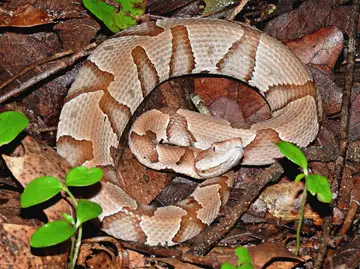
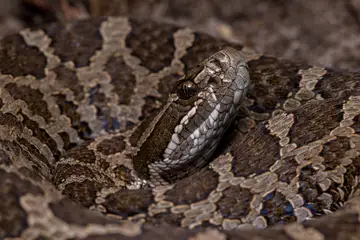
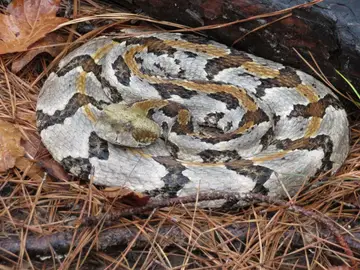
3 are venomous by official accounts: Eastern Copperhead, Massasauga and Timber Rattlesnake.
Venomous snakes in Ohio
Official sources label these snakes venomous in Ohio. Venomous snakes in Ohio has more on each one.
Venom: “Copperheads have the dubious distinction of having bitten more people in the United States than any other venomous snake … Ohio has only three species of venomous snakes, two of which have rattles at the end of the tail.” (Ohio Department of Natural Resources, Division of Wildlife)
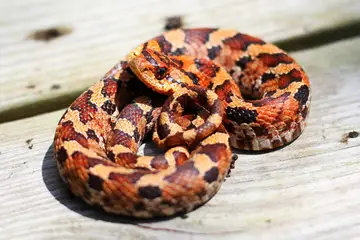
Range: Copperheads are widely scattered throughout most of unglaciated Ohio. Although they occupy a variety of habitats from floodplains to ridge tops, they show a marked preference for the rocky, wooded hillsides of southeastern Ohio.
Habitat: Copperheads are widely scattered throughout most of unglaciated Ohio. Although they occupy a variety of habitats from floodplains to ridge tops, they show a marked preference for the rocky, wooded hillsides of southeastern Ohio. They are not as averse to civilization as the timber rattlesnake, but copper- heads tend to stay away from well-settled areas. (Ohio Department of Natural Resources, Division of Wildlife)
Venom: “This is still a venomous snake, however, and should be treated with utmost caution and respect. … Ohio has only three species of venomous snakes, two of which have rattles at the end of the tail.” (Ohio Department of Natural Resources, Division of Wildlife)
Habitat: Historically recorded in more than 30 Ohio counties, the se- cretive massasauga swamp rattlers are widely scattered and rarely seen. Originally, these rattlers prob- ably inhabited all the scattered prairies of glaciated Ohio, but extensive farming has drastically reduced their numbers. Colonies still persist in bogs, swamps, and wet prairies within glaciated Ohio. (Ohio Department of Natural Resources, Division of Wildlife)
Venom: “By virtue of their large size, timber rattlesnakes are the most dangerous snakes in northeastern America. … Ohio has only three species of venomous snakes, two of which have rattles at the end of the tail.” (Ohio Department of Natural Resources, Division of Wildlife)
Habitat: Remnant colonies persist in widely scattered areas in southern unglaciated Ohio. They prefer dry, wooded hill country where they prey on a variety of small warm-blooded animals. (Ohio Department of Natural Resources, Division of Wildlife)
Venom: “Ohio has only three species of venomous snakes, two of which have rattles at the end of the tail.” (Ohio Department of Natural Resources, Division of Wildlife)
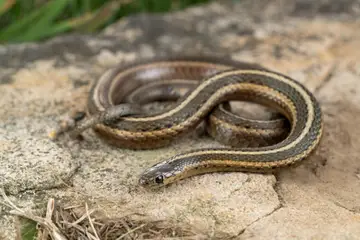
Habitat: This is chiefly an inhabitant of flat, open fields. Although its range covers most of glaciated Ohio, the Butler’s gartersnake occurs only in isolated colonies. They may utilize disturbed environments, such a parks and fallow agricultural fields. (Ohio Department of Natural Resources, Division of Wildlife)
Venom: “Ohio has only three species of venomous snakes, two of which have rattles at the end of the tail.” (Ohio Department of Natural Resources, Division of Wildlife)
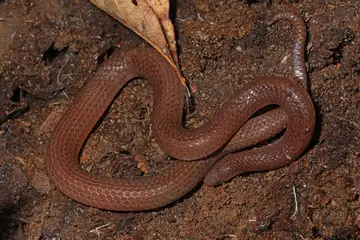
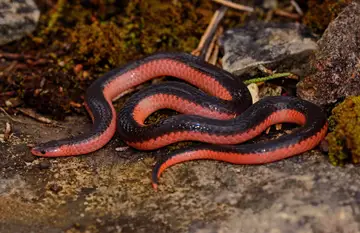
Habitat: These reptile versions of the nightcrawler are rarely encountered in the open, but can be discovered under large, flat slabs of rock, logs, and other debris. They show a marked preference for moist earth, such as hillside seeps. During dry weather, wormsnakes work deep into the ground, seeking moisture. (Ohio Department of Natural Resources, Division of Wildlife)
Venom: “Ohio has only three species of venomous snakes, two of which have rattles at the end of the tail.” (Ohio Department of Natural Resources, Division of Wildlife)
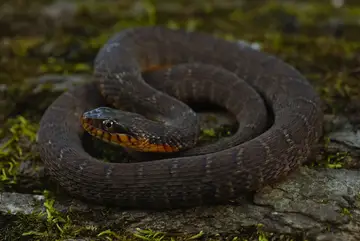
Habitat: This stout-bodied watersnake is currently known to occur only in Williams County, although small, widely scattered remnant populations may occur elsewhere. Copper-bellied watersnakes spend a great deal of time on land, moving among temporary and permanent wetlands, including swampy woodlands and river bottoms. (Ohio Department of Natural Resources, Division of Wildlife)
Most adults 9 to 13 inches; occasionally up to about 20 inches.
How to recognize it
Dark top of head; a dark spot under each eye and on each side of the neck
Keeled (ridged) scales in 17 rows; round pupil
Tennessee: a small dark downward streak on the side of the head
JFMAMJJASOND
617 records by month.What the sources say
Venom: “Ohio has only three species of venomous snakes, two of which have rattles at the end of the tail.” (Ohio Department of Natural Resources, Division of Wildlife)
Habitat: These common but secretive little snakes are often encountered hiding under stones, logs, old boards, and other such debris, where they feed extensively on snails, slugs, worms, and soft-bodied insects. (Ohio Department of Natural Resources, Division of Wildlife)
Venom: “Ohio has only three species of venomous snakes, two of which have rattles at the end of the tail.” (Ohio Department of Natural Resources, Division of Wildlife)
Habitat: This snake is limited in Ohio to Adams, Scioto, Jackson, and Lawrence counties, and even in this area it is relatively uncommon. It shows a marked preference for the Scioto and Ohio River bottomlands. Except in early spring and fall when they bask in the open, these snakes are very secretive, spending the day beneath logs, rocks, and the like, and emerging to hunt by night. (Ohio Department of Natural Resources, Division of Wildlife)
Venom: “Ohio has only three species of venomous snakes, two of which have rattles at the end of the tail.” (Ohio Department of Natural Resources, Division of Wildlife)
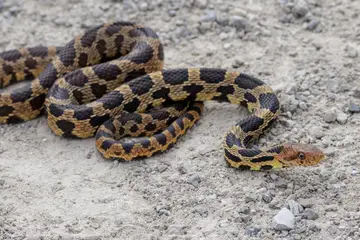
Habitat: Along the southwest- ern shores of Lake Erie, west of Sandusky, one may encounter the Eastern foxsnake. The handsomely marked snake inhabits many Lake Erie islands as well as the extensive marshes of Lucas, Ottawa, San- dusky, and Erie counties. (Ohio Department of Natural Resources, Division of Wildlife)
Venom: “Ohio has only three species of venomous snakes, two of which have rattles at the end of the tail.” (Ohio Department of Natural Resources, Division of Wildlife)
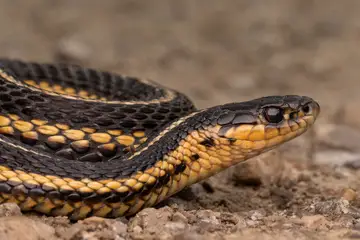
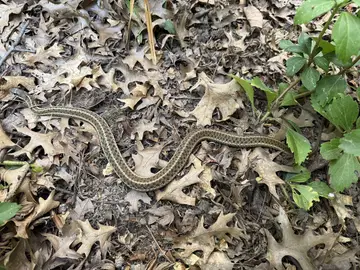
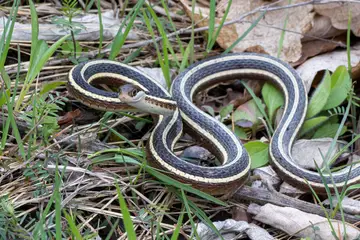
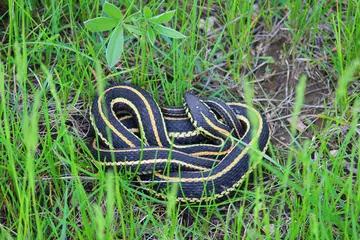
Habitat: This most common of Ohio’s gartersnakes is found across the state. Found in moist areas, such as damp woods and grasslands, and the edge of ponds, lakes, streams, and rivers. (Ohio Department of Natural Resources, Division of Wildlife)
Venom: “Ohio has only three species of venomous snakes, two of which have rattles at the end of the tail.” (Ohio Department of Natural Resources, Division of Wildlife)
Habitat: Dry, sandy areas are preferred, especially the Oak Openings region of northwestern Ohio where this generally uncom- mon snake is most abundant. In southern Ohio, it occurs in most of the hill counties. (Ohio Department of Natural Resources, Division of Wildlife)
Eastern milksnake 24 to 52 inches (Alabama); TN gives 24 to 36 inches for eastern and 21 to 28 for red milksnake.
How to recognize it
Eastern milksnake: black-and-white checkerboard belly (Ohio). Western milksnake in Louisiana: underside dull white with scattered black marks.
Eastern milksnake: a light Y- or V-shaped mark is usually present on the nape
Smooth, shiny scales and round pupils
JFMAMJJASOND
120 records by month.What the sources say
Venom: “Ohio has only three species of venomous snakes, two of which have rattles at the end of the tail.” (Ohio Department of Natural Resources, Division of Wildlife)
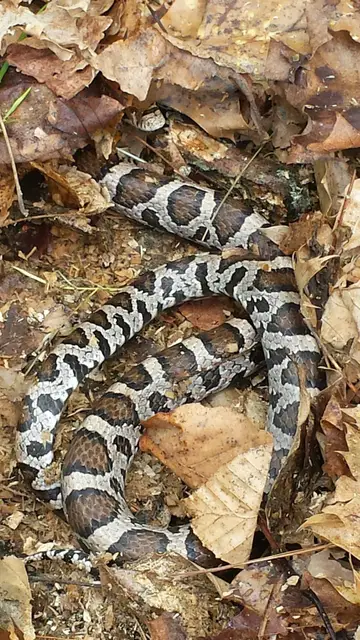
Habitat: Commonly encoun- tered throughout Ohio in a variety of habitats, including woods, meadows, and river bottoms – even within cities, where they occa- sionally enter buildings in search of mice. Their frequent occurrence in rodent-infested barns led to the fal- lacy that they milk cows by night; hence the name milksnake. (Ohio Department of Natural Resources, Division of Wildlife)
Eastern: most adults 18 to 26 inches (record 41 inches). Western: 16 to 42 inches in Louisiana; Oklahoma's orange-striped ribbonsnakes average 20 to 30 inches and can reach nearly 40.
How to recognize it
Very slender body; long tail, about one-third of total length.
Side stripes sit on the 3rd and 4th scale rows above the belly.
Upper lip scales white and unmarked; a distinct white spot in front of each eye; keeled (ridged) scales.
What the sources say
Venom: “Ohio has only three species of venomous snakes, two of which have rattles at the end of the tail.” (Ohio Department of Natural Resources, Division of Wildlife)
Habitat: These semi-aquatic snakes seldom venture far from water. As a rule, they frequent the margins of small lakes, ponds, swamps, wet prairies and mead- ows, and occasionally moist woods throughout Ohio. The small, trim ribbonsnake is more at home on shore than in the water. (Ohio Department of Natural Resources, Division of Wildlife)
Venom: “Ohio has only three species of venomous snakes, two of which have rattles at the end of the tail.” (Ohio Department of Natural Resources, Division of Wildlife)
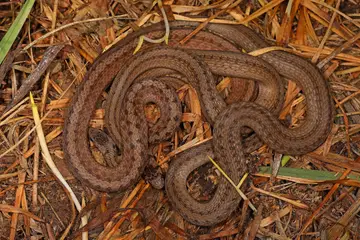
Habitat: Although rare over much of its range, the Eastern smooth earthsnake is often common locally. In Ohio, it occurs only in the southern quarter of the state, especially in the forested area of Shawnee and Pike state forests. This reptile is very secretive and spends most of its time hiding beneath flat stones and similar objects. (Ohio Department of Natural Resources, Division of Wildlife)
Venom: “Ohio has only three species of venomous snakes, two of which have rattles at the end of the tail.” (Ohio Department of Natural Resources, Division of Wildlife)
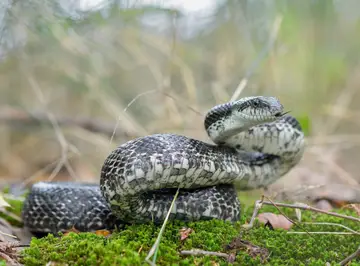
Habitat: An essentially forest-dwell- ing snake, the gray ratsnake occurs throughout most of Ohio, with the exception of most of northwest Ohio, especially in the range of the Eastern foxsnake. It is an accomplished climber and is often found high in trees, frequently taking shelter in woodpecker holes and other cavities. Gray ratsnakes often hibernate in rock crevices in the company of other snakes, such as copperheads and rattlesnakes. (Ohio Department of Natural Resources, Division of Wildlife)
Venom: “Ohio has only three species of venomous snakes, two of which have rattles at the end of the tail.” (Ohio Department of Natural Resources, Division of Wildlife)
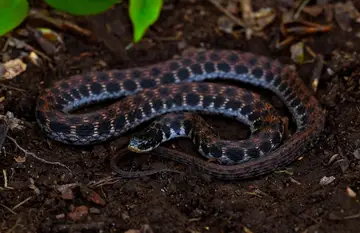
Habitat: Although encountered only occasionally, Kirtland’s snake ranges throughout the glaciated western half of Ohio and into a few glacial out- wash-filled valleys in southwestern Ohio. Its secretive nature and marked preference for wet meadows make it difficult to find. In addition to natural areas, Kirtland’s snakes may also be found in the urban areas of Cincinnati, Dayton, and Toledo. (Ohio Department of Natural Resources, Division of Wildlife)
Venom: “Ohio has only three species of venomous snakes, two of which have rattles at the end of the tail.” (Ohio Department of Natural Resources, Division of Wildlife)
Habitat: These snakes are limited to the islands of Lake Erie. The snake has benefited from the construction of docks and shoreline protection done in a snake-friendly manner demonstrating its ability to coexist with people. (Ohio Department of Natural Resources, Division of Wildlife)
Photo: Everglades NPS from Homestead, Florida, United States · Public domain · Wikimedia Commons
Most adults about 3 to 5 ft. Sources range from 20 to 56 inches (Florida Museum) to 34 to 77 inches (New Jersey); Alabama says some exceed 6 ft.
How to recognize it
Smooth scales
Long and slender with large eyes
White chin
JFMAMJJASOND
31 records by month.What the sources say
Venom: “Ohio has only three species of venomous snakes, two of which have rattles at the end of the tail.” (Ohio Department of Natural Resources, Division of Wildlife)
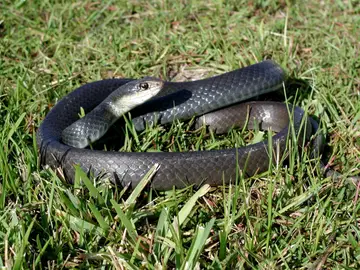
Habitat: Racers occupy a variety of habitats including fencerows, fields, and grasslands, edges of ponds and streams, and woodlands. Racers are excellent climbers; some have observed them 2 to 3 meters from the ground in early spring. (Ohio Department of Natural Resources, Division of Wildlife)
Venom: “Ohio has only three species of venomous snakes, two of which have rattles at the end of the tail.” (Ohio Department of Natural Resources, Division of Wildlife)
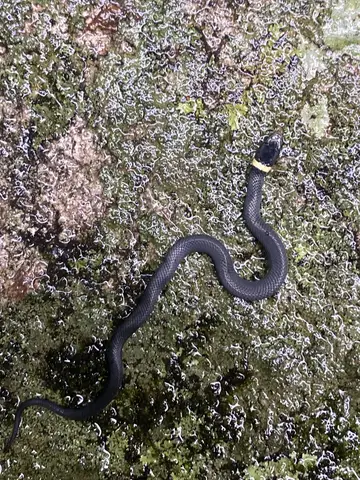
Habitat: Ring-necked snakes occur throughout Ohio except for the west-central and extreme northwest counties. They prefer rocky, wooded hillsides and cutover wooded areas such as those in southeastern Ohio, where they abound. Ring-necked snakes are basically nocturnal and spend most of the day concealed beneath logs, stones, boards, and similar objects. (Ohio Department of Natural Resources, Division of Wildlife)
Venom: “Ohio has only three species of venomous snakes, two of which have rattles at the end of the tail.” (Ohio Department of Natural Resources, Division of Wildlife)
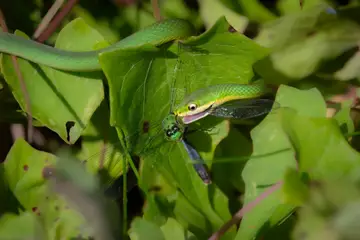
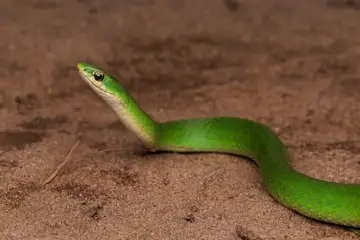
Habitat: The rough greensnake is found in southern Ohio. Much longer than the smooth greensnake, it is more arboreal and has rough instead of smooth scales. They are more likely to be encountered along willow-lined streams. Females lay their eggs in communal nests often in hollow trees on upland sites. (Ohio Department of Natural Resources, Division of Wildlife)
Venom: “Ohio has only three species of venomous snakes, two of which have rattles at the end of the tail.” (Ohio Department of Natural Resources, Division of Wildlife)
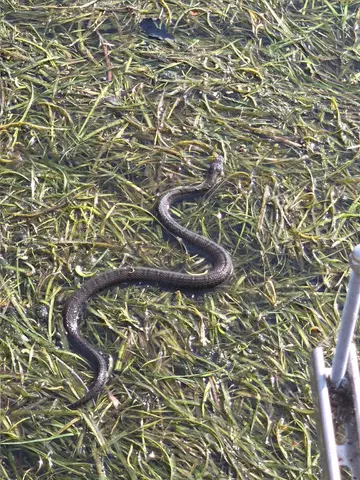
Habitat: Northern watersnakes are particularly fond of basking and can often be seen sunning upon logs, stumps, and rocks, or on low branches overhanging the water. They are very wary and when disturbed drop into the water and disappear quickly. (Ohio Department of Natural Resources, Division of Wildlife)
Photo: Photo Credit: Krista Lundgren/USFWS USFWS Mountain-Prairie · Public domain · Wikimedia Commons
Venom: “Ohio has only three species of venomous snakes, two of which have rattles at the end of the tail.” (Ohio Department of Natural Resources, Division of Wildlife)
Venom: “Ohio has only three species of venomous snakes, two of which have rattles at the end of the tail.” (Ohio Department of Natural Resources, Division of Wildlife)
Habitat: The decidedly aquatic queensnake prefers slow moving or shallow rocky creeks and rivers where it feeds primarily upon soft-shelled crayfish. These snakes are frequently found under large flat stones, boards, or other debris along streams, or seen basking in willows and other shrubs along the banks. (Ohio Department of Natural Resources, Division of Wildlife)
Usually 8 to 10 inches; state figures run from about 4 to 16 inches, with a Florida record of 16.6 inches.
How to recognize it
Plain, unmarked red or orange belly.
Three light spots just behind the head, which may fuse into a collar.
Keeled (ridged) scales in 15 rows at midbody and round pupils.
JFMAMJJASOND
79 records by month.What the sources say
Venom: “Ohio has only three species of venomous snakes, two of which have rattles at the end of the tail.” (Ohio Department of Natural Resources, Division of Wildlife)
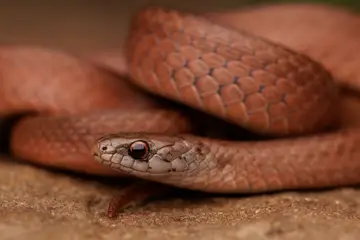
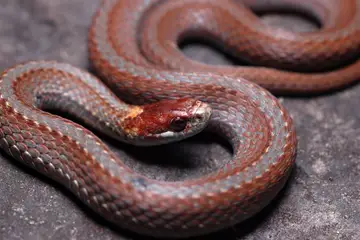
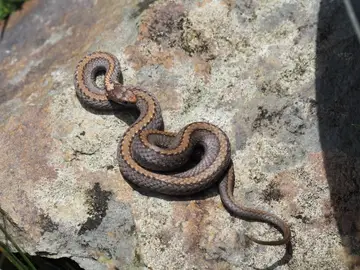
Habitat: This snake may be found in sphagnum bogs, wet meadows, or swamp forests, as well as dry, open wooded areas in the eastern half of the state. Very secre- tive, the red-bellied snake spends most of its life hidden beneath boards, rotting logs, brush piles, and leaves, where it seeks out slugs, earthworms, and beetle larvae. (Ohio Department of Natural Resources, Division of Wildlife)
Venom: “Ohio has only three species of venomous snakes, two of which have rattles at the end of the tail.” (Ohio Department of Natural Resources, Division of Wildlife)
Habitat: This gartersnake is an inhabitant of old fields and meadows that are associated with streams and marshes. The short-headed gartersnake occurs only in isolated colonies in and around Youngstown. Thamnophis brachystoma (Ohio Department of Natural Resources, Division of Wildlife)
Venom: “Ohio has only three species of venomous snakes, two of which have rattles at the end of the tail.” (Ohio Department of Natural Resources, Division of Wildlife)
Habitat: This dainty little snake is found in southwest, cen- tral, and northeast Ohio. It has smooth scales. It is also more ter- restrial than its cousin the rough greensnake. However, it does not hesitate to climb small shrubs, where it handles itself remarkably well. The smooth greensnake is very rare in southwest Ohio and has become increasingly rare throughout the state. (Ohio Department of Natural Resources, Division of Wildlife)
Copperheads have bold hourglass-shaped bands, and young copperheads under about 12 inches have bright yellow tail tips. Brown snakes have small spots, not hourglass bands.
Brown Snake (Dekay's Brownsnake) or Red-bellied Snake?
Missouri: red-bellied snakes are sometimes mistaken for young copperheads. Copperheads are stout-bodied with hourglass-shaped markings on the back, vertical pupils, a sensory pit between each nostril and eye and, sometimes, especially in young copperheads, a yellow tail tip.
Massachusetts: look at the neck; the wormsnake has no constriction between the head and body. Connecticut also lists it as confused with the redbelly snake.
Black Racer or Timber rattlesnake?
Photo: Everglades NPS from Homestead, Florida, United States · Public domain · Wikimedia Commons
Call 911 or Poison Help at 1-800-222-1222 right away. Poison Help connects you to your local poison center, any time of day.
Official advice from Ohio Department of Natural Resources, Division of Wildlife:
Venomous snakebite: call 911 or Poison Help at 1-800-222-1222. ODNR: get the person to a hospital immediately; Poison Help can tell you the nearest hospital that treats snakebites. Ohio Department of Natural Resources, Division of Wildlife
ODNR Division of Wildlife: 1-800-WILDLIFE (Wildlife headquarters and district offices are listed in the 2018 Reptiles of Ohio guide). An older undated ODNR brochure (Pub 115) asks people to report timber rattlesnake sightings by mail to the Division of Wildlife, 360 E. State Street, Athens, OH 45701; that address may be out of date. Ohio Department of Natural Resources, Division of Wildlife
“Ohio’s wealth of natural resources includes almost 50 types of reptiles.”
“Ohio has only three species of venomous snakes, two of which have rattles at the end of the tail.”
“The belly has a black and white checkerboard pattern.”
“A Y-shaped or V-shaped light-colored blotch is usually present on the nape of the neck.”
“Copperheads have the dubious distinction of having bitten more people in the United States than any other venomous snake … Ohio has only three species of venomous snakes, two of which have rattles at the end of the tail.”
“Because the amount of venom injected during a bite is not enough to seriously hurt a healthy adult, the bite is rarely fatal. However, it is extremely painful, and, like a honeybee sting, has the potential to produce a life-threatening allergic reaction.”
“This is still a venomous snake, however, and should be treated with utmost caution and respect. … Ohio has only three species of venomous snakes, two of which have rattles at the end of the tail.”
“Although the venom is highly toxic, a typical bite does not deliver large enough quantities to be lethal. This is still a venomous snake, however, and should be treated with utmost caution and respect.”
“By virtue of their large size, timber rattlesnakes are the most dangerous snakes in northeastern America. … Ohio has only three species of venomous snakes, two of which have rattles at the end of the tail.”
“By virtue of their large size, timber rattlesnakes are the most dangerous snakes in northeastern America.”
“Get the victim to a hospital immediately! Call the Poison Help hotline (1-800-222-1222) to find the nearest hospital capable of treating snake bites.”
“Prevention is the best method for dealing with snakebites. Learn how to distinguish venomous from nonvenomous snakes and learn where to find – and therefore how to avoid – the venomous ones.”
“Gray ratsnakes often hibernate in rock crevices in the company of other snakes, such as copperheads and rattlesnakes.”
“For more information about Ohio’s native wildlife, please contact the Division of Wildlife: 1-800-WILDLIFE (1-800-750-0750 Ohio Relay TTY only)”
“Ohio has only three species of venomous snakes, two of which have rattles at the end of the tail. The third species is the Northern copper-head.”
“Remnant colonies persist in widely scattered areas in southern unglaciated Ohio.”