This page lists 9 insects.
8 are venomous by official accounts. 4 are nonnative.
Not every species: no complete official list of Ohio insects exists, so this page covers the ones state and Extension sources name. How lists are built.
Which insects can hurt you
Official sources single out these insects in Ohio, in their own words:
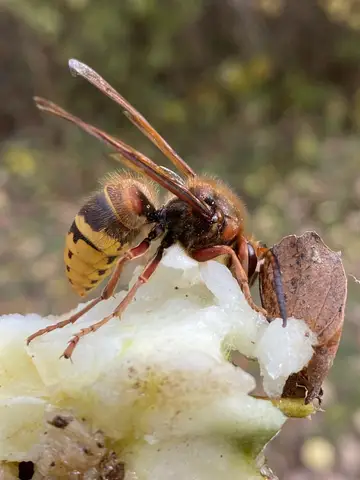
Missouri: workers 1/2 to 3/4 inch, queens 3/4 inch. University of Maryland: workers 5/8 to 3/4 inch, queens just over an inch. Penn State gives 13 to 20 mm for the queen and her offspring.
How to recognize it
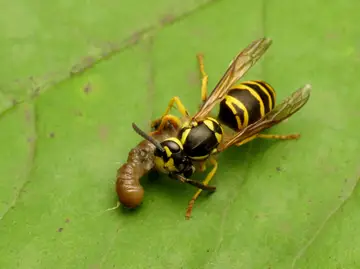
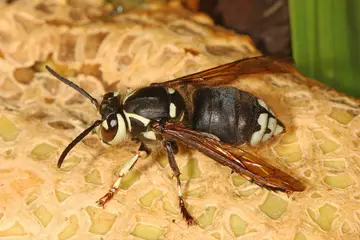
Not yellow, unlike typical yellowjackets; larger, black and ivory
Large, rounded, gray paper nest hanging in trees or shrubs, sometimes on buildings
Nest entrance is the lowest opening of the cone- or egg-shaped nest
JFMAMJJASOND
279 records by month.What the sources say
Venom: “In some cases, the ovipositor can be used as a defensive weapon that delivers venom from a gland inside the abdomen.” (Ohio Department of Natural Resources, Division of Wildlife)
Habitat: HABITAT: Common along forest edges, suburbs, and sometimes in urban sites. (Ohio Department of Natural Resources, Division of Wildlife)
Venom: “In some cases, the ovipositor can be used as a defensive weapon that delivers venom from a gland inside the abdomen.” (Ohio Department of Natural Resources, Division of Wildlife)
Habitat: HABITAT: Can be common in areas with barren sandy soil, sand blowouts, or beaches. (Ohio Department of Natural Resources, Division of Wildlife)
Venom: “In some cases, the ovipositor can be used as a defensive weapon that delivers venom from a gland inside the abdomen.” (Ohio Department of Natural Resources, Division of Wildlife)
Habitat: HABITAT: Common nearly everywhere, even urban parks and gardens. (Ohio Department of Natural Resources, Division of Wildlife)
Workers up to 1 inch (25 mm); queens slightly larger, up to about 1.3 inches.
How to recognize it
Large size plus reddish-brown color on the thorax and first abdominal segment
C-shaped eyes; somewhat hairy body
Flies at night and comes to porch lights
JFMAMJJASOND
56 records by month.What the sources say
Venom: “In some cases, the ovipositor can be used as a defensive weapon that delivers venom from a gland inside the abdomen.” (Ohio Department of Natural Resources, Division of Wildlife)
Habitat: HABITAT: Uncommon, found mostly in wooded areas. (Ohio Department of Natural Resources, Division of Wildlife)
Venom: “In some cases, the ovipositor can be used as a defensive weapon that delivers venom from a gland inside the abdomen.” (Ohio Department of Natural Resources, Division of Wildlife)
Habitat: HABITAT: Abundant in urban yards, gardens, and parks, but also rural areas. (Ohio Department of Natural Resources, Division of Wildlife)
Venom: “In some cases, the ovipositor can be used as a defensive weapon that delivers venom from a gland inside the abdomen.” (Ohio Department of Natural Resources, Division of Wildlife)
Venom: “In some cases, the ovipositor can be used as a defensive weapon that delivers venom from a gland inside the abdomen.” (Ohio Department of Natural Resources, Division of Wildlife)
Habitat: HABITAT: Widespread and ubiquitous in most habitats, suburban and rural locations. (Ohio Department of Natural Resources, Division of Wildlife)
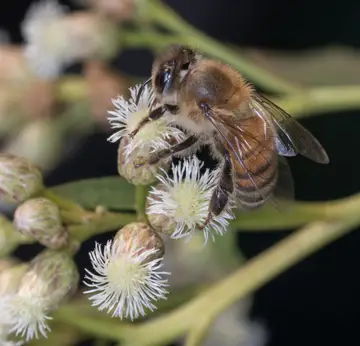
About 10 percent smaller than a European honey bee, a difference too subtle to see without measurement or lab tests.
How to recognize it
Cannot be identified by eye: only DNA testing or microscopic measurements can tell it from a European honey bee.
Clue is behavior and nest site: very defensive, and may nest in small cavities such as water meter boxes, old tires, house eaves or the ground.
JFMAMJJASOND
1,184 records by month.What the sources say
Venom: “In some cases, the ovipositor can be used as a defensive weapon that delivers venom from a gland inside the abdomen.” (Ohio Department of Natural Resources, Division of Wildlife)
Habitat: HABITAT: abundant in all habitats from urban to agricultural to wilderness. (Ohio Department of Natural Resources, Division of Wildlife)
No official source we use states whether this animal is venomous. That does not mean it is harmless: do not handle it.
Size
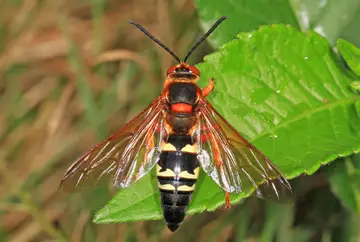
About 1 1/8 to 1 5/8 inches long (OSU, NC State); females up to nearly 2 inches, males up to 1.5 inches (University of Kentucky). Females larger than males.
How to recognize it
Nests in the ground: burrow about 1/2 inch wide with a U-shaped soil mound at the entrance
Hole about 1/2 inch across with excavated soil piled around it
Hovers 1-2 ft above the ground near nests
JFMAMJJASOND
61 records by month.What the sources say
Habitat: HABITAT: Common along forest edges, parks, and other open areas, espe- cially with sandy soil. (Ohio Department of Natural Resources, Division of Wildlife)
NC State Extension: European hornets are much larger (about 1 1/2 in.), brownish red with a dull yellow abdomen, and rarely build free-hanging or exposed nests (the bald-faced hornet is black and ivory and hangs its nest in the open).
Cicada killer abdomens are mostly black with yellow markings, and cicada killers are solitary and nest in the ground; European hornet abdomens are mostly yellow with brown markings and they build paper nests in aerial locations.
Cicada killer abdomen mostly black with yellow marks and nests in the ground; European hornet abdomen mostly yellow with brown marks, paper nest above ground (often in hollow trees).
Photos show typical adults; individuals vary. Never get close to compare.
When insects are active in Ohio
Records of insects in Ohio peak in June to August. They show when people record insects, not how many there are (about month bars).
JanFebMarAprMayJunJulAugSepOctNovDec
130,608 records of insects in Ohio by month (GBIF, CC0 and CC BY records).
“In some cases, the ovipositor can be used as a defensive weapon that delivers venom from a gland inside the abdomen.”
“For some people, bee and wasp stings are serious business due to severe reactions.”
“All of this serves to advertise the incredibly painful sting of the female.”
“For some people, bee and wasp stings are serious business due to severe reactions. They must – or should – carry epinephrine pens in case of stings.”
Ticks and Tick-Borne Diseases (HYG-2073). Ohio State University Extension (Ohioline); co-authors from the Ohio Department of Health. June 6, 2013; checked November 3, 2026.Quoted passages (3)
“Adults are active during spring and summer, but they are most abundant from mid-April to mid-July.”
“One or more life stages may be active during every month of the year (Figure 4), depending on temperature. Because of this year-long activity, preventative measures should be taken outdoors where the tick occurs, even during autumn and winter.”
“All stages can be found throughout the warm months of the year.”
Insects and Scorpions at Work. CDC / NIOSH. archived copy, captured October 4, 2026; checked November 3, 2026.Quoted passages (1)
“Bees, wasps, and hornets are most abundant in the warmer months.”