European Hornet
Vespa crabro · also called Giant Hornet · Last checked November 3, 2026.
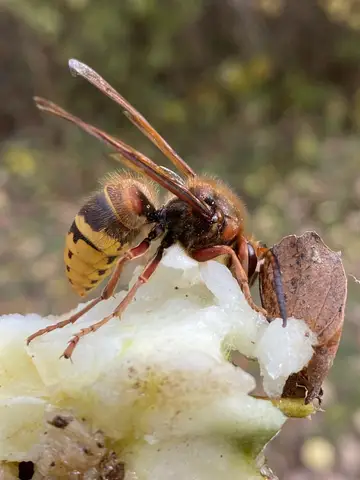
The European hornet is a large, brown-and-yellow social wasp, up to about an inch long (queens larger). It was brought from Europe in the 1800s and now lives across much of the eastern US. It can sting, and more than once. Missouri's conservation department says the sting is not considered medically dangerous except for people allergic to bee or wasp venom, who may have a life-threatening reaction. It is the hornet most often mistaken for the Asian giant ("murder") hornet, which does not live in the eastern US. Penn State Extension
On this page
Is the European hornet dangerous?
The sting is not considered medically dangerous, but people allergic to bee or wasp venom may have a life-threatening anaphylactic reaction. Missouri Department of Conservation
“The sting is not considered medically dangerous to people, but persons who are allergic to bee or wasp venom may have a life-threatening anaphylactic reaction if stung.”
Bites and stings: It stings rather than bites. Penn State: unlike honey bees it has a smooth stinger and can sting multiple times. Stings are most likely near the nest; foragers away from the nest are much less likely to sting unless handled (MDC, NC State Extension).
If someone is bitten or stung, call 911 or Poison Help at 1-800-222-1222.
How to identify an European hornet
A photo or description can narrow it down, but cannot confirm what an animal is or that it is safe. Look from a distance and do not handle wild animals.
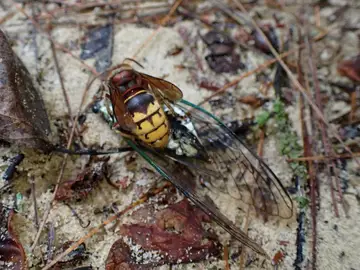
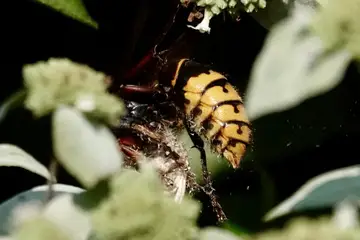
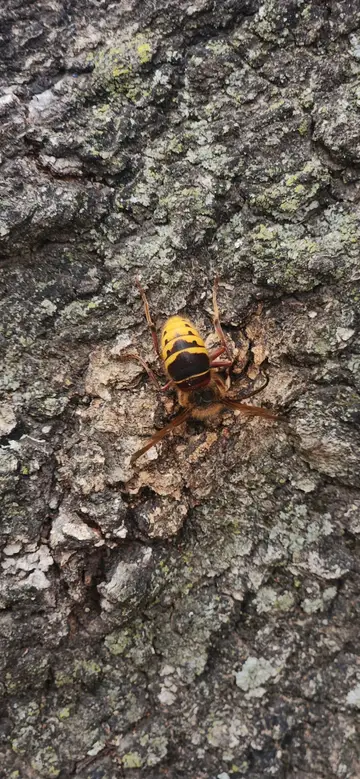
Size: Workers up to 1 inch (25 mm); queens slightly larger, up to about 1.3 inches. Penn State Extension
Colors: Head red and yellow (rust-colored with a yellow face); thorax red and brown; abdomen dark at the front and mostly yellow at the rear. Pattern: Narrow dark bands on the abdomen with teardrop-shaped markings extending into the yellow.
Key features
- Large size plus reddish-brown color on the thorax and first abdominal segment Missouri Department of Conservation
- C-shaped eyes; somewhat hairy body Missouri Department of Conservation
- Flies at night and comes to porch lights Penn State Extension
- Nests usually hidden in enclosed spaces (hollow trees, attics, wall voids), not hanging in the open; underground nests are occasionally reported NC State Extension
Animals mistaken for the European hornet
European Hornet or Asian Giant Hornet (Northern Giant Hornet, "murder hornet")?
European Hornet
Asian Giant Hornet (Northern Giant Hornet, "murder hornet") Vespa mandarinia
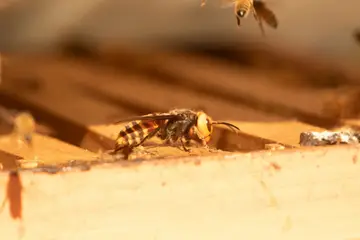
Penn State's comparison table. Asian giant hornet: head entirely yellow; thorax mostly black with a yellow spot between the wings; abdomen banded yellow, black and brown; larger gap between the rear of the eye and the rear of the head. European hornet: head red-brown and yellow; thorax black and reddish-brown; abdomen black at the front and yellow at the rear with rows of black teardrops; smaller gap. Penn State says the Asian giant hornet has only been found in Washington State and adjacent British Columbia and does not occur in eastern North America. Penn State Extension
Not stated in these sources beyond its harm to honeybee colonies (MDC).
European Hornet or Eastern Cicada Killer?
European Hornet
Eastern Cicada Killer Sphecius speciosus
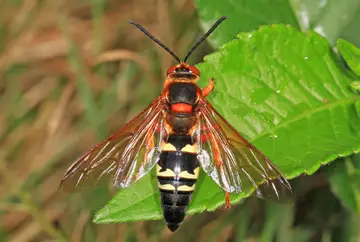
Cicada killer abdomens are mostly black with yellow markings, and cicada killers are solitary and nest in the ground; European hornet abdomens are mostly yellow with brown markings and they build paper nests in aerial locations. Penn State Extension
See the cicada killer page.
European Hornet or Bald-faced Hornet?
European Hornet
Bald-faced Hornet Dolichovespula maculata
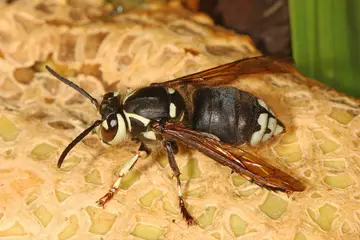

Bald-faced hornets are smaller and mostly black with whitish markings, and their round paper nests usually hang in trees. Missouri Department of Conservation
See the bald-faced hornet page.
European Hornet or Yellowjackets?
European Hornet
Yellowjackets Vespula spp.
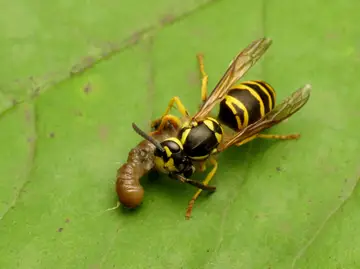
Yellowjackets are much smaller, about honeybee size, and usually nest underground. Missouri Department of Conservation
See the yellow jacket page.
Where the European hornet lives
- Native or listed
- Nonnative or not established
- No official record in our data
- 1–9
- 10–99
- 100–999
- 1,000+
On our state guides
- Arkansas insects and bugsNonnative
- Connecticut insects and bugsNonnative
- Indiana insects and bugs
- Missouri insects and bugs
- North Carolina insects and bugs
- Ohio insects and bugsNonnative
- Pennsylvania insects and bugsNonnative
- West Virginia insects and bugsNonnative
State boundaries: U.S. Census Bureau, cartographic boundary file cb_2024_us_state_20m.
When it is active
Ohio: queens come out of winter shelter in late April or May. Penn State: nest size peaks in mid-September; the nest and workers die out in the fall, and only fertilized queens survive. Missouri: workers die when temperatures freeze. Also active at night. Ohio Department of Natural Resources, Division of Wildlife
US open-licence records peak in August to October.
Habitat and habits
Habitat: Mostly forests and nearby areas, because it nests in hollow trees; also parks and suburbs with enough trees, and sometimes inside house walls. Penn State Extension
Behavior: Social wasp living in annual paper nests of a few hundred workers. Defends the nest; much less likely to sting away from it. Flies at night and is drawn to lights.
Diet: Hunts other insects (grasshoppers, flies, yellowjackets, sometimes honey bees) to feed its larvae; adults also take sugar from fallen fruit and plant sap, stripping bark from lilac and other shrubs.
Young: Each spring an overwintered queen starts a new nest; males and new queens are produced around mid-September, and the colony dies at freezing temperatures. Nests are not reused.
Legal status and reporting
Federal: No ESA record (USFWS ECOS returned no record for Vespa crabro). US Fish and Wildlife Service
Invasive status: Nonnative (introduced from Europe in the 1800s), but Missouri says it does not appear to be invasive and, unlike the Asian giant hornet, does not destroy whole honeybee colonies. Missouri Department of Conservation
Questions about the European hornet
European hornet
A large nonnative social wasp, up to about an inch long, brown and red at the front and mostly yellow at the rear with teardrop markings. It nests in hollow trees and wall voids across much of the eastern US and flies at night toward lights. It can sting repeatedly. The sting is not considered medically dangerous except for people allergic to bee or wasp venom. If someone has a severe reaction, call 911 or Poison Help at 1-800-222-1222.
Murder hornet
Penn State says European hornets are the species most commonly mistaken for Asian giant hornets (the so-called murder hornet) in eastern North America. Penn State says Asian giant hornets have only been found in Washington State and adjacent British Columbia. Missouri says the Asian giant hornet was declared eradicated from the US as of December 2024.
Asian giant hornet in us
Missouri's conservation department says the Asian giant hornet was found only in British Columbia and Washington State (2019 to 2021) and has been declared eradicated from the US as of December 2024. Penn State says European hornets are the species most commonly mistaken for them in eastern North America.
Murder hornet in nc
NC State Extension says the Japanese hornet does not occur in North Carolina, and that some people call the European hornet the Japanese hornet, but it is not. Penn State says Asian giant hornets do not occur in eastern North America.
Sources
- European Hornet. Penn State Extension. updated July 19, 2024; checked November 3, 2026.
Quoted passages (6)
“European hornet workers can be up to an inch (25 mm) long while queens are slightly larger and can reach 1.3 inches (35 mm).”
“European hornets are also the only nocturnal wasp in Pennsylvania and are sometimes attracted to porch lights at night.”
“Because they usually nest in hollow trees, European hornets are most commonly found in forests and adjacent areas.”
“European hornets are predatory for most of the year and hunt other insects, including grasshoppers, various flies, and yellowjackets (Figure 7).”
“European hornets are the species most commonly mistaken for Asian giant hornets in eastern North America.”
“The abdomens of cicada killers are mostly black with yellow markings while European hornet abdomens are mostly yellow with brown markings.”
- European Hornet (MDC Field Guide). Missouri Department of Conservation. undated page; checked November 3, 2026.
Quoted passages (7)
“The sting is not considered medically dangerous to people, but persons who are allergic to bee or wasp venom may have a life-threatening anaphylactic reaction if stung.”
“In Missouri, European hornets are distinguished from other large black, brown, and yellow wasps by their large size and by the presence of reddish-brown color on the thorax and on the first segment of the abdomen.”
“Each eye is basically C-shaped.”
“As with our native bald-faced hornets, the workers die when the temperatures freeze. The colony is finished. The nests are not reused.”
“Unlike the infamous Asian giant hornet (which, again, does not occur in Missouri), the European hornet does not appear to be invasive.”
“Also, bald-faced hornets are smaller and are mostly black with some whitish markings, so their bodies look much different.”
“Yellowjackets (genus Vespula), while also yellow-and-black striped, are a lot smaller, about the size of honeybees.”
- European Hornet in the Landscape (PDIC Factsheet). NC State Extension (N.C. Cooperative Extension). Publication date: Nov. 8, 2013; checked November 3, 2026.
Quoted passages (2)
“…is our only large wasp that nests in enclosed sites (in hollow trees, attics, out buildings etc.) rather than in the branches of trees or under eaves of buildings.”
“It is only near the nest that European hornets exhibit their nest-guarding instinct complete with alarm pheromone release and resulting aggressive behavior.”
- Bees and Wasps of Ohio Field Guide (Publication 5488). Ohio Department of Natural Resources, Division of Wildlife. Publication date 3/16; checked November 3, 2026.
Quoted passages (1)
“Queens survive the winter in protected situations, emerging to start scouting for nesting sites in late April or May.”
- ECOS species report query (Crotalus adamanteus, Storeria dekayi, Carcharhinus limbatus, Vespa crabro). U.S. Fish and Wildlife Service. live query 2026-11-03; checked November 3, 2026.
Quoted passages (1)
“Vespa crabro: no record returned”
- GBIF.org occurrence records, human observations licensed CC0 1.0 or CC BY 4.0 only, accessed November 3, 2026. The datasets behind these counts are listed on our Sources page.
- State boundaries: U.S. Census Bureau, cartographic boundary file cb_2024_us_state_20m.