Eastern cicada killer
Sphecius speciosus · also called cicada killer, cicada killer wasp, eastern cicada-killer wasp and giant cicada killer · Last checked November 3, 2026.
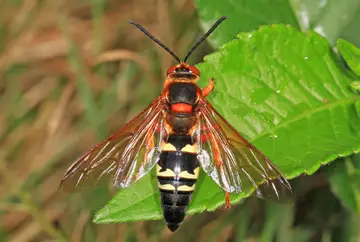
The eastern cicada killer is one of the largest wasps in North America: about 1 1/8 to 1 5/8 inches (some females near 2 inches), black with yellow abdominal markings, a reddish head and thorax and rusty or brownish wings. Females dig burrows in sunny, sandy or well-drained soil and stock them with paralyzed cicadas. Only females have a stinger, and official sources say they rarely sting people, almost always only when stepped on, grabbed or handled roughly; the males that hover and dive at people cannot sting. People allergic to wasp stings should stay away from all wasps (Missouri Department of Conservation). It occurs in the eastern and midwestern US (east of the Rocky Mountains) and is seen mostly in July and August. Ohioline
On this page
Is the eastern cicada killer dangerous?
Missouri Department of Conservation says it is not harmful to humans and could sting only if a female is handled roughly; people allergic to wasp stings should stay away from all wasps. University of Kentucky: not considered a stinging hazard unless directly disturbed. Missouri Department of Conservation
“Not harmful to humans. Only the females possess stingers, and they reserve these for use in subduing prey (cicadas). It is possible that a female eastern cicada-killer wasp could sting a person, but only if she is handled roughly. Persons allergic to wasp stings should stay away from all wasps.”
Bites and stings: Stings. No official source checked describes it biting people. Only females have a stinger; stings are rare and almost always happen when someone steps on, grabs or roughly handles a female or traps one against bare skin. Males cannot sting (they have a false stinger) even though they hover around and dive at people. Texas A&M: a sting gives sharp pain and local swelling.
If someone is bitten or stung, call 911 or Poison Help at 1-800-222-1222.
How to identify an eastern cicada killer
A photo or description can narrow it down, but cannot confirm what an animal is or that it is safe. Look from a distance and do not handle wild animals.
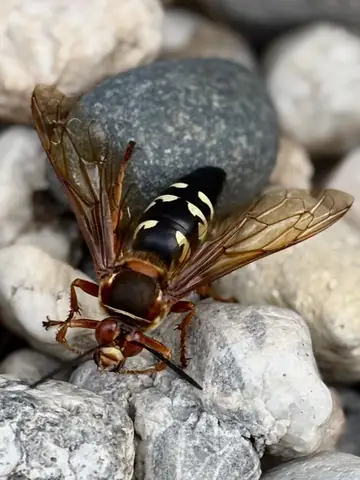
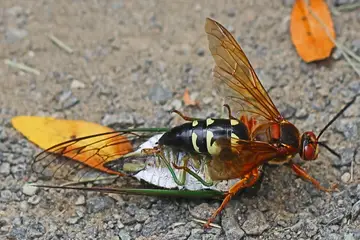

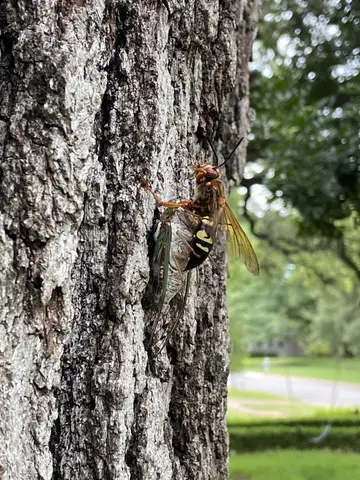
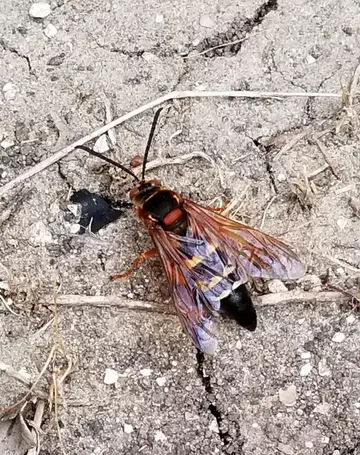
Size: About 1 1/8 to 1 5/8 inches long (OSU, NC State); females up to nearly 2 inches, males up to 1.5 inches (University of Kentucky). Females larger than males. Ohioline
Colors: black body with yellow to white stripes; dark red head and thorax; brownish wings and legs; dark orange head and thorax, black abdomen; honey- or russet-colored wings; black or rusty with yellow bands. Pattern: six yellow markings on the abdomen (three per side), small yellow marks on the thorax; three light-yellow abdominal stripes.
Key features
- nests in the ground: burrow about 1/2 inch wide with a U-shaped soil mound at the entrance Ohioline
- hole about 1/2 inch across with excavated soil piled around it UF/IFAS Extension
- hovers 1-2 ft above the ground near nests University of Georgia Cooperative Extension
- large size; females seen carrying or dragging a cicada Missouri Department of Conservation
- males hover at eye level near people University of Kentucky Entomology
Animals mistaken for the eastern cicada killer
Eastern cicada killer or European hornet?
Eastern cicada killer
European hornet Vespa crabro
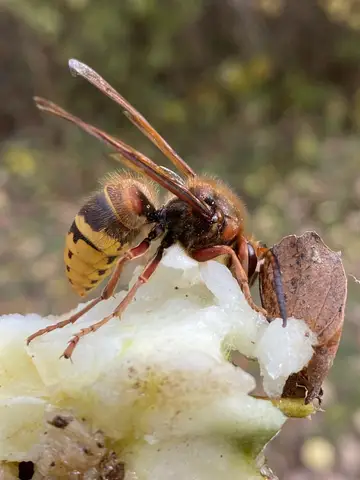
Cicada killer abdomen mostly black with yellow marks and nests in the ground; European hornet abdomen mostly yellow with brown marks, paper nest above ground (often in hollow trees). Penn State Extension
Social hornet that builds paper nests (Penn State; MDC). Its sting risk is not covered by the sources collected for this page.
Eastern cicada killer or Yellowjackets?
Eastern cicada killer
Yellowjackets Vespula spp.
Cicada killers look like very large yellowjackets; yellowjackets are about 1/2 inch long (Texas A&M) and live in social colonies with paper-carton nests. University of Maryland Extension, Home and Garden Information Center
Texas A&M: yellowjackets may be aggressive when foraging and southern yellowjackets can sting repeatedly ("Southern yellowjackets can sting repeatedly.").
Eastern cicada killer or Eastern stizus?
Eastern cicada killer
Eastern stizus Stizus brevipennis
Eastern stizus has smooth-edged yellow abdominal marks; on the cicada killer black hook-shaped edges cut into the yellow. The stizus stocks its nest with katydids, not cicadas. Missouri Department of Conservation
Eastern cicada killer or Northern giant hornet (Asian giant hornet)?
Eastern cicada killer
Northern giant hornet (Asian giant hornet) Vespa mandarinia
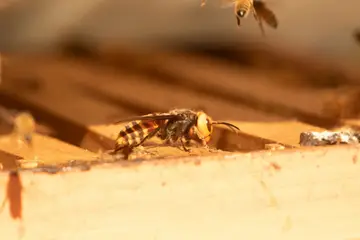
Giant hornet has a larger head with bigger jaws and smaller eyes. MDC: in North America it was found only in the Pacific Northwest and as of December 2024 was declared eradicated from the US. University of Kentucky Entomology
University of Kentucky: the cicada killer does not present the hazard associated with the Asian giant hornet ("However, the cicada killer does not present the hazard that is associated with the Asian giant hornet.").
Where the eastern cicada killer lives
- Native or listed
- Nonnative or not established
- No official record in our data
- 1–9
- 10–99
- 100–999
- 1,000+
On our state guides
- Arkansas insects and bugs
- Illinois insects and bugs
- Kansas insects and bugs
- Missouri insects and bugs
- Ohio insects and bugs
- Texas insects and bugs
State boundaries: U.S. Census Bureau, cartographic boundary file cb_2024_us_state_20m.
When it is active
Summer. Adults emerge from late June or early July and are seen mostly in July and August (Ohio: July to mid-September). University of Kentucky Entomology
US open-licence records peak in July to August.
Habitat and habits
Habitat: Open, sunny areas with loose, well-drained or sandy soil and sparse vegetation: lawns, pastures, parks, forest edges, sidewalk and patio edges, flower beds, sandy playgrounds and golf course sand traps. Often many females nest close together. Ohioline
Behavior: Solitary wasps (no queen or workers), so less defensive than social wasps. Males are territorial: they patrol nest areas, chase other insects and may fly at or 'inspect' people, but cannot sting. Ohio State says they are generally considered beneficial because they feed on cicadas; UF/IFAS says usually.
Diet: Adults feed on flower nectar and other sweet plant juices; Ohio DNR adds fermenting sap oozing from tree trunks. Females hunt annual (dog-day) cicadas, paralyze them with a sting and stock their burrows with one or two per cell as food for the larvae.
Young: One generation per year. Each female digs her own burrow with several cells (UF/IFAS: 1 to 4 feet long; Ohio State: 6-10 inches deep) and places one or two paralyzed cicadas and an egg in each cell. The larva eats the cicada and overwinters underground (in a cocoon per Ohio State and Missouri; Kentucky says as pupae), emerging as an adult the next summer. Adults live about 60-75 days.
Legal status and reporting
Invasive status: Not invasive: Ohio State Extension calls it a native wasp. Ohioline
Questions about the eastern cicada killer
Cicada killer sting
Only females have a stinger, and they rarely sting people: almost always only when stepped on, grabbed, handled roughly or trapped against skin. Males cannot sting. Texas A&M says a sting causes sharp pain and local swelling; people allergic to wasp stings should stay away from all wasps (MDC). For a serious reaction, call 911 or Poison Help 1-800-222-1222.
Cicada killer size
About 1 1/8 to 1 5/8 inches long; females can be nearly 2 inches, and males are smaller (up to about 1.5 inches). It is one of the largest wasps in North America.
Cicada killer nest
Females dig burrows in sunny, well-drained or sandy soil, often in lawns, beds or sand. The hole is about 1/2 inch across with a mound of soil at the entrance; UF/IFAS says tunnels can run 1 to 4 feet (Ohio State: 6-10 inches deep), with several cells, each stocked with paralyzed cicadas. Many females may nest close together.
Cicada killer hornet
It is a solitary wasp, not a hornet, though UF also calls it the 'giant ground hornet'. It is often confused with the European hornet (which has a mostly yellow abdomen and builds paper nests above ground) and with the Asian giant hornet, which has a bigger head and jaws and, per MDC, was declared eradicated from the US as of December 2024.
Cicada killer bees
Cicada killers are wasps, not bees (UF/IFAS lists them with hornets, yellow jackets, paper wasps and mud daubers as wasps). Like bees they visit flowers for nectar.
Cicada killer texas
Yes. Texas A&M AgriLife includes the cicada killer in its guide to venomous terrestrial animals of Texas: females can sting but rarely are aggressive, and males cannot sting.
Sources
- Cicada Killer Wasp (ENT-63). Ohio State University Extension (Ohioline). May 13, 2015; checked November 3, 2026.
Quoted passages (4)
“Adults are approximately 1⅛ to 1⅝ inches long, very robust, with a black body marked with yellow to white stripes.”
“Each female digs an individual burrow 6–10 inches deep and one-half inch wide. The soil is dislodged by her mouth, and loose particles are kicked back using her hind legs. The excess soil thrown out of the burrow forms a U-shaped mound at the entrance.”
“The female wasps prefer to dig new nesting holes in full sun, where well-drained soils exist and vegetation is sparse.”
“Cicada killers have only a single generation per year.”
- ENTFACT-004: Cicada Killer Wasps. University of Kentucky Entomology (Cooperative Extension). revised 2026-03; checked November 3, 2026.
Quoted passages (5)
“Female cicada killers are equipped with a stinger that they use to inject venom into a cicada they catch and then lay their eggs on top of.”
“Males will ‘inspect’ humans, hovering at eye level to evaluate you.”
“They do not have a social nest, meaning a nest that contains a queen and workers (like honey bees or yellowjackets), and are therefore less defensive than other wasps.”
“Adult wasps are most commonly seen in July and August.”
“Closer inspection of the two species will also reveal that Asian giant hornets have larger heads than cicada killers, with larger jaws and smaller eyes, also helping to differentiate the species”
- Eastern Cicada-Killer Wasp (Field Guide). Missouri Department of Conservation. undated page; checked November 3, 2026.
Quoted passages (4)
“Not harmful to humans. Only the females possess stingers, and they reserve these for use in subduing prey (cicadas). It is possible that a female eastern cicada-killer wasp could sting a person, but only if she is handled roughly. Persons allergic to wasp stings should stay away from all wasps.”
“In addition to their size and coloration, their behavior identifies them.”
“Adult cicada-killers feed on nectar and other sweet plant juices.”
“…in the eastern stizus, the yellow abdominal marks are smooth-edged, while on the cicada-killer, ornate black hook-shaped edges intrude into the yellow. … Finally, the eastern stizus provisions its nests with katydids, not cicadas.”
- Cicada Killer, Giant Ground Hornet, Sphecius hogardii (Latreille) and Sphecius speciosus (Drury) (EENY295 / IN573). UF/IFAS Extension (EDIS, Featured Creatures). publication date not shown in page text; checked November 3, 2026.
- Stinging or Venomous Insects and Related Pests (ENY-215). UF/IFAS Extension (EDIS). revised 2022-02; checked November 3, 2026.
Quoted passages (1)
“Cicada killers dig holes about ½ inch (1.3 cm) across and pile the excavated soil around the opening.”
- Stinging and Biting Pests (Circular 782). University of Georgia Cooperative Extension. October 26, 2022; checked November 3, 2026.
Quoted passages (1)
“The solitary adult is often seen hovering 1 to 2 ft above the ground near the entrance to its nest.”
- European Hornets and Look-alikes (ENT-0102). Ohio State University Extension (Ohioline). February 21, 2025; checked November 3, 2026.
Quoted passages (1)
“Another species often misidentified as European hornet is the solitary and native cicada killer wasp”
- European Hornet. Penn State Extension. updated 2024-07-19; checked November 3, 2026.
Quoted passages (1)
“The abdomens of cicada killers are mostly black with yellow markings while European hornet abdomens are mostly yellow with brown markings. European hornets construct paper nests in aerial locations, while cicada killers nest in the ground.”
- Cicada Killer Wasps. University of Maryland Extension, Home and Garden Information Center. updated 2023-03-01; checked November 3, 2026.
Quoted passages (1)
“Cicada killers resemble large yellowjackets.”
- Venomous Terrestrial Animals of Texas (B-6118). Texas A&M AgriLife Extension Service. 2004-08 (B-6118 8-04; checked November 3, 2026.
- GBIF.org occurrence records, human observations licensed CC0 1.0 or CC BY 4.0 only, accessed November 3, 2026. The datasets behind these counts are listed on our Sources page.
- State boundaries: U.S. Census Bureau, cartographic boundary file cb_2024_us_state_20m.