K-State Research and Extension: No official complete list of Kansas insects.
This page lists 8 insects.
5 are venomous by official accounts.
Not every species: no complete official list of Kansas insects exists, so this page covers the ones state and Extension sources name. How lists are built.
Which insects can hurt you
Official sources single out these insects in Kansas, in their own words:
bees and wasps
Venomous sting. “The sting includes venom designed to kill or paralyze prey but also may be used defensively when individuals or a colony is threatened.” K-State Research and Extension
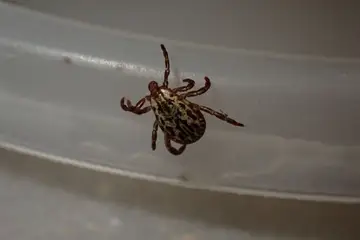
American dog tick, lone star tick, blacklegged tick
Disease. “The ticks most often encountered in Kansas are the American dog tick, lone star tick and blacklegged tick (or deer tick). Ticks can transmit diseases, including ehrlichiosis, tularemia, anaplasmosis, Lyme disease and Rocky Mountain spotted fever.” Kansas Department of Wildlife and Parks
All 8 insects
Venomous species first, then A to Z. Do not handle them.
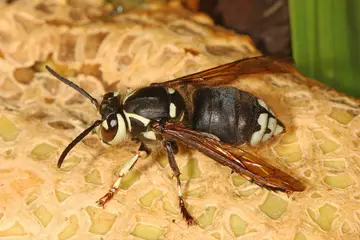
Missouri: workers 1/2 to 3/4 inch, queens 3/4 inch. University of Maryland: workers 5/8 to 3/4 inch, queens just over an inch. Penn State gives 13 to 20 mm for the queen and her offspring.
How to recognize it
Not yellow, unlike typical yellowjackets; larger, black and ivory
Large, rounded, gray paper nest hanging in trees or shrubs, sometimes on buildings
Nest entrance is the lowest opening of the cone- or egg-shaped nest
What the sources say
Venom: “The sting includes venom designed to kill or paralyze prey but also may be used defensively when individuals or a colony is threatened.” (K-State Research and Extension)
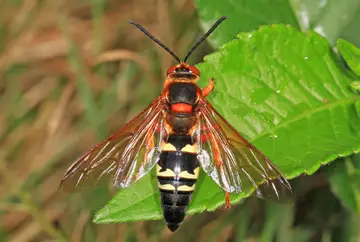
About 1 1/8 to 1 5/8 inches long (OSU, NC State); females up to nearly 2 inches, males up to 1.5 inches (University of Kentucky). Females larger than males.
How to recognize it
Nests in the ground: burrow about 1/2 inch wide with a U-shaped soil mound at the entrance
Hole about 1/2 inch across with excavated soil piled around it
Hovers 1-2 ft above the ground near nests
JFMAMJJASOND
33 records by month.What the sources say
Venom: “The sting includes venom designed to kill or paralyze prey but also may be used defensively when individuals or a colony is threatened.” (K-State Research and Extension)
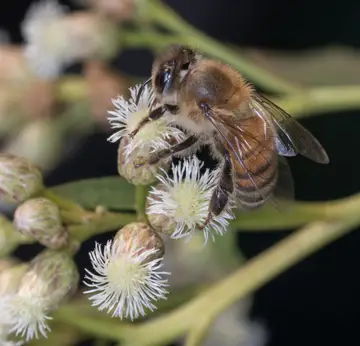
About 10 percent smaller than a European honey bee, a difference too subtle to see without measurement or lab tests.
How to recognize it
Cannot be identified by eye: only DNA testing or microscopic measurements can tell it from a European honey bee.
Clue is behavior and nest site: very defensive, and may nest in small cavities such as water meter boxes, old tires, house eaves or the ground.
JFMAMJJASOND
124 records by month.What the sources say
Venom: “The sting includes venom designed to kill or paralyze prey but also may be used defensively when individuals or a colony is threatened.” (K-State Research and Extension)
Venom: “The sting includes venom designed to kill or paralyze prey but also may be used defensively when individuals or a colony is threatened.” (K-State Research and Extension)
Venom: “The sting includes venom designed to kill or paralyze prey but also may be used defensively when individuals or a colony is threatened.” (K-State Research and Extension)
No confirmed photo of Black Imported Fire Ant
Black Imported Fire Ant
Solenopsis richteri
Not stated
Venom
No official source we use states whether this animal is venomous. That does not mean it is harmless: do not handle it.
Where in Kansas
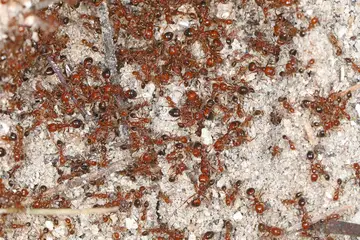
The two species described here do not overwinter in Kansas at this time but are pests of regulatory importance. K-State Research and Extension
Not established. K-State: red and black imported fire ants do not overwinter in Kansas; colonies arriving in nursery stock are quarantined and destroyed by the Kansas Department of Agriculture. K-State Research and Extension
“When detected, these colonies are quickly quarantined and destroyed by the Kansas Department of Agriculture.”
About this list
Venom labels come only from official sources and link to them; "Not stated" never means harmless. How labels work.
Household Pests of Kansas, MF3291 (Davis & Whitworth). K-State Research and Extension (Kansas State University Agricultural Experiment Station and Cooperative Extension Service). July 2018; checked November 3, 2026.Quoted passages (5)
“No official complete list of Kansas insects.”
“The sting includes venom designed to kill or paralyze prey but also may be used defensively when individuals or a colony is threatened.”
“When they do bite, it is extremely painful and results in localized swelling.”
“In this case, the victim should seek medical help immediately.”
“When detected, these colonies are quickly quarantined and destroyed by the Kansas Department of Agriculture.”
Outdoor Health and Safety (KDWP). Kansas Department of Wildlife and Parks. undated page; checked November 3, 2026.Quoted passages (4)
“West Nile virus is most commonly spread by infected mosquitoes that have fed on infected birds.”
“The ticks most often encountered in Kansas are the American dog tick, lone star tick and blacklegged tick (or deer tick). Ticks can transmit diseases, including ehrlichiosis, tularemia, anaplasmosis, Lyme disease and Rocky Mountain spotted fever.”
“Follow these steps to prevent tick bites: Dress, DEET, Avoid and Check.”
“Spring and summer are hunting, fishing, camping, and hiking seasons. It is also the time of year when ticks are out.”