Kansas Herpetofaunal Atlas (Travis W. Taggart), Sternberg Museum of Natural History, Fort Hays State University: 15 others lizards (Squamata) (3 of which are established exotic species), and
This page lists 15 lizards: all from Kansas Herpetofaunal Atlas (Travis W. Taggart), Sternberg Museum of Natural History, Fort Hays State University's Kansas Herpetofaunal Atlas species accounts: SQUAMATA, "ESTABLISHED TAXA"; cross-checked with "A Pocket Guide to Kansas Amphibians, Turtles and Lizards".
3 are nonnative.
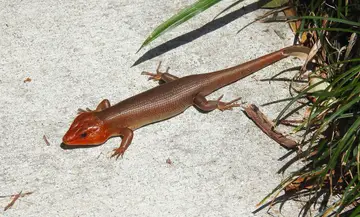
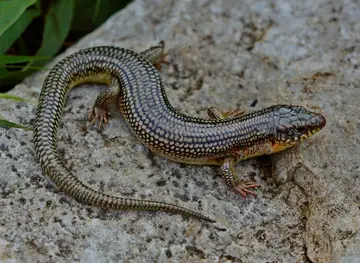
About 6.5 to 12.75 inches in total length. Oklahoma gives about 12 inches for large adults and SREL up to 13 inches. Males are larger than females.
How to recognize it
Large, wide head; breeding males have swollen orange-red jowls.
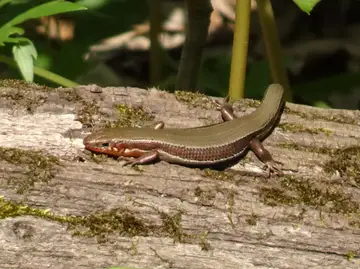
Smooth, glass-like scales, short legs and a stocky body.
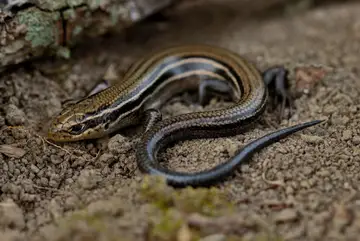
Upper-lip scales separate it from five-lined skinks: Maryland, Tennessee and North Carolina count five labial scales between the nostril and the eye rather than four. Oklahoma and Missouri count differently, around 8 or 9 in the full lip row.
Venom: “No species are venomous.” (Great Plains Nature Center (cooperative project of the U.S. Fish and Wildlife Service, Kansas Department of Wildlife and Parks and City of Wichita); published by the Friends of the Great Plains Nature Center)
Venom: “No species are venomous.” (Great Plains Nature Center (cooperative project of the U.S. Fish and Wildlife Service, Kansas Department of Wildlife and Parks and City of Wichita); published by the Friends of the Great Plains Nature Center)
Range: The habitat requirement of this species in Kansas are largely unknown. It has been observed in heavily wooded regions of eastern Kansas, generally east of the Flint Hills, and south of the Kansas River.Fleharty and Ittner (1967) reported three specimens (FHSM 2094, 2141-42) collected on 17 and 20 April 1965 under rocks in the grassy floodplain along the Smoky Hill River, 2 mi.
Venom: “No species are venomous.” (Great Plains Nature Center (cooperative project of the U.S. Fish and Wildlife Service, Kansas Department of Wildlife and Parks and City of Wichita); published by the Friends of the Great Plains Nature Center)
Range: Well documented from the forested eastern third of Kansas. Records from Ness (KU 18417-8; not plotted due to insufficient locality data) and Ellis (MHP 5624) counties are either introductions or misidentified specimens.
Venom: “No species are venomous.” (Great Plains Nature Center (cooperative project of the U.S. Fish and Wildlife Service, Kansas Department of Wildlife and Parks and City of Wichita); published by the Friends of the Great Plains Nature Center)
Range: This lizard is known from the western two-thirds of the state. The records for Girard, Crawford County (AMNH 1450-1) and Neosho Falls, Woodson County (USNM 4692) are dubious and in need of verification.
Venom: “No species are venomous.” (Great Plains Nature Center (cooperative project of the U.S. Fish and Wildlife Service, Kansas Department of Wildlife and Parks and City of Wichita); published by the Friends of the Great Plains Nature Center)
Range: Common in association with rocky areas but may also substitute mammal burrows along canyons in the southwest and south-central portions of the state (first reported by Tihen and Sprague, 1939). In northcentral Kansas, it is found in association with outcrops of the Cretaceous Greenhorn Limestone, Dakota Formation, and Niobrara Chalk (rarely).
Venom: “No species are venomous.” (Great Plains Nature Center (cooperative project of the U.S. Fish and Wildlife Service, Kansas Department of Wildlife and Parks and City of Wichita); published by the Friends of the Great Plains Nature Center)
Range: Probably statewide, although infrequently encountered in the upper Smoky-Hill River drainage. Preferring to hide a majority of the time, Great Plains Skinks use burrows or hide under rocks.
Venom: “No species are venomous.” (Great Plains Nature Center (cooperative project of the U.S. Fish and Wildlife Service, Kansas Department of Wildlife and Parks and City of Wichita); published by the Friends of the Great Plains Nature Center)
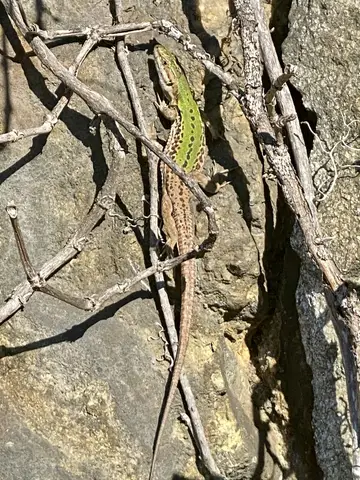
Range: Kansas populations of this non-native species are well-established in Topeka, Hays, and Lawrence. An April 2020 observation of an individual Italian Wall Lizard in Olathe is currently being properly documented.
Venom: “No species are venomous.” (Great Plains Nature Center (cooperative project of the U.S. Fish and Wildlife Service, Kansas Department of Wildlife and Parks and City of Wichita); published by the Friends of the Great Plains Nature Center)
Venom: “No species are venomous.” (Great Plains Nature Center (cooperative project of the U.S. Fish and Wildlife Service, Kansas Department of Wildlife and Parks and City of Wichita); published by the Friends of the Great Plains Nature Center)
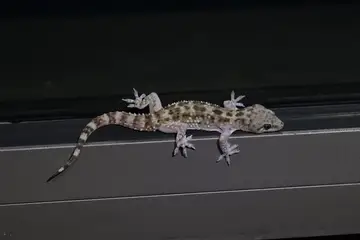
Range: In Kansas, this lizard is known from urban areas in Johnson, Lyon, Harvey, Saline, Douglas, and Sedgwick counties. They have been collected during warm weather around warehouses and hotels.
Venom: “No species are venomous.” (Great Plains Nature Center (cooperative project of the U.S. Fish and Wildlife Service, Kansas Department of Wildlife and Parks and City of Wichita); published by the Friends of the Great Plains Nature Center)
Venom: “No species are venomous.” (Great Plains Nature Center (cooperative project of the U.S. Fish and Wildlife Service, Kansas Department of Wildlife and Parks and City of Wichita); published by the Friends of the Great Plains Nature Center)
Range: Known from the Flint Hills, Cross Timbers, northern Osage Plains, and Drift Hills. It follows the Smoky-Hill, Saline, lower Soloman, and lower Republican river drainages west out of the Flint Hills.
Venom: “No species are venomous.” (Great Plains Nature Center (cooperative project of the U.S. Fish and Wildlife Service, Kansas Department of Wildlife and Parks and City of Wichita); published by the Friends of the Great Plains Nature Center)
Range: This lizard occurs throughout Kansas, and may particularly abundant in areas characterized by loose soils and patchy open (or rocky) vegetation. A quick and alert species, they are most easily taken under cover early in the morning.
Venom: “No species are venomous.” (Great Plains Nature Center (cooperative project of the U.S. Fish and Wildlife Service, Kansas Department of Wildlife and Parks and City of Wichita); published by the Friends of the Great Plains Nature Center)
Range: This species is found throughout the eastern two-thirds of Kansas. However, it is rare or absent from Drift Hills, Loess Hills, Arkansas River Sand Prairie, and eastern Smoky Hills.
Venom: “No species are venomous.” (Great Plains Nature Center (cooperative project of the U.S. Fish and Wildlife Service, Kansas Department of Wildlife and Parks and City of Wichita); published by the Friends of the Great Plains Nature Center)
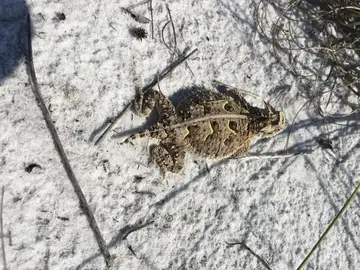
Range: The Texas Horned Lizard is locally abundant across much of Kansas. It avoids most of the High Plains north of the Arkansas River basin, northeast Kansas east and north of the Blue and Kansas rivers.
Venom: “No species are venomous.” (Great Plains Nature Center (cooperative project of the U.S. Fish and Wildlife Service, Kansas Department of Wildlife and Parks and City of Wichita); published by the Friends of the Great Plains Nature Center)
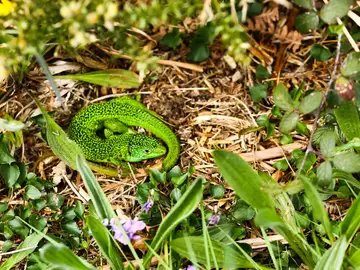
Range: Native to western and central Europe, this large lizard has been established in a small area of Topeka since at least 1973. Unlike the Italian Wall Lizard, there is little evidence to show that this species is expanding its range.
NCWRC: broadhead skinks reach a much larger size. ODWC: juveniles can be told apart by counting the upper lip scales (five-lined: seven, with two post-labials; broad-headed: nine, with no post-labials).
Oklahoma: its background color is tan to yellow, each scale bordered with black, giving the look of eleven irregular narrow stripes.
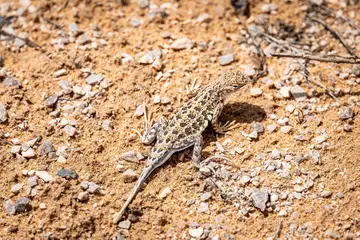
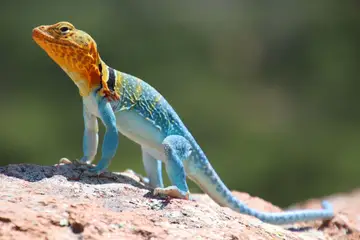
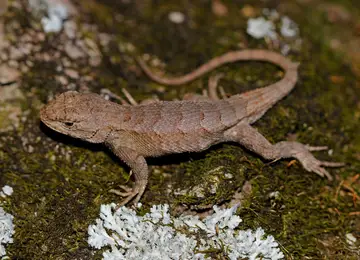
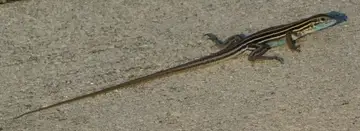
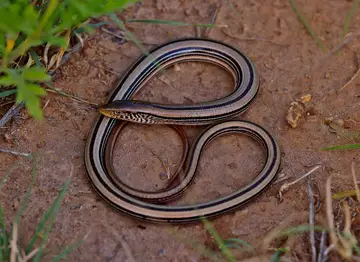
Photos show typical adults; individuals vary. Never get close to compare.
When lizards are active in Kansas
Records of lizards in Kansas peak in April to June. They show when people record lizards, not how many there are (about month bars).
JanFebMarAprMayJunJulAugSepOctNovDec
477 records of lizards in Kansas by month (GBIF, CC0 and CC BY records).
How to report
Report mountain lion, bear or wolf sightings and threatened, endangered, SINC or rare species to KDWP (Wildlife Sightings page; Pratt Operations Office, 512 SE 25th Avenue, Pratt, KS 67124, 620-672-5911). Nuisance wildlife: KDWP lists Nuisance Wildlife Damage Control permit holders. Kansas Department of Wildlife and Parks
Kansas Herpetofaunal Atlas: home page. Kansas Herpetofaunal Atlas (Travis W. Taggart), Sternberg Museum of Natural History, Fort Hays State University. page footer 1999-2026; checked November 3, 2026.Quoted passages (1)
“15 others lizards (Squamata) (3 of which are established exotic species), and”
A Pocket Guide to Kansas Amphibians, Turtles and Lizards (Taggart & Riedle). Great Plains Nature Center (cooperative project of the U.S. Fish and Wildlife Service, Kansas Department of Wildlife and Parks and City of Wichita); published by the Friends of the Great Plains Nature Center. First Edition; checked November 3, 2026.Quoted passages (1)
“No species are venomous.”
KHA species account: Slender Glass Lizard. Kansas Herpetofaunal Atlas (Travis W. Taggart), Sternberg Museum of Natural History, Fort Hays State University. updated February 27, 2024; checked November 3, 2026.
KHA species account: Eastern Collared Lizard. Kansas Herpetofaunal Atlas (Travis W. Taggart), Sternberg Museum of Natural History, Fort Hays State University. updated April 30, 2024; checked November 3, 2026.
KHA species account: Mediterranean House Gecko. Kansas Herpetofaunal Atlas (Travis W. Taggart), Sternberg Museum of Natural History, Fort Hays State University. updated February 27, 2024; checked November 3, 2026.
KHA species account: Western Green Lacerta. Kansas Herpetofaunal Atlas (Travis W. Taggart), Sternberg Museum of Natural History, Fort Hays State University. updated October 4, 2023; checked November 3, 2026.
KHA species account: Italian Wall Lizard. Kansas Herpetofaunal Atlas (Travis W. Taggart), Sternberg Museum of Natural History, Fort Hays State University. updated June 14, 2026; checked November 3, 2026.
KHA species account: Common Lesser Earless Lizard. Kansas Herpetofaunal Atlas (Travis W. Taggart), Sternberg Museum of Natural History, Fort Hays State University. updated April 29, 2025; checked November 3, 2026.
KHA species account: Texas Horned Lizard. Kansas Herpetofaunal Atlas (Travis W. Taggart), Sternberg Museum of Natural History, Fort Hays State University. updated February 27, 2024; checked November 3, 2026.
KHA species account: Prairie Lizard. Kansas Herpetofaunal Atlas (Travis W. Taggart), Sternberg Museum of Natural History, Fort Hays State University. updated May 9, 2023; checked November 3, 2026.
KHA species account: Coal Skink. Kansas Herpetofaunal Atlas (Travis W. Taggart), Sternberg Museum of Natural History, Fort Hays State University. updated August 7, 2023; checked November 3, 2026.
KHA species account: Common Five-lined Skink. Kansas Herpetofaunal Atlas (Travis W. Taggart), Sternberg Museum of Natural History, Fort Hays State University. updated April 9, 2026; checked November 3, 2026.
KHA species account: Broad-headed Skink. Kansas Herpetofaunal Atlas (Travis W. Taggart), Sternberg Museum of Natural History, Fort Hays State University. updated August 13, 2026; checked November 3, 2026.
KHA species account: Great Plains Skink. Kansas Herpetofaunal Atlas (Travis W. Taggart), Sternberg Museum of Natural History, Fort Hays State University. updated February 27, 2024; checked November 3, 2026.
KHA species account: Prairie Skink. Kansas Herpetofaunal Atlas (Travis W. Taggart), Sternberg Museum of Natural History, Fort Hays State University. updated February 27, 2024; checked November 3, 2026.
KHA species account: Little Brown Skink. Kansas Herpetofaunal Atlas (Travis W. Taggart), Sternberg Museum of Natural History, Fort Hays State University. updated March 14, 2025; checked November 3, 2026.
KHA species account: Six-lined Racerunner. Kansas Herpetofaunal Atlas (Travis W. Taggart), Sternberg Museum of Natural History, Fort Hays State University. updated August 3, 2023; checked November 3, 2026.
Wildlife Sightings (KDWP). Kansas Department of Wildlife and Parks. undated page; checked November 3, 2026.Quoted passages (1)
“If you observe a threatened or endangered species, a species in need of conservation, or a rare species in a new location, please report it to KDWP.”