Eastern collared lizard
Crotaphytus collaris · also called collared lizard, common collared lizard, yellow-headed collared lizard and mountain boomer · Last checked November 3, 2026.
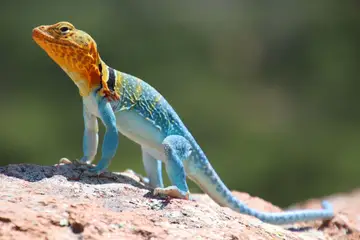
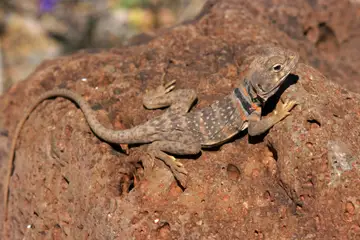
The eastern collared lizard is a colorful, big-headed lizard of rocky places, named for the two black collar markings on its neck. Adults reach 8 to 14 inches in total length. Males are often blue-green or green with yellow spots, while females are duller and develop orange markings when breeding. It is not venomous, according to Oklahoma's wildlife department, but it can give a painful bite that usually breaks the skin when handled. It lives across the south-central and southwestern US, from Arizona and Utah east to Missouri and Arkansas, with an introduced population in Illinois. Oklahoma Department of Wildlife Conservation
On this page
Is the eastern collared lizard dangerous?
Not venomous, but can inflict a painful bite that usually breaks the skin. NPS at Salinas Pueblo Missions calls it harmless. Oklahoma Department of Wildlife Conservation
“…although not venomous, collared lizards can inflict a painful bite that usually breaks the skin”
Bites and stings: Yes, when captured or handled. Bites can be painful, usually break the skin and can easily draw blood; Missouri calls the bite superficial, bleeding slightly.
How to identify an eastern collared lizard
A photo or description can narrow it down, but cannot confirm what an animal is or that it is safe. Look from a distance and do not handle wild animals.
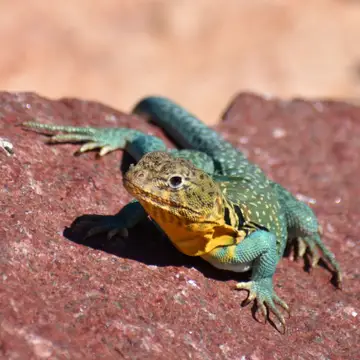
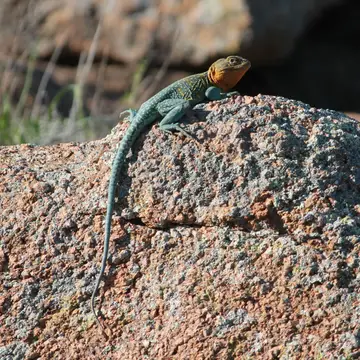
Size: Adult total length 8 to 14 inches (Missouri); up to about 14 inches (Colorado). Snout to vent up to 4.65 inches (Arizona). MDC
Colors: Adult males: mostly green with faint orange markings and small yellow spots; Missouri describes bright green legs, blue-green bodies and some orange on the throat; adult females: brown to gray, with bright orange blotches depending on breeding condition. Pattern: Two black collar markings on the neck; many light dots on the back.
Key features
- Large head, long tail about twice the body length, distinct black collar Oklahoma Department of Wildlife Conservation
- Round tail in cross-section, separating it from the Great Basin collared lizard; inside of mouth and throat often black Arizona Game and Fish Department
- Runs on its hind legs at top speed Arizona Game and Fish Department
Young
Hatchlings have a yellow background, an adult-like collar and rows of dark blotches among narrower yellow to orange blotches.
Animals mistaken for the eastern collared lizard
Eastern collared lizard or Great Basin collared lizard?
Eastern collared lizard
Great Basin collared lizard Crotaphytus bicinctores
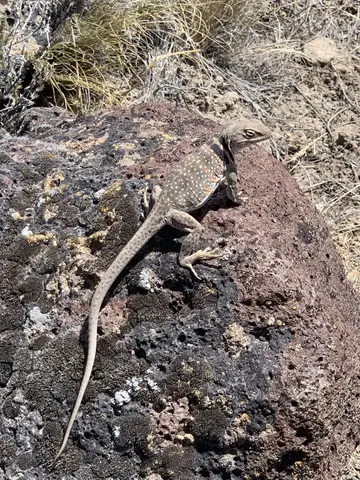
The Great Basin collared lizard's tail is taller than it is wide; the eastern's is round in cross-section. On Great Basin males the front collar completely encircles the neck, while on the eastern it does not cross the throat. Arizona Game and Fish Department
Eastern collared lizard or Sonoran collared lizard?
Eastern collared lizard
Sonoran collared lizard Crotaphytus nebrius
Both have round tails, so the tail does not separate them. On Sonoran collared lizard males the front collar completely crosses the neck, and the collar is often broken along the middle of the back; on the eastern the front collar does not cross the throat. Arizona Game and Fish Department
Where the eastern collared lizard lives
- Native or listed
- Nonnative or not established
- No official record in our data
- 1–9
- 10–99
- 100–999
- 1,000+
On our state guides
- Arizona lizards
- Arkansas lizards
- Colorado lizards
- Illinois lizardsNonnative
- Kansas lizards
- Missouri lizards
- New Mexico lizards
- Oklahoma lizards
- Texas lizards
- Utah lizards
State boundaries: U.S. Census Bureau, cartographic boundary file cb_2024_us_state_20m.
When it is active
Active by day, hibernating in late fall and winter. Oklahoma: mid-March through September. Missouri: usually April to September, with young possibly active through October. Arizona Game and Fish Department
US open-licence records peak in April to June.
Habitat and habits
Habitat: Rocky places: boulders, canyons, ledges and rock outcrops. In Missouri, open south- or southwest-facing glades, plus quarries and rocky dam riprap. Arizona Game and Fish Department
Behavior: Basks on boulders and is territorial; males may bob their heads and do push-ups. Unlike many lizards, it cannot cast off and regrow its tail, per AZGFD. It is voiceless despite the name mountain boomer.
Diet: Grasshoppers, beetles, other insects, spiders, lizards and small snakes; occasionally berries, leaves and flowers.
Young: Lays eggs in spring or summer. Clutch sizes vary by source: 4 to 10 (Oklahoma), 4 to 24 (Missouri), up to 14 (Arizona). Some females lay two clutches in a season. Hybridizes with the Great Basin collared lizard where ranges meet.
Legal status and reporting
Protection: Arkansas: AGFC excludes collared lizards from native wildlife that may be kept as pets, and lists it as a Species of Greatest Conservation Need (no regulatory status by itself). Missouri: Species of Conservation Concern. New Mexico: limited protection for commercial take; non-resident permit required. AGFC
Questions about the eastern collared lizard
Collared lizard
A colorful, big-headed lizard of rocky places with two black collar marks on the neck, 8 to 14 inches long. Oklahoma's wildlife department says it is not venomous but can give a painful bite that usually breaks the skin. It runs on its hind legs at top speed and hibernates in winter.
Are there collared lizards in missouri?
Yes. Missouri Department of Conservation says eastern collared lizards live throughout most of the Missouri Ozarks and in glades of the St. Francois Mountains, with relict populations south of the Missouri River in the Kansas City area. Populations north of the Missouri River appear to be introduced.
Sources
- Eastern Collared Lizard (ODWC Field Guide). Oklahoma Department of Wildlife Conservation. undated page; checked November 3, 2026.
Quoted passages (3)
“…although not venomous, collared lizards can inflict a painful bite that usually breaks the skin”
“…a large head relative to the body, bright coloration, a tail twice the body length, and a distinct black collar on the neck”
“Recently hatched juveniles have a yellow background color, collar similar to that of adults, and a series of irregular, nearly round dark blotches dispersed among series of narrower yellow to orange blotches across the dorsal body surface.”
- MDC Field Guide: Eastern Collared Lizard. Missouri Department of Conservation (MDC). undated page; checked November 3, 2026.
Quoted passages (1)
“Adult total length: 8–14 inches.”
- Online Field Guide species account: Eastern Collared Lizard (Crotaphytus collaris). Arizona Game and Fish Department. 2023; checked November 3, 2026.
Quoted passages (7)
“The tail is round in cross-section distinguishing this lizard from the similar Great Basin Collared Lizard … The inside of the mouth and throat are often black.”
“At top speeds this lizard lifts the forelimbs off the ground and runs on its hind limbs.”
“Primarily an inhabitant of rugged terrain with numerous large rocks or boulders that can be used for basking spots and lookouts.”
“It uses its powerful jaws to capture grasshoppers, beetles, other insects, spiders, lizards, and small snakes. It also occasionally eats plant material including berries, leaves, and flowers.”
“Like other collared lizards it is territorial and aggressive to other males. … Unlike many of our lizards collared lizards can not cast off and regenerate the tail.”
“It hibernates during the cold months of winter and late fall.”
“The Eastern Collared Lizard lays a clutch of up to 14 eggs in spring or summer. It hybridizes with the Great Basin Collared Lizard in areas where their ranges meet.”
- Vertebrate Information Compiled by the Utah Natural Heritage Program (Publication 03-45). Utah Division of Wildlife Resources. archived copy, captured October 19, 2020; checked November 3, 2026. Archived copy.
- Wild About Illinois Lizards! (family and species gallery). Illinois Department of Natural Resources (IDNR). undated page; checked November 3, 2026.
- Code of Regulations 09.14 Native Wildlife Pets Restricted. Arkansas Game and Fish Commission (AGFC). version effective 2026-05-02; checked November 3, 2026.
Quoted passages (1)
“Hand-captured native non-game wildlife other than birds, bats, … collared lizards”
- Online Field Guide species account: Great Basin Collared Lizard (Crotaphytus bicinctores). Arizona Game and Fish Department. 2023; checked November 3, 2026.
Quoted passages (1)
“The tail is taller than it is wide distinguishing this lizard from the similar Eastern Collared Lizard … On males the front collar completely encircles the neck.”
- Online Field Guide species account: Sonoran Collared Lizard (Crotaphytus nebrius). Arizona Game and Fish Department. 2023; checked November 3, 2026.
Quoted passages (1)
“The collar is often broken mid-dorsally. On males the front collar completely crosses the neck. … The tail is round in cross section”
- GBIF.org occurrence records, human observations licensed CC0 1.0 or CC BY 4.0 only, accessed November 3, 2026. The datasets behind these counts are listed on our Sources page.
- State boundaries: U.S. Census Bureau, cartographic boundary file cb_2024_us_state_20m.