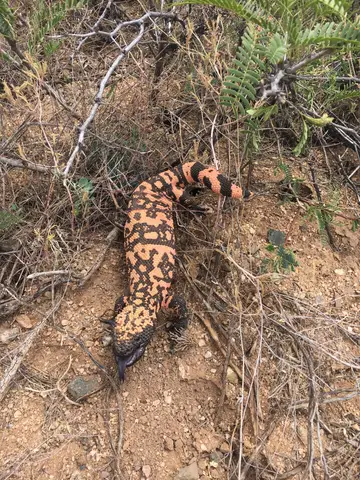
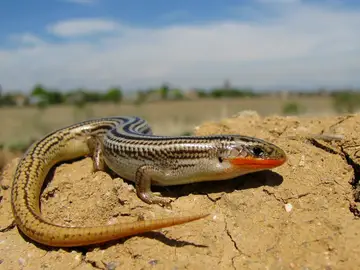
Venomous. “The Gila monster and the closely related Mexican beaded lizard are the only known medically important lizards in the world.” Arizona Poison and Drug Information Center
All 62 lizards
Venomous species first, then A to Z. Do not handle them.
“The Gila monster and the closely related Mexican beaded lizard are the only known medically important lizards in the world.” Arizona Poison and Drug Information Center
Size
NPS: up to 22 inches (560 mm) long and over a pound (450 g), the largest lizard in the United States. AZGFD: up to 14 inches from snout to vent. NDOW lists 18-24 inches and 2-4 lb.
How to recognize it
Hard, rounded, beadlike scales; dark forked tongue; short fat tail
Short, stout legs with long, sharp-clawed toes; big head and round tail
Venom: “This lizard is a member of Helodermatidae, the only family of venomous lizards in the world. … Venom secreted from glands in the lower jaw is delivered through grooves in the teeth.” (Arizona Game and Fish Department)
Habitat: Biotic communities ranging from Arizona’s desertscrubs into the lower reaches of Great Basin Conifer Woodland and Madrean Evergreen Woodland are home to this lizard. (Arizona Game and Fish Department)
No official source we use states whether this animal is venomous. That does not mean it is harmless: do not handle it.
Where in Arizona
This Arizona endemic is found in a small chain of ranges in western Yavapai County at elevations ranging from about 760 m (2,500′) to about 1,500 m (5,000′). Arizona Game and Fish Department
Conservation
HDMS: AZ SGCN Tier 2, state rank S1
What the sources say
Habitat: This inhabitant of rugged, rocky slopes and boulder fields within desertscrub and Interior Chaparral communities is primarily a crevice-dweller but it occasionally seeks shelter in and under plant debris such as dead yucca and prickly pear. (Arizona Game and Fish Department)
No official source we use states whether this animal is venomous. That does not mean it is harmless: do not handle it.
Where in Arizona
In Arizona there are only three known populations of this lizard – two in southern Graham County and one in northern Cochise County. Arizona Game and Fish Department
Conservation
HDMS: state rank S1S2
What the sources say
Habitat: Arizona populations are within the Semidesert Grassland and Chihuahuan Desertscrub communities. (Arizona Game and Fish Department)
No confirmed photo of Bezy’s Night Lizard
Bezy’s Night Lizard
Xantusia bezyi
Not stated
Venom
No official source we use states whether this animal is venomous. That does not mean it is harmless: do not handle it.
Where in Arizona
This Arizona endemic is found in a small chain of mountain ranges in central Arizona at elevations ranging from 730 m (2,400′) to about 1,770 m (5,800′). Arizona Game and Fish Department
Conservation
HDMS: AZ SGCN Tier 2, state rank S2
What the sources say
Habitat: R ugged, rocky slopes and boulder fields within the Arizona Upland Sonoran Desertscrub and Interior Chaparral communities are home to this lizard. (Arizona Game and Fish Department)
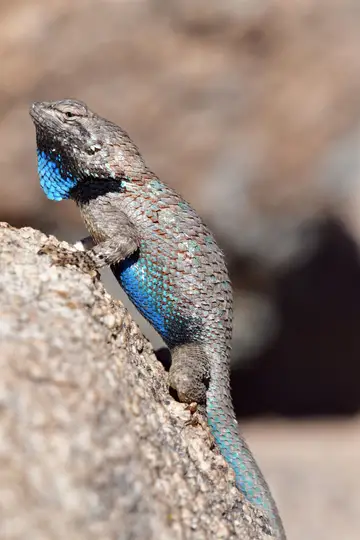
Habitat: Primarily an inhabitant of the Semidesert Grassland and Madrean Evergreen Woodland communities but also follows drainages down into Arizona Upland Sonoran Desertscrub and Chihuahuan Desertscrub in some areas. (Arizona Game and Fish Department)
No official source we use states whether this animal is venomous. That does not mean it is harmless: do not handle it.
Where in Arizona
This lizard is found in Greenlee County, extreme eastern Graham County, and portions of Cochise County. Arizona Game and Fish Department
Conservation
HDMS: state rank S2
What the sources say
Habitat: Primarily an inhabitant of Madrean Evergreen Woodland and Semidesert Grassland communities but this lizard also enters the lower reaches of Petran Montane Conifer Forest. (Arizona Game and Fish Department)
No official source we use states whether this animal is venomous. That does not mean it is harmless: do not handle it.
Where in Arizona
This lizard ranges across sub-Mogollon Rim central Arizona, south-central, and southeastern Arizona at elevations ranging from 3,000′ to about 6,000′. Arizona Game and Fish Department
Conservation
HDMS: state rank S4
What the sources say
Habitat: Clark’s Spiny Lizard is found in a variety of biotic communities including Arizona Upland Sonoran Desertscrub, Semidesert Grassland, Interior Chaparral, Madrean Evergreen Woodland and Great Basin Conifer Woodland. (Arizona Game and Fish Department)
No official source we use states whether this animal is venomous. That does not mean it is harmless: do not handle it.
Size
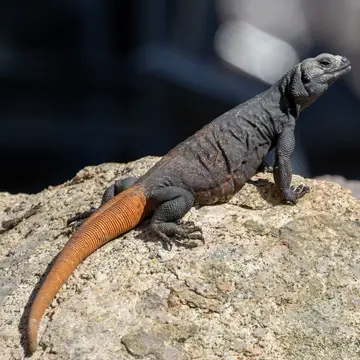
Adults 11 to 16.5 inches (28 to 42 cm) long (AZGFD); up to 9 inches snout to vent. NPS gives up to 20 inches. AZGFD calls it the largest native iguanid in the US.
How to recognize it
Flat, wide body with loose skin folds on neck and sides; flattened broad head; tail blunt at the tip and broad at the base
Small, granular body scales (Gila monster has large bead-like scales)
Larger and stockier than other US iguanid lizards, without head spines or enlarged scales along the back
Where in Arizona
This lizard is found across southwestern Arizona, along the states western border, and up through the Grand Canyon into Glen Canyon. Arizona Game and Fish Department
Conservation
HDMS: state rank S4
JFMAMJJASOND
99 records by month.What the sources say
Habitat: Most of this lizard’s range in Arizona is within the Sonoran and Mohave Desertscrub communities. (Arizona Game and Fish Department)
No official source we use states whether this animal is venomous. That does not mean it is harmless: do not handle it.
Where in Arizona
This lizard is distributed across the northeastern plateau region, a portion of the Arizona Strip (land north of the Colorado River), sub-Mogollon Rim central Arizona … Arizona Game and Fish Department
Conservation
HDMS: state rank S4
What the sources say
Range: This lizard is distributed across the northeastern plateau region, a portion of the Arizona Strip (land north of the Colorado River), sub-Mogollon Rim central Arizona, and the northernmost sky islands in the southeastern portion of the state.
Habitat: Found in communities ranging from Semidesert Grassland, through Interior Chaparral, and into woodlands. (Arizona Game and Fish Department)
No official source we use states whether this animal is venomous. That does not mean it is harmless: do not handle it.
Where in Arizona
It ranges across most of the northern Arizona plateau region including the Arizona Strip (land north of the Colorado River). Arizona Game and Fish Department
Conservation
HDMS: state rank S3S4
What the sources say
Habitat: A wide variety of biotic communities including Great Basin Desertscrub, Great Basin Conifer Woodland, Petran Montane Conifer Forest, and Petran Subalpine Conifer Forest are home to this lizard. (Arizona Game and Fish Department)
No official source we use states whether this animal is venomous. That does not mean it is harmless: do not handle it.
Where in Arizona
It is distributed across most of Arizona and is absent only from our high mountains and our central Mogollon Rim countr. Arizona Game and Fish Department
Conservation
HDMS: state rank S5
JFMAMJJASOND
989 records by month.What the sources say
Habitat: The Common Side-blotched Lizard inhabits all four of our state’s desertscrub communities, Semidesert Grassland, Interior Chaparral, and Great Basin Grassland. (Arizona Game and Fish Department)
No official source we use states whether this animal is venomous. That does not mean it is harmless: do not handle it.
Where in Arizona
This lizard is found in southeastern Arizona and across central Arizona below the Mogollon Rim. Arizona Game and Fish Department
Conservation
HDMS: state rank S4
What the sources say
Habitat: Primarily an inhabitant of Semidesert Grassland but also follows drainages up into Interior Chaparral and the woodland communities. (Arizona Game and Fish Department)
No official source we use states whether this animal is venomous. That does not mean it is harmless: do not handle it.
Where in Arizona
This lizard is distributed across our states western deserts north of the Gila River at elevations ranging from near sea level along the Colorado River to about 6,500’. Arizona Game and Fish Department
Conservation
HDMS: state rank S4
What the sources say
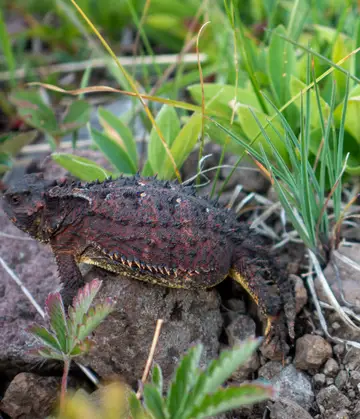
Habitat: In Arizona the Desert Horned Lizard inhabits Sonoran, Mohave, and Great Basin desertscrub communities and the lower reaches of Interior Chaparral and Great Basin Conifer Woodland. (Arizona Game and Fish Department)
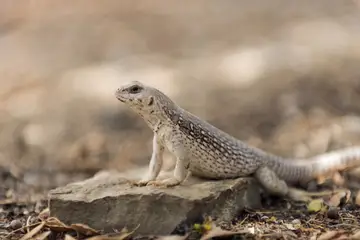
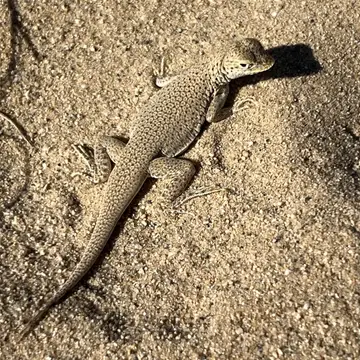
Photo: Joshua Tree National Park · Public domain · Wikimedia Commons
No official source we use states whether this animal is venomous. That does not mean it is harmless: do not handle it.
Size
Up to 5.75 inches (146 mm) snout to vent; NDOW says the tail is usually longer than the body. Total length not stated.
How to recognize it
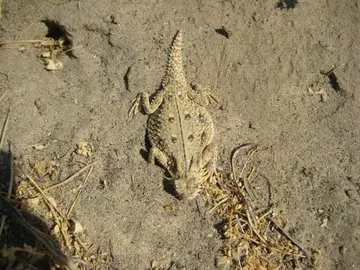
A single row of enlarged, pointed scales down the middle of the back
Small, blunt head; tail taller than wide; short, stocky limbs
Adults have two large rust patches on the belly during breeding season
Where in Arizona
The Desert Iguana is distributed across the desertscrubs of southwestern and far western Arizona. Arizona Game and Fish Department
Conservation
HDMS: state rank S4
JFMAMJJASOND
97 records by month.What the sources say
Habitat: This lizard is primarily an inhabitant of creosotebush dominated flatlands within Mohave Desertscrub and Lower Colorado River Sonoran Desertscrub communities. (Arizona Game and Fish Department)
No official source we use states whether this animal is venomous. That does not mean it is harmless: do not handle it.
Where in Arizona
This lizard’s range extends across the deserts of our northwestern border, up the western Grand Canyon to the vicinity of Powell Plateau, and down into several mountain … Arizona Game and Fish Department
Conservation
HDMS: state rank S4
What the sources say
Range: This lizard’s range extends across the deserts of our northwestern border, up the western Grand Canyon to the vicinity of Powell Plateau, and down into several mountain ranges in southwestern Arizona.
Habitat: The Desert Night Lizard’s range in northwestern Arizona closely follows the range of the Mohave Desertscrub and Interior Chaparral communities. (Arizona Game and Fish Department)
No official source we use states whether this animal is venomous. That does not mean it is harmless: do not handle it.
Where in Arizona
The Desert Spiny Lizard ranges across the deserts of southwestern Arizona and the northeastern plateaus at elevations ranging from near sea level along the Colorado … Arizona Game and Fish Department
Conservation
HDMS: state rank S4
What the sources say
Range: The Desert Spiny Lizard ranges across the deserts of southwestern Arizona and the northeastern plateaus at elevations ranging from near sea level along the Colorado River to about about 5,000′.
Habitat: Biotic communities including Sonoran Desertscrub, Great Basin Desertscrub, Semidesert Grassland, Interior Chaparral, and woodlands are home to this lizard. (Arizona Game and Fish Department)
Habitat: Found in communities ranging from Sonoran and Great Basin desertscrubs, through the grasslands and Interior Chaparral, and into the woodlands. (Arizona Game and Fish Department)
No official source we use states whether this animal is venomous. That does not mean it is harmless: do not handle it.
Where in Arizona
This lizard is found in the extreme southwestern corner of the state at elevations ranging from sea level to about 850’. Arizona Game and Fish Department
What the sources say
Habitat: In Arizona the Flat-tailed Horned Lizard is found exclusively in the Lower Colorado River subdivision of the Sonoran Desertscrub community. (Arizona Game and Fish Department)
Habitat: Primarily an inhabitant of Great Basin Conifer Woodland, Interior Chaparral, and Madrean Evergreen Woodland communities. (Arizona Game and Fish Department)
No confirmed photo of Gilbert’s Skink
Gilbert’s Skink
Plestiodon gilberti
Not stated
Venom
No official source we use states whether this animal is venomous. That does not mean it is harmless: do not handle it.
Where in Arizona
This lizard is found in a cluster of ranges and associated drainages in west by northwestern Arizona. Arizona Game and Fish Department
Conservation
HDMS: state rank S3S4
What the sources say
Habitat: Gilbert’s Skink inhabits a variety of communities ranging from riparian corridors within Arizona Upland Sonoran Desertscrub through Petran Montane Conifer Forest. (Arizona Game and Fish Department)
No confirmed photo of Goode’s Horned Lizard
Goode’s Horned Lizard
Phrynosoma goodei
Not stated
Venom
No official source we use states whether this animal is venomous. That does not mean it is harmless: do not handle it.
Where in Arizona
This lizard is distributed across Arizona southwestern basin deserts south of the Gila River at elevations ranging from near sea level along the Colorado River to about … Arizona Game and Fish Department
Conservation
HDMS: AZ SGCN Tier 2, state rank S3
What the sources say
Range: This lizard is distributed across Arizona southwestern basin deserts south of the Gila River at elevations ranging from near sea level along the Colorado River to about 610 m (2,000′).
Habitat: In Arizona this desert-dweller inhabits the Lower Colorado River Valley subdivision of Sonoran Desertscrub. (Arizona Game and Fish Department)
No official source we use states whether this animal is venomous. That does not mean it is harmless: do not handle it.
Where in Arizona
This lizard is distributed across our northwestern deserts and western deserts north of the Gila River. Arizona Game and Fish Department
Conservation
HDMS: state rank S3
What the sources say
Habitat: Primarily an inhabitant of Sonoran Desertscrub, Mohave Desertscrub, Great Basin Desertscrub, and Great Basin Grassland. (Arizona Game and Fish Department)
No official source we use states whether this animal is venomous. That does not mean it is harmless: do not handle it.
Where in Arizona
This lizard’s range extends across southeastern Arizona and over the state’s central Mogollon Rim country from the Hualapai Mountains in the west across the New Mexico … Arizona Game and Fish Department
Conservation
HDMS: state rank S3
What the sources say
Range: This lizard’s range extends across southeastern Arizona and over the state’s central Mogollon Rim country from the Hualapai Mountains in the west across the New Mexico border to the east.
Habitat: The Great Plains Skink inhabits a variety of communities including Semidesert Grassland, Interior Chaparral, Madrean Evergreen Woodland, Great Basin Conifer Woodland, and the lower reaches of Petran Montane Conifer Forest. (Arizona Game and Fish Department)
No official source we use states whether this animal is venomous. That does not mean it is harmless: do not handle it.
Where in Arizona
This lizard is found across sub-Mogollon Rim central Arizona and throughout much of the southeastern portion of the state at elevations ranging from about 900’ to 5,000′. Arizona Game and Fish Department
Conservation
HDMS: state rank S4
What the sources say
Habitat: The Greater Earless Lizard inhabits Arizona Upland Sonoran Desertscrub, Semidesert Grassland, Interior Chaparral, and Great Basin Conifer Woodland communities. (Arizona Game and Fish Department)
Habitat: This cold tolerant lizard is found in a variety of biotic communities including Semidesert Grassland, Plains and Great Basin Grassland, our woodlands, Interior Chaparral, Petran Montane Conifer Forest, and Petran Subalpine Conifer Forest. (Arizona Game and Fish Department)
No official source we use states whether this animal is venomous. That does not mean it is harmless: do not handle it.
Where in Arizona
This lizard’s range covers central Arizona’s Mogollon Rim country and extends south into the southeastern Arizona’s valleys and “sky island” ranges. Arizona Game and Fish Department
Conservation
HDMS: AZ SGCN Tier 2, state rank S4
What the sources say
Habitat: The Madrean Alligator Lizard inhabits a variety of biotic communities in Arizona including broadleaf riparian corridors, Semidesert Grassland, Interior Chaparral, woodlands, and Petran Montane Conifer Forest. (Arizona Game and Fish Department)
No official source we use states whether this animal is venomous. That does not mean it is harmless: do not handle it.
Where in Arizona
This lizard is distributed across Arizona’s northern plateau region and central Mogollon Rim country. Arizona Game and Fish Department
Conservation
HDMS: state rank S3
What the sources say
Habitat: In our state this lizard is found in Plains and Great Basin Grassland, Great Basin Conifer Woodland, and Petran Montane Conifer Forest communities. (Arizona Game and Fish Department)
Habitat: In our state this introduced lizard appears to be restricted to cities and towns within the warm desertscrub and Semidesert Grassland communities. (Arizona Game and Fish Department)
Habitat: This sand specialist occupies open dune fields and shrub invaded sand hummocks with at least sporadic, open patches of fine, wind-blown sand. (Arizona Game and Fish Department)
No confirmed photo of Mohawk Dunes Fringe-toed Lizard
Mohawk Dunes Fringe-toed Lizard
Uma thurmanae
Not stated
Venom
No official source we use states whether this animal is venomous. That does not mean it is harmless: do not handle it.
No official source we use states whether this animal is venomous. That does not mean it is harmless: do not handle it.
Where in Arizona
This lizard is found in a few of the sky island mountain ranges of southeastern Arizona including the Baboquivaris, Pajaritos, Atascosas, Santa Ritas, Huachucas, and … Arizona Game and Fish Department
Conservation
HDMS: AZ SGCN Tier 2, state rank S2
What the sources say
Range: This lizard is found in a few of the sky island mountain ranges of southeastern Arizona including the Baboquivaris, Pajaritos, Atascosas, Santa Ritas, Huachucas, and Peloncillos.
Habitat: In Arizona the Mountain Skink inhabits Madrean Evergreen Woodland and the upper reaches of adjoining Semidesert Grassland communities. (Arizona Game and Fish Department)
No official source we use states whether this animal is venomous. That does not mean it is harmless: do not handle it.
Where in Arizona
This lizard was not known to occur in Arizona prior to the 1998 discovery of a small population near the Puerco Ruins at Petrified Forest National Park. Arizona Game and Fish Department
Conservation
HDMS: state rank S1?
What the sources say
Habitat: The Arizona population of this lizard lives on a sandy, shrubby floodplain within the Plains Grassland community. (Arizona Game and Fish Department)
Habitat: It is found in most of the state’s biotic communities ranging from Lower Colorado River Sonoran Desertscrub to the lower reaches of Petran Subalpine Conifer Forest. (Arizona Game and Fish Department)
No confirmed photo of Pai Striped Whiptail
Pai Striped Whiptail
Aspidoscelis pai
Not stated
Venom
No official source we use states whether this animal is venomous. That does not mean it is harmless: do not handle it.
Where in Arizona
Populations of this Arizona endemic are scattered across the Colorado Plateau of northern Arizona. Arizona Game and Fish Department
What the sources say
Habitat: Primarily an inhabitant of Plains and Great Basin Grassland communities but also extends into Great Basin Conifer Woodland, Interior Chaparral, and Petran Montane Conifer Forest in some areas. (Arizona Game and Fish Department)
Habitat: A variety of biotic communities including Great Basin Desertscrub, Plains and Great Basin Grassland, Great Basin Conifer Woodland, Madrean Evergreen Woodland, and Petran Montane Conifer Forest are home to this lizard. (Arizona Game and Fish Department)
Habitat: A wide variety of communities are inhabited including Great Basin Desertscrub, Plains and Great Basin Grassland, Great Basin Conifer Woodland, and Petran Montane Conifer Forest. (Arizona Game and Fish Department)
No official source we use states whether this animal is venomous. That does not mean it is harmless: do not handle it.
Where in Arizona
This lizard is distributed across southeastern Arizona and along the southern transition zone of our central mountains region. Arizona Game and Fish Department
Conservation
HDMS: AZ SGCN Tier 2, state rank S4
What the sources say
Habitat: The range of this lizard in Arizona is within Arizona Upland Sonoran Desertscrub, Chihuahuan Desertscrub, and Semidesert Grassland communities. (Arizona Game and Fish Department)
Habitat: Valleys, bajadas, and low foothills within Chihuahuan Desertscrub and Semidesert Grassland communities are home to this lizard. (Arizona Game and Fish Department)
No confirmed photo of Slevin’s Bunchgrass Lizard
Slevin’s Bunchgrass Lizard
Sceloporus slevini
Not stated
Venom
No official source we use states whether this animal is venomous. That does not mean it is harmless: do not handle it.
Where in Arizona
This lizard is found in several of the “sky island” mountain ranges of southeastern Arizona and in the valleys of eastern Santa Cruz County. Arizona Game and Fish Department
Conservation
HDMS: AZ SGCN Tier 2, state rank S2
What the sources say
Habitat: Mountain populations inhabit Madrean Evergreen Woodland, Petran Montane Conifer Forest, and Petran Subalpine Conifer Forest communities. (Arizona Game and Fish Department)
Habitat: Inhabits communities ranging from Semidesert Grassland, through Madrean Evergreen Woodland, to Petran Montane Conifer Forest. (Arizona Game and Fish Department)
Habitat: A variety of biotic communities are home to this lizard. (Arizona Game and Fish Department)
No confirmed photo of Spiny-tailed Iguana
Spiny-tailed Iguana
Ctenosaura sp.
Not statedNonnative
Venom
No official source we use states whether this animal is venomous. That does not mean it is harmless: do not handle it.
Where in Arizona
Lizards from the genus Ctenosaura (see remarks) were introduced to the to the grounds of the Arizona-Sonora Desert Museum west of Tucson in the 1970s. Arizona Game and Fish Department
What the sources say
Habitat: In their native Mexico, spiny-tailed iguanas are found in desertscrub and transitional zones between desertscrub and subtropical forest. (Arizona Game and Fish Department)
No official source we use states whether this animal is venomous. That does not mean it is harmless: do not handle it.
Where in Arizona
In Arizona the Striped Plateau Lizard is found only in the Chiricahua and Peloncillo mountains. Arizona Game and Fish Department
Conservation
HDMS: AZ SGCN Tier 2, state rank S2
What the sources say
Habitat: The Striped Plateau Lizard inhabits Madrean Evergreen Woodland, Petran Montane Conifer Forest, and Petran Subalpine Conifer Forest communities. (Arizona Game and Fish Department)
Habitat: In our state the Texas Horned Lizard inhabits playas, low valleys, gentle bajadas, and foothills within Chihuahuan Desertscrub and Semidesert Grassland communities. (Arizona Game and Fish Department)
No official source we use states whether this animal is venomous. That does not mean it is harmless: do not handle it.
Where in Arizona
The Twin-spotted Spiny Lizard ranges across southeastern Arizona at elevations ranging from about 750 m (2,500′) to about 1,500 m (5,000′). Arizona Game and Fish Department
What the sources say
Habitat: The Twin-spotted Spiny Lizard is found primarily in Chihuahuan Desertscrub and Semidesert Grassland communities. (Arizona Game and Fish Department)
No official source we use states whether this animal is venomous. That does not mean it is harmless: do not handle it.
Where in Arizona
This lizard is found on the Kaibab Plateau and some of the higher peaks of the Arizona Strip (portion of the state north of the Colorado River). Arizona Game and Fish Department
Conservation
HDMS: state rank S1
What the sources say
Habitat: In Arizona this lizard is found in Great Basin Conifer Woodland, Petran Montane Conifer Forest, and Petran Subalpine Conifer Forest communities. (Arizona Game and Fish Department)
No official source we use states whether this animal is venomous. That does not mean it is harmless: do not handle it.
Where in Arizona
This lizard’s is found in the sky island mountain ranges of southeastern Arizona at elevations ranging from about 4,300′ to over 10,000′. Arizona Game and Fish Department
Conservation
HDMS: AZ SGCN Tier 2, state rank S3
What the sources say
Habitat: An inhabitant of Madrean Evergreen Woodland, Petran Montane Conifer Forest, and Petran Subalpine Conifer Forest communities. (Arizona Game and Fish Department)
No confirmed photo of Yellow-backed Spiny Lizard
Yellow-backed Spiny Lizard
Sceloporus uniformis
Not stated
Venom
No official source we use states whether this animal is venomous. That does not mean it is harmless: do not handle it.
Where in Arizona
The Yellow-backed Spiny Lizard ranges across northwestern Arizona at elevations ranging from about 150 m (500′) to about 1,500 m (5,000′). Arizona Game and Fish Department
What the sources say
Habitat: The Yellow-backed Spiny Lizard is found in Mohave and Great Basin desertscrub, Great Basin Grassland, Interior Chaparral, and Great Basin Conifer Woodland communities. (Arizona Game and Fish Department)
No confirmed photo of Yuman Fringe-toed Lizard
Yuman Fringe-toed Lizard
Uma rufopunctata
Not stated
Venom
No official source we use states whether this animal is venomous. That does not mean it is harmless: do not handle it.
Habitat: This sand specialist occupies open dune fields and shrub invaded sand hummocks with at least sporadic, open patches of fine, wind-blown sand. (Arizona Game and Fish Department)
No official source we use states whether this animal is venomous. That does not mean it is harmless: do not handle it.
Where in Arizona
Distributed across nearly all of southwestern Arizona, our western borderlands, and our southeastern deserts. Arizona Game and Fish Department
Conservation
HDMS: state rank S4
What the sources say
Habitat: Flatlands within the Sonoran Desertscrub, Mohave Desertscrub, and Chihuahuan Desertscrub communities are favored haunts for this lizard. (Arizona Game and Fish Department)
Lizards people confuse
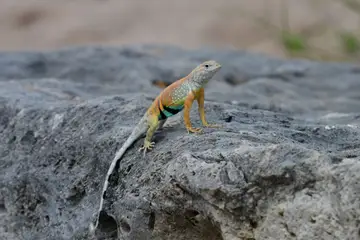
Eastern collared lizard or Great Basin collared lizard?
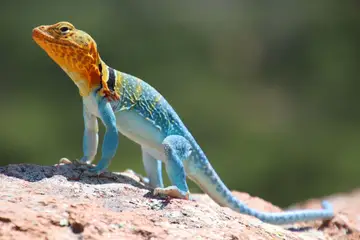
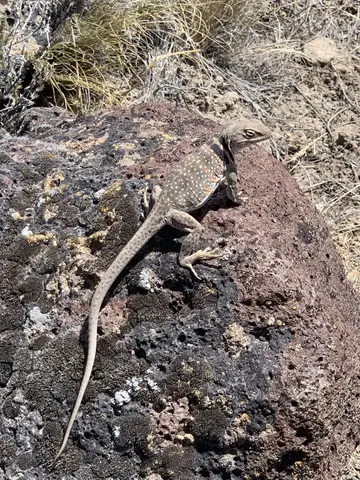
The Great Basin collared lizard's tail is taller than it is wide; the eastern's is round in cross-section. On Great Basin males the front collar completely encircles the neck, while on the eastern it does not cross the throat. Arizona Game and Fish Department
NPS says Gila monster hatchlings are sometimes confused with the banded gecko, a small, thin-skinned lizard. Hatchlings are much larger than an adult banded gecko.
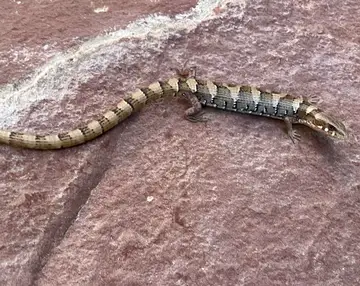
Mediterranean house gecko or Western banded gecko?
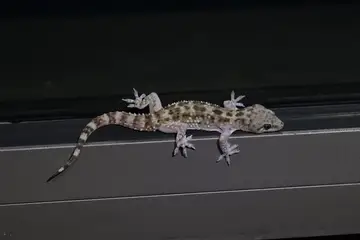
In Arizona, the small pale tubercles (bumps) on the upper surfaces set the Mediterranean house gecko apart from the similar-looking western banded gecko. Arizona Game and Fish Department
AZGFD: the chuckwalla has small granular body scales; the Gila monster has large bead-like scales. NPS: the Gila monster has bright orange to salmon-pink bands over black skin and a swollen tail. Arizona Game and Fish Department
Photo: Joshua Tree National Park · Public domain · Wikimedia Commons
Desert iguana Not stated
Arizona Game and Fish: the desert iguana has a small, blunt head, a long tail and short, stocky limbs, with a single row of enlarged, pointed scales down the middle of the back. Arizona Game and Fish Department
Photos show typical adults; individuals vary. Never get close to compare.
When lizards are active in Arizona
Records of lizards in Arizona peak in April to May and July to August. They show when people record lizards, not how many there are (about month bars).
JanFebMarAprMayJunJulAugSepOctNovDec
8,447 records of lizards in Arizona by month (GBIF, CC0 and CC BY records).
If you are bitten or stung
Call 911 or Poison Help at 1-800-222-1222 right away. Poison Help connects you to your local poison center, any time of day.
Official advice from Arizona Poison and Drug Information Center:
Call the local AZGFD office 8 a.m.-5 p.m. Monday-Friday (excluding holidays); after hours and weekends call the AZGFD dispatcher at 623-236-7201. Arizona Game and Fish Department
“The tail is taller than it is wide distinguishing this lizard from the similar Eastern Collared Lizard … On males the front collar completely encircles the neck.”
“The tail is round in cross-section distinguishing this lizard from the similar Great Basin Collared Lizard … The inside of the mouth and throat are often black.”
“At top speeds this lizard lifts the forelimbs off the ground and runs on its hind limbs.”
“A single row of enlarged, pointed, protruding scales runs down the midline of the back.”
“…a small, blunt head, a long tail, and short, stocky limbs. The tail is taller than it is wide.”
“Adults have two large, rust patches on the belly during breeding season.”
“A large (up to 146 mm or 5.75″ from snout to vent) lizard with a small, blunt head, a long tail, and short, stocky limbs.”
“A large (up to 146 mm or 5.75″ from snout to vent) lizard with a small, blunt head, a long tail, and short, stocky limbs. The tail is taller than it is wide. A single row of enlarged, pointed, protruding scales runs down the midline of the back.”
“This lizard is a member of Helodermatidae, the only family of venomous lizards in the world. … Venom secreted from glands in the lower jaw is delivered through grooves in the teeth.”
“The scales on the upper surfaces are hard, rounded, and bead-like. The tongue is dark and forked.”
Gila Monster. Arizona Poison and Drug Information Center (University of Arizona College of Pharmacy). 2026 (footer copyright; checked November 3, 2026.Quoted passages (2)
“The Gila monster and the closely related Mexican beaded lizard are the only known medically important lizards in the world.”
“Call 1-800-222-1222. All patients with a Gila monster bite who call the poison center are referred to a medical facility.”
“A large (up to 229 mm or 9″ from snout to vent) flat and wide lizard with loose folds of skin on the neck and sides of the body. … The head is flattened and broad. The tail is blunt on the end and broad at the base.”
“The small, granular body scales of this lizard distinguish it from the Gila Monster which has large bead-like scales.”
Living with Bobcats. Arizona Game and Fish Department. archived copy, captured January 16, 2026; checked November 3, 2026.Quoted passages (1)
“Call your local Arizona Game and Fish Department office from 8 a.m. to 5 p.m., Monday through Friday, excluding holidays. After hours and on weekends, a dispatcher is available at 623-236-7201.”