Mediterranean house gecko
Hemidactylus turcicus · also called Mediterranean gecko, Turkish gecko, Turkish (Mediterranean) house gecko and House gecko · Last checked November 3, 2026.
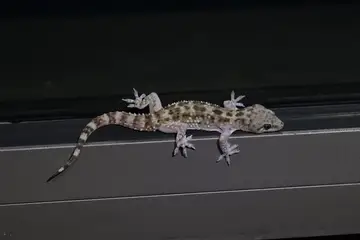
The Mediterranean house gecko is a small lizard, about 4 to 5 inches long, with pale, see-through-looking skin, dark spots, bumpy skin, big lidless eyes and sticky toe pads. It is not native to the United States: it came from the Mediterranean region, mostly by hitchhiking on cargo, and now lives in and around buildings across much of the southern US. It comes out at night and waits near outdoor lights to catch insects. Missouri's wildlife agency says all of Missouri's lizards, including this one, are harmless to humans, and LSU AgCenter says these geckos don't pose a threat to people. Outdoor Alabama
On this page
Is the mediterranean house gecko dangerous?
LSU AgCenter (Louisiana Cooperative Extension): Mediterranean geckos tend to bring out unfounded fears, but they really don't pose a threat to humans. LSU AgCenter (Louisiana Cooperative Extension Service), Dr. Don Reed
“Mediterranean geckos, probably more than any other lizard species, tend to bring out unfounded fears, although these creatures really don’t pose a threat to humans.”
Bites and stings: MDC says Missouri's lizards may try to bite if handled, usually causing mild pain like a pinch. Arizona Game and Fish says it squeaks when captured or fighting.
How to identify a mediterranean house gecko
A photo or description can narrow it down, but cannot confirm what an animal is or that it is safe. Look from a distance and do not handle wild animals.
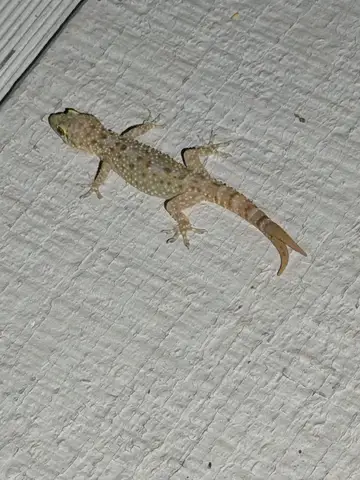
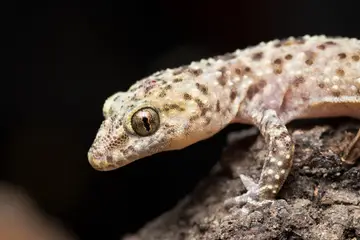

Size: Adults about 4 to 5 inches long in total (Missouri gives 3.9 to 5.0 inches); up to 2.4 inches from snout to vent.
Colors: Whitish to pink or tan, with brown blotches on the back; translucent to pinkish-white skin with black spots on the body and spots or stripes on the tail; light yellow, pink, peach or reddish-tan with dark reddish-brown spots or crossbars; white or pale cream underneath. Pattern: Tail often has dark crossbands, most noticeable in young geckos; rows of bumpy, keeled tubercles down the back and tail.
Key features
- Warty skin, large bulging eyes with vertical pupils, and wide toe pads for climbing. Indiana Department of Natural Resources, Division of Fish & Wildlife
- Large eyes without eyelids, covered by a clear scale. Outdoor Alabama
- Unlike any native lizard in Georgia and South Carolina, geckos have sticky toe pads, vertical pupils and lidless eyes. University of Georgia Savannah River Ecology Laboratory (SREL) Herpetology
- Makes chirping or squeaking sounds. Outdoor Alabama
Young
Dark tail crossbands are more noticeable in young individuals.
Animals mistaken for the mediterranean house gecko
Mediterranean house gecko or Indo-Pacific gecko?
Mediterranean house gecko
Indo-Pacific gecko Hemidactylus garnotii
The Mediterranean gecko has bumpy or warty skin; that is the easiest way to tell it from the similar Indo-Pacific gecko. University of Georgia Savannah River Ecology Laboratory (SREL) Herpetology
Mediterranean house gecko or Western banded gecko?
Mediterranean house gecko
Western banded gecko Coleonyx variegatus
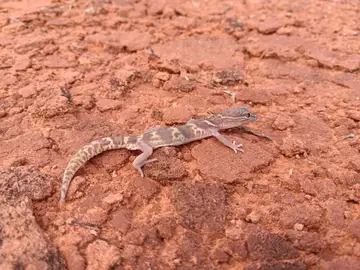
In Arizona, the small pale tubercles (bumps) on the upper surfaces set the Mediterranean house gecko apart from the similar-looking western banded gecko. Arizona Game and Fish Department
Where the mediterranean house gecko lives
- Native or listed
- Nonnative or not established
- No official record in our data
- 1–9
- 10–99
- 100–999
- 1,000+
On our state guides
- Alabama lizardsNonnative
- Arizona lizardsNonnative
- California lizardsNonnative
- Florida lizardsNonnative
- Georgia lizardsNonnative
- Illinois lizardsNonnative
- Indiana lizardsNonnative
- Kansas lizardsNonnative
- Louisiana lizardsNonnative
- Maryland lizardsNonnative
- Mississippi lizardsNonnative
- Missouri lizardsNonnative
- Nevada lizardsNonnative
- New Mexico lizardsNonnative
- North Carolina lizardsNonnative
- South Carolina lizardsNonnative
- Texas lizards
- Virginia lizardsNonnative
State boundaries: U.S. Census Bureau, cartographic boundary file cb_2024_us_state_20m.
When it is active
Nocturnal: active from dusk to dawn, often on walls near outside lights during the warm season.
US open-licence records peak in June to October.
Habitat and habits
Habitat: Almost always in and around buildings, especially in cities; may be found indoors at any time of year. In its native range it lives under palm leaves and in crevices of bark and rock.
Behavior: Climbs walls and even ceilings with its toe pads, waiting near lights to ambush insects. Males are territorial and defend their feeding spots. By day it hides in cracks, crevices and under bark.
Diet: Insects, spiders and other small invertebrates; Alabama notes moths and small roaches, and LSU AgCenter lists roaches, flies, ants, mosquitoes and spiders.
Young: Mating from March to July; females lay clutches of one or two eggs from April to August (several clutches a summer), and the eggs can be seen through a female's belly skin.
Legal status and reporting
Invasive status: Non-native (introduced). Florida FWC lists it as established, first observed in 1910 and brought in with cargo. Louisiana's 2025 State Wildlife Action Plan includes it in its Invasive Species List (Table 6.1). South Carolina DNR says it may compete with native lizards. Indiana DNR says little is known about its effects on local ecosystems.
Report: Indiana: send sightings, ideally with photos, to [email protected]. Florida: FWC says reports of lower-priority species such as small nonnative lizards are best made through the IveGot1 app or the IveGot1 website; its Invasive Species Hotline is 888-Ive-Got1 (888-483-4681).
Questions about the mediterranean house gecko
Are there geckos in alabama?
Yes. The Alabama Department of Conservation and Natural Resources lists the Mediterranean house gecko as an exotic (non-native) species; populations have been found sporadically in the southern half of the state.
Are there wild geckos in alabama?
Yes, though not native ones. Outdoor Alabama says populations of the non-native Mediterranean house gecko have been found sporadically in the southern half of the state, mostly in and near buildings in urban areas.
Are there geckos in arizona?
Yes. Arizona Game and Fish says the non-native Mediterranean house gecko has been introduced to urban areas including Phoenix, Tucson, Yuma, Casa Grande, Gila Bend, Marana and Douglas.
Are there geckos in california?
Yes. The California Department of Fish and Wildlife species list includes the Mediterranean house gecko, marked as introduced.
Are there geckos in florida?
Yes. Florida FWC lists the Mediterranean house gecko as an established nonnative species, first observed in 1910. FWC's list of nonnative geckos includes several other species too.
Are there geckos in georgia?
Yes. The UGA Savannah River Ecology Lab lists the Mediterranean gecko as introduced and reports it from many Georgia towns and cities, including Athens, Atlanta, Augusta and Savannah.
Are there geckos in illinois?
Yes. The Illinois DNR lists the Mediterranean gecko among Illinois lizards, marked as introduced.
Are there geckos in indiana?
Yes, in small numbers. Indiana DNR says Mediterranean geckos have been reported from several places in northern and southern Indiana, and two sites with sightings over several years may have established populations.
Are there geckos in louisiana?
Yes. LSU AgCenter says the non-native Mediterranean gecko has spread across Louisiana, with much larger numbers in the southern parishes.
Are there geckos in missouri?
Yes. The Missouri Department of Conservation lists the Mediterranean gecko as a nonnative species scattered through the southern half of the state, in warm urban buildings.
Are there geckos in north carolina?
Yes. The N.C. Wildlife Resources Commission's 2025 State Wildlife Action Plan species list includes the Mediterranean gecko and marks it as exotic.
Are there geckos in south carolina?
Yes. South Carolina DNR says the Mediterranean gecko is a recent introduction, most often seen in Columbia and Charleston.
Are there geckos in texas?
Yes. The Herps of Texas checklist (an archived copy of a state natural-history survey page) lists the Mediterranean house gecko.
Are there geckos in virginia?
Yes. The Virginia Department of Wildlife Resources list of native and naturalized species includes the Mediterranean gecko.
Sources
- Turkish (Mediterranean) House Gecko. Alabama Department of Conservation and Natural Resources (Outdoor Alabama). undated page; checked November 3, 2026.
Quoted passages (2)
“They have large elliptical eyes, but no eyelids. Their open eyes are protected by a transparent scale called a ‘spectacle’.”
“They have a distinct voice, similar to a bird chirping or a high pitched squeak, which is thought to be a territorial message.”
- Mediterranean Gecko. Indiana Department of Natural Resources, Division of Fish & Wildlife. dateModified 2026-03-09; checked November 3, 2026.
Quoted passages (2)
“These lizards have noticeably warty skin and large, bulging eyes with vertical pupils. They also have wide toe pads used for climbing.”
“The tail often has dark crossbands that are more noticeable in young individuals”
- Mediterranean Gecko (Hemidactylus turcicus) – Introduced. University of Georgia Savannah River Ecology Laboratory (SREL) Herpetology. undated page; checked November 3, 2026.
Quoted passages (2)
“Unlike any native lizard, geckos have sticky toe pads, vertical pupils, and their large eyes lack eyelids.”
“This species is most easily distinguished from the similar indo-pacific gecko by its bumpy or warty skin.”
- A Guide to Missouri's Lizards (MDC publication E00213). Missouri Department of Conservation (MDC). printed code "4/2023 E00213"; checked November 3, 2026.
Quoted passages (1)
“The overwhelming majority of lizards in the world are harmless except for the venomous Gila monster, Mexican beaded lizard, and Komodo dragon. All of Missouri’s lizards are harmless to humans, although some will attempt to bite if handled, usually causing a mild pain similar to being pinched.”
- Louisiana Critter Corner: Mediterranean Gecko (June 2013). LSU AgCenter (Louisiana Cooperative Extension Service), Dr. Don Reed. June 2013; checked November 3, 2026.
Quoted passages (1)
“Mediterranean geckos, probably more than any other lizard species, tend to bring out unfounded fears, although these creatures really don’t pose a threat to humans.”
- Online Field Guide species account: Mediterranean Gecko (Hemidactylus turcicus). Arizona Game and Fish Department. 2023; checked November 3, 2026.
Quoted passages (1)
“The upper surfaces are covered with small, pale tubercles distinguishing this lizard from the similar looking Western Banded Gecko.”
- Complete List of Amphibian, Reptile, Bird and Mammal Species in California. California Department of Fish and Wildlife (CWHR Program). 2016-05 (document dated "May, 2016"; checked November 3, 2026.
- Nonnative Geckos. Florida Fish and Wildlife Conservation Commission (FWC). archived copy, captured December 9, 2023; checked November 3, 2026.
- Wild About Illinois Lizards! (family and species gallery). Illinois Department of Natural Resources (IDNR). undated page; checked November 3, 2026.
- 2025 SWAP Appendix 3 Table 3-7 REPTILES SGCN and Priority Species List (2025 WAP Revision Taxa Team Evaluations). N.C. Wildlife Resources Commission. 2025 NC SWAP; checked November 3, 2026.
- Lizards in South Carolina. South Carolina Department of Natural Resources. page footer 2020; checked November 3, 2026.
- Herps of Texas: Lizards of Texas. Herps of Texas, Biodiversity Collections, Dept. of Integrative Biology, The University of Texas at Austin. 2020-04-28 (archive capture date; checked November 3, 2026.
- List of Native and Naturalized Fauna of Virginia. Virginia Department of Wildlife Resources (DWR). May, 2026; checked November 3, 2026.
- GBIF.org occurrence records, human observations licensed CC0 1.0 or CC BY 4.0 only, accessed November 3, 2026. The datasets behind these counts are listed on our Sources page.
- State boundaries: U.S. Census Bureau, cartographic boundary file cb_2024_us_state_20m.