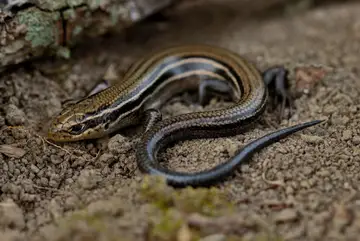
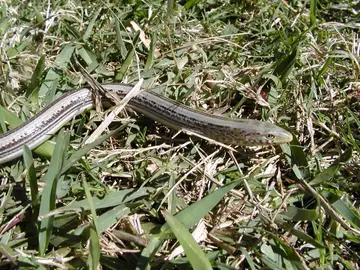
States Wildlife

Louisiana Lizards: Identification Guide With Pictures

Last checked November 3, 2026 against official sources.

On this page
  1. All 14 lizards
  2. Lookalikes
  3. When they are active
  4. How to report
  5. About this list
  6. Sources

This page lists 14 lizards. 8 are nonnative.

All 14 lizards

From A to Z.

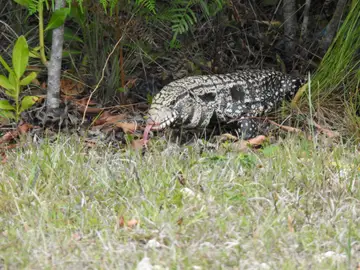
Argentine Black and White Tegu
Photo: Andrew Durso · CC BY 4.0 · iNaturalist

Argentine Black and White Tegu

Salvator merianae

Not stated Nonnative

Venom
No official source we use states whether this animal is venomous. That does not mean it is harmless: do not handle it.
Size
FWC: can reach nearly 5 feet. UF/IFAS: 4 to 5 feet and as much as 10 pounds. Georgia DNR: up to 4 feet, with adults documented in the wild in Georgia averaging slightly less than 2 feet.
How to recognize it
  • Head and neck much thicker than a Nile monitor's; fleshy, forked red tongue
  • Rarely climbs more than a few feet off the ground; a strong swimmer

Full Argentine Black and White Tegu guide

No confirmed photo of Broadhead Skink

Broadhead Skink

Non-venomous per LSU AgCenter, Keith Hawkins

What the sources say

Venom: “It is non-venomous, but the male skink is aggressive and will bite if handled.” (LSU AgCenter, Keith Hawkins)

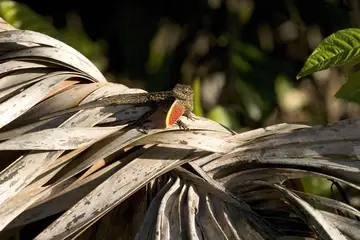
Brown Anole
Photo: Everglades NPS from Homestead, Florida, United States · Public domain · Wikimedia Commons

Brown Anole

Anolis sagrei

Not stated Invasive

Venom
No official source we use states whether this animal is venomous. That does not mean it is harmless: do not handle it.
Size
About 5 to 8.5 inches (12 to 21 cm) total length (SREL); Alabama DCNR says up to 9 inches, and the tail may be longer than the body.
How to recognize it
  • Males have an orange or red throat fan (dewlap) with a white edge.
  • Brown to grayish with whitish or yellowish markings on the back; variable dark spots, half moons, triangles or lines.
  • Fairly stout body and a shorter head than the green anole; slightly expanded toe pads.
406 records by month.

Full Brown Anole guide

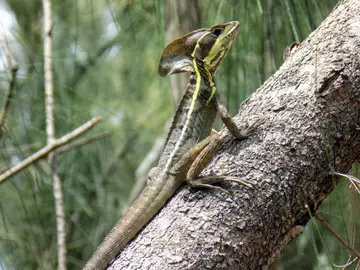
Brown Basilisk
Photo: Nick Tobler (Cowturtle) · CC BY 4.0 · iNaturalist

Brown Basilisk

Basiliscus vittatus

Not stated Nonnative

Venom
No official source we use states whether this animal is venomous. That does not mean it is harmless: do not handle it.
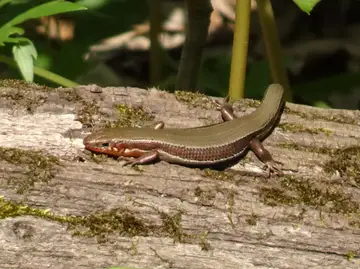
Coal Skink
Photo: Thomas Koffel · CC BY 4.0 · iNaturalist

Coal Skink

Plestiodon anthracinus

Not stated

Venom
No official source we use states whether this animal is venomous. That does not mean it is harmless: do not handle it.
Conservation
Louisiana SGCN, state rank S2 (imperiled) (2025 SWAP Table)
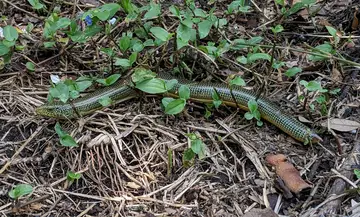
Eastern Glass Lizard
Photo: Semiv87 · CC BY-SA 4.0 · Wikimedia Commons · resized

Eastern Glass Lizard

Ophisaurus ventralis

Not stated

Venom
No official source we use states whether this animal is venomous. That does not mean it is harmless: do not handle it.
Conservation
Louisiana SGCN, state rank S2 (imperiled) (2025 SWAP Table)
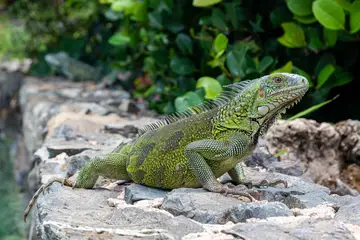
Green Iguana
Photo: Aatu Dorochenko · CC BY-SA 4.0 · Wikimedia Commons · resized

Green Iguana

Iguana iguana

Not stated Nonnative

Venom
No official source we use states whether this animal is venomous. That does not mean it is harmless: do not handle it.
Size
Males over 5 feet (FWC) to over 6 feet (UF/IFAS) including the tail, up to 17 lb; females about 5 feet, usually under 7 lb. Tail up to three quarters of total length. Hatchlings about 7 inches excluding the tail.
How to recognize it
  • Row of spike-like scales on neck, back and part of the tail (always present in adults, whatever their colour)
  • Dewlap (throat flap) and a large round scale at the rear of the jaw
  • Long tail, short legs, long toes and sharp claws

Full Green Iguana guide

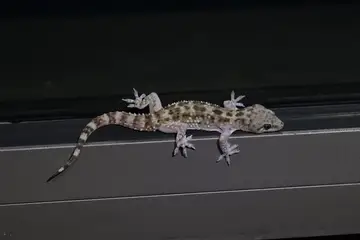
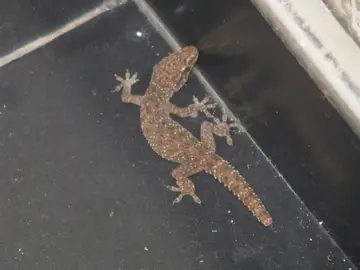
Mediterranean Gecko
Photo: Stephanie Tran · CC BY 4.0 · iNaturalist

Mediterranean Gecko

Hemidactylus turcicus

Not stated Nonnative

Venom
No official source we use states whether this animal is venomous. That does not mean it is harmless: do not handle it.
Size
Adults about 4 to 5 inches long in total (Missouri gives 3.9 to 5.0 inches); up to 2.4 inches from snout to vent.
How to recognize it
  • Warty skin, large bulging eyes with vertical pupils, and wide toe pads for climbing.
  • Large eyes without eyelids, covered by a clear scale.
  • Unlike any native lizard in Georgia and South Carolina, geckos have sticky toe pads, vertical pupils and lidless eyes.
Where in Louisiana
Since entering Louisiana, these geckos have spread across the state, although their numbers are much greater in the southern parishes. LSU AgCenter (Louisiana Cooperative Extension Service), Dr. Don Reed
211 records by month.

Full Mediterranean Gecko guide

Nile Monitor
Photo: Giles Laurent · CC BY-SA 4.0 · Wikimedia Commons · resized

Nile Monitor

Varanus niloticus

Not stated Nonnative

Venom
No official source we use states whether this animal is venomous. That does not mean it is harmless: do not handle it.
Size
Florida FWC: a typical adult averages 5 feet and close to 15 pounds; can reach about 6.5 feet and 17.8 pounds. USGS gives higher maximums: total length may exceed 7.5 feet and weight over 22 pounds.
How to recognize it
  • Lightly banded, rudder-shaped tail, usually 1.5 times the body length
  • Blue tongue
  • Large strong claws, a neck longer than the narrow-snouted head, and a side-flattened tail

Full Nile Monitor guide

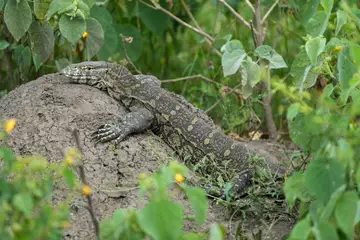
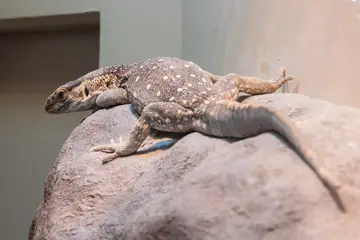
Savannah Monitor
Photo: Σ64 · CC BY 4.0 · Wikimedia Commons

Savannah Monitor

Varanus exanthematicus

Not stated Nonnative

Venom
No official source we use states whether this animal is venomous. That does not mean it is harmless: do not handle it.
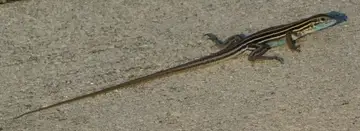
Six-lined Racerunner
Photo: Jade Fortnash · CC0 1.0 · iNaturalist

Six-lined Racerunner

Aspidoscelis sexlineatus

Not stated

Venom
No official source we use states whether this animal is venomous. That does not mean it is harmless: do not handle it.
Conservation
Louisiana SGCN, state rank S4 (apparently secure) (2025 SWAP Table)
Southern Prairie Skink
Photo: Peter Paplanus · CC BY 2.0 · Wikimedia Commons

Southern Prairie Skink

Plestiodon septentrionalis obtusirostris

Not stated

Venom
No official source we use states whether this animal is venomous. That does not mean it is harmless: do not handle it.
Conservation
Louisiana SGCN, state rank S1 (critically imperiled) (2025 SWAP Table)
Sri Lankan Spotted House Gecko
Photo: Gihan Jayaweera · CC BY-SA 4.0 · Wikimedia Commons · resized

Sri Lankan Spotted House Gecko

Hemidactylus parvimaculatus

Not stated Nonnative

Venom
No official source we use states whether this animal is venomous. That does not mean it is harmless: do not handle it.
Western Slender Glass Lizard
Photo: Mike Duran · CC BY 4.0 · iNaturalist

Western Slender Glass Lizard

Ophisaurus attenuatus attenuatus

Not stated

Venom
No official source we use states whether this animal is venomous. That does not mean it is harmless: do not handle it.
Conservation
Louisiana SGCN, state rank S3 (vulnerable) (2025 SWAP Table)

Lizards people confuse

Argentine Black and White Tegu or Nile Monitor?

Argentine Black and White Tegu
Photo: Andrew Durso · CC BY 4.0 · iNaturalist

Argentine Black and White Tegu Not stated

Nile Monitor
Photo: Giles Laurent · CC BY-SA 4.0 · Wikimedia Commons · resized

Nile Monitor Not stated

A tegu's head and neck are much thicker than a Nile monitor's.

Argentine Black and White Tegu or Gold Tegu?

Argentine Black and White Tegu
Photo: Andrew Durso · CC BY 4.0 · iNaturalist

Argentine Black and White Tegu Not stated

No confirmed photo of Gold Tegu

Gold Tegu Not stated

UF/IFAS: black-and-white tegus have a grayish body with dark bands and many light spots; other tegus are marked similarly but their base color varies, and the gold tegu has a yellow-tan base color.

Photos show typical adults; individuals vary. Never get close to compare.

When lizards are active in Louisiana

Records of lizards in Louisiana peak in March to July. They show when people record lizards, not how many there are (about month bars).

2,257 records of lizards in Louisiana by month (GBIF, CC0 and CC BY records).

How to report

Nuisance alligators: contact an LDWF field office, or Operation Game Thief 800-442-2511 after hours and weekends. Sick/injured/stranded sea turtles or marine mammals: 844-SEA-TRTL (844-732-8785). Rabies: Louisiana Department of Health, Office of Public Health, 1-800-256-2748. Louisiana Department of Wildlife and Fisheries

About this list

Venom labels come only from official sources and link to them; "Not stated" never means harmless. How labels work.
"Nonnative" and "Invasive" follow the wording of the source list. See invasive species in Louisiana.

Want a paper copy? Print the Louisiana lizards ID chart.

Sources

  1. About Us. Louisiana Department of Wildlife and Fisheries. undated page; checked November 3, 2026.
  2. 2025 Louisiana State Wildlife Action Plan. Louisiana Department of Wildlife and Fisheries. 2025 plan; checked November 3, 2026.
  3. Roots, Shoots, Fruits & Flowers: Holiday Cactus, Damaged Camellia, Stump Borer, a Native Lizard, and Cucumber Beetles. LSU AgCenter, Keith Hawkins. August 29, 2023; checked November 3, 2026.
    Quoted passages (1)
    “It is non-venomous, but the male skink is aggressive and will bite if handled.”
  4. Louisiana Critter Corner: Mediterranean Gecko (June 2013). LSU AgCenter (Louisiana Cooperative Extension Service), Dr. Don Reed. June 2013; checked November 3, 2026.
  5. Nuisance Alligators. Louisiana Department of Wildlife and Fisheries. undated page; checked November 3, 2026.
    Quoted passages (1)
    “Operation Game Thief: 800-442-2511 / (for nuisance alligator reports after hours and on weekends)”
  6. GBIF.org occurrence records, human observations licensed CC0 1.0 or CC BY 4.0 only, accessed November 3, 2026. The datasets behind these counts are listed on our Sources page.