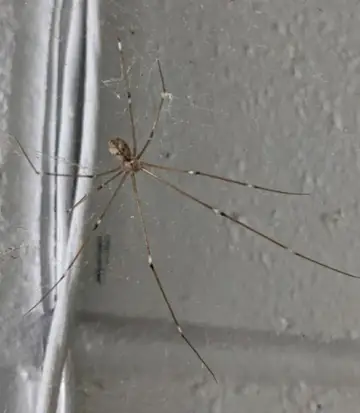
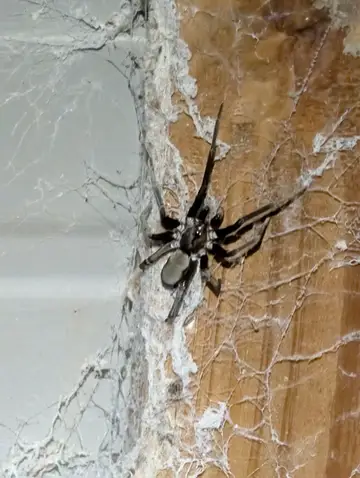
This page lists 10 spiders.
5 are venomous by official accounts. 5 are nonnative.
Not every species: no complete official list of Louisiana spiders exists, so this page covers the ones state and Extension sources name. How lists are built.
Which spiders can hurt you
Official sources single out these spiders in Louisiana, in their own words:
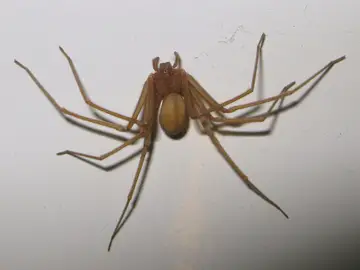
Brown Recluse
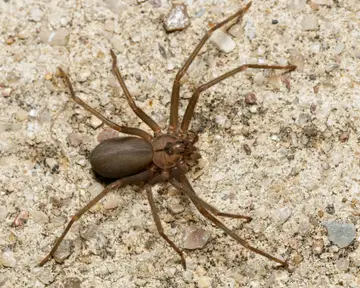
Medically significant venomous spider (LSU AgCenter). “Recluse spiders are among the few medically significant spiders in the southern U.S. (widow spiders, Latrodectus spp., are the other).” LSU AgCenter
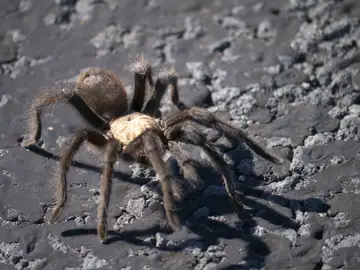
Painful bite and irritating urticating hairs when cornered (LDWF). “Although much more prone to flee and hide than attack, when cornered, this species can inflict a painful bite and may fling urticating hairs, which are irritating to skin and dangerous if cast into the eyes.” LDWF species profile: Texas Brown Tarantula
All 10 spiders
Venomous species first, then A to Z. Do not handle them.
The species is exceedingly uncommon in southern Louisiana. LSU AgCenter
What the sources say
Venom: “Recluse spiders are among the few medically significant spiders in the southern U.S. (widow spiders, Latrodectus spp., are the other).” (LSU AgCenter)
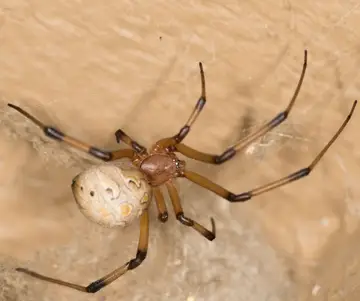
“Brown widows are less of a medical threat to humans than black widows.” LSU AgCenter
Size
Adult female body about 8-12 mm (0.3-0.5 in); UC IPM gives about 3/8 in (10 mm), smaller than a mature western black widow. Clemson (2003) gives 1 to 1 1/2 in with legs extended. Males are tiny, 2-5 mm.
How to recognize it
Spiky egg sac (covered in silk points, like a pollen grain or sandspur; about 10 mm per LSU AgCenter, 1/2 in per Clemson 2003) is diagnostic even without the spider
Egg sac surface: blunt silken spikes, about 10 mm
Egg sac described by UC IPM
What the sources say
Venom: “Even in rare cases of bites, the amount of venom injected is less than with other species and usually results in milder symptoms.” (LSU AgCenter)
Venom: “Recluse spiders are among the few medically significant spiders in the southern U.S. (widow spiders, Latrodectus spp., are the other).” (LSU AgCenter)
No official source we use states whether this animal is venomous. That does not mean it is harmless: do not handle it.
Danger to people
“Although much more prone to flee and hide than attack, when cornered, this species can inflict a painful bite and may fling urticating hairs, which are irritating to skin and dangerous if cast into …” LDWF species profile: Texas Brown Tarantula
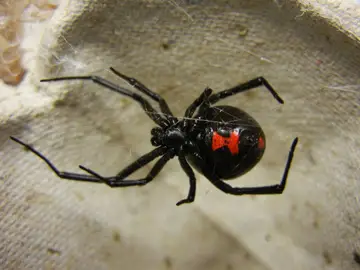
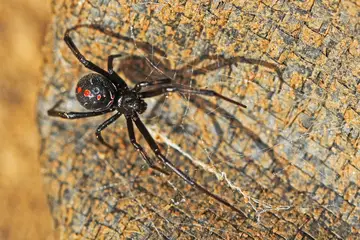
Adult female black widows are usually shiny black with red markings; very dark brown widows are flat black. The brown widow hourglass is usually orange to yellow-orange, but do not rely on color alone: UF/IFAS shows a brown widow with a red hourglass, Clemson says usually orange or red-orange, and black widow markings vary (northern black widows have two red spots; a western black widow's red can be almost imperceptible or absent). Brown widow egg sacs are spiky; Clemson (2003) and UF/IFAS Sarasota describe black widow sacs as smooth, and Clemson (2026) says the southern black widow's sac has a single small point.
Photos show typical adults; individuals vary. Never get close to compare.
When spiders are active in Louisiana
Records of spiders in Louisiana peak in April to August. They show when people record spiders, not how many there are (about month bars).
JanFebMarAprMayJunJulAugSepOctNovDec
3,800 records of spiders in Louisiana by month (GBIF, CC0 and CC BY records).
If you are bitten or stung
Call 911 or Poison Help at 1-800-222-1222 right away. Poison Help connects you to your local poison center, any time of day.
What official sources say
Are there brown recluse spiders in Louisiana?
Yes. LSU AgCenter: common in the northern half of the state, exceedingly uncommon in southern Louisiana. LSU AgCenter
“In Louisiana, brown recluses are common in the northern half of the state approximately north of a line drawn through Alexandria.”
Are there black widow spiders in Louisiana?
Yes. LSU AgCenter: southern and northern black widows both occur in Louisiana; the introduced brown widow is also present. LSU AgCenter
“Both the northern and southern black widow overlap in distribution in the southern U.S., including Louisiana.”
About this list
Venom labels come only from official sources and link to them; "Not stated" never means harmless. How labels work.
“Even in rare cases of bites, the amount of venom injected is less than with other species and usually results in milder symptoms.”
“Egg sacs of brown widow spiders are distinct and diagnostic for the presence of brown widows, even in the absence of the spiders themselves.”
“They are round, formed from silk and typically are around 10 mm in diameter. The surface has a regular arrangement of blunt silken spikes or tubercles”
“Brown widows are less of a medical threat to humans than black widows.”
“Adults females are medium to large 0.3-0.5 inches (8-12 mm in body length), tan to dark brown spiders, with globular abdomens that are dull or slightly shiny in surface luster and covered with fine velvet hairs.”
“Although much more prone to flee and hide than attack, when cornered, this species can inflict a painful bite and may fling urticating hairs, which are irritating to skin and dangerous if cast into the eyes.”