Black widow spiders
Latrodectus (US black widows: Latrodectus mactans, L. variolus, L. hesperus) · also called southern black widow, northern black widow, western black widow and widow spider · Last checked November 3, 2026.
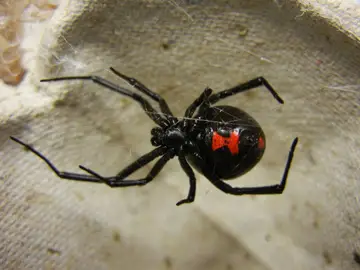

Black widows are shiny black spiders; adult females usually have a red or orange hourglass mark on the underside of the round abdomen. They are venomous: CDC/NIOSH lists the black widow among the venomous spiders found in the US, and its venom is a neurotoxin. Bites are uncommon and usually happen when a spider is trapped or touched, or when someone contacts its web. Three black widow species live in the US: official sources confirm the southern and northern black widows in states from Pennsylvania and Ohio south to Florida, Louisiana and Texas, and UC IPM says the western black widow is the only black widow in the western US. CDC says black widows are found throughout North America but are most common in the southern and western US. If bitten, call 911 or Poison Help at 1-800-222-1222. CDC/NIOSH
This page covers a genus (Latrodectus (US black widows: Latrodectus mactans, L. variolus, L. hesperus)), not a single species.
On this page
Are black widow spiders dangerous?
Venomous and medically significant: a bite can be serious and may need medical care. Deaths are extremely rare. CDC/NIOSH
“Although extremely rare, death can occur in the most severe cases.”
Bites and stings: Not aggressive; bites usually happen when the spider is trapped or touched or its web is contacted. Almost all medically important bites come from adult females (Penn State; UC IPM). CDC: the venom is a neurotoxin causing pain at the bite that can spread to the chest, abdomen or whole body.
If someone is bitten or stung, call 911 or Poison Help at 1-800-222-1222.
How to identify black widow spiders
A photo or description can narrow it down, but cannot confirm what an animal is or that it is safe. Look from a distance and do not handle wild animals.
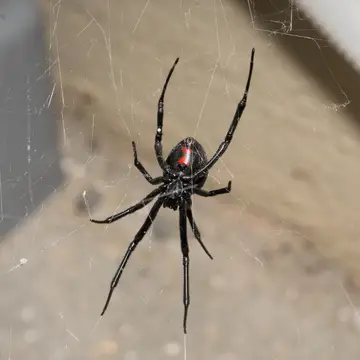

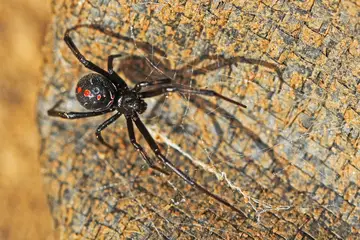

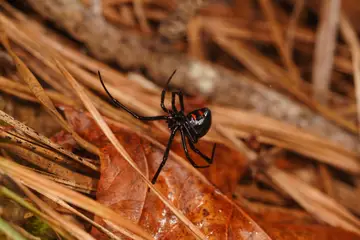
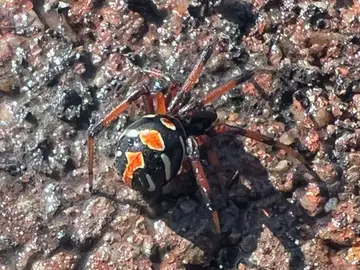
Size: Adult female body about 8-13 mm (about 1/2 inch), 25-35 mm with legs; males much smaller, 4-6 mm body. Penn State Extension
Colors: shiny jet black (adult female); red to orange markings. Pattern: red hourglass on the underside of the abdomen; may be broken in two, reduced or rarely absent; southern: hourglass connected; northern: broken in the center, often with red marks on top.
Key features
- large round abdomen; messy cobweb where it hangs upside down UF/IFAS Extension
- lives in undisturbed places: woodpiles, eaves, fences, debris, outdoor toilets CDC/NIOSH
- egg sac yellowish, teardrop-shaped, tough (western black widow) University of California Statewide IPM Program
Young
Young look very different from adult females: tan to gray with orange and white stripes; spiderlings tan with a mostly white abdomen. Males keep juvenile-like striped coloring.
Animals mistaken for black widow spiders
Black widow spiders or False black widow?
Black widow spiders
False black widow Steatoda grossa
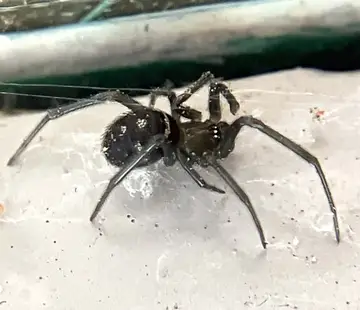
Chocolate brown and never has red on the belly; slightly smaller than a mature western black widow (about 3/8 in body length); egg sac looks like a cotton ball with indistinct margins. Caution: UC IPM says a black widow's hourglass can be almost imperceptible or, rarely, completely absent, so a lack of red alone does not rule out a black widow. University of California Statewide IPM Program
UC IPM: mild venom; bites may feel like a yellowjacket sting ("They have mild venom, and bites may cause symptoms similar to those of yellowjacket wasp stings").
Black widow spiders or False black widow (Steatoda borealis)?
Black widow spiders
False black widow (Steatoda borealis) Steatoda borealis
No red hourglass and not pure black; looks purplish-brown in bright light, and larger ones have a light T-shaped mark on the abdomen. Caution: a black widow's hourglass can rarely be almost or completely absent (UC IPM), so a lack of red alone does not rule out a black widow. Ohio Department of Natural Resources, Division of Wildlife
Ohio DNR does not include it among the spiders it considers dangerous ("Only two groups of Ohio spiders, the black widows and the recluse spiders are considered dangerous to humans."). UC IPM says the related false black widow Steatoda grossa has mild venom.
Black widow spiders or Brown widow?
Black widow spiders
Brown widow Latrodectus geometricus
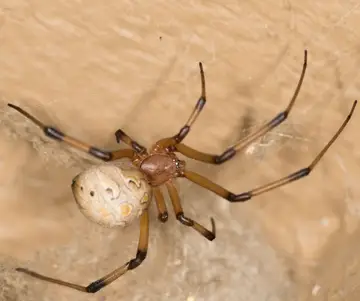
Usually a mottled mix of tan, brown and gray, with a lengthwise stripe and diagonal side stripes; colour varies from almost white to almost black, and very dark ones are flat black rather than shiny black. Mature females are smaller than mature female western black widows (about 3/8 in body length). The egg sac is covered in silk bumps, like a very large pollen grain; UC IPM calls the egg sac a much surer way to confirm a brown widow. Caution: brown widows also have a red hourglass on the underside (UF/IFAS), and a mature brown widow looks very similar to an immature western black widow (UC IPM). University of California Statewide IPM Program
Venomous widow spider. UF/IFAS says widow spiders, which in Florida include the brown widow, have medically significant venom. UC IPM says its bite is usually much milder than a western black widow's, but its venom is at least as potent drop for drop and one verified US bite needed hospitalization.
Black widow spiders or Common house spider?
Black widow spiders
Common house spider Parasteatoda tepidariorum
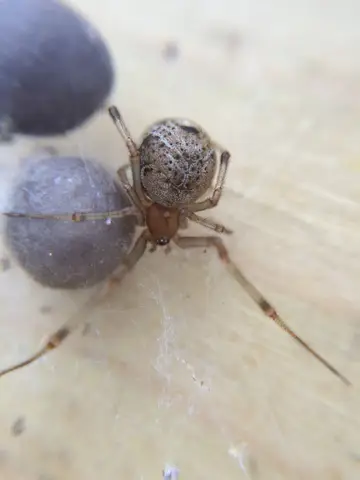
Penn State Extension: the female common house spider is 5 to 6 mm long with a yellowish-brown carapace and a dirty-white to brown abdomen with gray chevrons; its legs are yellow with darker rings at the end of each segment. Penn State Extension
Virginia Cooperative Extension: "not considered dangerous".
Where black widow spiders live
- Native or listed
- Nonnative or not established
- No official record in our data
- 1–9
- 10–99
- 100–999
- 1,000+
State boundaries: U.S. Census Bureau, cartographic boundary file cb_2024_us_state_20m.
When it is active
Active at night (out at dusk). The female guards her eggs in summer, when most bites occur (Penn State). University of California Statewide IPM Program
US open-licence records for the three US black widows (Latrodectus mactans, L. variolus and L. hesperus) peak in June to October.
Habitat and habits
Habitat: Dark, undisturbed places: under stones, in stumps, woodpiles, rodent holes, dark corners of barns and garages, outdoor privies; mostly outdoors around homes rather than inside. Penn State Extension
Behavior: Shy and not aggressive; hides by day and comes out at dusk to sit in the web, belly up; retreats if the web is disturbed.
Diet: Catches flying and crawling prey in its web at night, usually close to the ground.
Young: Females may live a year or more and make up to nine egg sacs of 200-800 eggs each; males are often eaten after mating, hence the name 'widow'.
Legal status and reporting
Invasive status: Penn State says black widows are native in Pennsylvania and LSU AgCenter says both the northern and southern black widows are native. UC IPM calls the related brown widow non-native. Penn State Extension
Questions about black widow spiders
Are black widows in every state?
Official sources describe a very wide range but do not give a state-by-state list. CDC/NIOSH says black widows are found throughout North America and are most common in the southern and western US; Texas A&M AgriLife says the southern black widow and its relatives live across the entire United States. This page lists the states where an official source was checked.
Are there black widows in ohio?
Yes, northern and southern black widows, but Ohio DNR says they are not nearly as common as in southern states and occur most often in the southern unglaciated part of the state.
Are there black widows in florida?
Yes. UF/IFAS lists the southern black widow, northern black widow, brown widow and red widow in Florida.
Are there black widows in pennsylvania?
Yes. Penn State Extension says the southern black widow is found in Pennsylvania and the northern black widow is probably present.
Are there black widows in north carolina?
Yes. NC State Extension calls the black widow one of the two best-known poisonous spiders found in North Carolina.
Are there black widows in south carolina?
Yes. Clemson Extension: the southern black widow is found throughout South Carolina and the northern black widow mainly in the Piedmont and Upstate; the non-native brown widow also occurs.
Are there black widows in texas?
Yes. Texas DSHS says the black widow is one of Texas's two venomous spiders and is found indoors and outdoors throughout the state; Texas A&M AgriLife also lists the western and northern black widows.
Are there black widows in virginia?
Yes. Virginia Cooperative Extension says both northern and southern black widows are commonly found in Virginia.
Are there black widows in tennessee?
Yes. UT Extension: both northern and southern black widows, the southern being most common.
Are there black widows in arizona?
Yes. University of Arizona Extension names the western black widow as one of Arizona's two most common venomous spiders.
Are there black widows in georgia?
Yes. UGA Extension says the black widow is very common throughout Georgia, which has southern and northern black widows plus the brown widow.
Are there black widows in alabama?
Yes. Alabama Extension lists the black widow (southern) and the northern black widow among Alabama's potentially harmful spiders.
Are there black widows in louisiana?
Yes. LSU AgCenter says northern and southern black widows overlap in Louisiana.
Has a black widow ever killed anyone
Deaths are extremely rare. CDC/NIOSH says death can occur in the most severe cases; Penn State Extension, citing the American Association of Poison Control Centers, says about 2,200 people a year are bitten in the US and no deaths have been recorded from black widow bites since 1983.
Southern black widow vs western black widow
Range is the main difference: UC IPM says the western black widow is the only black widow in the western US, while official sources confirm the southern black widow in states from Pennsylvania and Ohio south to Florida and Texas. Adult females of both are shiny black with a red hourglass on the underside.
Sources
- Venomous Spiders at Work. CDC/NIOSH. archived copy, captured October 6, 2026; checked November 3, 2026.
Quoted passages (3)
“Although extremely rare, death can occur in the most severe cases.”
“Venomous spiders found in the United States include the black widow and the brown recluse.”
“In workplaces containing undisturbed areas such as woodpiles, eaves, fences, and areas where debris has accumulated. … Living in outdoor toilets where there are lots of flies.”
- Southern Black Widow Spider. Penn State Extension. updated September 8, 2025; checked November 3, 2026.
Quoted passages (3)
“They are 8 to 13 millimeters in body length and measure 25 to 35 millimeters with legs extended. The male, which is black and has white underbody markings with red spots, is only 4 to 6 millimeters long”
“Black widows can be found under stones, in stumps or woodpiles, in vacant rodent holes, in the dark corners of barns and garages, and in outdoor privies and other undisturbed cavities.”
“Males are often killed and eaten by the females shortly after mating, thus the origin of the name "widow. " A female may live for a year or more and produce up to nine 0.5-inch-diameter egg sacs, each containing 200 to 800 eggs.”
- Pest Notes: Widow Spiders and Their Relatives. University of California Statewide IPM Program (UC ANR, Cooperative Extension). 2017-03; checked November 3, 2026.
Quoted passages (6)
“The egg sac of the western black widow is yellowish and teardrop-shaped, tapered at the top and bulbous at the bottom.”
“…allowing the spider to emerge to catch both flying and crawling prey at night, usually within three feet of the ground.”
“Black widows are shy spiders that seek retreats, such as holes between bricks or spaces around pipe penetrations in walls, where they can hide during the day and then come out at night.”
“Widow spiders come out at dusk.”
“It is slightly smaller than a mature western black widow spider [body length: 3/8 inch (10 mm)], chocolate brown in color, and never has red coloration on its belly. … False black widows make an egg sac that looks like a cotton ball with indistinct margins.”
“Mature female brown widows are smaller than mature female western black widows, being about 3/8" in body length (10 mm). The normal brown widow spider coloration is a mottled collection of tan, brown, and gray. It has a lengthwise stripe halfway up the back side of the abdomen with two isolated dots in front of it and diagonal stripes on the side … When brown widows are very dark, though, this coloration is closer to a flat black than a shiny black like that of a mature black widow female. … A mature brown widow female looks very similar to an immature western black widow, thus some skill is needed to identify the two accurately. However, the brown widow egg sac, as described in the next paragraph, is distinctive and a much surer way to confirm the species. … The egg sac of the brown widow spider has protuberances of silk all over its surface, resembling a very large pollen grain.”
- Common Spiders of Ohio Field Guide (Publication 5140). Ohio Department of Natural Resources, Division of Wildlife (text by Richard A. Bradley, Ph.D.). PUBLICATION 5140; checked November 3, 2026.
Quoted passages (1)
“The false black widow does not have the red hourglass marking of the black widow, however. Nor is it pure black. … Seen in bright light false black widows look purplish-brown, and larger individuals have a light colored T-shaped mark on the abdomen.”
- Latrodectus mactans and L. variolus, Southern and Northern Black Widow Spiders (Araneae: Theridiidae). LSU AgCenter (Louisiana Cooperative Extension Service). November 10, 2021; checked November 3, 2026.
- Spiders (E-408 6/06), Jackman, Brown, Engler & Merchant. Texas A&M AgriLife Extension Service. 6/06; checked November 3, 2026.
- ENY2080 An Introduction to Some Common and Charismatic Florida Spiders (Powell & Taylor). UF/IFAS Extension (EDIS). Original publication date February 2023; checked November 3, 2026.
Quoted passages (1)
“Widow spiders have characteristic red markings on their large round abdomens. They build a messy cobweb where they usually hang upside down”
- Spiders in and Around Homes. NC State Extension (N.C. Cooperative Extension, NC State University). Publication date: Jan. 1, 2008; checked November 3, 2026.
Quoted passages (1)
“Young black widow spiders are tan-to-gray in color and have orange and white stripes on their abdomens.”
- Spiders Commonly Encountered in Pennsylvania and the Northeast. Penn State Extension. updated September 30, 2025; checked November 3, 2026.
Quoted passages (1)
“Although black widows can be found native in Pennsylvania, the brown recluse spiders must be introduced”
- Common House Spider. Penn State Extension. updated January 19, 2026; checked November 3, 2026.
Quoted passages (1)
“The common house spider female is 5 to 6 millimeters in length with a yellowish-brown carapace and a dirty-white to brown abdomen with gray chevrons. The legs are yellow, with darker rings at the end of each segment.”
- Widow Spiders in South Carolina (HGIC 2518). Clemson Cooperative Extension, Home & Garden Information Center. Published Sep 17, 2026; checked November 3, 2026.
- Spiders (Venom: Animal Bites, Venomous Bites). Texas Department of State Health Services. undated page; checked November 3, 2026.
- Spiders of Medical Concern in Virginia (ENTO-73NP / ENTO-346NP). Virginia Cooperative Extension, Virginia Tech (T.A. Dellinger, E. Day). Publication Date August 1, 2025; checked November 3, 2026.
- PB1193 The Black Widow Spider. University of Tennessee Extension (UT Institute of Agriculture). PB1193-500-7/02 [July 2002 revision]; checked November 3, 2026.
- Backyard Gardener #177: Spiders. University of Arizona Cooperative Extension, Yavapai County. June 12, 2024; checked November 3, 2026.
- Stinging and Biting Pests (Circular 782). University of Georgia Cooperative Extension. October 26, 2022; checked November 3, 2026.
- Widow spiders: Why gardeners wear work gloves. University of Georgia CAES Field Report (UGA Cooperative Extension). published 2008-02-21; checked November 3, 2026.
- Black Widow and Recluses: Avoiding Venomous Spiders of the Southeast. Alabama Cooperative Extension System. published 2018-11-28; checked November 3, 2026.
- GBIF.org occurrence records, human observations licensed CC0 1.0 or CC BY 4.0 only, accessed November 3, 2026. The datasets behind these counts are listed on our Sources page.
- State boundaries: U.S. Census Bureau, cartographic boundary file cb_2024_us_state_20m.