False widow spiders
Steatoda (US false widows: Steatoda grossa, S. nobilis, S. borealis; also S. triangulosa) · also called false black widow, false widow, noble false widow and combfoot / cobweb spider · Last checked November 3, 2026.
False widows (Steatoda) are round-bodied cobweb spiders in the same family as black widows, and people often mistake them for black widows. They are usually purplish-brown to chocolate brown and lack the red hourglass. They are venomous, but UC IPM calls the venom mild and compares bites to a yellowjacket sting. Penn State says bite symptoms are similar to, but much less severe than, a true black widow bite, and that bites can cause moderate to severe pain. They often live in homes. The false black widow (S. grossa) is common in Pacific Coast homes and coastal states, S. borealis is more common in northern states, and the larger noble false widow (S. nobilis) has spread in coastal California since 2011. A black widow's hourglass can be faint or, rarely, missing, so if you are not sure what bit someone, call 911 or Poison Help at 1-800-222-1222. University of California Statewide IPM Program
This page covers a genus (Steatoda (US false widows: Steatoda grossa, S. nobilis, S. borealis; also S. triangulosa)), not a single species.
On this page
Are false widow spiders dangerous?
Mild venom (UC IPM): bites may cause burning pain and minor local swelling, like a yellowjacket sting. Penn State: symptoms are similar to but much less severe than a true black widow bite, and can include moderate to severe pain. UC IPM says noble false widow bites are not considered medically significant; Virginia Cooperative Extension says Steatoda spiders are not considered dangerous. University of California Statewide IPM Program
“They have mild venom, and bites may cause symptoms similar to those of yellowjacket wasp stings: initial burning pain followed by minor localized swelling around the envenomation site.”
Bites and stings: False black widows are more often involved in bite incidents than black or brown widows because they are common in homes (UC IPM). Bites are described as painful: Penn State says symptoms can include moderate to severe pain and are similar to but much less severe than a black widow bite; Texas A&M AgriLife says Steatoda species have, in rare cases, been reported to cause painful bites.
If someone is bitten or stung, call 911 or Poison Help at 1-800-222-1222.
How to identify false widow spiders
A photo or description can narrow it down, but cannot confirm what an animal is or that it is safe. Look from a distance and do not handle wild animals.
Size: False black widow (S. grossa) female 6-10.5 mm (about 3/8 inch) body length; noble false widow females up to 5/8 inch (14 mm); S. borealis female 6-11 mm. Penn State Extension
Colors: chocolate brown, never red on the belly (S. grossa); purplish-brown to black abdomen with pale-yellow to grayish markings that may be faded; red-brown cephalothorax; purplish-brown in bright light; not pure black (S. borealis). Pattern: noble false widow: light tan pattern on top of the abdomen like a house with two windows and a domed roof; broad tan band on the front of the abdomen; no red hourglass.
Key features
- same round-abdomen body form and messy cobweb as widow spiders; same family (Theridiidae) University of California Statewide IPM Program
- egg sac like a cotton ball with indistinct margins University of California Statewide IPM Program
Young
Spiderlings are dark like their mothers when they emerge (unlike black widow spiderlings).
Animals mistaken for false widow spiders
False widow spiders or Black widow spiders?
False widow spiders
Black widow spiders Latrodectus
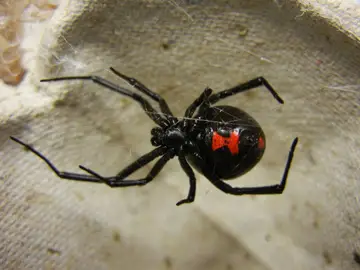

False black widows are chocolate brown and never have red on the belly; black widows are shiny jet black with a red hourglass. Caution: a black widow's hourglass can be almost invisible or, rarely, missing, so no red alone does not rule out a black widow. University of California Statewide IPM Program
Venomous; medically important bites (UC IPM), considered dangerous to humans (Ohio DNR). See the black widow page.
False widow spiders or Common house spider?
False widow spiders
Common house spider Parasteatoda tepidariorum
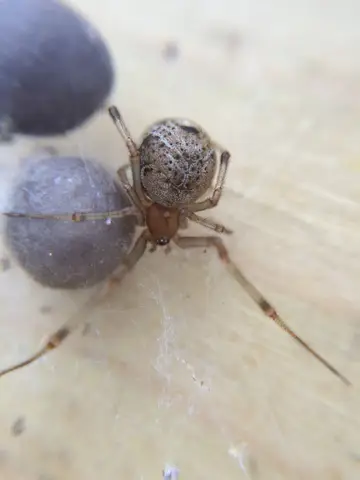
Penn State Extension: the female common house spider is 5 to 6 mm long with a yellowish-brown carapace and a dirty-white to brown abdomen with gray chevrons; its legs are yellow with darker rings at the end of each segment. Penn State Extension
Penn State: not regarded as a medically important species.
Where false widow spiders live
- Native or listed
- Nonnative or not established
- No official record in our data
- 1–9
- 10–99
- 100–999
- 1,000+
State boundaries: U.S. Census Bureau, cartographic boundary file cb_2024_us_state_20m.
When it is active
All life stages found in buildings year-round; adults of S. borealis in any month (Ohio DNR). Penn State Extension
US open-licence records for the four US false widows named on this page (Steatoda grossa, S. nobilis, S. borealis and S. triangulosa) peak in April to May and July to November.
Habitat and habits
Habitat: Mostly in and around buildings: washrooms, cupboards, under appliances and furniture, garages and outbuildings; outside on low foliage, under bark, in rock crevices and under bridges. University of California Statewide IPM Program
Behavior: Hangs upside down in a tangled cobweb in protected places; males wander into houses in spring looking for females (Ohio DNR, S. borealis).
Diet: Catches prey in an irregular web; reported to prey on other spiders, including true black widows.
Young: Mate in spring; females make three or more egg sacs from May through July, each with 200 or more eggs. Females may live up to six years.
Legal status and reporting
Invasive status: UC IPM calls S. grossa a European immigrant and S. nobilis a European native newly established in California. University of California Statewide IPM Program
Questions about false widow spiders
Black widow vs false widow
False black widows are chocolate or purplish-brown and never have red on the belly. Black widows are shiny jet black, usually with a red hourglass. But UC IPM warns that a black widow's hourglass can be almost invisible or, rarely, missing. False black widow spiderlings are dark like their mother; black widow spiderlings are pale. The false widow's venom is mild; black widow venom is medically significant.
False widow california
Yes. The false black widow is extremely common in Pacific Coast homes, and the larger noble false widow, found in Ventura County in 2011, is now widespread in coastal San Diego County, Monterey and the San Francisco Bay area (UC IPM).
False widow pennsylvania
Yes. Penn State says S. borealis, a close relative of the false black widow, is more common in northern states, Pennsylvania included, and is found in homes all year.
False widow washington state
UC IPM says the false black widow is extremely common in Pacific Coast homes from San Diego to British Columbia, a stretch that includes the Washington coast.
False widow oregon
UC IPM says the false black widow is extremely common in Pacific Coast homes from San Diego to British Columbia, a stretch that includes the Oregon coast.
False widow alaska
UC IPM reports only isolated finds of the false black widow in Alaska.
Noble false widow north carolina
No official source checked confirms the noble false widow in North Carolina. The only official US record found is UC IPM's for California, where it was found in 2011.
Sources
- Pest Notes: Widow Spiders and Their Relatives. University of California Statewide IPM Program (UC ANR, Cooperative Extension). 2017-03; checked November 3, 2026.
Quoted passages (8)
“They have mild venom, and bites may cause symptoms similar to those of yellowjacket wasp stings: initial burning pain followed by minor localized swelling around the envenomation site.”
“They have mild venom, and bites may cause symptoms similar to those of yellowjacket wasp stings”
“…is not a true widow spider; however, it is in the same family, Theridiidae, as widow spiders and can easily be confused with them. It shares the same rounded-abdomen body form and web-making traits.”
“False black widows make an egg sac that looks like a cotton ball with indistinct margins.”
“Unlike black widow spiders, false black widow spiderlings are dark like their mothers when they emerge.”
“Unlike black widows, false black widow spiders thrive indoors, especially in washrooms, inside cupboards and underneath appliances, furniture and cabinets.”
“In 2011, Steatoda nobilis was discovered in Southern California. Like the false black widow, this spider is a European native.”
“The false black widow, which is discussed below, is chocolate brown and never has red coloration, although many people frequently mistake it for a black widow.”
- False Black Widow Spider. Penn State Extension. updated September 8, 2025; checked November 3, 2026.
Quoted passages (4)
“Similar to the true black widow, the false black widow female is 6 to 10.5 millimeters in length”
“It makes an irregular web and is reported to capture and prey upon other spiders, including the true black widow spiders.”
“All stages of immature and adult spiders can be found in human-made structures throughout the year.”
“These spiders mate in the spring, and the females can produce three or more egg sacs, or cocoons, from May through July. Each sac can contain 200 or more cream-colored eggs.”
- Spiders of Medical Concern in Virginia (ENTO-73NP / ENTO-346NP). Virginia Cooperative Extension, Virginia Tech (T.A. Dellinger, E. Day). Publication Date August 1, 2025; checked November 3, 2026.
- Common Spiders of Ohio Field Guide (Publication 5140). Ohio Department of Natural Resources, Division of Wildlife (text by Richard A. Bradley, Ph.D.). PUBLICATION 5140; checked November 3, 2026.
Quoted passages (1)
“The males wander in search of females, often blundering into houses in the spring.”
- Common House Spider. Penn State Extension. updated January 19, 2026; checked November 3, 2026.
Quoted passages (1)
“The common house spider female is 5 to 6 millimeters in length with a yellowish-brown carapace and a dirty-white to brown abdomen with gray chevrons. The legs are yellow, with darker rings at the end of each segment.”
- GBIF.org occurrence records, human observations licensed CC0 1.0 or CC BY 4.0 only, accessed November 3, 2026. The datasets behind these counts are listed on our Sources page.
- State boundaries: U.S. Census Bureau, cartographic boundary file cb_2024_us_state_20m.