Brown widow spider
Latrodectus geometricus · also called brown widow · Last checked November 3, 2026.
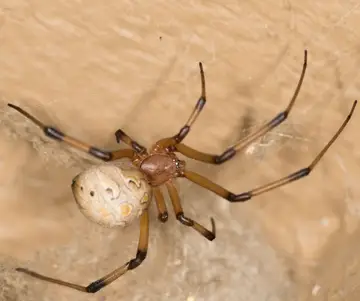
The brown widow is a non-native widow spider, tan to dark brown (sometimes almost white or almost black). The marking under its round abdomen is usually an orange or yellow-orange hourglass, though it can be irregular and some official sources describe it as red-orange or red, so color alone does not identify it. Its spiky egg sac is a sure sign it is around. It is venomous: officials say its venom is at least as potent as a black widow's, drop for drop, but it injects much less, so bites are usually much less severe than black widow bites; severe reactions are uncommon but documented. Bites are rare and happen when a female is pressed against skin. In the US it was long found only in Florida. Official sources now also place it in Louisiana, Georgia, South Carolina and Texas and in southern California, and Hawaii's health department says it is seen there. If bitten, call 911 or Poison Help at 1-800-222-1222. University of California Statewide IPM Program
On this page
Is the brown widow spider dangerous?
Venomous widow spider with medically significant venom. Official sources agree its bite is usually much less severe than a black widow's because it injects less venom, but its venom is at least as potent drop for drop, and more serious, systemic reactions have been documented (UGA: severe reactions in about 5 percent of people bitten; UC IPM: one verified US bite needed hospitalization). UGA adds that the young and old are especially vulnerable. Clemson Cooperative Extension, Home & Garden Information Center
“The bite from a brown widow spider is much less severe to people. These spiders rarely inject enough venom to cause more than a minor reaction and are considered much less dangerous.”
Bites and stings: Bites are very rare: brown widows are timid, retreat or drop and play dead when disturbed, and do not defend their webs; bites almost always happen when an adult female is trapped against the skin (in clothes or shoes, or a hand reaching into a dark spot). LSU AgCenter says males and immatures are no threat to humans.
If someone is bitten or stung, call 911 or Poison Help at 1-800-222-1222.
How to identify a brown widow spider
A photo or description can narrow it down, but cannot confirm what an animal is or that it is safe. Look from a distance and do not handle wild animals.
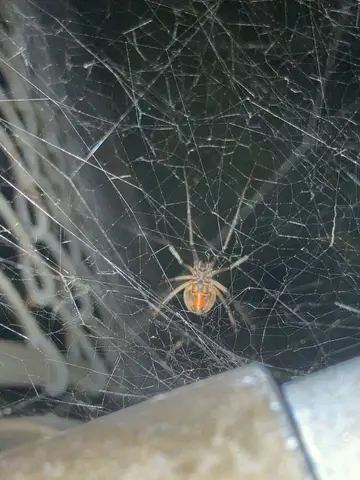
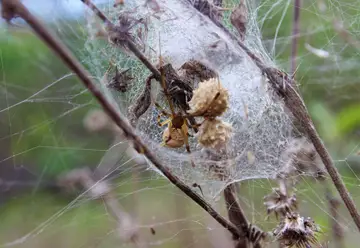

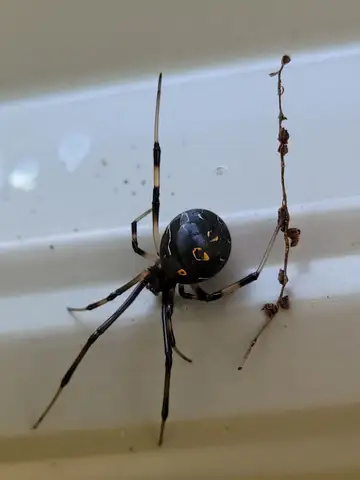
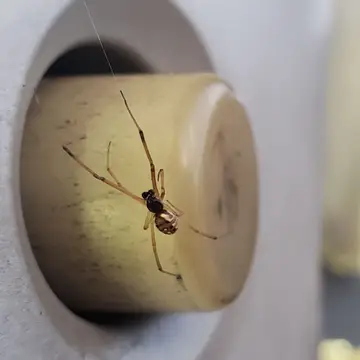
Size: Adult female body about 8-12 mm (0.3-0.5 in); UC IPM gives about 3/8 in (10 mm), smaller than a mature western black widow. Clemson (2003) gives 1 to 1 1/2 in with legs extended. Males are tiny, 2-5 mm. LSU AgCenter
Colors: mottled tan, brown and gray; grey to tan to dark brown, some appearing black; varies from almost white to almost black; very dark individuals are flat black, not shiny black like a mature black widow female. Pattern: orange to yellow-orange hourglass on the underside of the abdomen (UF/IFAS Sarasota); LSU AgCenter says the orange or yellowish orange marking may be distinctly hourglass-shaped or irregular; hourglass usually orange or red-orange (Clemson); brown, white and black geometric pattern on top of the abdomen; dark-banded legs; hourglass color varies between official sources: a UF/IFAS figure caption describes a brown widow with a red hourglass.
Key features
- spiky egg sac (covered in silk points, like a pollen grain or sandspur; about 10 mm per LSU AgCenter, 1/2 in per Clemson 2003) is diagnostic even without the spider LSU AgCenter
- egg sac surface: blunt silken spikes, about 10 mm LSU AgCenter
- egg sac described by UC IPM University of California Statewide IPM Program
- females often sit in a web corner without hiding, unlike other widows LSU AgCenter
- harder to recognize than black widows because of variable color UF/IFAS Extension Sarasota County
Young
Spiderlings look like the adults: tan to dark brown with white and brown markings. Males are much smaller with long legs.
Animals mistaken for the brown widow spider
Brown widow spider or Black widow (immature western black widow)?
Brown widow spider
Black widow (immature western black widow) Latrodectus hesperus
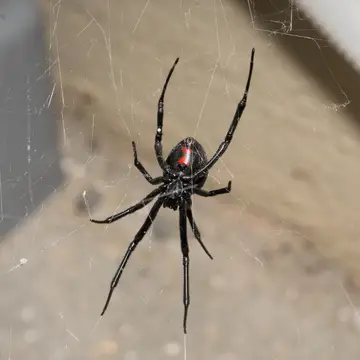

A mature brown widow female looks very like an immature western black widow. Brown widow: large squarish black spots on the side stripes, hourglass with bottom half larger and rough edges, broken white marks on the front of the abdomen; the spiky egg sac is a much surer way to confirm the species. University of California Statewide IPM Program
Black widows are venomous and medically significant; UC IPM says the brown widow bite is much milder than the western black widow's.
Brown widow spider or Black widow (adult)?
Brown widow spider
Black widow (adult) Latrodectus mactans / L. variolus / L. hesperus
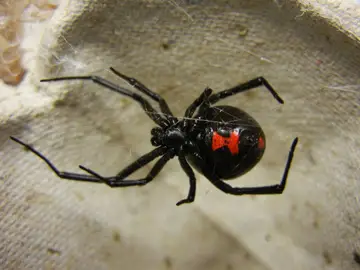

Adult female black widows are usually shiny black with red markings; very dark brown widows are flat black. The brown widow hourglass is usually orange to yellow-orange, but do not rely on color alone: UF/IFAS shows a brown widow with a red hourglass, Clemson says usually orange or red-orange, and black widow markings vary (northern black widows have two red spots; a western black widow's red can be almost imperceptible or absent). Brown widow egg sacs are spiky; Clemson (2003) and UF/IFAS Sarasota describe black widow sacs as smooth, and Clemson (2026) says the southern black widow's sac has a single small point. University of California Statewide IPM Program
Venomous and medically significant (see black-widow page); LSU AgCenter says brown widows are less of a medical threat than black widows.
Where the brown widow spider lives
- Native or listed
- Nonnative or not established
- No official record in our data
- 1–9
- 10–99
- 100–999
- 1,000+
On our state guides
- California spidersNonnative
- Florida spiders
- Hawaii spiders
- Louisiana spidersNonnative
- Mississippi spiders
- New Mexico spiders
- South Carolina spidersNonnative
- Texas spiders
State boundaries: U.S. Census Bureau, cartographic boundary file cb_2024_us_state_20m.
When it is active
Adults can be found year-round in South Carolina; in Louisiana development can continue year-round indoors or outdoors in mild weather. Widow spiders come out at dusk. Clemson Cooperative Extension, Home & Garden Information Center
US open-licence records peak in July to November.
Habitat and habits
Habitat: Mostly around buildings and other human-made structures: cluttered outdoor spots such as woodpiles, tires, empty containers, pots, mailboxes, eaves and outdoor chairs, the undersides of plastic patio furniture, exposed places like chain-link fences, and also vegetation. University of California Statewide IPM Program
Behavior: Timid; when disturbed it retreats into the web or drops to the ground, often pulling in its legs and playing dead; does not defend its web. Studies show it can outcompete and even kill native black widows, and it may be displacing them in urban areas.
Diet: Catches insects and other prey in its tangled cobweb, wraps it in silk, bites it and feeds at leisure.
Young: About 130 eggs per sac (UC IPM); Clemson (2003) says about 250 and LSU AgCenter says several dozen. UC IPM says 20 or more sacs in a lifetime; Clemson (2003) says 10 to 20. Spiderlings hatch in two or more weeks. Females often kill the male after mating (LSU AgCenter).
Legal status and reporting
Invasive status: Non-native. UC IPM calls it an invasive, non-native pest species; Louisiana DWF includes it on its 2025 Invasive Species List. University of California Statewide IPM Program
Questions about the brown widow spider
Brown widow bite
Bites are rare and usually happen when a female is pressed against the skin. Officials say the bite is usually much less severe than a black widow's, but serious reactions have been documented: UGA says about 5 percent of people bitten have severe reactions, and Hawaii's health department says the bites can be dangerous and need a doctor. Call 911 or Poison Help at 1-800-222-1222.
Brown widow poisonous
It is venomous (it injects venom by biting). Officials say its venom is at least as potent as black widow venom drop for drop, but it injects much less, so bites are usually milder than black widow bites.
Brown widow egg sac
The egg sac is round, about 10 mm (LSU AgCenter) or 1/2 inch (Clemson, 2003), tan, and covered in small silk spikes. Clemson (2003) and UF/IFAS Sarasota describe the black widow's sac as smooth. A spiky sac shows brown widows are present even if you don't see the spider.
Brown widow vs black widow
UF/IFAS Sarasota and Hawaii's health department say brown widows are slightly smaller than black widows. They are tan to dark brown, with a marking usually orange to yellow-orange, and spiky egg sacs; adult female black widows are shiny black, usually with red markings. Color alone is not a safe test: official sources also describe brown widow hourglasses as red-orange or red, and a mature brown widow can look like an immature western black widow. Brown widow bites are generally much less severe, but both are venomous. If bitten, call 911 or Poison Help at 1-800-222-1222.
Brown widow spider florida
Yes. UF/IFAS lists the brown widow among Florida's four widow spiders; Clemson says it was introduced into Florida and is now found throughout the state, and UF/IFAS Sarasota calls it the widow most commonly encountered around homes and workplaces in Sarasota County.
Brown widow spider california
Yes. UC IPM says the non-native brown widow became established in southern California in the 2000s; as of 2016 it was established from Santa Barbara to the San Bernardino area and south to Mexico.
Brown widow spiders in south carolina
Yes. Clemson Extension says brown widows are not native but are now found throughout South Carolina, most densely along the coast, and adults can be found year-round.
Sources
- Pest Notes: Widow Spiders and Their Relatives. University of California Statewide IPM Program (UC ANR, Cooperative Extension). 2017-03; checked November 3, 2026.
Quoted passages (6)
“The egg sac of the brown widow spider has protuberances of silk all over its surface, resembling a very large pollen grain.”
“They generally reside in cluttered areas outside, such as woodpiles, but you will also find them in more exposed areas, such as on chain-link fences where black widows normally would not be found. They are also extremely common in the nooks and crannies on the undersides of inexpensive plastic patio furniture.”
“Brown widows produce about 130 eggs per egg sac and are able to make 20 or more egg sacs in a lifetime, sometimes multiple sacs within a short time period.”
“…they are an invasive, non-native pest species and should not be there anyway.”
“A mature brown widow female looks very similar to an immature western black widow, thus some skill is needed to identify the two accurately.”
“Spiders can vary from almost white to almost black. When brown widows are very dark, though, this coloration is closer to a flat black than a shiny black like that of a mature black widow female.”
- Widow Spiders in South Carolina (HGIC 2518). Clemson Cooperative Extension, Home & Garden Information Center. Published Sep 17, 2026; checked November 3, 2026.
Quoted passages (4)
“The bite from a brown widow spider is much less severe to people. These spiders rarely inject enough venom to cause more than a minor reaction and are considered much less dangerous.”
“All three types of widow spiders have venom that is toxic to people.”
“Brown widow spiderlings resemble the adults with tan to dark brown bodies covered in white and brown markings. The egg sacs are rounded, light tan, and covered in small points.”
“Brown widow spiders are not native to the U.S. but can now be found throughout South Carolina, with higher densities in the coastal regions. Adults from all three types of widow spiders can be found year-round in South Carolina.”
- Latrodectus geometricus, Brown Widow Spider (Araneae: Theridiidae) (P3797). LSU AgCenter (Louisiana Cooperative Extension Service). November 10, 2021; checked November 3, 2026.
Quoted passages (5)
“Adults females are medium to large 0.3-0.5 inches (8-12 mm in body length), tan to dark brown spiders, with globular abdomens that are dull or slightly shiny in surface luster and covered with fine velvet hairs.”
“Egg sacs of brown widow spiders are distinct and diagnostic for the presence of brown widows, even in the absence of the spiders themselves.”
“They are round, formed from silk and typically are around 10 mm in diameter. The surface has a regular arrangement of blunt silken spikes or tubercles”
“Females and immatures hide in one corner of the web, but often are not concealed, unlike most other widow spiders. When a prey item is detected, the spider produces enough silk to prevent escape, then bites it and feeds on it at leisure.”
“When disturbed, brown widows retreat to the interior of the web or drop to the ground to escape the threat.”
- Brown widow spiders – hiding in a log near you. University of Georgia CAES Field Report. published 2008-11-26; checked November 3, 2026.
- ENY2080 An Introduction to Some Common and Charismatic Florida Spiders. UF/IFAS Extension (EDIS). Original publication date February 2023; checked November 3, 2026.
- Spider Bites. Hawaii State Department of Health, Disease Outbreak Control Division. July 21, 2022; checked November 3, 2026.
- Spiders (E-408 06/12). Texas A&M AgriLife Extension Service. E-408 06/12; checked November 3, 2026.
- Brown Widow Spider. UF/IFAS Extension Sarasota County. page Last Modified 2026-09-22; checked November 3, 2026.
Quoted passages (1)
“Because they vary from light tan to dark brown or almost black, with variable markings of black, white, yellow, orange, or brown on the back of their abdomens, brown widows are not as easy to recognize as black widows.”
- EENY 560 Southern Black Widow Latrodectus mactans. UF/IFAS Extension (EDIS, Featured Creatures). Original May 2013; checked November 3, 2026.
- Brown Widow Spiders (HGIC 2474). Clemson University Cooperative Extension, Home & Garden Information Center. Published Apr 6, 2003; checked November 3, 2026.
- GBIF.org occurrence records, human observations licensed CC0 1.0 or CC BY 4.0 only, accessed November 3, 2026. The datasets behind these counts are listed on our Sources page.
- State boundaries: U.S. Census Bureau, cartographic boundary file cb_2024_us_state_20m.