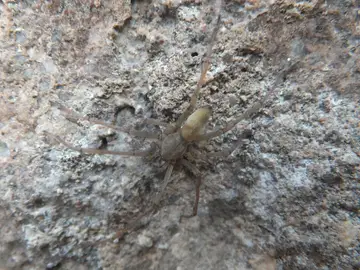
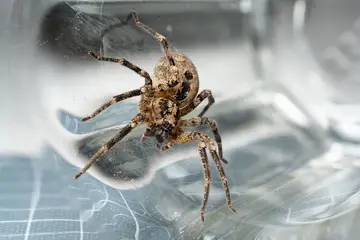
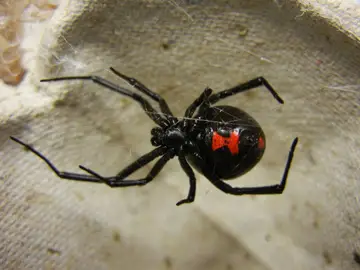
This page lists 7 spiders.
4 are venomous by official accounts, and 1 mildly venomous. 3 are nonnative.
Not every species: no complete official list of California spiders exists, so this page covers the ones state and Extension sources name. How lists are built.
Which spiders can hurt you
Official sources single out these spiders in California, in their own words:
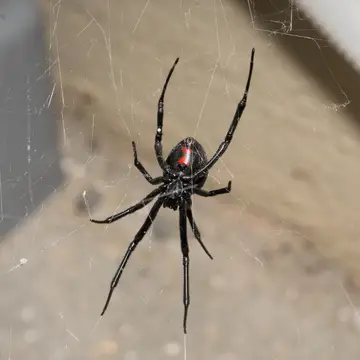
Venomous. “In California, the main spider that can cause serious injury is the black widow, which generally remains outdoors and out of sight.” University of California Statewide IPM Program
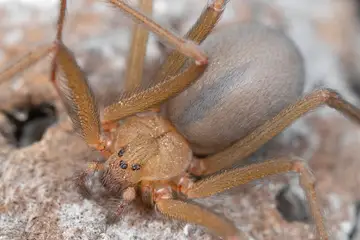
Venomous. “Although the brown recluse does not live in California, four species of native recluse spiders occur in southern areas of the state and can cause similar medical concerns.” University of California Statewide IPM Program
Chilean Recluse
Venomous recluse. “In comparison to the brown recluse spider, the Chilean recluse supposedly has more potent venom and the Mediterranean recluse's venom has been said to be less potent.” University of California Statewide IPM Program
All 7 spiders
Venomous species first, then A to Z. Do not handle them.
Adult female body about 8-12 mm (0.3-0.5 in); UC IPM gives about 3/8 in (10 mm), smaller than a mature western black widow. Clemson (2003) gives 1 to 1 1/2 in with legs extended. Males are tiny, 2-5 mm.
How to recognize it
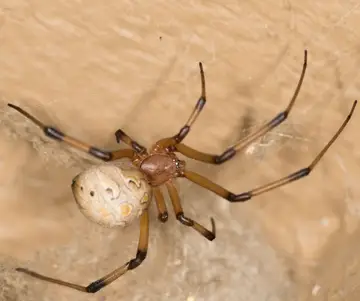
Spiky egg sac (covered in silk points, like a pollen grain or sandspur; about 10 mm per LSU AgCenter, 1/2 in per Clemson 2003) is diagnostic even without the spider
Venom: “Although its venom is at least as potent as black widow venom (drop for drop, as tested in mice), the brown widow is smaller and likely injects much less venom during a bite.” (University of California Statewide IPM Program)
“In comparison to the brown recluse spider, the Chilean recluse supposedly has more potent venom and the Mediterranean recluse's venom has been said to be less potent.” University of California Statewide IPM Program
Where in California
This spider, however, seems to be confined to a very limited area in Los Angeles County, has been present there for at least 80 years (one specimen was collected from … University of California Statewide IPM Program
What the sources say
Venom: “All Loxosceles spiders tested so far have the venom component that is capable of causing necrotic skin lesions, so it is best to assume that all recluse spiders may be capable of causing skin damage.” (University of California Statewide IPM Program)
Range: This spider, however, seems to be confined to a very limited area in Los Angeles County, has been present there for at least 80 years (one specimen was collected from Los Angeles in 1936) and is not spreading.
“Although the brown recluse does not live in California, four species of native recluse spiders occur in southern areas of the state and can cause similar medical concerns.” University of California Statewide IPM Program
Where in California
It is found mostly in the Sonoran and Mojave deserts, in the foothills of the lower San Joaquin Valley, and in adjacent areas of Mexico; most of these areas are sparsely … University of California Statewide IPM Program
JFMAMJJASOND
30 records by month.What the sources say
Venom: “In general, the desert recluse spider's venom is similar to that of the brown recluse and should be considered of equal potency.” (University of California Statewide IPM Program)
Range: It is found mostly in the Sonoran and Mojave deserts, in the foothills of the lower San Joaquin Valley, and in adjacent areas of Mexico; most of these areas are sparsely populated by humans.
Venom: “Venom from its bite can cause reactions ranging from mild to painful and serious, but death is very unlikely and many symptoms can be alleviated if medical treatment is obtained.” (University of California Statewide IPM Program)
Venom: “They have mild venom, and bites may cause symptoms similar to those of yellowjacket wasp stings: initial burning pain followed by minor localized swelling” (University of California Statewide IPM Program)
A mature brown widow female looks very like an immature western black widow. Brown widow: large squarish black spots on the side stripes, hourglass with bottom half larger and rough edges, broken white marks on the front of the abdomen; the spiky egg sac is a much surer way to confirm the species. University of California Statewide IPM Program
Photos show typical adults; individuals vary. Never get close to compare.
When spiders are active in California
Records of spiders in California peak in April to May and July to October. They show when people record spiders, not how many there are (about month bars).
JanFebMarAprMayJunJulAugSepOctNovDec
29,839 records of spiders in California by month (GBIF, CC0 and CC BY records).
If you are bitten or stung
Call 911 or Poison Help at 1-800-222-1222 right away. Poison Help connects you to your local poison center, any time of day.
How to report
Wildlife conflicts: CDFW Wildlife Incident Reporting (WIR) system https://apps.wildlife.ca.gov/wir, emergencies 9-1-1. Invasive animal sightings: CDFW Invasive Species Program (866) 440-9530 or [email protected]; invasive insects/spiders/terrestrial invertebrates: California Department of Food and Agriculture 1-800-491-1899. California Department of Fish and Wildlife
Pest Notes: Spiders (UC ANR Publication 7442). University of California Statewide IPM Program (UC ANR, Cooperative Extension). 2020-10; checked November 3, 2026.Quoted passages (4)
“Venom from its bite can cause reactions ranging from mild to painful and serious, but death is very unlikely and many symptoms can be alleviated if medical treatment is obtained.”
“In California, the main spider that can cause serious injury is the black widow, which generally remains outdoors and out of sight.”
“Black widow spiders occur in most parts of California.”
“The brown recluse spider and the hobo spider do not live in California.”
Pest Notes: Widow Spiders and Their Relatives. University of California Statewide IPM Program (UC ANR, Cooperative Extension). 2017-03; checked November 3, 2026.Quoted passages (4)
“Although its venom is at least as potent as black widow venom (drop for drop, as tested in mice), the brown widow is smaller and likely injects much less venom during a bite.”
“The egg sac of the brown widow spider has protuberances of silk all over its surface, resembling a very large pollen grain.”
“They have mild venom, and bites may cause symptoms similar to those of yellowjacket wasp stings: initial burning pain followed by minor localized swelling”
“A mature brown widow female looks very similar to an immature western black widow, thus some skill is needed to identify the two accurately.”
“In general, the desert recluse spider's venom is similar to that of the brown recluse and should be considered of equal potency.”
“Although the brown recluse does not live in California, four species of native recluse spiders occur in southern areas of the state and can cause similar medical concerns.”
“All Loxosceles spiders tested so far have the venom component that is capable of causing necrotic skin lesions, so it is best to assume that all recluse spiders may be capable of causing skin damage.”
“In comparison to the brown recluse spider, the Chilean recluse supposedly has more potent venom and the Mediterranean recluse's venom has been said to be less potent.”
Report an Invasive Species Sighting. California Department of Fish and Wildlife (Invasive Species Program). undated page; checked November 3, 2026.Quoted passages (1)
“To report a sighting of a known, or suspected invasive species of an animal (mammal, bird, reptile, amphibian, fish, aquatic invertebrate) or marine plant, complete and submit the Suspect Invasive Species Sighting Report form below or contact us at (866) 440-9530. / For a known invasive plant, terrestrial invertebrate (worm, beetle, spider, bug, bee, fly, ant, snail, etc.) or plant/tree disease, or one that you suspect may be new to your area of California, contact the California Department of Food and Agriculture at 1-800-491-1899. / [ca-cdfw-hwc] Wildlife Incident Reporting (WIR) System For Emergencies, call 9-1-1”