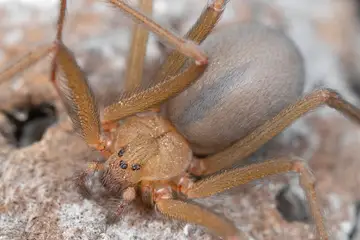
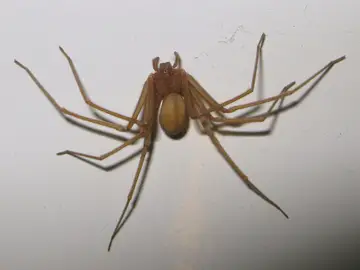
UC IPM: no brown recluse populations in California; native desert recluse and a limited Chilean recluse population do occur.
University of California Statewide IPM Program: “Contrary to popular belief, there are no populations of the brown recluse spider in California.” Source
“Although the brown recluse does not live in California, four species of native recluse spiders occur in southern areas of the state and can cause similar medical concerns.” University of California Statewide IPM Program
Where in California
It is found mostly in the Sonoran and Mojave deserts, in the foothills of the lower San Joaquin Valley, and in adjacent areas of Mexico; most of these areas are sparsely … University of California Statewide IPM Program
JFMAMJJASOND
30 records by month.What the sources say
Venom: “In general, the desert recluse spider's venom is similar to that of the brown recluse and should be considered of equal potency.” (University of California Statewide IPM Program)
Range: It is found mostly in the Sonoran and Mojave deserts, in the foothills of the lower San Joaquin Valley, and in adjacent areas of Mexico; most of these areas are sparsely populated by humans.
“In comparison to the brown recluse spider, the Chilean recluse supposedly has more potent venom and the Mediterranean recluse's venom has been said to be less potent.” University of California Statewide IPM Program
Where in California
This spider, however, seems to be confined to a very limited area in Los Angeles County, has been present there for at least 80 years (one specimen was collected from … University of California Statewide IPM Program
What the sources say
Venom: “All Loxosceles spiders tested so far have the venom component that is capable of causing necrotic skin lesions, so it is best to assume that all recluse spiders may be capable of causing skin damage.” (University of California Statewide IPM Program)
Range: This spider, however, seems to be confined to a very limited area in Los Angeles County, has been present there for at least 80 years (one specimen was collected from Los Angeles in 1936) and is not spreading.
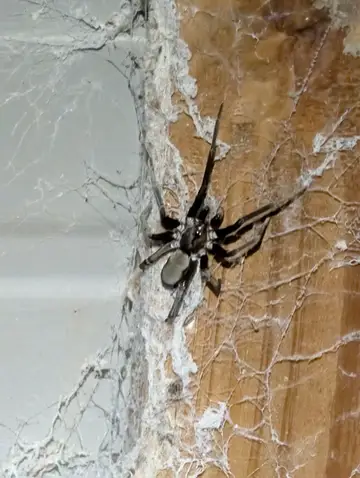
UF/IFAS says males are often mistaken for brown recluses. The brown recluse has six eyes in three separate pairs, while the southern house spider has eight eyes bunched together at the front.
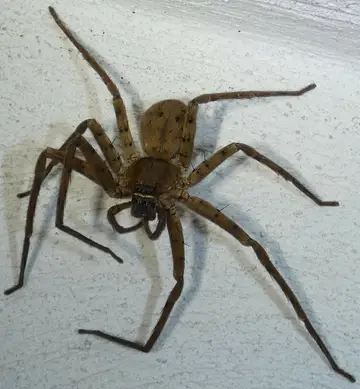
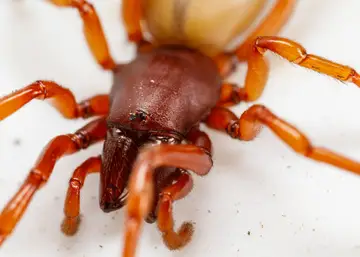
Ohio DNR says it is sometimes confused with the recluse, perhaps because it also has six eyes; recluses are much smaller, dull brown and have tiny fangs. UC IPM says the woodlouse spider's six eyes are in two groups of three (a recluse has three pairs) and it has no body markings.
Alabama Extension says the Mediterranean and Chilean recluses closely resemble the brown recluse and are difficult to tell apart from it; it has the same six eyes in three pairs. UC IPM says telling recluse species apart needs a high-magnification microscope and a spider expert. It is not native; Alabama Extension says it has been found in only a few small, isolated locations, and Ohio DNR reports it from buildings in several Ohio cities.
When spiders are seen in California
JanFebMarAprMayJunJulAugSepOctNovDec
29,839 records (GBIF, CC0 and CC BY).
If you see one in California
Keep your distance and do not try to catch or handle it. Wildlife conflicts: CDFW Wildlife Incident Reporting (WIR) system https://apps.wildlife.ca.gov/wir, emergencies 9-1-1. Invasive animal sightings: CDFW Invasive Species Program (866) 440-9530 or [email protected]; invasive insects/spiders/terrestrial invertebrates: California Department of Food and Agriculture 1-800-491-1899. California Department of Fish and Wildlife
“Contrary to popular belief, there are no populations of the brown recluse spider in California.”
“In general, the desert recluse spider's venom is similar to that of the brown recluse and should be considered of equal potency.”
“Although the brown recluse does not live in California, four species of native recluse spiders occur in southern areas of the state and can cause similar medical concerns.”
“All Loxosceles spiders tested so far have the venom component that is capable of causing necrotic skin lesions, so it is best to assume that all recluse spiders may be capable of causing skin damage.”
“In comparison to the brown recluse spider, the Chilean recluse supposedly has more potent venom and the Mediterranean recluse's venom has been said to be less potent.”
Pest Notes: Spiders (UC ANR Publication 7442). University of California Statewide IPM Program (UC ANR, Cooperative Extension). 2020-10; checked November 3, 2026.Quoted passages (2)
“Black widow spiders occur in most parts of California.”
“The brown recluse spider and the hobo spider do not live in California.”
Pest Notes: Scorpions. University of California Statewide IPM Program (UC ANR, Cooperative Extension). 2011-12; checked November 3, 2026.Quoted passages (1)
“In California, the bark scorpion occurs only in the extreme southeastern part of the state, along the Arizona border.”
Report an Invasive Species Sighting. California Department of Fish and Wildlife (Invasive Species Program). undated page; checked November 3, 2026.Quoted passages (1)
“To report a sighting of a known, or suspected invasive species of an animal (mammal, bird, reptile, amphibian, fish, aquatic invertebrate) or marine plant, complete and submit the Suspect Invasive Species Sighting Report form below or contact us at (866) 440-9530. / For a known invasive plant, terrestrial invertebrate (worm, beetle, spider, bug, bee, fly, ant, snail, etc.) or plant/tree disease, or one that you suspect may be new to your area of California, contact the California Department of Food and Agriculture at 1-800-491-1899. / [ca-cdfw-hwc] Wildlife Incident Reporting (WIR) System For Emergencies, call 9-1-1”