Brown recluse spider
Loxosceles reclusa · also called brown recluse, violin spider and fiddleback spider · Last checked November 3, 2026.
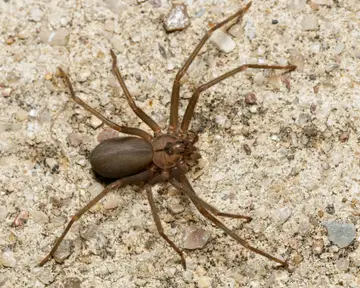
The brown recluse is a small brown spider with a dark violin-shaped mark and six eyes. CDC/NIOSH lists it as one of the venomous spiders in the United States, and its bite can destroy skin tissue. Penn State Extension says it is established in 16 midwestern and southern states, from Texas and Nebraska east to Georgia and Ohio. Elsewhere only isolated finds are reported, almost all inside buildings. Bites are uncommon and usually happen when a spider is trapped against the skin. CDC / NIOSH
On this page
Is the brown recluse spider dangerous?
CDC/NIOSH names the brown recluse as one of the venomous spiders found in the United States. Its venom can cause a severe skin lesion that needs professional medical attention. In very rare, severe cases a spider bite can kill.
Bites and stings: Yes, but rarely. CDC/NIOSH says it cannot bite humans without counterpressure, such as when it is accidentally trapped against the skin.
If someone is bitten or stung, call 911 or Poison Help at 1-800-222-1222.
How to identify a brown recluse spider
A photo or description can narrow it down, but cannot confirm what an animal is or that it is safe. Look from a distance and do not handle wild animals.
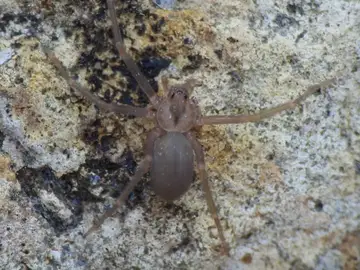
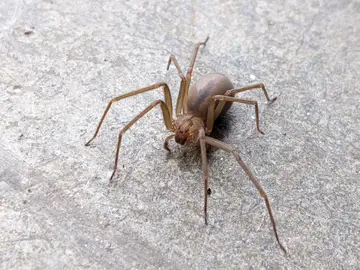
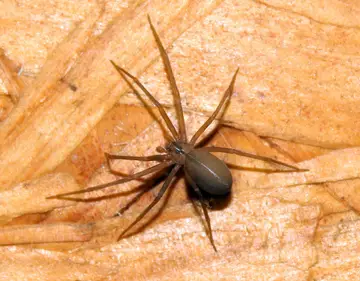
Size: Body about 7 to 12 mm (about 3/8 inch); females average about 9 mm and males about 8 mm. UC IPM says a recluse body is not more than 3/8 inch long.
Colors: Chocolate brown; abdomen evenly colored (light beige to dark brown) and finely haired; never patterned. Pattern: Dark violin-shaped marking on the head region (cephalothorax), with the neck of the violin pointing back toward the abdomen.
Key features
- Six equal-sized eyes in three pairs. UC IPM calls this the most definitive feature, since most spiders have eight eyes. UC ANR
- The violin mark alone is not a reliable way to identify it UC ANR
- UC IPM's five-point check: six eyes in pairs, evenly colored finely haired abdomen, no spines on the legs, evenly colored legs, body no more than 3/8 inch UC ANR
Young
Juveniles are paler than adults
Animals mistaken for the brown recluse spider
Brown recluse spider or Wolf spiders?
Brown recluse spider
Wolf spiders Lycosidae
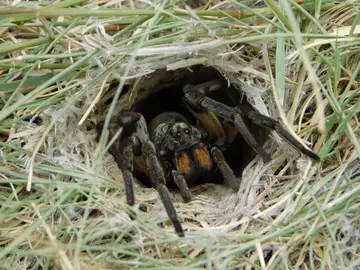

UC IPM lists wolf spiders among the brown spiders often mistaken for recluses. They have 8 eyes, so they can be ruled out quickly. UC ANR
Penn State Extension: wolf spiders "will bite if mishandled or trapped next to the skin"; typical reactions are initial pain and redness, sometimes with some localized swelling, generally subsiding within 24 hours; "No serious medical consequences of these bites have been noted."
Brown recluse spider or Southern house spider (male)?
Brown recluse spider
Southern house spider (male) Kukulcania hibernalis
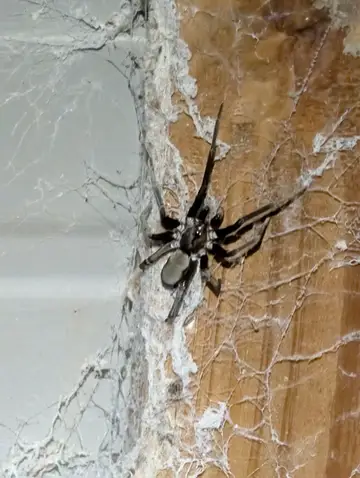
UF/IFAS says males are often mistaken for brown recluses. The brown recluse has six eyes in three separate pairs, while the southern house spider has eight eyes bunched together at the front. UF/IFAS Extension (EDIS); author G. B. Edwards, FDACS-DPI
Brown recluse spider or Huntsman spider?
Brown recluse spider
Huntsman spider Heteropoda venatoria
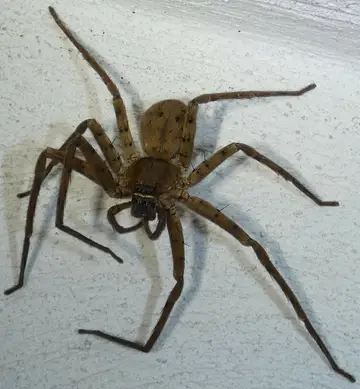
UF/IFAS says its carapace pattern is reversed: a light central mark on a dark background. Adults are also much larger than a brown recluse. UF/IFAS Extension (EDIS); author G. B. Edwards, FDACS-DPI
Brown recluse spider or Woodlouse spider?
Brown recluse spider
Woodlouse spider Dysdera crocata
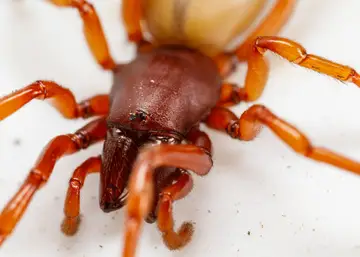
Ohio DNR says it is sometimes confused with the recluse, perhaps because it also has six eyes; recluses are much smaller, dull brown and have tiny fangs. UC IPM says the woodlouse spider's six eyes are in two groups of three (a recluse has three pairs) and it has no body markings.
Ohio DNR: woodlouse spiders "only bite when threatened" and their bites "are unlikely to cause significant medical consequences."
Brown recluse spider or Mediterranean recluse?
Brown recluse spider
Mediterranean recluse Loxosceles rufescens
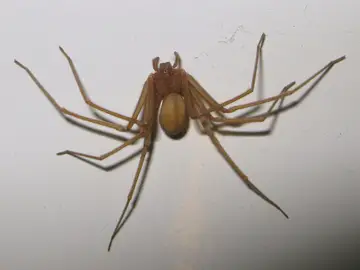

Alabama Extension says the Mediterranean and Chilean recluses closely resemble the brown recluse and are difficult to tell apart from it; it has the same six eyes in three pairs. UC IPM says telling recluse species apart needs a high-magnification microscope and a spider expert. It is not native; Alabama Extension says it has been found in only a few small, isolated locations, and Ohio DNR reports it from buildings in several Ohio cities.
A recluse spider (genus Loxosceles). Alabama Extension lists the Mediterranean recluse among the five potentially harmful spiders in Alabama. UC IPM says all Loxosceles spiders tested so far have venom that can cause necrotic skin lesions, so all recluse spiders should be assumed capable of causing skin damage.
Where the brown recluse spider lives
- Native or listed
- Nonnative or not established
- No official record in our data
- 1–9
- 10–99
- 100–999
- 1,000+
On our state guides
- Alabama spiders
- Arkansas spiders
- Georgia spiders
- Illinois spiders
- Indiana spiders
- Iowa spiders
- Kansas spiders
- Kentucky spiders
- Michigan spiders
- Mississippi spiders
- Missouri spiders
- Nebraska spiders
- New Mexico spiders
- North Carolina spiders
- Ohio spiders
- Oklahoma spiders
- Pennsylvania spidersNonnative
- Rhode Island spiders
- Tennessee spiders
- Texas spiders
- Virginia spiders
- Wyoming spiders
State boundaries: U.S. Census Bureau, cartographic boundary file cb_2024_us_state_20m.
When it is active
Nocturnal: hides by day in a silk retreat and comes out at night to hunt UC ANR
US open-licence records peak in May to August.
Habitat and habits
Habitat: Outdoors in its native range: under rocks, boards and the bark of dead trees and logs. Indoors: cracks in walls and boards and behind or under stored items. It prefers warm, dry spots. Penn State Extension
Behavior: Reclusive and not aggressive. CDC/NIOSH says most spider bites happen because a spider is trapped or touched. Penn State says brown recluse bites usually happen when a spider is trapped against the skin, for example when someone puts on shoes left out overnight or rolls over a spider while sleeping; Ohio DNR says wandering males may hide in clothing left on the floor and bite when crushed as it is put on.
Diet: Other arthropods, including spiders and ants
Young: Mates in June or July. The female lays 20 to 50 eggs in a round egg case and may make two to five egg cases in her life. Young take about a year to mature.
Questions about the brown recluse spider
What states brown recluse live in?
Penn State Extension says brown recluses are established in 16 states: Alabama, Arkansas, Georgia, Illinois, Indiana, Iowa, Kansas, Kentucky, Louisiana, Mississippi, Missouri, Nebraska, Ohio, Oklahoma, Tennessee and Texas. Isolated finds have been reported in Arizona, California, Washington DC, Florida, North Carolina, New Jersey, Pennsylvania, Washington and Wyoming.
Are there brown recluse in california?
No established populations. UC IPM says there are no brown recluse populations in California, and fewer than 20 verified specimens have been found there over several decades. But four native recluse species live in southern California and can cause similar medical concerns; the most common is the desert recluse.
Are there brown recluse in florida?
Only rarely. UF/IFAS lists verified brown recluse records from just five northern Florida counties, each a single spider or an infestation in one or two buildings, and found no evidence of a widespread population in Florida.
Are there brown recluse in pennsylvania?
Rarely. Penn State Extension says brown recluses in Pennsylvania are confined to buildings and almost always arrive with people moving from places where the spider is native.
Are there brown recluse in north carolina?
Yes, but NC State Extension says they are not very common there.
Are there brown recluse in ohio?
Yes, but Ohio DNR says it is quite rare. The Ohio Spider Survey holds only nine specimens from three localities, all found inside buildings.
Are there brown recluse in texas?
Yes. Texas DSHS says the brown recluse is one of two venomous spiders in Texas and is found indoors and outdoors throughout the state.
Are there brown recluse in tennessee?
Yes. UT Extension says it is found in every Tennessee county except possibly a few in the far east.
Are there brown recluse in georgia?
Yes. Penn State lists Georgia among the 16 states where brown recluse spiders are established, and UC IPM says its range reaches north Georgia.
Are brown recluse spiders in virginia?
Yes. Virginia Cooperative Extension says its natural range reaches the far southwestern tip of Virginia, and isolated populations have been confirmed elsewhere in the state.
Are there brown recluse spiders in alabama?
Yes. Alabama Extension lists it among the potentially harmful spiders in Alabama, and Penn State Extension lists Alabama as a state where it is established.
Are there brown recluse in new jersey?
Only isolated finds. Penn State Extension lists New Jersey among the places with isolated occurrences, not among the states where it is established.
Brown recluse vs wolf spider
Count the eyes. A brown recluse has six eyes in three pairs. UC IPM says wolf spiders and the other brown spiders often mistaken for it have eight eyes. Penn State Extension says wolf spiders bite if mishandled or trapped next to the skin, usually causing pain and redness, and no serious medical consequences of their bites have been noted.
Brown recluse vs southern house spider
UF/IFAS says male southern house spiders are often mistaken for brown recluses. The brown recluse has six eyes in three separate pairs, while the southern house spider has eight eyes bunched together at the front.
Brown recluse spider bite
CDC/NIOSH says a bite may sting and hurt at the site, often with a small white blister, and the venom can cause a severe skin lesion that needs professional medical attention. Call 911 or Poison Help at 1-800-222-1222.
Sources
- Venomous Spiders at Work (Outdoor Workers). CDC / NIOSH. archived copy, captured September 29, 2026; checked November 3, 2026.
- Brown Recluse Spiders. Penn State Extension. updated September 8, 2025; checked November 3, 2026.
Quoted passages (2)
“The brown recluse, L. reclusa, in its normal range, prefers to inhabit gaps under rocks, boards, and the bark of dead trees and logs. In structures, it will live inside cracks in walls and boards and behind and under any number of items in storage. The brown recluse prefers nesting sites that are warm and dry.”
“After mating in June or July, the female will deposit twenty to fifty eggs in a spherical case. She can produce two to five such batches of eggs during her lifetime. Laboratory-raised individuals can live for two to three years. The young require about one year to mature.”
- Pest Notes: Brown Recluse and Other Recluse Spiders (UC ANR Publication 7468). University of California Statewide IPM Program (UC ANR). 2018-11; checked November 3, 2026.
Quoted passages (5)
“The most definitive physical feature of recluse spiders is their 6 equal-sized eyes arranged in 3 pairs.”
“The presence or absence of the violin marking is not a reliable way to identify this spider.”
“…six eyes in dyads (pairs) uniformly colored abdomen with fine hairs no spines on the legs uniformly colored legs body not more than 3/8" in length”
“They also use silk to build retreats in which to hide during the day. These nocturnal spiders emerge from their retreats at night and actively hunt down prey or may wait for prey to land in the small area several inches from their retreat.”
“…wolf spiders (Lycosidae) … All of these brown spiders have 8 eyes and thus can be quickly eliminated from consideration.”
- EENY299 Brown Recluse Spider, Loxosceles reclusa. UF/IFAS Extension (EDIS); author G. B. Edwards, FDACS-DPI. Original Aug 2003; checked November 3, 2026.
Quoted passages (4)
“Juveniles are paler in all respects, as are occasional adults.”
“Prey consists of a variety of other arthropods, including rather dangerous prey like other spiders and ants.”
“Males of the common southern house spider, Kukulcania (= Filistata) hibernalis (Hentz), are frequently confused with the brown recluse … Loxosceles reclusa has six eyes composed of three isolated pairs (dyads), whereas Kukulcania hibernalis has eight eyes all clumped together in the middle front of the carapace.”
“Occasionally, the huntsman spider, Heteropoda venatoria (Linnaeus), is misidentified as a brown recluse (Edwards 1979). However, the color pattern on the carapace of this species is reversed, with a light median mark on a dark background, and adults of this spider are much larger than a brown recluse.”
- Spiders in and Around Homes. NC State Extension. Publication date: Jan. 1, 2008; checked November 3, 2026.
- Common Spiders of Ohio Field Guide (Publication 5140). Ohio Department of Natural Resources, Division of Wildlife. PUBLICATION 5140; checked November 3, 2026.
- Venomous Spiders (Zoonosis Control). Texas Department of State Health Services. undated page; checked November 3, 2026.
- PB1191 The Brown Recluse Spider. University of Tennessee Extension. PB1191-500-7/02 [July 2002 reprint]; checked November 3, 2026.
- ENTO-73 Spiders with Potentially Harmful Venom Found in Virginia. Virginia Cooperative Extension, Virginia Tech. Publication Date August 1, 2025; checked November 3, 2026.
- Black Widow and Recluses: Avoiding Venomous Spiders of the Southeast. Alabama Cooperative Extension System. datePublished 2018-11-28; checked November 3, 2026.
- Wolf Spiders. Penn State Extension. updated September 8, 2025; checked November 3, 2026.
- GBIF.org occurrence records, human observations licensed CC0 1.0 or CC BY 4.0 only, accessed November 3, 2026. The datasets behind these counts are listed on our Sources page.
- State boundaries: U.S. Census Bureau, cartographic boundary file cb_2024_us_state_20m.